

 About Innovation Hub
 Global Content Pulse (Webinars)


 Global Production Financing
(Webinars)
Global Production Financing
(Webinars)  LeaderSpeak Podcast
  Global Entertainment Digest (Newsletter)
  About Vitrina
 About VIQI
 Our Story
 Our Solutions 🔥
 Film+TV Projects Tracker 🚀
 Case Studies
 Our Profile
Deal Overview
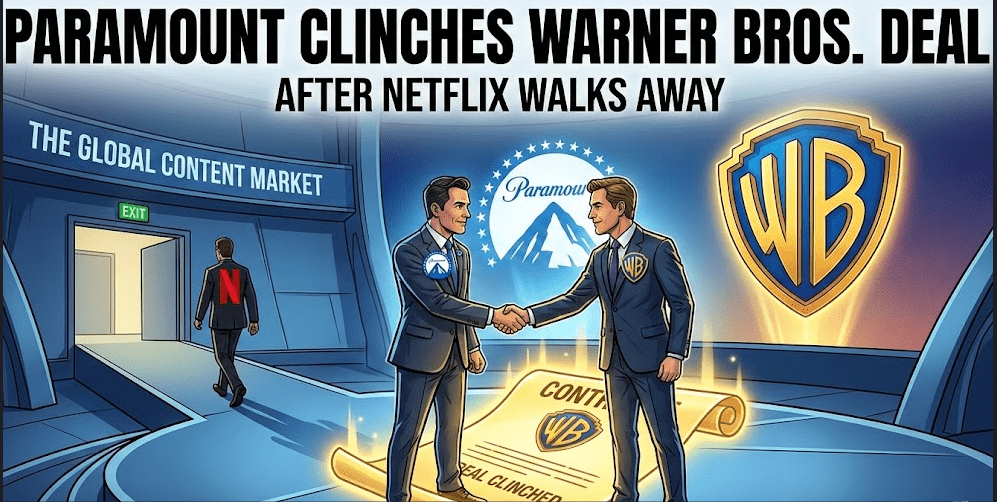
Paramount Skydance has entered into a definitive agreement to acquire Warner Bros. Discovery in a transaction valued at approximately $110 billion.
Paramount will acquire 100% of WBD at $31.00 per share. The Paramount WBD deal is expected to close in Q3 2026.
The Paramount WBD deal combines two major studios under one capital structure. It also marks a leadership transition, with David Ellison set to serve as Chairman and CEO of the combined company.
This is structural consolidation across production, distribution, and streaming.
Strategic Rationale
Paramount is acquiring a company with significantly larger market value and a deeper content library.
The logic is scale.
The combined entity gains control of more than 15,000 titles and integrates WBD’s existing debt and cash flow base. Linear networks, franchise IP, and studio infrastructure now sit under one balance sheet.
This is a capital-driven decision. The company is increasing leverage to accelerate repositioning toward streaming while maintaining theatrical commitments.
The combined portfolio is projected to represent close to 40% of the domestic box office. That concentration affects negotiating leverage across exhibition, licensing, and windowing.
Capital Structure and Backing
The transaction is supported by a large equity and debt consortium.
David Ellison will lead the combined company. His bid includes an irrevocable personal guarantee from Larry Ellison, backed by Oracle shares.
RedBird Capital Partners acted as a core equity partner and financial advisor.
Debt commitments range between $54 billion and $57.5 billion, supported by Bank of America, Citigroup, and Apollo Global Management.
Centerview and RedBird Advisors served as financial advisors. Legal counsel included Cravath and Latham & Watkins for Paramount, and Wachtell and Debevoise for WBD.
The scale of financing reflects the leverage profile the company will carry post-close.
Netflix’s Exit and Supply Chain Implications
Netflix withdrew from the bidding process and will receive a $2.8 billion breakup fee.
By stepping away, Netflix avoided taking on significant incremental debt. It also forfeited control of HBO, DC Studios, and the Wizarding World franchises.
Those assets influence long-term subscriber retention and franchise monetization.
At the same time, a heavily levered Paramount–WBD may need near-term liquidity. Library licensing becomes a practical lever. High-value titles such as Friends, The Last of Us, and House of the Dragon may circulate into third-party windows to support debt servicing.
Netflix remains a pure-play streaming platform without ownership of WBD’s production infrastructure. Studio space, production capacity, and talent access remain competitive variables rather than internal assets.
Supply Chain Impact
Production Strategy: In-House Infrastructure and Assets
The merger significantly expands Paramount’s internal production and broadcast infrastructure.
The combined company will control a large portfolio of global broadcast networks, production studios, and distribution platforms. This increases vertical integration across the content pipeline.
Broadcasters and Distribution Networks
Through WBD, Paramount adds a large suite of global cable and specialty channels to its existing CBS and MTV ecosystem.
These include:Discovery Channel, TLC, HGTV, Food Network, Animal Planet, Investigation Discovery, Science Channel, Travel Channel, Cooking Channel, Magnolia Network, OWN (Oprah Winfrey Network), Destination America.
These networks expand the company’s global distribution footprint and advertising inventory.
Kids and Animation Platforms
The merger also strengthens Paramount’s position in youth and animation content.
New additions include:Cartoon Network, Adult Swim.
These brands extend Paramount’s reach across children’s programming, family entertainment, and adult animation.
News and Sports Assets
The transaction also combines major global news and sports operations.
CNN and CNN International join Paramount’s existing CBS News division.
TNT Sports integrates alongside CBS Sports.
This creates a broader news and live sports distribution network across broadcast and cable platforms.
Production Studios and Content Engines
Paramount also gains several major production houses.
These include:Warner Bros. Pictures, New Line Cinema, DC Studios, Warner Bros. Television Group, Warner Bros. Pictures Animation
These studios add significant film and television production capacity to Paramount’s existing operations.
IP Portfolio and Franchise Strategy
The combined company controls a library exceeding 15,000 titles.
The strategy centers on long-term franchise development and lifecycle monetization across film, television, streaming, consumer products, and themed entertainment.
Paramount Key IP
Mission: Impossible, Star Trek, Top Gun, Transformers, SpongeBob SquarePants, Teenage Mutant Ninja Turtles, Yellowstone, South Park, Survivor.
Warner Bros. Discovery Key IP
Harry Potter, Game of Thrones, DC Universe (Batman, Superman), Lord of the Rings, The Matrix, The Last of Us, Succession, The Sopranos, Sex and the City.
Control of these franchises allows the company to extend monetization beyond screen distribution into consumer products, merchandising, and location-based entertainment.
Owning both the content and distribution layers allows the company to manage franchise lifecycle value internally.
Streaming Scale and Platform Positioning
Paramount+ and HBO Max are expected to combine into a single streaming platform following the merger.
Together, Paramount+ (approximately 79 million subscribers) and HBO Max (approximately 131.6 million subscribers) represent roughly 210 million global subscribers.
At that scale, the combined service moves ahead of the current Disney+ and Hulu total of approximately 196 million subscribers.
The platform enters the top tier of global streaming services alongside Netflix and Prime Video.
The distribution model will operate across multiple tiers. Pluto TV anchors the FAST layer, while the combined Paramount+ and HBO Max platform supports ad-supported and premium subscription tiers.
This structure allows the company to serve audiences across FAST, AVOD, and premium streaming tiers.
Subscriber scale also affects negotiating leverage with talent, distributors, and international partners. It strengthens the company’s position in global commissioning and windowing discussions.
Scale does not guarantee retention. But it materially changes platform positioning.
Library Licensing
The company is expected to expand third-party licensing of library titles.
Reducing streaming exclusivity for older content generates immediate cash flow. Titles such as Friends, NCIS, and The Big Bang Theory become liquidity instruments as well as platform drivers.
International Distribution
WBD’s existing international distribution relationships, including partnerships in Europe and Africa, become part of Paramount’s global pipeline.
This reduces the need for standalone direct-to-consumer expansion in some markets. Franchises can move through existing distribution agreements.
Broadband and Bundling Leverage
The combined entity increases its negotiating leverage in pay-TV and broadband bundling discussions.
Control of premium content and linear networks strengthens positioning in carriage agreements and bundled streaming packages.
Physical Infrastructure
Paramount will control approximately 12 million square feet of studio real estate following the merger.
Overlapping facilities create pressure to consolidate production operations and divest non-core properties.
Real estate rationalization will likely become part of cost discipline during integration.
Post-Production and AI Integration
The company has identified approximately $6 billion in synergies.
Technology integration will contribute to that target. Automation in localization, dubbing, and visual effects is expected to reduce distribution costs across international markets.
Vendor Consolidation
Cost discipline will extend to external vendors.
As integration progresses, the combined company is likely to reduce its vendor pool and renegotiate terms with production service providers and VFX houses.
Scale increases buyer leverage across the supply chain.
Closing Perspective
This transaction concentrates IP, production capacity, broadcast networks, and streaming platforms under one balance sheet.
It also introduces significant debt obligations.
Execution will determine whether scale translates into stable margins and sustainable growth.
Integration discipline, licensing strategy, and capital allocation will shape the outcome.
For the global Film & TV supply chain, the shift is clear: fewer independent centers of power, greater capital concentration, and tighter control over production and distribution pathways.
Find Film+TV Projects, Partners, and Deals – Fast.
VIQI matches you with the right financiers, producers, streamers, and buyers – globally.
Producers Seeking Financing & Partnerships?
Book Your Free Concierge Outreach Consultation
(To know more about Vitrina Concierge Outreach Solutions click here)
Join Industry Briefings Trusted by Leaders
The Mid-Budget Comeback: Why Mid-Budget Films Is the Smartest Bet in the Room
Mid-budget films are attracting new capital. See why this segment is becoming one of the strongest bets in Film today.
Franchise Fatigue vs. IP Dependency: What Studios Should Be Betting On Now
s franchise performance softens, where will the next generation of valuable IP come from? Join the briefing.
Unscripted Is Eating the World: The Multi-Billion Reality and Format Boom
Unscripted is the new prestige — inside the $19.8B global format boom reshaping how streaming platforms compete.
How Co-Productions and Regional IP Are Reshaping Global Drama
As global drama evolves, which stories travel, which stay local, and how are they getting financed?
