Insights on Production Transaction Volumes
January’26
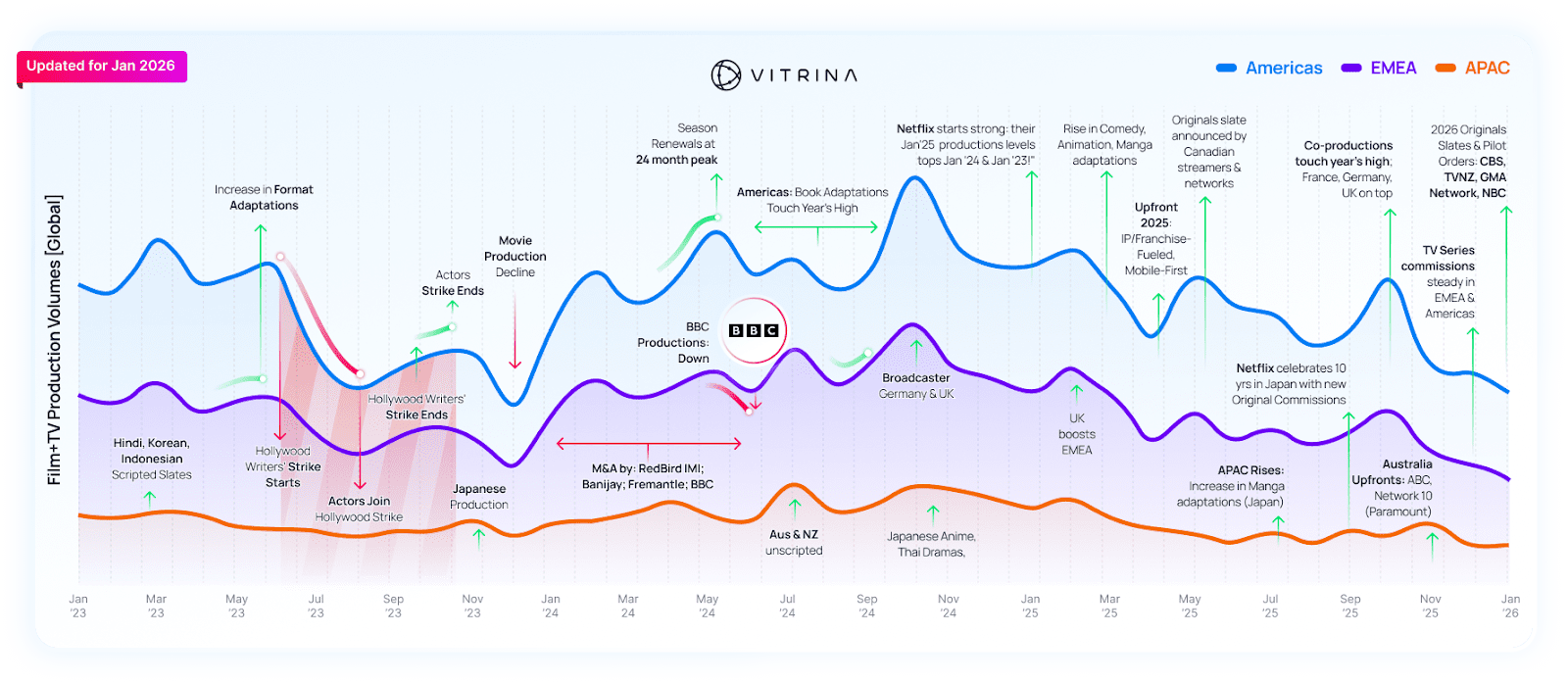
Methodology: Vitrina monitors unreleased or in-motion projects worldwide across all stages of the content lifecycle—development, production, post-production, and till release—on a daily basis. We track various transactions and deal activities related to content financing, commissioning, co-productions, green-lighting, as well as early stage (content development) and late stage (licensing) arrangements. These transactions between production houses, distributors, streamers, and broadcasters enable us to gain valuable insights into industry trends, key players, buyer behavior, and the specializations of production companies. Our monthly Film+TV productions chart serves as a bellwether of production financing and industry health.
Below are the key highlights for January 2026 Film+TV Production Volumes:
🇺🇸 Americas
With 82% of projects scripted and 74% English-language, the Americas are operating in full risk-mitigation mode.
Commissioning is concentrated around renewals, extensions, and book adaptations. Experimentation is limited; recognizable IP dominates.
-
Netflix is building its 2026 slate around global IP — including a live-action Gundam, Film 44, and The Cage.
-
Prime Video pairs sports with premium adaptations like Fallout and Sex Criminals.
-
CBS expands its procedural and reality engines through Survivor, NCIS, and Young Sheldon.
-
NBC invests in event programming such as Last Chance Lawyer.
-
Hulu reinforces franchise comedies like Shoresy.
Book IP is accelerating. The Housemaid’s Secret, Mistborn: The Final Empire, and The Bridge Kingdom illustrate strong demand for fantasy world-building, dark suspense, and romantic sagas. Netflix and Apple TV+ are competing aggressively for genre-rich literary properties.
Co-productions are increasingly built around high-concept thrillers and psychological horror — including The Catch and Mommy’s Home — while cross-border collaborations like The Blue Box (The Mediapro Studio × Infinity Hill) highlight scale-driven alliances.
Takeaway: The region isn’t expanding — it’s reinforcing what already works.
🇪🇺 EMEA
EMEA remains scripted-led at 74%, with a diversified language mix — English (39%), German (23%), French (8%), Arabic (5%).
Commissioning balances prestige drama and high-impact factual.
-
Netflix backs crime and political thrillers.
-
BBC, Channel 4, and Channel 5 lean into historical drama and investigative factual.
France, Germany, and Ukraine anchor co-production activity, driving globally portable thrillers, prestige animation, and socially resonant dramas.
Literary adaptations run in parallel:
The Girl with the Dragon Tattoo, His & Hers, Narnia, Hamnet, The Odyssey — scaled through producers like Left Bank Pictures and StudioCanal.
Takeaway: EMEA is building internationally marketable prestige with multi-language reach.
🌍 APAC
APAC is the most scripted-heavy region globally, with 90% of deals scripted.
Language distribution is diverse — Hindi (21%), Japanese (19%), English (16%), Malayalam (9%) — but the underlying driver is clear: graphic novel and manga IP.
Titles like Blue Lock and Gundam lead sports and sci-fi momentum, while fantasy properties such as Monster Eater and Megami Isekai Tensei accelerate animation output. Romance (Firefly Wedding) and localized horror (Ella Arcangel) broaden the slate.
Production hubs including Studio Kafka, Cygames Pictures, and Brain’s Base anchor the ecosystem.
Drama blends national historical epics, psychological thrillers (including adaptations of The Night Manager and The Girl with the Dragon Tattoo), and socially grounded character studies.
Takeaway: APAC is scaling culturally rooted, genre-driven scripted content at high velocity.
The January 2026 Pattern
Across all territories:
-
Scripted dominates.
-
Proven IP outpaces originals.
-
Literary and graphic novel adaptations accelerate.
-
Co-productions increase structural resilience.
-
Franchise ecosystems stabilize pipelines.
The global market is no longer chasing “Peak TV.”
It is building controlled, defensible, scalable content economies.


 IHUB
IHUB
 Private Briefings (Webinars)


 LeaderSpeak Podcast
  Global Entertainment Digest (Newsletter)
  Premium Lists
 Membership Benefits
 About Vitrina
 Our Story