

 About Innovation Hub
 Global Content Pulse (Webinars)


 Global Production Financing
(Webinars)
Global Production Financing
(Webinars)  LeaderSpeak Podcast
  Global Entertainment Digest (Newsletter)
  About Vitrina
 About VIQI
 Our Story
 Our Solutions 🔥
 Film+TV Projects Tracker 🚀
 Case Studies
 Our Profile
Netflix and Sony Pictures seal a landmark global pay-1 deal, consolidating Netflix’s position as the dominant window for Sony’s theatrical slate worldwide.
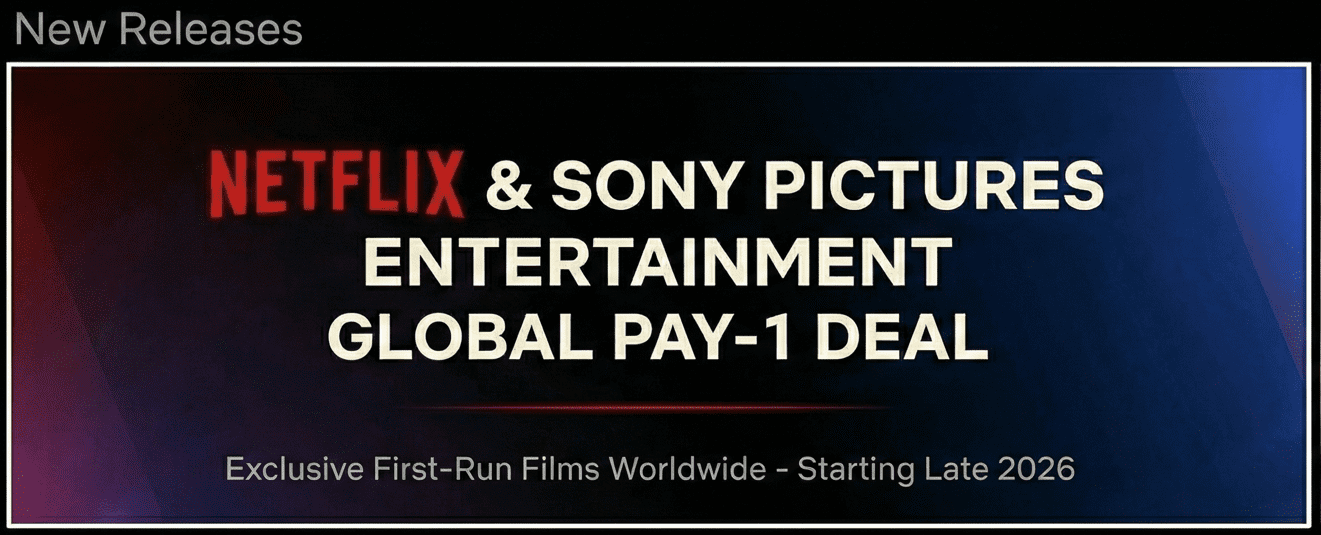
Deal Overview
Netflix and Sony Pictures Entertainment (SPE) have restructured the standard Pay-1 film window, moving from a territory-by-territory patchwork to a unified global licensing framework. Previously, Netflix held fragmented Pay-1 rights to SPE’s feature films only in select markets, including the U.S., Germany, and Southeast Asia. Under this new multi-year agreement, Netflix expands that footprint to become the exclusive Pay-1 home for SPE’s theatrical slate worldwide. The deal covers all windows following theatrical and home entertainment holdbacks (typically 6–9 months post-release). The inventory includes high-value franchises (Spider-Man: Beyond the Spider-Verse, The Legend of Zelda) and a dedicated library component. Reports value the agreement at approximately $7 billion over the term, a significant markup that reflects the premium for global unification.
Parties & Dealmakers
Netflix, acting as the global aggregator, represented by Lauren Smith, VP of Licensing and Programming Strategy. Sony Pictures Entertainment, continuing its strategy as the market’s premier independent “arms dealer,” led by Paul Littmann, EVP of Global Distribution.
Strategic Divergence: The Aggregator and The Arms Dealer
This agreement crystallizes two distinct, dominant strategies in the post-consolidation era. For Sony, this validates the “Studio-Without-a-Streamer” dividend. By bypassing the capital-intensive direct-to-consumer (DTC) model, Sony has effectively auctioned its slate to the highest bidder without incurring churn risk or tech overhead. The global exclusivity commands a scarcity multiplier, de-risking their theatrical slate for the rest of the decade while rivals burn cash on platforms. For Netflix, the deal is a critical piece of a “Super-Aggregator” defensive moat. As they move forward with the acquisition of Warner Bros. (HBO Max) and prepare for the 2027 start of the Universal Pay-1B window (which places titles on Netflix 8 months after Peacock), Netflix is effectively cornering the market on theatrical-grade supply. By securing Sony’s slate globally, they prevent fragmentation—where a title sits on Netflix in the UK but Amazon in Germany—and ensure that even as they digest the massive WB integration, their pipeline remains stocked with external hits that competitors cannot touch.
The Creative Engine: A Fourth Strategic Pillar
Beyond the structural advantage, this deal grants Netflix access to one of the industry’s most aggressive talent pipelines. Over the last 24 months, Sony has quietly assembled a formidable roster of creators, signing over 30 overall and first-look deals that now effectively feed the Netflix Pay-1 window. This includes genre masters like Scott Derrickson (Crooked Highway) and Alfred Gough & Miles Millar, prestige storytellers like Vince Gilligan (High Bridge) and Ronald D. Moore (Tall Ship), and hitmakers like Neal H. Moritz (Original Film) and Kumail Nanjiani. For Netflix, this is an index fund on Hollywood’s best creative output. By locking in Sony, Netflix ensures that the next cultural phenomenon generated by this specific ecosystem—whether a Breaking Bad successor or a new horror franchise—lands exclusively on their service globally, bypassing competitors entirely.
Supply-Chain Impact: The "Super-Library" and The Fortress of Habit
This deal finalizes the construction of an unrivaled content supply chain designed to make leaving the Netflix ecosystem illogical. The platform’s offering is no longer just about “Originals”; it is now a layered fortress comprising Netflix Originals, a constant stream of individual third-party licensing deals, the incoming Warner Bros. Discovery library (via acquisition), the Universal Pay-1B window, and now Sony’s global slate. This density does more than reduce churn; it fundamentally reshapes consumer behavior. We are witnessing the industrialization of the “Wait for Netflix” habit. While theatrical die-hards remain, a massive segment of the audience is now conditioned to bypass the box office for mid-tier and even blockbuster titles, knowing the market’s best supply inevitably flows to their homepage. By aggregating this volume of premium IP—bolstered by Sony’s recent signing of over 30 strategic talent pacts—Netflix reinforces a loop where subscribers have no incentive to look elsewhere. This squeezes transactional VOD (TVOD) margins and renders competing SVOD services as “secondary” add-ons rather than essentials.
Vitrina Perspective
By 2028, Netflix will have effectively become the “Global Box Office” utility. The sheer weight of this combined lineup—Sony, WBD, Universal (Pay-1B), and Originals—creates a gravity that competitors cannot match. This strategy engineers a self-fulfilling prophecy of user retention. While theatrical purists will always frequent cinemas, a continuous, irreversible habit formation is taking hold of the mass market. For the “Netflix Loyalist,” the theatrical window is no longer a temptation; it is merely a notification. The reflex to simply think and say “I will catch it on Netflix” is becoming the default operating system of global film consumption.
Find Film+TV Projects, Partners, and Deals – Fast.
VIQI matches you with the right financiers, producers, streamers, and buyers – globally.
Join Industry Briefings Trusted by Leaders
Film & TV Production Financing: 2026 Trends
Production financing conditions are changing quickly. Understanding where money is moving and what buyers are backing is key to getting projects approved and funded in 2026.
Unreleased Film+TV Projects: Opportunities & Showcase
A curated view of unreleased Film and TV projects open for financing and collaboration
The Mid-Budget Comeback: Why Mid-Budget Films Is the Smartest Bet in the Room
Mid-budget films are attracting new capital. See why this segment is becoming one of the strongest bets in Film today.
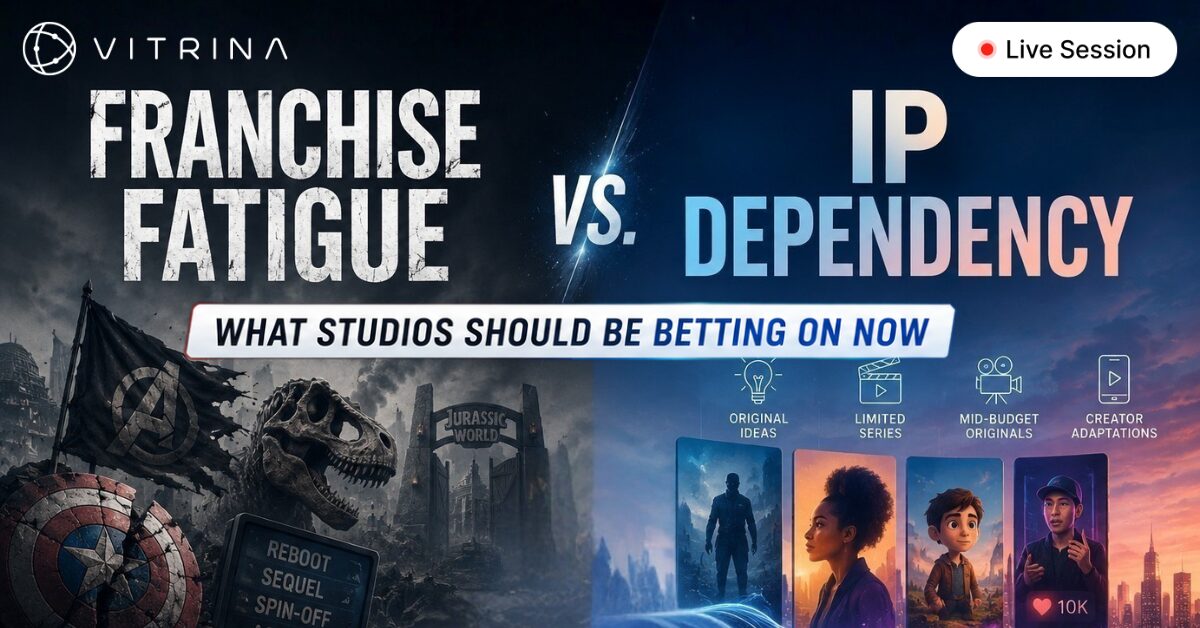
Franchise Fatigue vs. IP Dependency: What Studios Should Be Betting On Now
s franchise performance softens, where will the next generation of valuable IP come from? Join the briefing.
