

 Global Content Pulse (Webinars)


 Global Production Financing
(Webinars)
Global Production Financing
(Webinars)  LeaderSpeak Podcast
  About Vitrina
 Our Story
 Our Solutions 🔥
 Film+TV Projects Tracker 🚀
 Case Studies
 Our Profile
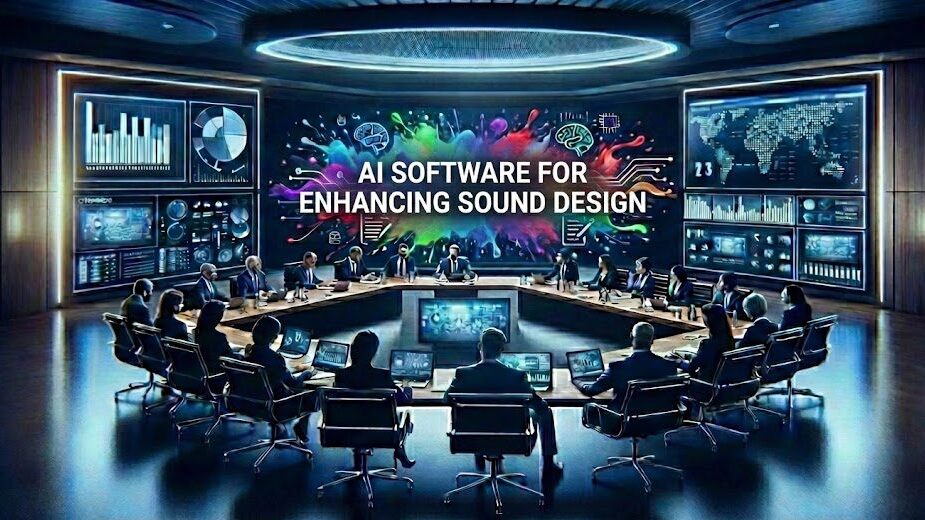
Top AI software for enhancing sound design in films includes platforms like Adobe Firefly Audio, Stable Audio, and iZotope RX, which automate complex dialogue isolation and foley generation.
This involves using deep learning models to analyze frequency patterns and synthesize hyper-realistic environmental textures without the need for traditional, time-intensive field recording.
According to industry intelligence from Vitrina AI, the demand for AI-driven post-production services has increased by 40% as studios seek to compress production timelines without sacrificing auditory quality.
In this guide, you will learn technical implementation strategies, comparative software analyses, and real-world case studies to optimize your audio post-production pipeline.
While most online resources provide surface-level lists of apps, they fail to address the technical friction points of integrating AI into a professional Dolby Atmos or 5.1 surround sound workflow.
This comprehensive analysis fills those gaps by providing professional-grade implementation steps—from identifying target AI vendors to tracking real-time project intelligence.

Your AI Assistant, Agent, and Analyst for the Business of Entertainment
VIQI AI helps you plan content acquisitions, raise production financing, and find and connect with the right partners worldwide.
- Find active co-producers and financiers for scripted projects
- Find equity and gap financing companies in North America
- Find top film financiers in Europe
- Find production houses that can co-produce or finance unscripted series
- I am looking for production partners for a YA drama set in Brazil
- I am looking for producers with proven track record in mid-budget features
- I am looking for Turkish distributors with successful international sales
- I am looking for OTT platforms actively acquiring finished series for the LATAM region
- I am seeking localization companies offer subtitling services in multiple Asian languages
- I am seeking partners in animation production for children's content
- I am seeking USA based post-production companies with sound facilities
- I am seeking VFX partners to composite background images and AI generated content
- Show me recent drama projects available for pre-buy
- Show me Japanese Anime Distributors
- Show me true-crime buyers from Asia
- Show me documentary pre-buyers
- List the top commissioners at the BBC
- List the post-production and VFX decision-makers at Netflix
- List the development leaders at Sony Pictures
- List the scripted programming heads at HBO
- Who is backing animation projects in Europe right now
- Who is Netflix’s top production partners for Sports Docs
- Who is Commissioning factual content in the NORDICS
- Who is acquiring unscripted formats for the North American market
Table of Contents
- 01What is AI-Driven Sound Design in Film?
- 02How Do AI Foley Tools Enhance Production?
- 03Workflow Integration: Step-by-Step Guide
- 04Top AI Software for Sound Enhancement
- 05Comparative Analysis: Feature vs. Budget
- 06Success Story: Getty Images & Vitrina AI
- 07Market Intelligence for Audio Services
- 08Expert Perspective
- 09Key Takeaways
- 10FAQ
Key Takeaways for Sound Designers
-
Automated Foley Efficiency: AI software can reduce foley generation time by up to 60%, allowing designers to focus on artistic narrative layers rather than mechanical textures.
-
Dialogue Isolation Precision: Modern spectral repair AI identifies and removes 99% of environmental noise from field recordings while preserving the actor’s emotional timbre.
-
Supply Chain Advantage: Using Vitrina AI’s Global Projects Tracker helps audio vendors identify unreleased films in post-production, securing bidding windows months ahead of competitors.
What is AI-Driven Sound Design in Film?
AI-driven sound design refers to the application of generative artificial intelligence and machine learning to the audio post-production phase of filmmaking. Unlike traditional digital audio workstations (DAWs) that require manual editing of every waveform, AI software utilizes neural networks to predict and generate sounds based on visual or textual prompts. This technology is revolutionizing how professionals approach world-building, transforming soundscapes from static background noise into dynamic, narrative-driven elements.
For professionals, this shift solves the primary pain point of “audio fragmentation,” where high-quality sound assets are often scattered across disconnected libraries. By integrating AI, designers can now synthesize custom textures—such as the specific sound of wind through a pine forest or the metallic resonance of a futuristic engine—in real-time, ensuring tonal consistency across the entire project.
Find AI audio post-production vendors for your project:
How Do AI Foley Tools Enhance Production?
Foley—the reproduction of everyday sound effects—is notoriously one of the most resource-heavy segments of post-production. Traditional foley requires physical sound stages, props, and synchronized recording sessions. AI foley generation tools, such as those integrated into Adobe Firefly Audio, use “video-to-audio” (V2A) technology to analyze visual movements on screen and automatically generate synchronized footsteps, cloth rustle, or impact sounds.
The true value for sound designers lies in the ability to generate “variation batches.” Instead of recording a single footstep, a designer can prompt the AI to generate twenty variations of a “heavy boot on wet gravel.” This provides immediate creative flexibility during the final mix, allowing for nuanced adjustments that were previously only possible through expensive re-recording sessions.
Top AI Software for Sound Enhancement (2026 Edition)
1. Adobe Firefly Audio (Generative Soundscapes)
The Challenge: Building complex ambient soundscapes often requires layering hundreds of individual field recordings, creating massive project files and CPU strain.
The Approach: Adobe’s generative audio engine allows designers to use text-to-audio prompts to create 30-second environmental loops that are mathematically unique. By using the “Atmosphere Masking” feature, the AI ensures these generated sounds don’t clash with the dialogue’s primary frequencies.
✓ Action Item: Use text prompts for background “fill” to save 10+ hours on ambient track layering.
2. iZotope RX 12 (AI Dialogue Isolation)
The Challenge: Location recordings often suffer from “unfixable” noise like distant sirens, wind, or electronic hum, forcing expensive ADR (Automated Dialogue Replacement).
The Approach: RX 12’s Neural Re-Sourcing engine extracts clean dialogue from noisy backgrounds with artifact-free clarity. For independent filmmakers, this eliminates the need for ADR in 80% of outdoor scenes, preserving the original on-set performance.
✓ Success Metric: Reduce ADR budget by up to 50% using spectral repair AI.
Industry Expert Perspective: AI in Entertainment Supply-Chain
In this deep-dive session, industry leaders explore how AI is fundamentally reshaping post-production workflows. This discussion provides critical context for sound designers looking to understand the broader supply-chain shifts impacting audio services.
Atul Phadnis interviews Seth Hallen and Craig German about AI’s impact on localization, scriptwriting, and post-production. They emphasize the need for demystification and collaboration to leverage AI’s potential in sound and distribution pipelines.
Case Study: Getty Images & Vitrina AI Supply-Chain Mapping
The Situation: Getty Images, a global leader in visual media, sought to enhance its video supply-chain mapping to identify growth opportunities in the Middle East and Southeast Asia. Their internal teams lacked real-time visibility into local production hubs and emerging post-production vendors, creating a strategic blind spot.
The Solution: The company leveraged Vitrina AI’s vertical intelligence platform to map 140,000+ companies across the global supply chain. By utilizing the Global Film+TV Projects Tracker, they were able to identify unreleased projects in early production stages, allowing for proactive outreach to sound and VFX vendors before bidding windows closed.
The Results: This data-driven approach allowed Getty Images to sharpen its strategic decision-making and expand its international presence. They successfully identified emerging distribution companies and production hubs, compressing their market research timeline from months to weeks.
Looking Forward: This case study highlights that success in modern filmmaking isn’t just about using AI software in the studio—it’s about using AI-powered intelligence platforms like Vitrina to navigate the complex global supply chain.
Moving Forward
The landscape of sound design has moved from manual asset management to an era defined by generative synthesis and intelligent supply-chain mapping. By bridging the gap between artistic software and market intelligence, designers can now achieve a level of cinematic scale once reserved for major studios.
Whether you are a freelance sound designer looking to optimize your foley workflow, or a studio lead trying to identify global production partners, the principle remains: actionable data drives creative velocity.
Outlook: Over the next 18 months, expect AI sound software to integrate directly with project intelligence trackers, allowing audio textures to auto-adjust based on a film’s specific regional distribution and metadata profiles.
Frequently Asked Questions
What is the best AI software for film sound design in 2026?
Can AI generate foley effects automatically?
How does AI dialogue isolation work?
Is AI sound design expensive for independent filmmakers?
Can Vitrina AI help me find audio post-production partners?
Will AI replace human sound designers?
About the Author
This analysis was compiled by the Vitrina Content Architecture team, leveraging decades of experience in the entertainment supply chain and AI technology integration. Connect on Vitrina.
Find Film+TV Projects, Partners, and Deals – Fast.
VIQI matches you with the right financiers, producers, streamers, and buyers – globally.
Not a Vitrina Member? Apply Now!
Vitrina tracks global Film & TV projects, partners, and deals—used to find vendors, financiers, commissioners, licensors, and licensees
Join Industry Briefings Trusted by Leaders

White Space Opportunities in Animation
Deep dive into animation market gaps, studios, and commissioners. Use real-world animation case studies to capitalize on emerging business trends.

Deep dive into Co-Pros
Ambitious co-productions are key to global hits, but most deals collapse. This deep-dive briefing is the strategic playbook. We’ll break down the financing models, partnership structures, and market insights behind today’s successful deals.

Film & TV Financing: Tax Credits & Incentives
A focused look at how 2025 tax credits and incentives are reshaping Film & TV financing decisions — and where the real value now sits.

Film & TV Financing: Pre-Buys
Learn how pre-buys work in current Film and TV financing, how they differ from pre-sales, and how they are used to close real finance plans.
Vitrina tracks global Film & TV projects, partners, and deals—used to find vendors, financiers, commissioners, licensors, and licensees
Not a Vitrina Member? Apply Now!