About Innovation Hub
 Global Content Pulse (Webinars)


 Global Production Financing
(Webinars)
Global Production Financing
(Webinars)  LeaderSpeak Podcast
  About Vitrina
 Our Story
 Our Solutions 🔥
 Film+TV Projects Tracker 🚀
 Case Studies
 Our Profile
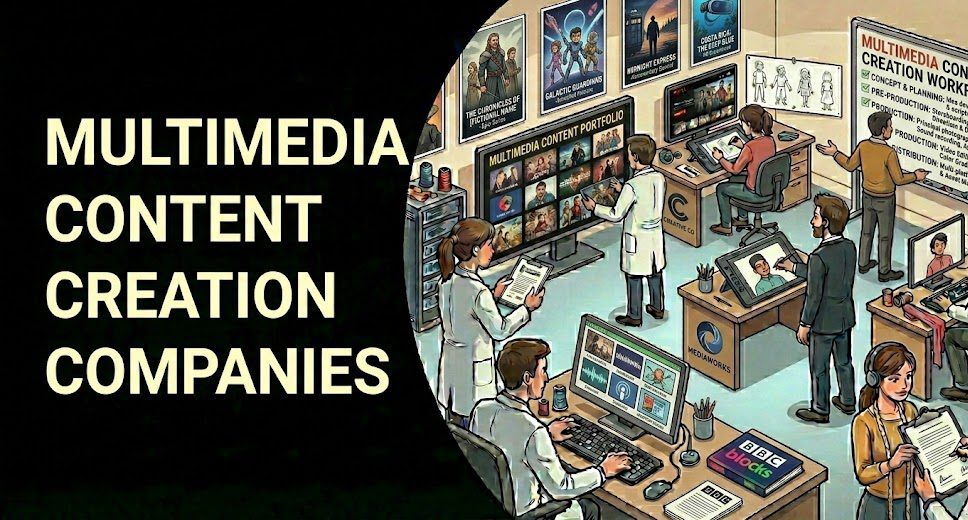
You’d think that finding multimedia content creation companies in 2025 would be easy. There are more of them than ever. But here’s the problem—600,000+ companies operate across the global film and TV supply chain, and the sheer volume doesn’t simplify your search. It makes it harder.
Most producers and studio executives still end up cycling through the same 5 or 6 vendors they’ve always known, paying a 15–20% premium because they don’t have visibility into the full market. That’s the Fragmentation Paradox at work, and it’s costing your production real money.
This guide gives you a framework for identifying, vetting, and selecting the right multimedia content creation partner for your project—whether you’re greenlighting a global drama series, producing branded content at scale, or sourcing post-production services for an international distributor’s slate. And it’ll show you exactly how to compress that 3–6 month discovery process into days.
TABLE OF CONTENTS
- What Multimedia Content Creation Actually Covers
- The Real Problem: Why Finding Good Companies Is So Hard
- Types of Multimedia Content Creation Companies to Know
- 5 Criteria That Actually Matter When Vetting a Vendor
- How Smart Pairing Accelerates Vendor Selection
- Frequently Asked Questions
- Key Takeaways
Find Verified Multimedia Companies for Your Project Today
Vitrina maps 140,000+ verified companies across the global entertainment supply chain—animation studios, post-production houses, VFX vendors, sound studios, localization services, and more. Filter by budget, territory, genre, and verified project history. No guesswork. No cold calls.
200 free credits · No credit card required · Trusted by teams at Netflix, Warner Bros, Paramount, and Google TV
What Multimedia Content Creation Actually Covers
Let’s be clear about scope, because “multimedia content creation” is a term that gets stretched to mean very different things depending on who’s using it.
In the entertainment and media production context—which is where Vitrina operates—multimedia content creation companies typically span the full production and post-production stack. We’re talking about:
- Animation studios — 2D, 3D, stop-motion, and hybrid formats across feature film, series, and branded content
- VFX houses — Visual effects from photorealistic environments to creature work and compositing
- Post-production companies — Editing, color grading, sound design, and finishing services
- Sound and music production studios — Original composition, sound mixing, ADR, and foley
- Localization and dubbing services — Subtitle translation, lip-sync dubbing, and creative localization for global markets
- Virtual production facilities — LED volume stages, real-time rendering environments, and hybrid physical-digital shooting
And here’s what makes selection genuinely complex: most projects need multiple categories simultaneously. Your drama series doesn’t just need a VFX vendor—it needs one who’s available in your production window, has worked at your budget level, delivers to platform specs, and can handle the localization pipeline when sales kick in. Finding that alignment isn’t a Google search problem. It’s an intelligence problem.

Your AI Assistant, Agent, and Analyst for the Business of Entertainment
VIQI AI helps you plan content acquisitions, raise production financing, and find and connect with the right partners worldwide.
- Find active co-producers and financiers for scripted projects
- Find equity and gap financing companies in North America
- Find top film financiers in Europe
- Find production houses that can co-produce or finance unscripted series
- I am looking for production partners for a YA drama set in Brazil
- I am looking for producers with proven track record in mid-budget features
- I am looking for Turkish distributors with successful international sales
- I am looking for OTT platforms actively acquiring finished series for the LATAM region
- I am seeking localization companies offer subtitling services in multiple Asian languages
- I am seeking partners in animation production for children's content
- I am seeking USA based post-production companies with sound facilities
- I am seeking VFX partners to composite background images and AI generated content
- Show me recent drama projects available for pre-buy
- Show me Japanese Anime Distributors
- Show me true-crime buyers from Asia
- Show me documentary pre-buyers
- List the top commissioners at the BBC
- List the post-production and VFX decision-makers at Netflix
- List the development leaders at Sony Pictures
- List the scripted programming heads at HBO
- Who is backing animation projects in Europe right now
- Who is Netflix’s top production partners for Sports Docs
- Who is Commissioning factual content in the NORDICS
- Who is acquiring unscripted formats for the North American market
The Real Problem: Why Finding Good Companies Is So Hard
Most production executives and studio heads know this feeling: you need a specialist multimedia partner—say, a photorealistic VFX vendor with APAC territory experience—and you end up calling the same three contacts from your festival network. You know there are better options. You just don’t know where to find them.
This isn’t a failure of effort. It’s the Fragmentation Paradox in action. 600,000+ companies operate across the global film and TV supply chain, distributed across 195 countries. But because most vendor intelligence lives in relationship networks, IMDb credits, and 6-month-old trade reports, producers effectively operate blind to 99.9% of the market. The companies you know aren’t necessarily the best-fit vendors—they’re just the ones you’ve met.
The financial consequences are real. When you’re negotiating without pricing benchmarks, vendors charge what the market will bear—not what the market rate actually is. A VFX partner quoting $100K for a deliverable that 8 comparable studios would do for $75–85K isn’t gouging you. They’re just operating with more information than you have. That 15–20% margin leakage compounds across every budget line on your production. On a $10M shoot, that’s potentially $600K lost to information asymmetry alone.
And the timeline cost compounds too. A traditional vendor search—contacts, capabilities decks, reference calls, scheduling, negotiation—routinely runs 3–6 months. In a production environment where talent holds expire and location windows close, that’s not just inconvenient. It’s a greenlight killer.
As we’ve detailed in our guide to vendor discovery and qualification in global entertainment, the companies that consistently outperform on margin and timeline aren’t luckier—they’re better informed.
Stop Searching Blind. Start with Verified Data.
Vitrina’s platform surfaces verified multimedia production companies filtered by capability, territory, capacity, and hero project history. What used to take 3 months now takes days. Join 140,000+ companies already using Vitrina to find, vet, and connect with the right production partners.
200 free credits · No credit card required
Types of Multimedia Content Creation Companies to Know
Not all multimedia companies are built the same. And the difference between an all-in-one production house and a specialist boutique matters enormously depending on your project’s needs. Here’s how to think through the landscape.
Full-Service Production Companies
These are your turnkey partners—studios like O2 Films in Brazil or Illuminate Hollywood in the US that handle everything from concept and pre-production through final delivery. The pitch is efficiency: one relationship, one contract, one pipeline. But you’ll pay a premium for that integration, and quality on any single discipline is rarely as high as a specialist shop.
Full-service companies work best when you need consistent output at scale—branded content slates, episodic series with predictable specs, or international co-productions that need a single local delivery point. They’re not the right call for a $15M VFX-heavy feature where photorealistic creature work is your primary quality driver.
Specialist Post-Production Houses
Companies like Dinamita Post in Mexico or the Global Post Network operators connected through platforms like DigitalFilm Tree focus deep rather than wide. They do one thing—color, online editing, sound design, VFX compositing—extraordinarily well. Specialist shops are ideal when a single production discipline is your creative differentiator and you can’t afford to compromise on quality.
But they require coordination overhead. You’re managing multiple vendor relationships instead of one. For larger productions with experienced line producers, that’s a manageable trade-off. For leaner teams without dedicated production management, it’s a scheduling and quality-control headache.
Localization and Dubbing Specialists
Don’t underestimate this category. If your content has any international distribution runway—and if you’re reading this, it probably does—localization partners become part of your supply chain whether you plan for them or not. Companies specialising in AI-enhanced dubbing, lip-sync technology, and subtitling at scale are transforming what’s economically viable for multi-territory releases. As reported by Variety, the global localization market is expanding rapidly as streaming platforms demand faster multi-language delivery across more territories simultaneously.
The smart move is to include localization requirements in your vendor search from pre-production—not as an afterthought once your cut is locked. Vitrina’s multimedia content creation company directory lets you filter for companies with verified dubbing, subtitling, and localization capabilities alongside their production credentials.
5 Criteria That Actually Matter When Vetting a Vendor
Showreels are table stakes. Every multimedia content creation company has one—and most of them are excellent, because they’re curated. You need to go deeper than the reel. Here’s what actually predicts delivery performance.
1. Hero Project History (Verified, Not Self-Reported)
What productions has this company actually delivered, for which platforms, at what budget level, and when? The difference between “we’ve worked with Netflix” and “we delivered 24 VFX shots for Netflix’s [specific series] in Q3 2024 on a $2M budget” is enormous. Verified project history—cross-referenced against public data rather than taken at face value from the company’s own website—tells you whether their capabilities match your production’s actual requirements.
2. Current Capacity Status
This one kills more deals than any other factor. You find an ideal partner—capabilities match, pricing is right, chemistry is good—and they’re fully booked for your window. Current capacity status, tracked in real time rather than asked during a first call, lets you filter for companies that are actually available before you invest weeks in a discovery process.
3. Budget Tier Alignment
A company that’s built to deliver at the $50M studio level isn’t necessarily your best option for a $3M indie series—not because they can’t technically do it, but because your project won’t get their A-team. Conversely, a boutique that specialises in $1–5M productions may not have the infrastructure to scale to your delivery spec. Budget tier fit matters as much as raw capability.
4. Territory and Technical Compliance
Platform delivery specs vary—Netflix, Amazon Prime Video, BBC iPlayer, and linear broadcast all have different technical requirements. Confirm your shortlisted companies have delivered to your specific platform’s spec before, not just that they “can” do it. And for international co-productions, verify their understanding of your territory’s regulatory environment. A production service company with strong Morocco credentials may have no experience navigating Saudi Arabia’s content approval process.
5. Financial Stability Indicators
This is the criterion most producers skip—until a vendor fails mid-production. Does the company have the financial foundation to complete your project? Have they delivered on comparable-scale commitments recently? Financial stability isn’t something you can determine from a showreel or a reference call with a happy client. But it’s the difference between a partner and a liability. As we’ve covered in our 2025 due diligence guide for vetting production companies, structural financial health checks should be part of every significant vendor engagement.
How Smart Pairing Accelerates Your Vendor Selection
Smart Pairing is Vitrina’s approach to matching productions with verified supply chain partners—not based on who you know or who pitches loudest, but on verifiable alignment across capability, capacity, budget fit, and territory.
Here’s the practical difference. Traditional vendor discovery works like this: you need a sound design partner, so you call your line producer who calls her contacts, who send over 3 capabilities decks, and 6 weeks later you’re still scheduling introductory calls. It’s relationship-dependent, slow, and structurally biased toward the same small pool of companies your network already knows.
Vitrina’s approach flips that. You search across 140,000+ active suppliers—verified by project history, not self-reported—filtered to exactly your requirements. Budget range. Available production window. Territory expertise. Platform delivery history. Specific technical capability. You go from a blank search to a ranked shortlist of qualified candidates in minutes, not months. And because you’re negotiating with pricing benchmarks in hand, the Insider Advantage shifts to your side of the table.
The ROI is measurable: 80–90% reduction in deal timeline. 15–20% margin protection through transparent pricing intelligence. And genuine access to the 99.9% of the market your relationship network doesn’t surface. That’s not a workflow improvement—it’s a structural EBITDA advantage on every production you run.
For productions that need immediate human support—navigating a complex multi-vendor supply chain, identifying co-production partners in unfamiliar territories, or de-risking an emerging market vendor shortlist—Vitrina’s Concierge Service pairs you with a dedicated intelligence analyst who’s already mapped the landscape you’re navigating.
Let VIQI Find the Right Multimedia Companies for You
Not sure which type of multimedia company your project needs? Ask VIQI—Vitrina’s AI intelligence engine trained on 400,000+ entertainment projects. Tell it your project specs and it’ll identify the right vendor categories, surface qualified companies, and flag capacity and budget alignment in real time.
Used by Netflix, Warner Bros, Paramount, and Google TV teams worldwide · No credit card required
Frequently Asked Questions
What is a multimedia content creation company in the film and TV context?
In film and television, multimedia content creation companies provide specialised production and post-production services—including animation, VFX, sound design, color grading, localization, and virtual production. Some operate as full-service studios handling the entire pipeline; others are boutique specialists in a single discipline. The right choice depends on your project’s scale, budget tier, technical requirements, and territory.
How do I find multimedia content creation companies outside my existing network?
The fastest way is to use a verified entertainment supply chain platform like Vitrina, which maps 140,000+ active companies by capability, territory, project history, and current capacity. Traditional discovery—referrals, festival contacts, trade publications—typically surfaces only a fraction of qualified vendors and adds 3–6 months to your production timeline. Vitrina compresses that to days while adding pricing benchmark data that protects your margin.
What should I verify before hiring a multimedia production company?
Five criteria matter most: verified hero project history at comparable scale and budget, current production capacity in your required window, budget tier alignment, platform delivery and territory compliance experience, and financial stability indicators. Showreels and reference calls are starting points, not sufficient due diligence. Cross-reference claimed project credits against public data and platform delivery logs before committing.
Is it better to use a full-service studio or multiple specialist companies?
It depends on production scale and your internal capacity to manage vendor coordination. Full-service studios offer efficiency and a single contract structure but rarely match specialist quality in any individual discipline. Multi-vendor approaches deliver higher quality across each pipeline stage but require experienced production management to coordinate timelines, specs, and delivery. For high-budget productions where a single creative discipline is the quality differentiator—VFX-heavy drama, for instance—specialist vendors typically win on output quality.
How does Vitrina help with finding multimedia content creation companies?
Vitrina maps 140,000+ verified entertainment supply chain companies globally, including the full spectrum of multimedia production services. The platform lets you filter by capability type, territory, budget range, platform delivery experience, and capacity status. It provides pricing benchmarks that give you negotiating leverage, and VIQI—Vitrina’s AI intelligence engine—can identify the right vendor categories for your specific project requirements and surface qualified matches in minutes.
What is the typical cost of hiring a multimedia content creation company?
Costs vary enormously by discipline, scale, and territory. VFX deliverables can range from $5,000 per shot at boutique studios to $50,000+ at premium facilities. Full post-production on an episodic series might run $200K–$2M+ per episode depending on spec. Localization typically runs $3,000–$15,000 per episode depending on language count and dubbing vs. subtitling. The critical insight: without market pricing benchmarks, you’re negotiating blind. Vitrina’s intelligence layer provides market rate data across all these categories.
Can I find multimedia content creation companies in emerging markets through Vitrina?
Yes—Vitrina’s coverage spans 195 countries, including emerging production hubs across MENA, Southeast Asia, Sub-Saharan Africa, and Latin America. Accessing qualified vendors in these Sovereign Content Hubs is one of the most significant cost optimisation opportunities available to global productions right now. Vitrina’s verification process includes cross-referencing project credits and financial stability indicators, reducing the risk typically associated with engaging vendors in less-familiar markets.
Key Takeaways
Finding the right multimedia content creation company is a market intelligence problem as much as a creative one. Here’s what to act on from this guide:
- The Fragmentation Paradox is real and costly: 600,000+ companies in the global supply chain creates opacity, not choice. Without verified intelligence, you’re paying 15–20% margin premiums and burning 3–6 months in vendor discovery.
- Showreels aren’t due diligence: Verify hero project history against public data, confirm current capacity in your production window, and check budget tier alignment before any vendor relationship advances to negotiation.
- Full-service vs. specialist is a coordination trade-off: Full-service studios offer efficiency; specialist companies offer higher quality per discipline. Match your choice to your internal production management capacity.
- Build localization into your vendor strategy early: International distribution economics depend on your localization pipeline being production-ready, not added post-lock. Find your localization partners in pre-production alongside your VFX and post-production teams.
- Use Vitrina to compress timeline and protect margin: With 200 free credits and no credit card required, you can start searching 140,000+ verified multimedia companies today—and close with pricing benchmarks that put the Insider Advantage on your side.
Start Finding Multimedia Companies the Smart Way
Access 140,000+ verified multimedia production companies across 195 countries. Filter by capability, budget tier, capacity, and platform delivery history. Start with 200 free credits—no credit card, no commitment.
Trusted by Netflix, Warner Bros, Paramount, Google TV, and 140,000+ entertainment professionals worldwide
Find Film+TV Projects, Partners, and Deals – Fast.
VIQI matches you with the right financiers, producers, streamers, and buyers – globally.
Producers Seeking Financing & Partnerships?
Book Your Free Concierge Outreach Consultation
(To know more about Vitrina Concierge Outreach Solutions click here)
Producers Seeking Financing, Co-Pros, or Pre-Buys?
Vitrina Concierge helps producers reach the right financiers, commissioners, distributors, and co-production partners — with precision outreach, not cold pitching.
Join Industry Briefings Trusted by Leaders

Film & TV Financing: Pre-Buys
Learn how pre-buys work in current Film and TV financing, how they differ from pre-sales, and how they are used to close real finance plans.

Streamers – Netflix vs. Amazon – The 2026 Strategy
How Netflix and Amazon’s content and revenue strategies are diverging ahead of 2026.

Format Adaptations: Global Trends
Where formats are traveling, which adaptations are breaking out, and how streamers are backing remakes in 2025–2026.