About Innovation Hub
 Global Content Pulse (Webinars)


 Global Production Financing
(Webinars)
Global Production Financing
(Webinars)  LeaderSpeak Podcast
  About Vitrina
 Our Story
 Our Solutions 🔥
 Film+TV Projects Tracker 🚀
 Case Studies
 Our Profile
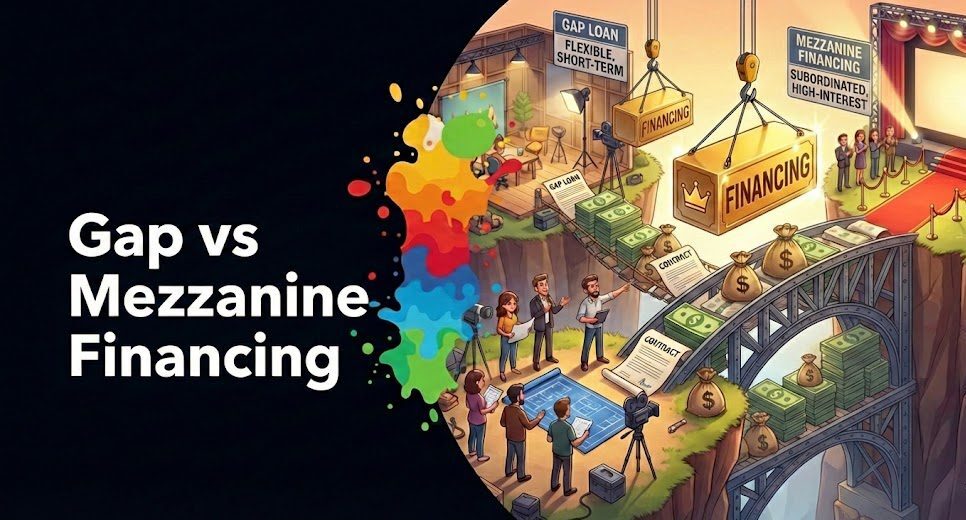
Gap financing is debt secured against the estimated value of unsold distribution territories, while mezzanine financing is a subordinated debt layer that sits between senior debt and equity. The core difference? Seniority and collateral.
Gap lenders bet on specific sales estimates—like Japan or Germany—while mezzanine lenders typically take a broader risk on the project’s overall cash flow, demanding higher interest rates (often 15-20%+) for their junior position in the capital stack.
In the high-stakes world of independent film production, the “capital stack” isn’t just a spreadsheet; it’s a hierarchy of survival. If you’re a producer looking to greenlight a project in 2025, you’ve likely realized that equity is expensive and senior bank debt is conservative.
That’s where the “mid-stack” instruments—gap and mezzanine—come into play. But choosing the wrong one won’t just cost you basis points; it can mess up your entire recoupment waterfall.
Understanding the nuances of Gap vs Mezzanine financing is critical for CFOs and senior producers who need to optimize their project’s IRR while keeping lenders happy. Here’s what we’re seeing behind closed doors in the current market.
Stop Guessing Who’s Financing. Get Targeted Outreach.
Stop searching and start getting funded. We identify the exact decision-makers currently backing projects like yours, turning raw data into risk-aligned capital partnerships.
Major Studios
Scouting early stage projects, IP, and Regional partners for global studio pipelines.
IP Owners & Leads
Connecting creative leads with qualified financiers and major streaming platforms.
Streamers
Securing high-value pre-buy content and discovering early-stage global IP for platforms.
Indie Producers
Bridging the gap for indie filmmakers to reach executive production partners and capital.
Global Financing Ecosystems
Mapping complex markets and pairing projects with disciplined, risk-aligned capital across global territories worldwide.
The Capital Stack Hierarchy: Visualizing Seniority
To understand the risk, you have to understand the waterfall. In any film deal, the order of repayment—the “seniority”—is everything. If a project underperforms, the people at the top of the stack get paid in full, while the people at the bottom might get nothing. That’s not just theory; it’s the capital reality of media finance.
Typically, a film production financing stack looks like this:
- Senior Debt: Secured by pre-sales and tax credits. Lowest risk, lowest interest.
- Gap Financing: Secured by unsold territories. Mid-risk.
- Mezzanine Financing: Subordinated debt. Higher risk, often uncollateralized by specific paper.
- Equity: The “first loss” layer. Highest risk, highest potential upside.
Strategic players recognize that gap and mezzanine are often confused because they both “fill the hole.” But from a CFO’s perspective, they’re treated very differently on the balance sheet. Gap is generally considered a hard asset loan; mezzanine is more like “equity-lite” with a fixed return.
What is Gap Financing? (The “Unsold Territory” Bet)
Gap financing is a debt facility that allows producers to borrow against the “gap” between their secured funding and the total budget. The collateral? The estimated sales value of territories you haven’t sold yet. If you’ve sold the UK and Germany but still have Japan, France, and Latin America open, a gap lender hires a sales agent to estimate those values and lends you a percentage of that “paper.”
Look, gap lenders aren’t in the business of losing money. They typically lend only 50-70% of the *discounted* sales estimates. This provides a “buffer” so that even if the film underperforms at market, the lender is still protected. In today’s market, getting a gap lender to move requires more than a good script—it requires a “bankable” cast and a reputable sales agent. (And that’s being generous; some lenders won’t even look at a project without two A-list attachments.)
Phil Hunt, CEO of Head Gear Films, explains the current “crunch” in the debt market:

As Hunt notes, the “big crunch” means that gap financing—once a staple of indie film—has become much harder to secure. Lenders are compressing their risk profiles. This has led many producers to look further down the stack toward mezzanine options.
Find the Financiers Backing Your Genre
Stop searching and start getting funded. We identify the exact decision-makers currently backing projects like yours, turning raw data into risk-aligned capital partnerships.
What is Mezzanine Financing? (The “Strategic Bridge”)
Mezzanine financing is the bridge between senior debt and equity. It’s often referred to as “subordinated debt” because it sits below the senior and gap lenders in the repayment order. If the film’s revenue only covers 80% of the total debt, the gap lender gets their 100% back, and the mezzanine lender takes the hit. Because of this junior position, mezzanine isn’t cheap.
In Q1 2025, mezzanine interest rates for film projects are hovering between 15% and 22% annually. Compare that to gap financing, which usually sits in the 8% to 14% range. Why the jump? Because mezzanine lenders are essentially taking equity-level risk without the equity-level “infinite” upside.
However, mezzanine debt often comes with “sweeteners”—also known as equity kickers. This might mean the lender gets a small percentage of the “back-end” or “corridor” profits in addition to their interest rate. For a producer, it’s a way to avoid giving up a massive chunk of the project to a pure equity investor who might want creative control.
The Vitrina Capital Seniority Matrix™
Use this matrix to determine where your project’s funding fits in the risk-return hierarchy.
| Layer | Risk Level | Typical Return | Collateral |
|---|---|---|---|
| Senior Debt | Low | 6% – 9% | Pre-sales / Credits |
| Gap Financing | Medium | 8% – 14% | Unsold Territories |
| Mezzanine | High | 15% – 22% | Subordinated Cash Flow |
| Equity | Critical | 25%+ / Points | First Loss / Ownership |
Producers looking to optimize their capital stack and find lenders can explore 140+ verified financing partners on Vitrina.
Gap vs Mezzanine Financing: The Risk-Return Spectrum
So, what’s the real dynamic between these two? It comes down to the “probability of recoupment.” A gap lender is looking at a Japan pre-sale estimate of $500,000 and lending you $250,000. Their risk is that Japan sells for less than $250,000. That’s a fairly quantifiable risk based on historical data.
A mezzanine lender, on the other hand, is looking at the *entire* waterfall after everyone else has been paid. They are betting on the project’s ability to “cross-collateralize.” If Japan fails but Germany over-performs, the mezzanine lender is happy. But if the whole market softens? They’re the first debt layer to get “haircut.”
Strategic players understand that Gap vs Mezzanine financing choices often depend on the “quality of the paper.” If you have conservative sales estimates from a top-tier agent, gap is the cheaper, safer bet. If your estimates are aggressive or you’re betting on a “breakout” hit that hasn’t sold yet, mezzanine might be your only bridge to the finish line.
When to Choose Mezzanine Over Equity?
This is the question we get most often from senior producers. Equity is great because you don’t have to pay it back if the film flops. But equity is terrible because it stays with you forever—taking a cut of every dollar the film ever makes.
Mezzanine is the “weaponized” alternative. It allows you to protect your long-term margins by paying a high interest rate now to avoid giving up ownership later. Insiders recognize that mezzanine is a “yield-play.” Once the lender gets their 18% and their principal back, they’re gone. You keep the upside.
Matthew Helderman of BondIt Media Capital discusses the shift in media financing roles:

As Helderman points out, navigating the post-streamer world requires a more sophisticated approach to the middle of the stack. Mezzanine debt has become a vital tool for producers who need capital but want to “de-risk” their own equity position.
Frequently Asked Questions
What is the main difference between gap and mezzanine financing?
The main difference is seniority and collateral. Gap financing is secured against unsold territory sales estimates and sits higher in the recoupment waterfall. Mezzanine financing is subordinated debt that sits junior to gap and senior debt, typically relying on overall project cash flow rather than specific pre-sale collateral.
Is mezzanine debt riskier than gap financing for a lender?
Yes, significantly. Because mezzanine debt is subordinated, it only gets repaid after senior and gap lenders are made whole. If a film underperforms, the mezzanine layer is the first debt to experience loss. This higher risk is why mezzanine lenders charge much higher interest rates (15-22%).
What are typical mezzanine interest rates in 2025?
In the current 2025 market, mezzanine rates for independent film and TV projects generally range from 15% to 22% per annum. Many deals also include an “equity kicker” or a small percentage of back-end participation to compensate for the subordinated risk.
When should a producer choose mezzanine over equity?
Producers should choose mezzanine when they are confident in the film’s ability to recoup and want to avoid long-term profit sharing. Mezzanine is “expensive money” in the short term, but “cheap money” in the long term because it doesn’t take a permanent ownership stake in the project’s intellectual property.
How Vitrina Helps with Gap and Mezzanine Financing
Finding the right partner in the mid-stack is about more than just the interest rate—it’s about “appetite.” Some lenders only do gap for action films; others only do mezzanine for projects with tax incentives. Searching manually through LinkedIn or trade ads is a recipe for wasted months.
Vitrina streamlines this process by providing a verified database of global lenders, categorized by their specific financing niches. Whether you’re looking to de-risk a $5M indie or structure a $50M slate, we provide the insider access you need.
The Bottom Line
The choice between gap and mezzanine financing isn’t just about cost; it’s about control. Gap financing is a structured, asset-backed bet on your sales agent’s estimates. Mezzanine is a higher-risk, higher-reward bridge that protects your equity at the expense of higher interest. In 2025, the most successful producers are using a hybrid approach—layering gap for the “sure things” and mezzanine for the “strategic bridge.”
Ready to optimize your capital stack? Vitrina’s Concierge team can connect you with matched lenders in 48 hours.
📊 SEO/AEO Metadata
Find Film+TV Projects, Partners, and Deals – Fast.
VIQI matches you with the right financiers, producers, streamers, and buyers – globally.
Producers Seeking Financing, Co-Pros, or Pre-Buys?
Vitrina Concierge helps producers reach the right financiers, commissioners, distributors, and co-production partners — with precision outreach, not cold pitching.
Join Industry Briefings Trusted by Leaders

Format Adaptations: Global Trends
Where formats are traveling, which adaptations are breaking out, and how streamers are backing remakes in 2025–2026.

Books, Novels & Comics Adaptations: Global Trends
Books, webtoons, and manga driving the next global screen hits. Discover how in this webinar.

Micro-Dramas & Mobile-First Storytelling
Micro-dramas are building real audiences and revenue. Understand the platforms, buyers, and economics behind the growth.

Navigating Global Content Licensing Trends
How global content licensing is shifting beyond flat fees to flexible, deal-driven models.