About Innovation Hub
 Global Content Pulse (Webinars)


 Global Production Financing
(Webinars)
Global Production Financing
(Webinars)  LeaderSpeak Podcast
  About Vitrina
 Our Story
 Our Solutions 🔥
 Film+TV Projects Tracker 🚀
 Case Studies
 Our Profile
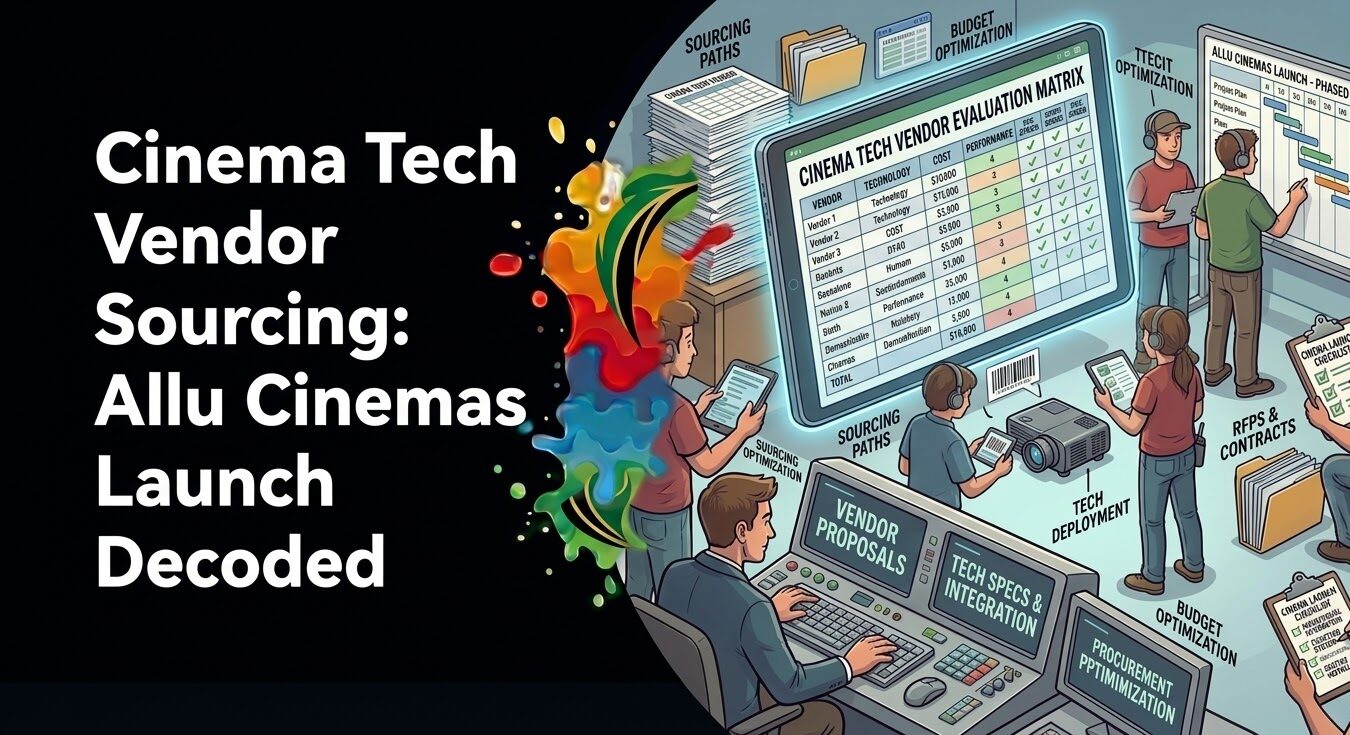
When Allu Arjun called Allu Cinemas a “passion project, not a real-estate venture,” he wasn’t being modest. He was describing the single most expensive decision a cinema exhibitor makes — choosing the right cinema technology vendors to build around. The Kokapet multiplex, inaugurated on March 12, 2026 by Telangana Chief Minister Revanth Reddy, now hosts India’s largest Dolby Cinema screen: a 75-foot-wide dual 4K Dolby Vision installation paired with a 64-channel Dolby Atmos sound system.
That combination didn’t happen by accident. It happened because someone in the Allu family procurement chain made the right calls — on Christie Digital, on Dolby Laboratories, on projection specs, on seating, on the entire technology stack — months before a single ticket was sold.
But here’s the thing about the Allu Cinemas story that every exhibitor, studio, and entertainment supply chain professional should understand: the vendor decisions that define a megaplex launch are made in the dark. In a market with 600,000+ companies operating globally across the film and TV ecosystem — and thousands more specializing in cinema exhibition technology — the gap between a world-class multiplex and an expensive mistake comes down to who you can find, verify, and engage before the construction crew shows up.
Table of Contents
- What Allu Cinemas Actually Chose — and Why It Signals a Wider Procurement Shift
- Why India’s Exhibition Tech Boom Is Different From Any Previous Market Cycle
- The 7 Vendor Categories Every Premium Cinema Build Needs to Map
- The Fragmentation Paradox: Why the Cinema Tech Market Is Harder to Navigate Than It Looks
- How India’s Cinema Boom Connects to the Sovereign Hub Strategy
- What the Allu Cinemas Benchmark Means If You’re a Cinema Technology Vendor
- How to Track Exhibition Technology Procurement Before the Window Closes
- The Global Cinema Screens Market: Why the Procurement Race Is Just Starting
- Frequently Asked Questions
- Conclusion
Ask VIQI: Which Cinema Technology Vendors Are Active in South Asia Right Now?
VIQI is Vitrina’s AI assistant — trained on 1.6 million titles, 360,000 companies, and 5 million entertainment professionals. Get real-time vendor intelligence on Dolby, Barco, Christie, GDC, Qube Cinema, and emerging players across India and Southeast Asia.
✓ Included with 200 free credits | ✓ No credit card needed
What Allu Cinemas Actually Chose — and Why It Signals a Wider Procurement Shift
Let’s start with the specs, because the numbers matter. The flagship auditorium at Allu Cinemas seats 644 viewers and runs dual 4K Dolby Vision projectors — the Christie-powered system that debuted at CinemaCon 2025. That’s not a standard installation. The three remaining screens are equipped with high-end 4K laser projection and Dolby Atmos throughout — making the entire property, not just the headline auditorium, a premium-tier operation.
Compare that to AMB Cinemas’ Bengaluru property (opened January 2026), where Barco laser Series 4 projectors power eight of nine screens, with a single Christie 6K Dolby Vision screen handling premium duties. Two South Indian celebrity-owned multiplexes. Two different projection strategies. Both right for their respective contexts. But the sourcing decisions that led to each outcome? Those happened 18-24 months before opening — before most people in the industry even knew these properties were being built.
That’s the Fragmentation Paradox in exhibition tech. Dolby, Christie, Barco, GDC Technology, Qube Cinema, Sony, IMAX — these are the headline names. But beneath them sits a 10,000-company-deep supply chain of integrators, media servers, seating manufacturers, acoustic treatment specialists, ticketing platform providers, and concession system vendors. Your head of procurement knows three or four names. The market contains hundreds of qualified alternatives they’ll never hear about unless someone maps it for them.
As covered in our complete guide to entertainment supply chain discovery, the cost of information asymmetry in vendor procurement isn’t just financial — it’s structural. When exhibitors miss a better vendor because they didn’t know to look, that decision bakes into the building for 15 years.
Why India’s Exhibition Tech Boom Is Different From Any Previous Market Cycle
India’s movie theater market is projected to reach USD 5.36 billion in 2026, making it one of the two or three most consequential exhibition markets on earth. And it’s not acting like a mature market doing incremental upgrades — it’s acting like a first-build market with deep pockets and very specific ambitions.
Here’s what’s actually happening: Dolby Laboratories announced six new Dolby Cinema installations across India for 2025-2026. The Allu Cinemas Kokapet opening marks the third. AMB Cinemas Bengaluru was the second. The first was in Pune. That’s an 8.5% CAGR expansion pace — and it’s just the branded premium tier. Beneath the headline format deals, hundreds of standard multiplex screens are being built or upgraded annually, each requiring full technology stacks sourced from a global vendor ecosystem that most regional developers have never properly mapped.
According to Omdia, the new Christie single-machine Dolby Vision system unveiled in March 2025 will significantly reduce the cost barrier for premium large-format installations globally. Previously, dual projection was required for any screen — a capital expense that made Dolby Cinema viable only for flagship auditoriums. That constraint is now dissolving. Which means the procurement conversations happening at studios and exhibition groups today will define which vendors capture the next wave of Indian multiplex growth.
But here’s what doesn’t change with the cost curve: the underlying need to de-risk vendor selection before construction begins. A 75-foot Dolby Cinema screen with a 644-seat auditorium represents a capital commitment that can’t be unwound. The vendor shortlist that informs that decision — the one built 18 months before opening — needs to come from verified market intelligence, not festival conversations and word of mouth.
The 7 Vendor Categories Every Premium Cinema Build Needs to Map — and How to Source Them Globally
Let’s be specific. When a new premium multiplex like Allu Cinemas goes through procurement, the technology vendor decisions break into distinct categories — each with its own global supply landscape and its own information problem.
1. Projection Systems
The headline category. Christie Digital, Barco, and Sony dominate branded formats. But the global 4K cinema projectors market is projected to reach USD 3.33 billion by 2026 at a 7.31% CAGR — and Asian manufacturers, particularly from South Korea and Taiwan, are competing aggressively at the sub-premium tier. Appotronics out of China is one name that has expanded significantly into South Asian markets with cost-competitive laser projection. Most Indian exhibitors have never evaluated them.
2. Immersive Audio Systems
Dolby Atmos is the market standard for premium installations, but Auro-3D (now part of Barco) and DTS:X remain viable alternatives at lower integration cost. The Allu Cinemas choice of a 64-channel Dolby Atmos system is the most powerful consumer configuration commercially available. Understanding when that level of investment is appropriate — versus a 48-channel or standard 7.1 system — requires vendor intelligence that most exhibition developers source through manufacturer representatives rather than independent market data.
3. Media Servers and Theatre Management
GDC Technology and Qube Cinema — both headquartered in Asia — are the two most significant players in media servers and Theatre Management Systems (TMS) for the Indian market. But they’re not interchangeable. GDC holds market-leading positions in China and Southeast Asia; Qube has deeper roots in South Asian multiplex chains. When you’re building in Hyderabad, that distinction affects your whole operational workflow. And there are smaller TMS vendors in the ecosystem you’ll only discover if you search beyond the three names your integrator happens to represent.
4. Premium Large Format (PLF) and Branded Experiences
IMAX, ScreenX (CJ 4DPlex), and 4DX represent the branded PLF tier where the format provider dictates most of the tech stack. But the competitive dynamics are shifting fast — as reported by Screen International, ScreenX has now expanded to over 400 auditoriums globally with Barco as sole projection partner through 2030. That’s a vendor relationship with 10-year implications for any exhibitor considering the format. You need to know about these partnerships before you sign a PLF deal, not after.
5. LED Cinema Screens (Direct-View)
This is the category that’s rewriting the technology rules right now. Samsung launched the first DCI-certified cinema LED screen in 2017 and remains market leader. But over 20 manufacturers — the majority Chinese, several Korean, plus Barco and NanoLumens — now produce DCI-certified LED screens. For an Indian exhibitor building premium screens in 2026, this category demands dedicated vendor scouting. The economics are shifting: higher upfront cost, lower operational cost over a 10-year horizon versus laser projection. The ROI math changes depending on which manufacturer you evaluate.
6. Seating and Interior Technology
Less glamorous than projection specs, but the Allu Cinemas premium pricing strategy — reportedly Rs. 295 for standard seats, Rs. 350 for recliners, competitive with AMB Cinemas — depends entirely on the seating product delivering on its promise. The global premium cinema seating market has a fragmented vendor landscape across Europe, Turkey, and Asia. Italian and Spanish manufacturers compete against Chinese volume producers. Most procurement decisions in this category are still made through trade show relationships rather than systematic market mapping.
7. Content and Technology Delivery Infrastructure
Digital Cinema Packages (DCPs), satellite delivery, encryption key management — this is the unsexy end of cinema technology that determines whether your premiere night goes smoothly. For a property like Allu Cinemas, which planned a digital cinema launch with RRR trailer screenings for media on March 13, the DCP delivery chain has to be bulletproof. Vendors like Technicolor, Deluxe, and regional DCP mastering specialists are all relevant here — and the ecosystem of local Indian providers in this space is growing rapidly.
Map Cinema Technology Vendors Across India and 195 Countries in Days, Not Months
Trusted by Netflix, Warner Bros, and Paramount. Join 140,000+ companies tracking the global entertainment supply chain — including the exhibition technology sector’s fastest-growing players.
✓ 200 free credits | ✓ No credit card required | ✓ Full platform access
The Fragmentation Paradox: Why the Cinema Tech Market Is Harder to Navigate Than It Looks
You know the headline names. You’ve seen the Dolby logos and the Christie branding. But the Fragmentation Paradox — Vitrina’s framework for understanding why information asymmetry persists even in markets with abundant suppliers — applies just as brutally to exhibition technology as it does to VFX or co-production sourcing.
Think about the sub-vendor layer. When AMB Cinemas chose Barco laser Series 4 projectors for eight of its nine Bengaluru screens, Barco didn’t build the entire installation stack. Local systems integrators, acoustic specialists, screen manufacturers, and cabling contractors filled in the rest. Some of those companies were excellent. Some were second-best choices made because procurement didn’t know better options existed three cities away, or in Southeast Asia.
At a $10 million premium multiplex build, a 15% margin leakage from suboptimal vendor selection across the full technology stack means $1.5 million in direct cost that doesn’t have to be spent. That’s before you account for the downstream impact of choosing a media server platform that creates operational headaches for three years, or a seating vendor whose recliner mechanisms need servicing after 18 months.
And it’s not just cost. It’s timing. The Allu Cinemas property was reportedly in construction for 18 months before the March 12 inauguration. Every week of delay in finalizing a vendor — projection system, audio system, seating, DCP infrastructure — flows directly into the launch timeline. When your opening film is Dhurandhar 2 with Ranveer Singh, that deadline is not negotiable.
How India’s Cinema Boom Connects to the Sovereign Hub Strategy
India’s exhibition technology procurement doesn’t exist in isolation. It sits inside a larger strategic shift that Vitrina tracks under the Sovereign Hubs framework — the pattern where governments and entertainment ecosystems deploy capital to build local industry infrastructure that competes with Western production centers.
Saudi Arabia is targeting 1,000+ cinema screens by 2030, up from 630+ in 2024, with cinema chains like Muvi, VOX, and AMC all expanding rapidly. The kingdom’s cinema box office hit $248.9 million in 2024, with projections of $266.6 million for 2025. Those numbers represent an enormous technology procurement wave — one where most of the vendor sourcing decisions are happening right now, and where the Fragmentation Paradox applies as severely as anywhere in the world.
Here’s the strategic read: South Asian celebrity-driven multiplex launches like Allu Cinemas and AMB Cinemas aren’t just entertainment business stories. They’re signals. They tell you where Dolby, Christie, and Barco are prioritizing their sales teams, where local integrators are building expertise, and where the next procurement wave will come from. If you’re a vendor trying to accelerate into South Asian or MENA exhibition markets, the intelligence you need isn’t in a press release — it’s in the company tracking layer that maps active deals before they hit the trades.
Our deep dive into the MENA film and TV landscape maps how Saudi Arabia’s cinema infrastructure buildout is accelerating vendor demand across the region — including for exhibition technology categories most global vendors haven’t yet prioritized.
What the Allu Cinemas Benchmark Means If You’re a Cinema Technology Vendor
The Allu Cinemas specification list is now public knowledge — India’s largest Dolby Cinema screen, dual 4K Christie projection, 64-channel Atmos, three additional 4K laser screens. Within the next 18 months, every serious premium multiplex under development in South Asia will be benchmarked against it. That’s how exhibition technology markets work — one landmark installation sets the reference point, and everyone else either meets it or explains why they didn’t.
So if you’re Barco, GDC, Qube Cinema, or an emerging Asian manufacturer with products competitive at this tier, you have a 12-month window before the next wave of Indian premium multiplex procurement solidifies around Allu Cinemas specs. That’s your window to get into the consideration set. But only if you can find the right decision-makers before they’ve finalized their shortlists — which, as we’ve established, happens well before any announcement reaches Screen International or Deadline.
And if you’re a systems integrator or regional distributor for any of these technology categories in South or Southeast Asia? The Fragmentation Paradox is your opportunity as much as it’s a problem for buyers. The exhibitor who doesn’t know about your products isn’t a lost customer — they’re a customer waiting to be found. But you can’t wait for trade shows to do that work for you anymore.
Smart pairing — Vitrina’s approach to connecting buyers and suppliers based on verified capability and active project signals — is how vendors in this category accelerate pipeline. Not by blasting cold email to a purchased list of cinema chains. By tracking which properties are in development, which developers have signed technology deals already, and which procurement timelines are still open. That’s the intelligence advantage that compresses a 6-month sales cycle into weeks.
Need to Connect With Cinema Exhibitors or Tech Buyers in India and MENA? We’ll Make the Introduction.
Vitrina Concierge is your Virtual Agent. We don’t give you a list — we make warm introductions directly to decision-makers actively seeking your technology or services.
- Technology vendor → South Asian multiplex development teams (direct access)
- LA producer → Netflix UK, Fifth Season, Fox Entertainment (48 hours)
- Middle Eastern studio → Legendary Pictures (direct access)
How to Track Exhibition Technology Procurement Before the Window Closes
Let’s get tactical. If you’re working in exhibition technology — either sourcing vendors for a new build, or selling into the sector — here’s how to Weaponize the Allu Cinemas data point to your advantage.
Step 1: Map the development pipeline, not the announced openings. Allu Cinemas started procurement conversations roughly 18 months before the March 2026 inauguration. That means the relevant market intelligence point was September 2024 — not March 2026. You want to track property developments at planning and permit stage, not at ribbon-cutting. In India alone, several major premium multiplex projects are currently in design or early construction phases. Most of that information is publicly accessible in some form, but none of it is consolidated anywhere meaningful.
Step 2: Track the celebrity and star-backed properties specifically. The Allu family’s move into exhibition mirrors what Mahesh Babu did with AMB Cinemas and what other South Indian film talent may do over the next 5 years. These properties are consistently positioned at the premium tier — which means they set the technology benchmark and they always want the best available vendors. They’re also more likely to prioritize brand alignment over cost negotiation. If you’re a technology vendor in this space, these are your highest-leverage target accounts.
Step 3: Monitor the Saudi and MENA cinema expansion in parallel. Saudi Arabia’s target of 350 cinema locations by 2030 — up from current levels — represents a technology procurement wave that will hit the same vendor ecosystem India is drawing on now. The parallel procurement cycles mean vendor capacity gets constrained. The exhibitors who secure committed vendor partnerships first have a structural advantage, both on pricing and on guaranteed installation timelines. This isn’t a hypothetical risk — it’s a supply chain timing problem that smart buyers should be solving today.
Step 4: Use verified capability data, not relationship networks. The 15-20% margin leakage that Vitrina’s Fragmentation Paradox framework documents across entertainment supply chain decisions applies here. Your contact at the local Christie distributor knows three integrators. Vitrina’s platform maps hundreds. Not all of them are relevant — but the ones that are relevant, and that your competitor hasn’t found yet, represent direct competitive advantage on cost, quality, and timeline.
The Global Cinema Screens Market: Why the Procurement Race Is Just Starting
Step back from individual launches. The global cinema screens market was valued at $3.58 billion in 2025, with projections to reach $5.54 billion by 2033 — a 5.61% CAGR driven primarily by Asia-Pacific multiplex expansion and premium format upgrades in mature markets.
But look at the regional breakdown and the real story becomes clear. Asia Pacific holds 30% of global cinema screen market share, and it’s the growth leader — not because China and India are playing catch-up, but because they’re leapfrogging. They’re installing LED screens and laser projection systems that Western markets are still debating upgrading to. They’re building premium large-format auditoriums at scale. They’re partnering directly with Dolby, Barco, and Christie rather than through legacy distribution chains.
The multiplexes segment already accounts for 72.37% of global movie theater market share in 2026. That’s the segment where Allu Cinemas and AMB Cinemas compete. And it’s the segment where the vendor sourcing decisions — projection, audio, seating, TMS, DCP delivery — have the biggest ROI implications per build. At a premium multiplex capex of $10-20 million, optimizing the vendor stack isn’t a procurement efficiency exercise. It’s a financing and return-on-capital question that belongs in the same conversation as the site lease and the content licensing agreements.
For vendors in the exhibition technology space, that reframe changes your sales motion entirely. You’re not selling projection systems to a cinema operator. You’re helping a capital deployer de-risk a 15-year infrastructure asset. That conversation has to start much earlier, go much deeper on ROI modeling, and involve decision-makers well above the head of technology.
Frequently Asked Questions
What cinema technology does Allu Cinemas use for its flagship auditorium?
Allu Cinemas’ flagship auditorium at Kokapet, Hyderabad features dual 4K Dolby Vision projectors from Christie, a 75-foot-wide Dolby Cinema screen (India’s largest), a 64-channel Dolby Atmos sound system, pitch-black interiors, and stadium seating for 644 viewers. The three additional screens use high-end 4K laser projection and Dolby Atmos throughout, making the entire property a premium-tier installation.
Who are the major cinema technology vendors in the Indian exhibition market?
The key cinema technology vendors active in India include Dolby Laboratories (audio and projection formats), Christie Digital (projection systems, Dolby Vision partner), Barco (laser projection, HDR systems), Qube Cinema (media servers and TMS, India-founded), GDC Technology (media servers, strong in Asia-Pacific), Sony and NEC (projection), IMAX and CJ 4DPlex (premium large format). Sub-vendors including integrators, acoustic specialists, and seating manufacturers round out the procurement landscape.
How does cinema technology procurement differ from standard entertainment supply chain sourcing?
Cinema technology procurement has a much longer lead time — typically 12-24 months before a multiplex opens — and involves capital commitments that are effectively irreversible for 10-15 years. Unlike content production vendors who can be switched project-to-project, projection systems, audio infrastructure, and media servers are baked into the building. This makes the pre-procurement research phase disproportionately valuable: identifying the right vendors before construction begins can save 15-20% of a $10 million+ technology budget versus settling for the first shortlist your integrator recommends.
What is the Dolby Cinema format and how does it differ from standard multiplex installations?
Dolby Cinema is a premium format combining Dolby Vision laser projection (dual 4K Christie projectors for screens over 58 feet wide) with Dolby Atmos immersive audio. It delivers a color gamut 112% wider than standard DCI-P3 projectors and contrast ratios exceeding 1,000,000:1. The format requires specific physical specifications including pitch-black interior design and acoustic treatment. As of 2026, fewer than 20 Dolby Cinema installations exist in India, compared to 800+ theatrical features released in Dolby Vision/Atmos globally. The new Christie single-machine Dolby Vision system announced in March 2025 is expected to reduce implementation costs for screens under 58 feet wide.
How large is the global cinema technology market and what’s driving growth?
The global cinema screens market was valued at $3.58 billion in 2025, projected to reach $5.54 billion by 2033 at a 5.61% CAGR. The 4K cinema projectors sub-market alone is projected at $3.33 billion by 2026 at 7.31% CAGR. Growth is driven by premium large-format expansion across Asia-Pacific (30% of global market share), laser projection upgrades replacing legacy 2K systems, and multiplex buildouts in India, Saudi Arabia, and Southeast Asia. The Sovereign Hubs trend — government-backed entertainment infrastructure programs in Saudi, UAE, and India — is accelerating the procurement cycle.
What cinema technology is Saudi Arabia deploying as it expands to 1,000+ screens?
Saudi Arabia’s cinema expansion — targeting 350+ cinema locations and 1,000+ screens by 2030 — is deploying international premium formats through chains like Muvi, VOX, and AMC. Current installation preferences follow global premium multiplex standards: Barco and Christie projection systems, Dolby Atmos audio, and GDC or Qube media servers. The $248.9 million box office in 2024 and projected 8.5% CAGR make Saudi Arabia the fastest-growing premium cinema market globally. Vendors seeking early positioning in Saudi exhibition technology need to engage development pipelines now, as procurement windows typically open 18-24 months before announced openings.
How can cinema technology vendors find new multiplex development opportunities in India and MENA?
The most effective approach is to track multiplex development pipelines 12-24 months before announced openings — which is when procurement teams are actively shortlisting vendors. Platforms like Vitrina map active entertainment supply chain projects, company capabilities, and deal flow in real-time. Vitrina’s database covers 140,000+ active entertainment companies across 195 countries, including the exhibition technology sub-sector. Connecting early — before a developer’s shortlist is finalized — is the primary lever for vendors looking to accelerate their market position in South Asian and MENA exhibition markets.
What is the Fragmentation Paradox and how does it apply to cinema exhibition technology?
The Fragmentation Paradox is Vitrina’s framework describing how an abundance of suppliers in a market creates scarcity of actionable intelligence — not the lower costs and faster deals that logic would predict. In cinema exhibition technology, there are thousands of vendors globally across projection, audio, seating, media servers, and integration. But buyers typically evaluate only 3-5 known names, leaving a majority of potentially superior vendors undiscovered. The result is 15-20% margin leakage on technology budgets, suboptimal long-term performance, and avoidable procurement delays — all driven by information asymmetry rather than any lack of supply.

Your AI Assistant, Agent, and Analyst for the Business of Entertainment
VIQI AI helps you plan content acquisitions, raise production financing, and find and connect with the right partners worldwide.
-
Find
active co-producers and financiers for scripted projects
-
Find
equity and gap financing companies in North America
-
Find
top film financiers in Europe
-
Find
production houses that can co-produce or finance unscripted series
-
I am looking for
production partners for a YA drama set in Brazil
-
I am looking for
producers with proven track record in mid-budget features
-
I am looking for
Turkish distributors with successful international sales
-
I am looking for
OTT platforms actively acquiring finished series for the LATAM region
-
I am seeking
localization companies offer subtitling services in multiple Asian languages
-
I am seeking
partners in animation production for children's content
-
I am seeking
USA based post-production companies with sound facilities
-
I am seeking
VFX partners to composite background images and AI generated content
-
Show me
recent drama projects available for pre-buy
-
Show me
Japanese Anime Distributors
-
Show me
true-crime buyers from Asia
-
Show me
documentary pre-buyers
-
List the
top commissioners at the BBC
-
List the
post-production and VFX decision-makers at Netflix
-
List the
development leaders at Sony Pictures
-
List the
scripted programming heads at HBO
-
Who is
backing animation projects in Europe right now
-
Who is
Netflix’s top production partners for Sports Docs
-
Who is
Commissioning factual content in the NORDICS
-
Who is
acquiring unscripted formats for the North American market
Your AI Assistant, Agent, and Analyst for the Business of Entertainment
VIQI AI helps you plan content acquisitions, raise production financing, and find and connect with the right partners worldwide.
- Find active co-producers and financiers for scripted projects
- Find equity and gap financing companies in North America
- Find top film financiers in Europe
- Find production houses that can co-produce or finance unscripted series
- I am looking for production partners for a YA drama set in Brazil
- I am looking for producers with proven track record in mid-budget features
- I am looking for Turkish distributors with successful international sales
- I am looking for OTT platforms actively acquiring finished series for the LATAM region
- I am seeking localization companies offer subtitling services in multiple Asian languages
- I am seeking partners in animation production for children's content
- I am seeking USA based post-production companies with sound facilities
- I am seeking VFX partners to composite background images and AI generated content
- Show me recent drama projects available for pre-buy
- Show me Japanese Anime Distributors
- Show me true-crime buyers from Asia
- Show me documentary pre-buyers
- List the top commissioners at the BBC
- List the post-production and VFX decision-makers at Netflix
- List the development leaders at Sony Pictures
- List the scripted programming heads at HBO
- Who is backing animation projects in Europe right now
- Who is Netflix’s top production partners for Sports Docs
- Who is Commissioning factual content in the NORDICS
- Who is acquiring unscripted formats for the North American market
Conclusion: The Vendor Decisions That Define a Megaplex Are Made Before Most People Are Watching
Allu Cinemas didn’t become India’s home of the largest Dolby Cinema screen by accident. It happened because someone made the right cinema technology vendor decisions 18 months before Revanth Reddy cut the ribbon. The Christie projectors, the 64-channel Atmos system, the 75-foot screen — all of that was locked into contract while construction crews were still finishing the shell. The entertainment industry has always rewarded insiders who gather intelligence early. Exhibition technology procurement is no different.
Key Takeaways:
- India’s exhibition market is at $5.36 billion in 2026 — driven by premium multiplexes like Allu Cinemas and AMB Cinemas setting new technology benchmarks that will govern procurement decisions for the next 5 years.
- The global cinema screens market hits $5.54 billion by 2033 at 5.61% CAGR, with Asia-Pacific’s 30% market share being the fastest-growing region — making South Asian vendor intelligence a priority, not an afterthought.
- Procurement windows open 12-24 months before opening — vendors who reach multiplex developers at planning stage, not at announcement stage, have a structural competitive advantage that cannot be recovered later.
- The Fragmentation Paradox costs exhibitors 15-20% of technology budgets on a $10M+ build — information asymmetry, not vendor quality, is the primary driver of suboptimal cinema technology decisions.
- Saudi Arabia’s 350-location, 1,000-screen target by 2030 runs on the same vendor procurement timeline as India — creating a parallel, compounding demand cycle that the same technology ecosystem must serve simultaneously.
The exhibitors and vendors who win the next decade of South Asian and MENA cinema expansion won’t be the ones with the best products in the room. They’ll be the ones who were in the right room 18 months early — with verified intelligence, warm introductions, and a clear view of what was being built before it hit the trades.
Track Cinema Tech Vendors Globally
200 free credits. No credit card required. Join 140,000+ companies on Vitrina.
Ask VIQI About Exhibition Tech Markets
Get instant answers on vendors, procurement timelines, and market intelligence. Trained on 360,000 companies.
Find Film+TV Projects, Partners, and Deals – Fast.
VIQI matches you with the right financiers, producers, streamers, and buyers – globally.
Producers Seeking Financing & Partnerships?
Book Your Free Concierge Outreach Consultation
(To know more about Vitrina Concierge Outreach Solutions click here)
Producers Seeking Financing, Co-Pros, or Pre-Buys?
Vitrina Concierge helps producers reach the right financiers, commissioners, distributors, and co-production partners — with precision outreach, not cold pitching.
Join Industry Briefings Trusted by Leaders

Film & TV Financing: Pre-Buys
Learn how pre-buys work in current Film and TV financing, how they differ from pre-sales, and how they are used to close real finance plans.

Streamers – Netflix vs. Amazon – The 2026 Strategy
How Netflix and Amazon’s content and revenue strategies are diverging ahead of 2026.

Format Adaptations: Global Trends
Where formats are traveling, which adaptations are breaking out, and how streamers are backing remakes in 2025–2026.