

 About Innovation Hub
 Global Content Pulse (Webinars)


 Global Production Financing
(Webinars)
Global Production Financing
(Webinars)  LeaderSpeak Podcast
  About Vitrina
 Our Story
 Our Solutions 🔥
 Film+TV Projects Tracker 🚀
 Case Studies
 Our Profile
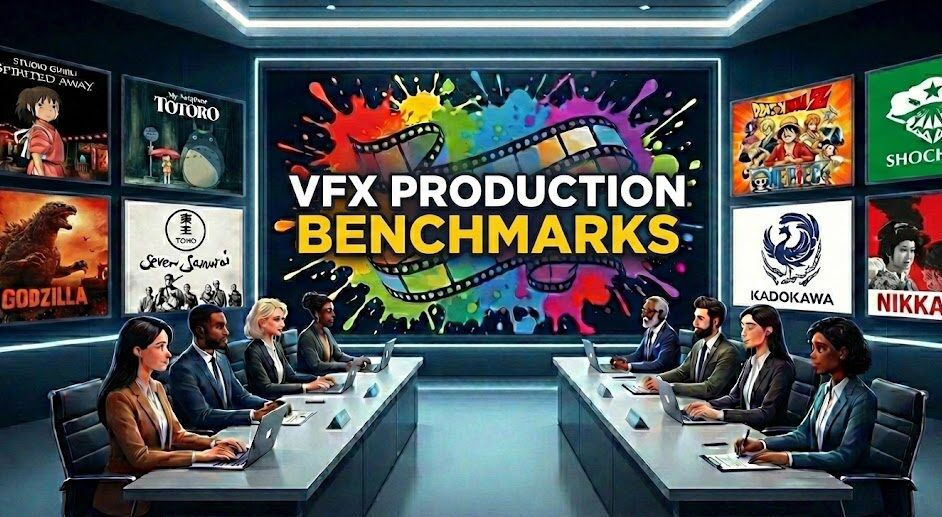
VFX production benchmarks are the technical and operational standards used to measure efficiency, quality, and scalability in high-budget visual storytelling.
Setting these benchmarks involves aligning creative vision with a global supply chain of vendors capable of delivering thousands of photorealistic shots under tight deadlines.
According to Ampere Analysis, the global VFX market reached $18.2 billion in 2024, with demand increasingly concentrated in high-scale episodic and franchise content like Salaar 2.
In this analysis, you will learn how production leads leverage supply chain intelligence to manage visual grandeur, vet high-tier VFX vendors, and compress production cycles.
While many industry discussions focus solely on the “look” of visual effects, they often overlook the critical supply chain logistics required to sustain such grandeur. This article bridges that gap by exploring the frameworks used by market leaders to secure top-tier talent and technology.
This report addresses identified market gaps in technical supply chain visibility, providing actionable strategies for production executives to master global vendor discovery.

Your AI Assistant, Agent, and Analyst for the Business of Entertainment
VIQI AI helps you plan content acquisitions, raise production financing, and find and connect with the right partners worldwide.
- Find active co-producers and financiers for scripted projects
- Find equity and gap financing companies in North America
- Find top film financiers in Europe
- Find production houses that can co-produce or finance unscripted series
- I am looking for production partners for a YA drama set in Brazil
- I am looking for producers with proven track record in mid-budget features
- I am looking for Turkish distributors with successful international sales
- I am looking for OTT platforms actively acquiring finished series for the LATAM region
- I am seeking localization companies offer subtitling services in multiple Asian languages
- I am seeking partners in animation production for children's content
- I am seeking USA based post-production companies with sound facilities
- I am seeking VFX partners to composite background images and AI generated content
- Show me recent drama projects available for pre-buy
- Show me Japanese Anime Distributors
- Show me true-crime buyers from Asia
- Show me documentary pre-buyers
- List the top commissioners at the BBC
- List the post-production and VFX decision-makers at Netflix
- List the development leaders at Sony Pictures
- List the scripted programming heads at HBO
- Who is backing animation projects in Europe right now
- Who is Netflix’s top production partners for Sports Docs
- Who is Commissioning factual content in the NORDICS
- Who is acquiring unscripted formats for the North American market
Producers Seeking Financing & Partnerships?
Book Your Free Concierge Outreach Consultation
(To know more about Vitrina Concierge Outreach Solutions click here)
Table of Contents
Key Takeaways for VFX & Production Leads
-
Data-Driven Sourcing: Production teams using supply chain intelligence identify capable VFX vendors across global hubs 40% faster than traditional referral methods.
-
Pipeline Visibility: Tracking unreleased projects allows service providers to identify active bidding windows for high-scale cinema during early development stages.
-
Verified Benchmarks: Using vertical AI to analyze historical deal patterns ensures that production budgets align with modern visual grandeur expectations and vendor specializations.
What Defines a VFX Production Benchmark?
A VFX production benchmark is a multifaceted standard that evaluates both the technical complexity of visual assets and the operational efficiency of the delivery pipeline. For projects of massive scale, such as Salaar 2, these benchmarks are not just about pixel-perfect renders; they encompass the ability to manage thousands of complex shots across a distributed global network of vendors. This requires a “single source of truth” for production data to maintain consistency.
Production teams now measure success by “shot density”—the ratio of high-complexity visual elements to total screen time. As audiences demand more immersive “visual grandeur,” the pressure on the supply chain to provide specialized talent in niche areas like fluid dynamics, crowd simulation, and real-time environment rendering has intensified. Traditional networking methods often fail to find these specialists at the required scale.
Find specialized VFX studios for high-scale projects:
The Logistics of Visual Grandeur in Large-Scale Cinema
The scale of production for *Salaar 2* highlights a major shift in the “Entertainment Supply Chain.” Visual grandeur is no longer a localized effort; it is an international logistical operation involving hundreds of specialized companies. Vitrina’s data shows that high-budget productions now distribute their VFX workloads across an average of 15-20 vendors globally to mitigate risk and leverage territorial tax incentives.
This “weaponized distribution” of production tasks creates a need for deep intelligence on vendor capacity. Studios like PhantomFX, which work on high-profile global projects, exemplify how vendors are scaling their technical stacks with AI to meet the rising demand for cinematic scale. For production leads, the challenge lies in vetting these vendors’ actual track records versus their marketing portfolios.
Industry Expert Perspective: PhantomFX: Blending Art, AI & Innovation
As visual grandeur becomes the new standard for theatrical releases, understanding how leading studios like PhantomFX integrate AI into their VFX pipelines is crucial for production leads aiming to set new benchmarks.
Bejoy Arputharaj, CEO of PhantomFX, explores the evolution of high-end CGI and how global expansion and AI-driven innovation are shaping the future of visual effects for Hollywood, Netflix, and beyond.
How Do Production Teams Map the VFX Supply Chain?
Mapping the VFX supply chain requires moving beyond anecdotal referrals and into the realm of structured data intelligence. Vitrina AI provides the industry’s first global supply chain platform to solve this “data deficit,” tracking 140,000+ companies including specialized VFX studios and post-production houses. This allows production leads to discover hubs beyond traditional Hollywood borders—such as emerging centers in India, the Middle East, and Southeast Asia.
Using tools like the Global Film+TV Projects Tracker, executives can monitor titles in pre-production to identify which vendors are currently reaching capacity and which are available for new “visual grandeur” mandates. This proactive tracking prevents the common mistake of engaging vendors too late in the cycle, where premium pricing and limited talent availability become major friction points.
Identify active projects entering VFX stages:
Strategic Vetting: Selecting High-Tier VFX Partners
Vetting high-tier VFX partners requires an objective evaluation of their historical performance and collaborator networks. Vitrina’s Company & People Intelligence allows production teams to verify a vendor’s “reputation score” by analyzing their past associations with major studios like Disney, Warner Bros., or Netflix. This objective data replaces subjective “demo reels,” which can often mask a vendor’s inability to handle large-scale asset management.
For *Salaar 2*, setting a benchmark means working with partners who not only deliver art but also adhere to strict security and cloud-native workflow standards. As the industry moves toward the MovieLabs 2030 Vision, production executives must prioritize vendors who demonstrate interoperability and Zero Trust security protocols. Mapping these capabilities through centralized intelligence ensures that visual grandeur does not come at the cost of data security.
Access intelligence on high-tier VFX vendors:
Moving Forward
The pursuit of visual grandeur in modern cinema is fundamentally a supply chain challenge. By transitioning from opaque, relationship-driven networking to data-powered discovery, production leads can compress lead times and ensure their projects set new benchmarks for quality and scale.
Whether you are a production executive looking to manage a multi-vendor global slate, or a VFX studio trying to target high-tier franchise projects like *Salaar 2*, the principle is clear: actionable intelligence drives production velocity.
Outlook: Over the next 18 months, we expect a massive consolidation in the “Authorized Data” market, where VFX studios will increasingly license proprietary IP for AI-assisted environment building, further raising the visual benchmark for global cinema.
Frequently Asked Questions
Quick answers to common queries about VFX production benchmarks and supply chain intelligence.
What are the main components of a VFX production benchmark?
How does Vitrina AI help in finding VFX vendors?
Why is tracking unreleased projects important for VFX studios?
What is “weaponized distribution” in the context of VFX?
How can I vet a VFX studio’s reputation objectively?
What role does AI play in modern VFX benchmarks?
What is the MovieLabs 2030 Vision?
How can production leads identify emerging VFX hubs?
About the Author
Written by Vitrina’s Editorial Team, specializing in the global entertainment supply chain and visual effects intelligence. Our analysts track 1.6M+ titles and 140K+ companies to provide market-leading insights. Connect on Vitrina.
Find Film+TV Projects, Partners, and Deals – Fast.
VIQI matches you with the right financiers, producers, streamers, and buyers – globally.
Producers Seeking Financing & Partnerships?
Book Your Free Concierge Outreach Consultation
(To know more about Vitrina Concierge Outreach Solutions click here)
Producers Seeking Financing, Co-Pros, or Pre-Buys?
Vitrina Concierge helps producers reach the right financiers, commissioners, distributors, and co-production partners — with precision outreach, not cold pitching.
Join Industry Briefings Trusted by Leaders

Deep dive into Co-Pros
Ambitious co-productions are key to global hits, but most deals collapse. This deep-dive briefing is the strategic playbook. We’ll break down the financing models, partnership structures, and market insights behind today’s successful deals.

Film & TV Financing: Tax Credits & Incentives
A focused look at how 2025 tax credits and incentives are reshaping Film & TV financing decisions — and where the real value now sits.

Film & TV Financing: Pre-Buys
Learn how pre-buys work in current Film and TV financing, how they differ from pre-sales, and how they are used to close real finance plans.
Streamers – Netflix vs. Amazon – The 2026 Strategy
How Netflix and Amazon’s content and revenue strategies are diverging ahead of 2026.