About Innovation Hub
 Global Content Pulse (Webinars)


 Global Production Financing
(Webinars)
Global Production Financing
(Webinars)  LeaderSpeak Podcast
  About Vitrina
 Our Story
 Our Solutions 🔥
 Film+TV Projects Tracker 🚀
 Case Studies
 Our Profile
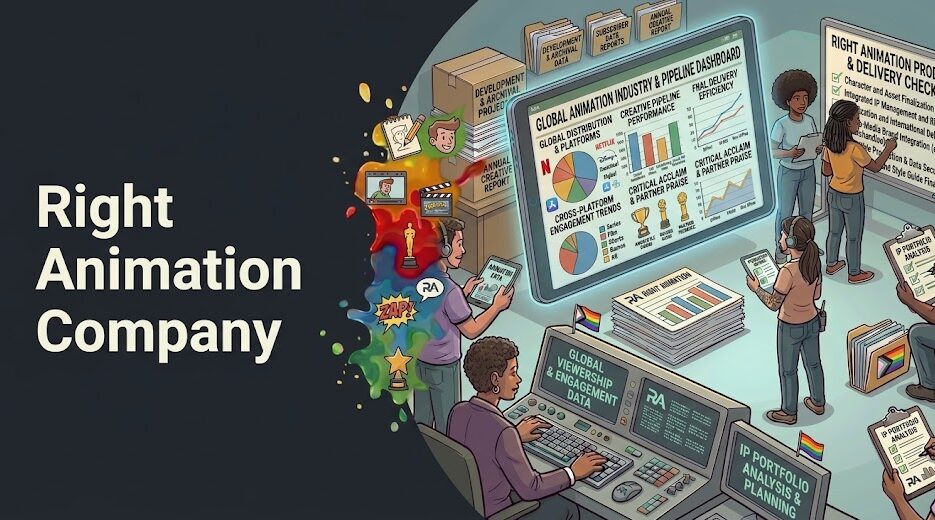
The right animation company delivers your vision on time, on budget, and with the creative integrity your project demands. The wrong one? Six months of expensive rebuilds, missed deadlines, and a final reel that doesn’t match what you saw in the pitch. With over 10,000 animation studios operating globally, selection isn’t just a creative decision—it’s a strategic one that producers, commissioners, and brand teams consistently underestimate.
Most buyers focus on the showreel. That’s a mistake. The showreel shows you what the studio wants you to see. This guide covers the 7 criteria that actually determine whether a partnership works—and the questions that separate genuinely capable studios from impressive-looking ones.
Whether you’re commissioning a 2D animated series, a feature film with heavy CGI, or a brand-sponsored short for global distribution, the selection framework is the same. Here’s how to use it.
Table of Contents
- What Makes an Animation Company the Right Fit?
- Types of Animation Companies: Know What You Need
- The 7 Criteria That Actually Determine Your Choice
- How Do You Evaluate an Animation Company’s Portfolio?
- What Questions Should You Ask Before Signing?
- Regional Animation Hubs: Why Geography Shapes Value
- FAQ
- Conclusion
Not Sure Which Animation Studio Fits Your Project?
VIQI is Vitrina’s AI assistant—trained on 1.6 million titles, 360,000 companies, and 5 million entertainment professionals. Ask it about animation studios by region, budget range, or specialization.
✓ Included with 200 free credits | ✓ No credit card needed
What Makes an Animation Company the Right Fit?
Not every studio can handle every project. Full stop. A company with a deep reel of preschool content may not be the right partner for a dark adult anthology series. A studio that excels at motion graphics for broadcast might struggle with full character-driven animation.
“Fit” isn’t just creative compatibility—it’s operational alignment. And that’s where most commissioning decisions go wrong. Buyers evaluate the work but miss the workflow. Here’s what you’re actually assessing when you evaluate an animation company:
- Technical capabilities matching your project’s delivery requirements (IMF, DCP, UHD broadcast, streaming specs)
- Pipeline capacity aligned with your production window—not just theoretical availability
- Communication infrastructure compatible with how your team reviews and approves work
- Budget range the studio is genuinely accustomed to operating in (a studio that normally works at $2M/episode will struggle below $200K)
- IP ownership clarity—who owns the animation assets, character rigs, and background art on delivery
And here’s something most buyers don’t account for: the best animation studios are often committed 12–18 months out. The studio winning awards at Annecy or MIPCOM this year? They’re likely unavailable for your Q3 production start. That’s why evaluating fit and availability in parallel isn’t optional—it’s the difference between a productive shortlist and wasted discovery time.
For a regularly updated overview of studios currently accepting new projects, Vitrina’s global animation company guide tracks active studios across 30+ countries with verified project histories and current capacity signals.
Types of Animation Companies: Know What You Need
Before you can evaluate a studio, you need to know which type you’re actually looking for. These aren’t interchangeable categories—and confusing them is one of the most common (and expensive) mistakes in animation procurement.
2D Animation Studios
Traditional frame-by-frame or vector-based production. Strong for kids’ series, explainer content, and branded animation with distinctive artistic styles. Industry-standard tools include Toon Boom Harmony, Adobe Animate, and TVPaint. Cost-effective at mid-range budgets—though what “mid-range” means varies significantly by geography. Our dedicated guide on choosing a 2D animation studio breaks down the technical criteria specific to this format.
3D Animation Studios
Computer-generated imagery for feature films, premium broadcast series, gaming content, and high-end branded work. Higher cost ceiling, longer production cycles, and more complex pipeline management. There’s a wide spectrum here—from full-service global companies like Toonz Media Group down to strong boutique studios delivering premium output at mid-range pricing. For technical criteria specific to this format, our 3D animation studio selection guide goes deeper on software stacks and pipeline compatibility.
Motion Graphics Studios
Primarily for broadcast design, digital marketing, and title sequences. Fast turnaround, scalable production, and lower cost than character animation. Don’t conflate this with character animation—it’s a different creative and technical discipline, with different team skill sets and tools.
Full-Service vs. Boutique Studios
Full-service studios handle concept through final delivery. Boutiques specialize in specific pipeline stages—character rigging, background design, compositing, or color grading. Knowing which you need directly affects your production management overhead. Going boutique means you’re managing integration between vendors. That’s complexity most buyers underestimate until they’re in the middle of it.
Find Verified Animation Studios on Vitrina
Trusted by Netflix, Warner Bros, and Paramount. Search 140,000+ verified companies—filter animation studios by type, region, budget range, and confirmed project history.
✓ 200 free credits | ✓ No credit card required | ✓ Full platform access
The 7 Criteria That Actually Determine Your Choice
Most selection frameworks stop at creative quality. That’s one criterion of seven—and it’s not even the most important one when production is live. Here’s what we call at Vitrina the Animation Partner Readiness Score™:
The Vitrina Animation Partner Readiness Score™
- Portfolio Relevance (0–20 pts) — Does their reel include work similar to yours in both style AND technical complexity? General quality isn’t enough. You need genre, tone, and pipeline alignment.
- Technical Capabilities (0–20 pts) — Can they actually hit your delivery spec? IMF, DCP, broadcast master, UHD streaming, proprietary engine—confirm this before any creative conversation.
- Pipeline & Tools Compatibility (0–15 pts) — What software are they running? How does it integrate with your existing production pipeline and review workflows?
- Confirmed Capacity & Timeline (0–20 pts) — Are they genuinely available for your production window? Not “we can probably make it work”—confirmed, contracted availability.
- Communication Infrastructure (0–10 pts) — Do they have a project management system? How are revisions handled? Who’s your named day-to-day contact?
- Financial Stability & References (0–10 pts) — Can you verify they’ll complete the project? Do they have recent client references who’ll speak specifically to delivery track record?
- IP & Rights Clarity (0–5 pts) — Who owns the animation assets on delivery? Are they using AI-generated elements that could create downstream IP exposure for your distribution deals?
Score 70+ out of 100: Strong partnership candidate. Below 50: Address the gaps before committing budget.
Criterion 4—confirmed capacity—is the one buyers most consistently miss. You can find a studio with a perfect reel and impeccable references. But if they’re booked through your delivery window, none of that matters. And here’s the fragmentation problem: with 10,000+ animation companies operating globally, capacity intelligence is scattered across relationship networks, stale directories, and outdated databases.
What we’re seeing in the market is that the producers who close the best animation partnerships aren’t the ones with the biggest budgets—they’re the ones with the best supply chain intelligence. The real competitive advantage isn’t finding great studios (there are thousands). It’s finding great studios that are available for your specific production window. That’s where the Fragmentation Paradox™ hits hardest in animation: the market is enormous, but actionable capacity data is nearly invisible without the right tools.

Your AI Assistant, Agent, and Analyst for the Business of Entertainment
VIQI AI helps you plan content acquisitions, raise production financing, and find and connect with the right partners worldwide.
- Find active co-producers and financiers for scripted projects
- Find equity and gap financing companies in North America
- Find top film financiers in Europe
- Find production houses that can co-produce or finance unscripted series
- I am looking for production partners for a YA drama set in Brazil
- I am looking for producers with proven track record in mid-budget features
- I am looking for Turkish distributors with successful international sales
- I am looking for OTT platforms actively acquiring finished series for the LATAM region
- I am seeking localization companies offer subtitling services in multiple Asian languages
- I am seeking partners in animation production for children's content
- I am seeking USA based post-production companies with sound facilities
- I am seeking VFX partners to composite background images and AI generated content
- Show me recent drama projects available for pre-buy
- Show me Japanese Anime Distributors
- Show me true-crime buyers from Asia
- Show me documentary pre-buyers
- List the top commissioners at the BBC
- List the post-production and VFX decision-makers at Netflix
- List the development leaders at Sony Pictures
- List the scripted programming heads at HBO
- Who is backing animation projects in Europe right now
- Who is Netflix’s top production partners for Sports Docs
- Who is Commissioning factual content in the NORDICS
- Who is acquiring unscripted formats for the North American market
How Do You Evaluate an Animation Company’s Portfolio?
Don’t just watch the showreel. Their showreel is curated—edited to show you the best 90-second moments, not what a full production actually looks like at episode 8 of a 26-episode season. Here’s how to go deeper:
Ask for full-length pieces. Specifically the full episode or project the clip came from. Reel quality and full-production quality diverge more than most buyers expect—especially in series work where consistency across a full run is what actually determines delivery success.
Request team-specific references. The person who directed that award-winning short may not be on your project. Ask who specifically will lead your work—then request references tied to that person’s projects, not the studio’s collective output. Big difference.
Look at their most recent delivery, not their most celebrated one. The recent project tells you about current capacity, current team quality, and current communication process. Ask to see it—and ask for client contact details.
Check delivery format compliance. Ask for examples of how they’ve met Netflix, Amazon, or broadcast technical specifications before. If they can’t show you a verified IMF package or UHD deliverable, that’s a serious red flag for any high-spec project. Our broader guide to vetting global visual effects and animation vendors covers the verification framework in detail—including how to assess technical compliance before contracts move forward.
Jayakumar P (CEO, Toonz Media Group) discusses animation studio expansion, strategic partnership models, and how the integration of AI tools is reshaping modern animation pipelines—worth watching for anyone selecting a studio for scale production:
What Questions Should You Ask Before Signing with an Animation Studio?
The right questions reveal more than a contract review—and they reveal it faster. Here are the ones that matter most, and what the answers tell you:
“Who specifically will work on my project?” Not the company in general—the named leads on direction, character animation, and compositing. Creative quality varies within studios more than people realize. You want the team, not just the brand.
“What’s your revision process—and how many rounds are included in the quote?” This is where most contracts break down. “Unlimited revisions” sounds good until you’re on round seven being billed at hourly overage rates. Get the scope written down before a single frame moves forward.
“What happens if a key team member leaves mid-production?” This happens more than studios like to admit—especially in a remote-first industry where animators change employers frequently. Ask what their continuity plan actually looks like.
“What’s your standard payment schedule—and does it tie to delivery milestones?” Milestone-based payments protect you. Front-loaded payments protect them. Know the negotiation landscape before you sit down.
“Can I speak to a client from a project you delivered in the last six months?” Not a reference they’ve pre-selected from three years ago. A recent one—and when you speak to them, ask one question: “Did they deliver on time, on spec, and on budget?”
And one more question most buyers skip entirely: “Are you using AI-generated elements in your pipeline, and how are rights handled?” As authorized AI licensing becomes a distribution deal requirement—Netflix, Disney, and Amazon are already building AI usage clauses into content agreements—your animation company’s IP practices directly affect your downstream deals. According to Variety, major distributors are increasingly scrutinizing AI usage in content pipelines, making chain-of-title clarity a non-negotiable for premium deals.
Regional Animation Hubs: Why Geography Shapes Value
Animation is one of the most globally distributed segments of the entertainment supply chain. And geography matters—not just for cost, but for creative style, communication patterns, technical specialization, and delivery infrastructure. Here’s how the major production hubs compare:
But here’s what the regional table doesn’t capture: the fragmentation within each hub. India alone has hundreds of animation companies ranging from Netflix-specification pipelines down to five-person freelance collectives—all using the same geographic label. Geography is a starting filter. It’s not a quality guarantee.
As reported by Screen International, cross-border animation co-productions have grown significantly, with producers increasingly combining studios across two or three regions to optimize cost and capability simultaneously. For active animation co-production opportunities by region, Vitrina surfaces verified studios actively seeking partnerships—filtered by specialization and availability.
For projects with a significant kids’ content component, cross-border collaboration has its own dynamics around co-production treaties and broadcaster requirements. Our analysis of kids’ content animation collaboration strategies covers those territory-specific nuances in detail.
Need Direct Introductions to Verified Animation Studios? We’ll Find Them.
Vitrina Concierge makes warm introductions to decision-makers at verified animation companies—matched to your project’s budget, style, delivery spec, and confirmed production window.
- Korean animation studio → Netflix Adult Animation partnership (week one)
- LA producer → Fifth Season, Fox Entertainment introductions (48 hours)
- Regional broadcaster → verified studio, confirmed capacity in target window
Frequently Asked Questions
How much does an animation company typically charge?
Costs vary enormously by type, region, and complexity. A 60-second 2D explainer might run $3,000–$15,000. A full animated series episode (22 minutes, broadcast-quality) ranges from $50,000 to $500,000+ depending on studio location and production value. 3D feature animation starts at seven figures. Always get project-specific quotes—general rate cards mean almost nothing without a defined scope attached.
What’s the difference between a 2D and 3D animation company?
2D animation uses flat, hand-drawn or vector-based techniques—traditional cartoons, illustrated explainers, and stylized series. 3D animation creates three-dimensional digital environments and characters using software like Maya, Blender, or Cinema 4D. They require different tools, different teams, and entirely different production pipelines. Some full-service studios handle both, but most specialize. Know which you need before shortlisting anyone.
How do I verify an animation company can meet Netflix or broadcast delivery standards?
Ask directly—and ask for proof. Request examples of projects they’ve delivered to Netflix, Amazon, or your target broadcaster, along with the technical delivery specs used. A studio that’s never produced an IMF package or UHD deliverable will struggle with platform-specific requirements. If they can’t provide verified examples at your required spec, factor in significant QC overhead—or choose a different studio.
Can I hire an animation company in a different country?
Absolutely—and many of the strongest studios operate internationally. India, South Korea, the Philippines, and Eastern Europe all have deep animation talent pools. You’ll want to confirm time zone overlap for creative reviews, language capabilities for notes and approvals, and whether their contract terms accommodate cross-border IP ownership. Co-production structures can also unlock regional tax incentives. It’s not complicated, but it does require deliberate structuring upfront.
How long does it take to produce an animated series?
A 52-episode preschool series (7 minutes each) typically takes 18–24 months from greenlight to delivery. A 13-episode broadcast series (22 minutes each) runs 2–3 years at most quality tiers. These timelines assume design lock before production begins—which many first-time animation buyers don’t account for. Design phases alone (character, backgrounds, style guide approval) can add 4–8 months before a single production frame is animated.
What are the red flags when evaluating an animation company?
Watch for: inability to provide full-length work samples beyond reel clips; vague answers about who’ll specifically work on your project; no milestone-based contract structure; reluctance to connect you with references from recent projects; and timeline promises without a supporting production schedule. Any animation studio that won’t introduce you to a recent client is a red flag—full stop.
Who owns the content an animation company produces for me?
Not automatically you—it depends entirely on your contract. Work-for-hire agreements transfer all rights to the commissioning party on delivery. Co-production structures split ownership by contribution. Service-only arrangements can get complicated if studios use proprietary rigs or third-party asset libraries. Always have an entertainment attorney review IP ownership clauses before signing, and confirm that any AI-generated pipeline elements don’t create downstream IP exposure for your distribution deals.
How do I find animation companies that specialize in my specific genre?
The most efficient route is a platform with verified, filterable studio data—not Google searches or film market directories that go stale within months. Vitrina lets you filter animation companies by specialization (kids, adult, brand, documentary), style (2D, 3D, mixed media), region, and verified project history with current capacity signals. You can explore top animation studios by specialization with hero projects and verified delivery track records.
Conclusion: The Selection Framework Is the Work
Choosing the right animation company isn’t a creative decision—it’s a strategic one. The studios that deliver are identifiable by verified capabilities, confirmed availability, transparent IP practices, and clear revision structures. The ones that don’t deliver are usually identified by the absence of those things—not by a weak showreel. Most failed animation partnerships looked great on paper.
Key Takeaways:
- Know Your Type First: 2D, 3D, motion graphics, and full-service studios aren’t interchangeable—match the type to your project’s requirements before shortlisting.
- Use All 7 Criteria: The Animation Partner Readiness Score™ covers portfolio relevance, technical capability, pipeline fit, confirmed capacity, communication, financial stability, and IP clarity—don’t stop at the first one.
- Go Beyond the Showreel: Request full-length work, recent client references, and delivery spec evidence. Showreels are marketing, not verification.
- Capacity Is the Hidden Variable: The best studios are often booked 12–18 months out. Evaluate availability alongside quality or you’ll waste discovery time on unavailable options.
- Ask the AI Question: Whether a studio’s pipeline uses AI-generated elements affects your downstream distribution deals—it’s not a secondary concern anymore.
The fragmentation of the global animation market is real—but it’s also solvable. The producers and commissioners who close the best animation partnerships are the ones who start with the right intelligence, not the best guess. That’s what this framework gives you.
Find Verified Animation Companies—Filtered to Your Project
Trusted by Netflix, Warner Bros, Paramount, and Google TV. Search 140,000+ verified companies. Filter animation studios by type, region, specialization, and confirmed project history.
✓ 200 free credits | ✓ No credit card required | ✓ Cancel anytime
Need warm introductions to matched studios? Explore Concierge Service →
Find Film+TV Projects, Partners, and Deals – Fast.
VIQI matches you with the right financiers, producers, streamers, and buyers – globally.
Producers Seeking Financing, Co-Pros, or Pre-Buys?
Vitrina Concierge helps producers reach the right financiers, commissioners, distributors, and co-production partners — with precision outreach, not cold pitching.
Join Industry Briefings Trusted by Leaders
Streamers – Netflix vs. Amazon – The 2026 Strategy
How Netflix and Amazon’s content and revenue strategies are diverging ahead of 2026.

Format Adaptations: Global Trends
Where formats are traveling, which adaptations are breaking out, and how streamers are backing remakes in 2025–2026.

Books, Novels & Comics Adaptations: Global Trends
Books, webtoons, and manga driving the next global screen hits. Discover how in this webinar.

Micro-Dramas & Mobile-First Storytelling
Micro-dramas are building real audiences and revenue. Understand the platforms, buyers, and economics behind the growth.