About Innovation Hub
 Global Content Pulse (Webinars)


 Global Production Financing
(Webinars)
Global Production Financing
(Webinars)  LeaderSpeak Podcast
  Global Entertainment Digest (Newsletter)
  About Vitrina
 About VIQI
 Our Story
 Our Solutions 🔥
 Film+TV Projects Tracker 🚀
 Case Studies
 Our Profile
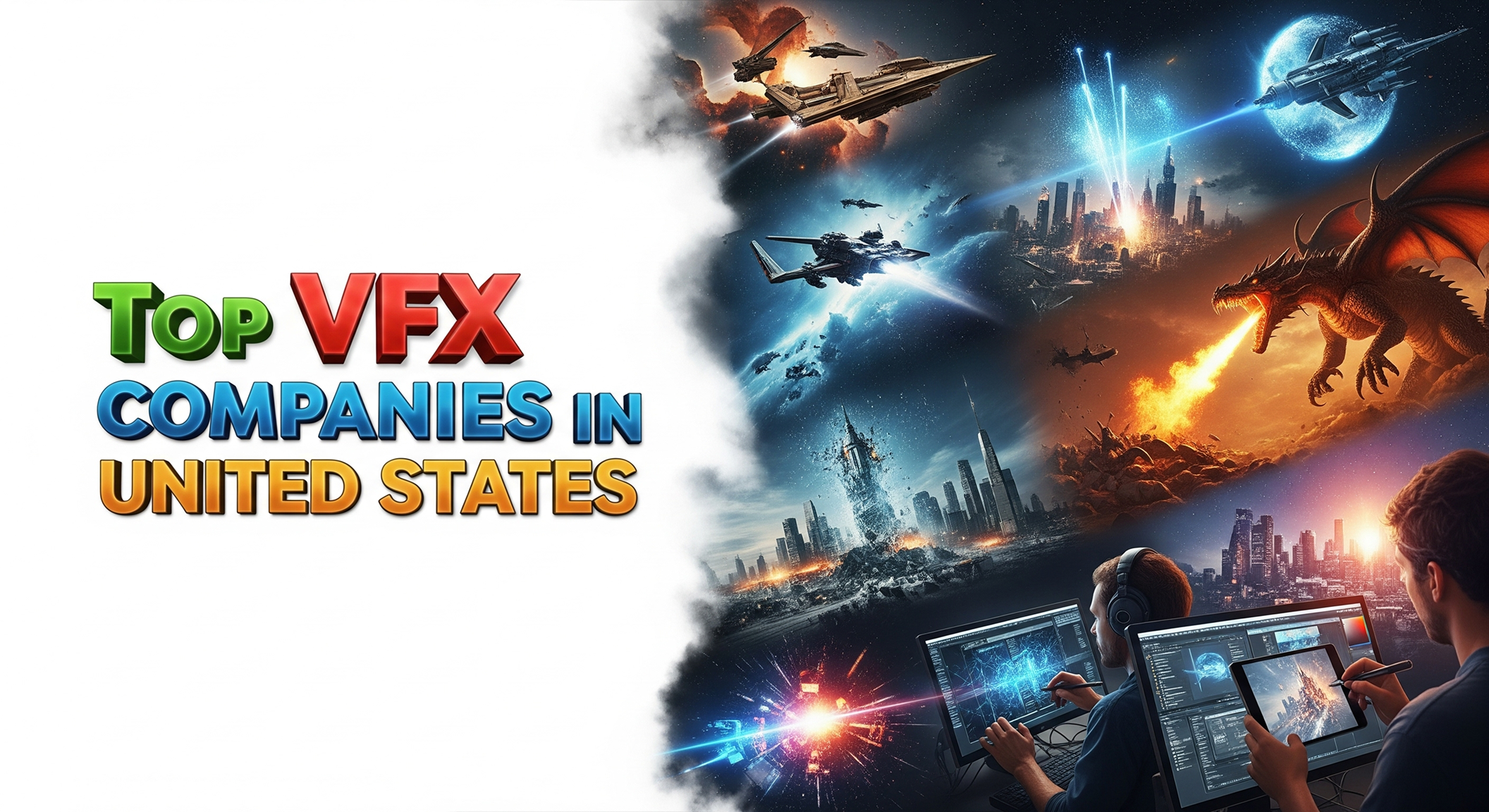
Here’s something most producers don’t want to hear: you’re probably overpaying for VFX companies in the United States—and you don’t even know it. The fragmentation paradox is real. A typical producer knows 5 to 10 VFX vendors. The U.S. market alone has thousands more. And that blind spot costs you, project after project, in inflated budgets and missed creative options.
But the landscape is shifting fast. As Industrial Light & Magic (ILM) and other legacy giants adapt to AI-driven pipelines, a new generation of boutique American studios is delivering Marvel-caliber work at a fraction of the cost. The question isn’t whether great U.S. VFX talent exists. It’s whether you’re finding it—or defaulting to whoever your last production used.
This guide cuts through the noise. You’ll get a clear-eyed look at the top VFX companies operating in the United States right now—from the Hollywood heavyweights to the under-the-radar specialists delivering results for Netflix, Warner Bros, and Paramount. We’ll also show you exactly how to de-risk your vendor selection process so you stop leaving money on the table.
💡 Vitrina Analyst Note
Our analysts note that the U.S. VFX market is deeply fragmented, with producers typically accessing fewer than 0.1% of available vendors. From what we track on Vitrina, the tax incentive differential alone, New York at 30%, Georgia at up to 30%, New Mexico at up to 35%, routinely shifts the sourcing decision before a single creative conversation happens. Most producers discover this math too late.
Table of Contents
Ask VIQI: Which U.S. VFX Studios Are Verified for Your Budget and Genre?
Join 140,000+ companies using Vitrina to track the global entertainment supply chain. Netflix, Warner Bros, and Paramount trust Vitrina intelligence.
✔ 200 free credits | ✔ No credit card required | ✔ Instant access
The U.S. VFX Fragmentation Problem Nobody Talks About
Let’s be direct: the U.S. visual effects industry is one of the most fragmented markets in global entertainment. You’ve got household names—ILM, Weta FX (which now operates major U.S. offices), Framestore—and then thousands of boutique studios you’ve never heard of. That asymmetry is costing producers real money.
According to Vitrina’s proprietary data, a typical producer is aware of fewer than 0.1% of available VFX vendors. In practice, that means you’re negotiating with 5 familiar names while the broader U.S. market has more than 10,000 active VFX companies. The result? You pay the Weta premium when a verified boutique shop could deliver the same quality for 30–40% less.
And the cost isn’t just financial. It’s temporal. Manual vendor research—calling contacts, requesting capability decks, chasing references—takes 3 to 6 months from need to signed deal. That’s talent holds expiring. Greenlight windows closing. Seasonal production slots disappearing.
The Fragmentation Paradox works like this: the more companies exist, the harder it is to find the right one—and the more you default to expensive familiarity over verified quality. That’s the core challenge any serious producer must solve before they even start calling studios.
Top VFX Companies in the United States: The Strategic Shortlist
Not every studio belongs on your shortlist. What you actually need is a verified map of who does what, at what budget tier, in what genre. Here’s the honest breakdown of the U.S. VFX landscape—divided by capability, not by prestige alone.
Tier 1: Legacy Giants (Blockbuster-Scale VFX)
Industrial Light & Magic (ILM) — San Francisco, CA. Founded by George Lucas in 1975, ILM has won over 35 Academy Awards for Visual Effects. Their credits include every major Marvel film, the Star Wars franchise, and Avatar. Their StageCraft LED volume technology is now the gold standard for virtual production. But they’re not the right fit for every project—ILM’s minimum engagement threshold typically starts at high-budget studio features.
Weta FX — With U.S. operations scaling significantly post-acquisition by Unity, Weta brings unparalleled creature and digital double capabilities. Their work on Avatar: The Way of Water—which achieved $2.3 billion at the global box office—remains the benchmark for photorealistic digital performance. But again: premium capabilities carry premium pricing.
Framestore — U.S. offices in New York and Los Angeles. British-founded but deeply embedded in the American market, Framestore has delivered VFX for Gravity, Guardians of the Galaxy, and numerous Netflix originals. Their advertising VFX division is among the most profitable in the industry.
Tier 2: Mid-Market Specialists (Studio Films & Premium Streaming)
DNEG — With offices in Los Angeles, DNEG has won 5 Academy Awards for Visual Effects and is one of the fastest-scaling VFX organizations globally. Their credits include Tenet, Dune, and numerous Apple TV+ originals. For mid-to-large budget streaming content, DNEG hits a strategic sweet spot on quality-to-cost ratio. You can read more in our deep-dive on DNEG’s capabilities and pipeline.
Prime Focus VFX — Los Angeles, CA. The VFX arm of Prime Focus World has delivered work for major studio releases across the U.S. and internationally. Their CLEAR technology—a cloud-based media services platform—sets them apart for productions requiring remote collaboration pipelines.
MARZ (Monsters, Aliens, Robots, Zombies) — U.S. operations expanding. Co-founded by Matt Panousis, MARZ pivoted from a traditional VFX house into an AI-powered studio combining automated dubbing with visual effects. Their approach to de-aging and digital doubles using AI has attracted significant streaming platform interest. As Joseph Bell—a VFX industry veteran who spent years at ILM—notes, the convergence of AI and VFX execution is no longer a future trend. It’s today’s production reality.
Joseph Bell, a seasoned VFX expert with over two decades in the industry, shares his perspective on current trends and where U.S. studios are heading:
Joseph Bell (VFX Industry Veteran, former Industrial Light & Magic) discusses AI, VFX trends, and the evolving industry landscape:
Tier 3: Boutique Studios (Episodic, Independent, & Genre Work)
This is where the real opportunity lies—and where most producers are blind. U.S.-based boutique VFX studios are delivering sequence-level work for prestige TV, independent features, and genre content at 30–50% below Tier 1 pricing. The challenge has always been finding them, verifying their credits, and confirming capacity before your production timeline closes.
Studios like Zoic Studios (Los Angeles), known for episodic television work including The Flash and Firefly, and Perception (New York), whose motion graphic and UI VFX appear in films from Iron Man to Black Panther, sit in this category—verified, capable, and consistently booked by savvy producers who’ve done their research.
Find Verified U.S. VFX Companies Before Your Competitors Do
Trusted by Netflix, Warner Bros, and Paramount. Join 140,000+ companies tracking the global entertainment supply chain on Vitrina.
✔ 200 free credits | ✔ No credit card required | ✔ Full platform access
Hollywood & Los Angeles VFX Hubs: Where the Big Work Gets Done
Los Angeles remains the gravitational center of U.S. VFX production. The concentration of studio infrastructure, qualified crew, and client proximity creates an ecosystem that’s genuinely hard to replicate—even as Sovereign Content Hubs in Saudi Arabia and South Korea try. But don’t confuse concentration with superiority. Hollywood’s dominance is real; so is its pricing premium.
According to Variety, streaming platforms committed over $30 billion to content production in 2024, and the lion’s share of high-end VFX work tied to those commissions flows through Los Angeles-based vendors or their U.S.-based offices. That’s the economic engine driving the L.A. VFX market—and it’s not slowing down.
The city’s VFX cluster includes facilities in Burbank, Santa Monica, Culver City, and Hollywood itself. You’ll find everything from LED volume stages operated by major studios to specialized compositing boutiques in converted warehouse spaces in Silver Lake. The geographic density means you can—in theory—physically meet with three vendors in a single afternoon. In practice, most producers still do it by Zoom. Which raises the obvious question: why limit yourself to L.A. geography at all?
Our full breakdown of VFX studios in Los Angeles covers the verified market comprehensively—including studios you won’t find through the usual referral networks.
New York VFX Studios: The Overlooked Alternative to L.A.
New York doesn’t get enough credit in the VFX conversation. But it should. The city hosts a dense network of studios specializing in advertising VFX, episodic television, documentary, and increasingly—streaming originals. And because New York’s cost structure differs from Los Angeles, you can often negotiate sharper rates on episodic work without sacrificing quality.
The Mill, with significant New York presence, has delivered VFX and motion design work for some of the most recognized brands and broadcast productions in the world. Ghost VFX maintains New York operations. And the city’s post-production infrastructure—built around advertising, news production, and entertainment—creates a talent pool that’s genuinely deep.
What’s particularly interesting about New York is its specialization in invisible effects. The city’s VFX studios excel at the kind of work that doesn’t make the reel—wire removal, environment extensions, period-accurate digital set dressing. That’s exactly what prestige drama and documentary productions need. And it’s exactly what gets undervalued when buyers default to L.A. vendor relationships. For more context, explore our overview of top New York VFX studios and their projects.
As reported by Deadline, New York’s production tax credit—worth up to 30% on qualified VFX expenditures—is one of the most competitive in the United States, making the economic case for sourcing New York VFX talent increasingly compelling for cost-conscious producers.

Your AI Assistant, Agent, and Analyst for the Business of Entertainment
VIQI AI helps you plan content acquisitions, raise production financing, and find and connect with the right partners worldwide.
- Find active co-producers and financiers for scripted projects
- Find equity and gap financing companies in North America
- Find top film financiers in Europe
- Find production houses that can co-produce or finance unscripted series
- I am looking for production partners for a YA drama set in Brazil
- I am looking for producers with proven track record in mid-budget features
- I am looking for Turkish distributors with successful international sales
- I am looking for OTT platforms actively acquiring finished series for the LATAM region
- I am seeking localization companies offer subtitling services in multiple Asian languages
- I am seeking partners in animation production for children's content
- I am seeking USA based post-production companies with sound facilities
- I am seeking VFX partners to composite background images and AI generated content
- Show me recent drama projects available for pre-buy
- Show me Japanese Anime Distributors
- Show me true-crime buyers from Asia
- Show me documentary pre-buyers
- List the top commissioners at the BBC
- List the post-production and VFX decision-makers at Netflix
- List the development leaders at Sony Pictures
- List the scripted programming heads at HBO
- Who is backing animation projects in Europe right now
- Who is Netflix’s top production partners for Sports Docs
- Who is Commissioning factual content in the NORDICS
- Who is acquiring unscripted formats for the North American market
AI and the Future of U.S. VFX: Acceleration, Not Replacement
Artificial intelligence isn’t replacing U.S. VFX artists. But it’s radically changing what they can deliver—and how fast. Studios that weaponize AI correctly are compressing 12-week pipeline timelines to 6 weeks. That’s the competitive edge that separates studios worth your attention from those still running legacy workflows.
Here’s what you actually need to know about AI in U.S. VFX right now. Tools like Runway ML, Adobe Firefly integrations, and proprietary AI compositing systems are being deployed in serious production contexts—not just demos. MARZ’s AI de-aging pipeline reduced per-shot costs by a reported 60% on specific sequences while maintaining broadcast quality. That’s not a prototype. That’s a competitive differentiator being sold to streaming platforms today.
But there’s a critical distinction between authorized AI and unvetted tools—and for any project going to a major distributor, that distinction matters for your completion bond and your delivery acceptance. Authorized AI frameworks with clean chain-of-title on training data are quickly becoming a contract requirement, not an optional technical preference. Smart producers are already asking vendors about their AI stack before finalizing deals.
The studios that are winning in 2026 aren’t the ones resisting AI. They’re the ones who’ve integrated it deliberately—building pipelines where human artistry accelerates on top of machine-generated foundations. And from a buyer’s perspective, that means your quality ceiling goes up while your budget pressure does too—unless you’ve verified which studios are actually there versus which ones are just pitching AI as a buzzword.
Need Direct Introductions to Verified U.S. VFX Studios?
Vitrina Concierge is your Virtual Agent. We don’t give you a list—we make warm introductions directly to VFX decision-makers actively seeking your type of project.
- L.A. producer → Netflix UK, Fifth Season, Fox Entertainment (48 hours)
- Documentary team → Verified episodic VFX studio match (week one)
- Studio project → Direct access to credentialed VFX supervisors
How to Choose the Right U.S. VFX Partner: A Buyer’s Framework
Stop thinking about VFX vendor selection as a creative decision. It’s a financial and operational decision that happens to produce creative outputs. Here’s how the smartest producers frame it.
Step one: Define the shot complexity before you brief anyone. Clean-up and invisible effects have a completely different vendor market than photoreal creature work or environment builds. Conflating them in your RFP wastes time and generates misaligned bids. Be specific—sequence by sequence if possible.
Step two: Verify capacity, not just capability. A studio’s demo reel tells you what they can do at their best. It tells you nothing about their current pipeline load, their delivery track record, or whether their key artists will still be on staff when your deadline hits. Ask for references from productions delivered in the last 12 months. Not 3 years ago. The last year.
Step three: Run the cost against tax incentive stacking. New York, Georgia, and New Mexico all offer meaningful VFX-eligible tax credits. A studio in Albuquerque delivering the same quality as an L.A. boutique at a 25% credit difference could be the decision that keeps your production EBITDA-positive. Your VFX supervisor shouldn’t make this call alone—your line producer and a tax credit consultant should be in that conversation.
Step four: Benchmark against the market. You can’t negotiate smartly without knowing what the market actually charges. That’s the data deficit the Fragmentation Paradox creates. But producers using real-time intelligence platforms—tracking 400,000+ active projects and their vendor relationships—can benchmark any bid against verifiable market rates before the negotiation even starts. That’s the insider advantage that accelerates recoupment and protects margin.
The Smart Pairing approach—matching projects to vendors based on verified capability, capacity, and budget tier, not just relationship networks—is how studios like Netflix and Warner Bros maintain consistent quality across hundreds of concurrent productions. You can apply the same rigor at any budget level. But only if you have the data.
Frequently Asked Questions
What are the top VFX companies in the United States?
The leading U.S. VFX companies include Industrial Light & Magic (ILM) in San Francisco, DNEG with Los Angeles operations, Framestore (New York and Los Angeles), Weta FX (with expanding U.S. operations), and Prime Focus VFX. Beyond these names, thousands of mid-tier and boutique studios operate across California, New York, Georgia, and New Mexico—many delivering comparable quality at significantly lower price points.
How much do VFX companies in the United States typically charge?
U.S. VFX pricing varies dramatically by studio tier, shot complexity, and region. Tier 1 studios like ILM typically start at $5–10 million minimum for major feature engagements. Mid-market studios handle streaming and studio films in the $500,000–$5 million range per project. Boutique episodic studios can deliver quality work from $50,000 per episode upward, depending on shot count and complexity. Tax incentives in states like New York (30%) and New Mexico (25%) can substantially reduce effective costs.
Which U.S. cities have the strongest VFX industry concentration?
Los Angeles remains the dominant hub, concentrating the majority of major studio VFX facilities and talent. New York City is second, with particular strength in episodic television, advertising VFX, and documentary production. Atlanta has grown significantly on the back of Georgia’s 30% tax incentive program. Albuquerque, New Mexico is emerging as a cost-competitive alternative, and San Francisco remains ILM’s home base.
How is AI changing VFX production in the United States?
AI is compressing timelines and reducing per-shot costs significantly for specific VFX categories. Studios like MARZ report 60% cost reductions on de-aging and digital double work through AI-assisted pipelines. Real-time rendering, AI-driven rotoscoping, and generative environment tools are now in active production use—not just R&D. For buyers, the key question is whether a studio uses authorized AI with verifiable chain-of-title on training data, which increasingly matters for completion bond acceptance and distributor delivery standards.
What tax incentives exist for VFX production in the United States?
Multiple U.S. states offer production tax incentives that include VFX expenditures. New York provides up to 30% on eligible post-production and VFX costs. Georgia offers a 20–30% transferable tax credit. New Mexico provides a 25–35% rebate. California offers a 20–25% tax credit through the California Film Commission. These incentives can dramatically change the cost calculus—a decision to shoot and post in New Mexico versus L.A. can save hundreds of thousands of dollars on a mid-budget production.
How do I verify a U.S. VFX studio’s capability before signing a deal?
Request references from productions completed in the last 12 months—not 3 years ago. Ask specifically about delivery timelines: did they hit every milestone, or did they slip? Get clarity on who will actually be supervising your work—demo reels often showcase work done by artists who’ve since left. Verify financial stability (VFX studio closures are not uncommon in financial pressure periods). And if you’re using a platform like Vitrina, you can cross-reference a studio’s recent project history against 400,000+ tracked projects to validate their credits independently.
Which VFX companies in the United States work with Netflix and major streamers?
Netflix’s approved U.S. VFX vendor roster includes DNEG, Framestore, ILM, Weta FX, and a rotating slate of approved boutique studios. Warner Bros works with ILM, Framestore, and Weta for tentpole releases. Apple TV+ has developed close relationships with DNEG. The common thread across all major platform relationships: verified delivery track record, robust technical pipeline documentation, and capability to operate within platform-specific technical specifications (color science, codec requirements, deliverable formats).
What should I include in a VFX brief for a U.S. studio?
An effective VFX brief should include: total shot count by category (cleanup, environment, creature, digital doubles, etc.), example references for each VFX category, delivery format requirements from your distributor or platform, post schedule with key milestones, editorial cut access or locked picture expectations, budget range and payment milestone structure, and any platform-specific technical specifications. The clearer your brief, the more accurate your bids—vague briefs produce bloated estimates and scope creep.
Conclusion: The Right U.S. VFX Partner is Out There—If You Know How to Find Them
The United States has the deepest VFX talent pool in the world. From ILM’s iconic facilities in San Francisco to the episodic boutiques of Atlanta and Albuquerque, the capability exists to execute virtually any visual effects requirement at any budget tier. But that capability is fragmented across thousands of companies—and most producers are accessing less than 1% of the market when they make vendor decisions.
Key Takeaways:
- Fragmentation is your budget risk: Producers who rely on relationship networks access fewer than 0.1% of the U.S. VFX market, paying premiums of 30–40% over verifiable market rates.
- Tier matters more than name recognition: ILM and Weta are exceptional for blockbuster work. For streaming episodics and mid-budget features, boutique studios often deliver comparable results at dramatically lower cost.
- Tax incentive stacking changes the math: New York (30%), Georgia (20–30%), and New Mexico (25–35%) credits can shift the cost calculus significantly—especially for episodic VFX budgets over $1 million.
- AI is production-ready, not R&D: Studios using authorized AI pipelines are delivering 60% cost reductions on specific shot categories—and major distributors are now asking about AI chain-of-title as a delivery condition.
- Verification beats reputation alone: Ask for 12-month delivery references, confirm current pipeline capacity, and benchmark bids against market data—not just your last project’s rates.
The producers closing deals efficiently in 2026 aren’t the ones with the longest Rolodex. They’re the ones with real-time intelligence on who’s delivering what, for whom, at what cost. That’s the insider advantage. And it’s available to you right now.
Track U.S. VFX Studios, Projects, and Deal Flow in Real Time
Trusted by Netflix, Warner Bros, Paramount, and Google TV. Track 400,000+ projects. Access 3 million verified executives. Ask VIQI strategic questions about your market.
✔ 200 free credits | ✔ No credit card required | ✔ Cancel anytime
Need direct introductions to verified VFX studios? Explore Concierge Service →