

 Global Content Pulse (Webinars)


 Global Production Financing
(Webinars)
Global Production Financing
(Webinars)  LeaderSpeak Podcast
  About Vitrina
 Our Story
 Our Solutions 🔥
 Film+TV Projects Tracker 🚀
 Case Studies
 Our Profile

The Future of Music: How AI is Revolutionizing Composition is no longer a speculative scenario; it is the current operational reality reshaping how studios, streamers, and indie producers allocate their sound budgets. While the industry has long relied on the “Golden Ear” of a human composer, the fragmentation of global content demand has created an unsustainable production bottleneck. The reality? Demand for high-quality, genre-specific audio now outpaces human output, leaving executives trapped between the high costs of premium scores and the generic sterility of traditional stock libraries. But here is the catch: the transition to AI-driven composition is not just about speed; it is about “Authorized Data” and the strategic reallocation of IP value in a post-streaming landscape.
This analysis provides a comprehensive roadmap for navigating the “Intelligence Layer” of modern audio production. We will surface the critical shifts in “Authorized Generative AI,” de-risk the “Timing Trap” inherent in global sound design, and explore how “Weaponized Distribution” is moving from video to high-value audio catalogs. By the end of this report, executives will understand how to weaponize Vitrina’s data to identify the top 10 regional leaders currently reshaping the global music supply chain and how to ensure their projects bypass the localized hurdles of talent gaps and audit traps.
⚡ Executive Summary
|
Contents
- The Future of Music: How AI is Revolutionizing Composition and Audio Workflows
- Authorized Generative AI and the Music Rights Paradigm
- The Timing Trap in Music Production and Sound Design
- Weaponized Audio: Licensing and Global Distribution
- Regional Friction: The Global Talent Gap in AI Composition
- The Future of Music: How AI is Revolutionizing Composition in Post-Production
- Top 10 Leaders in AI Audio & Music Composition (2024-2025)
- Strategic Conclusion
🎙️ Expert Intelligence: Tony Abrahams
“AI-Media’s Lexi Voice product is transforming live translation… unlocking multilingual access to real-time content at scale, speed, and just $30 an hour.”
Source: Vitrina Expert Series. Tony Abrahams, CEO of AI-Media, highlights the radical cost-efficiency and scaling potential of AI in the broadcast supply chain, a direct parallel to the efficiency shifts occurring in the music composition sector.
The Future of Music: How AI is Revolutionizing Composition and Audio Workflows
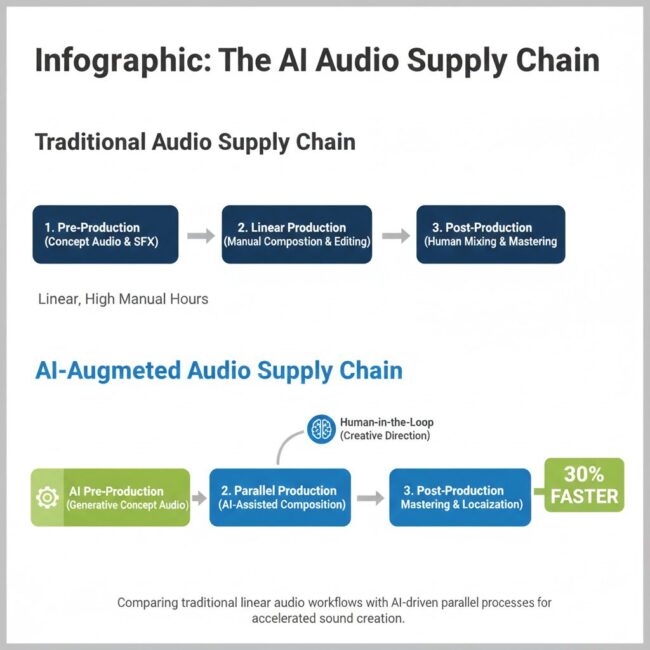
The global music supply chain is currently witnessing a structural metamorphosis. For decades, music composition was a manual, linear process where the score was often the final layer added to a project. The reality? This “Siloed Approach” is fundamentally broken in an era of simultaneous global releases and localized content slates. The Future of Music: How AI is Revolutionizing Composition shifts the focus from purely human creativity to an “Augmented Creative” model where AI-Media and similar pioneers have already proven the ROI of AI-driven audio synchronization.
But here is the catch: speed is nothing without sentiment. Modern AI models are no longer just generating “elevator music”; they are being trained on emotional scene analysis. According to data from $$Vionlabs$$, AI can now map the emotional arc of a film and suggest harmonic shifts that resonate with specific demographics. This allows studios to de-risk their soundtracks by ensuring the audio “hooks” match the visual tension. The bottom line: AI is not replacing the composer; it is weaponizing them by automating the 80% of mundane tasks—like stems and atmospheric layering—allowing the human talent to focus on the 20% that creates iconic “Hero Projects.”
Let’s be candid: the financial dynamics of the industry demand this shift. With content spending reaching record highs, yet margins eroding under the weight of marketing and distribution, every dollar in the supply chain must be justified. By integrating AI at the pre-production stage, companies can surface audio concepts earlier, reducing the need for expensive late-stage revisions. This is the transition from “Art as a Service” to “Art as a Strategic Data Asset.”
Identify the active players in the global AI audio supply chain to de-risk your next production:
Find me active post-production or VFX companies in USA specializing in AI Audio
Authorized Generative AI and the Music Rights Paradigm
The “Fragmentation Paradox” of the music industry is most visible in the realm of rights and licensing. While platforms like Suno and Udio have demonstrated the creative power of AI, they have also triggered a wave of litigation over “Unauthorized Scraping.” The bottom line? The future belongs to “Authorized Generative AI”—markets where IP is licensed at the source for training. We are seeing a parallel to the Disney-OpenAI $1B deal, where music catalogs are being treated as “Training Fuel” for proprietary studio models.
The reality? Major labels and publishers are no longer just selling tracks; they are licensing their “Audio DNA.” This shift is reshaping financial dynamics by creating a new revenue stream: “Model Licensing Fees.” Companies like $$Warner Music Group$$ and $$Sony Music$$ are signaling a move toward “Artist-Centric AI Principles,” ensuring that when AI is revolutionizing composition, the original creators are credited and compensated. This de-risks the entire supply chain by providing a “Single Source of Truth” for audio ownership, preventing the audit traps that often plague global co-productions.
But here is the catch: small indies and regional players often lack the legal firepower to navigate these new markets. This is where Vitrina’s “Deals Intelligence” becomes a strategic advantage. By tracking who is signing authorized data deals now, producers can align their projects with “Safe” AI partners, ensuring that their soundtracks are globally compliant and ready for licensing. The shift is clear: from unauthorized chaos to a structured, data-driven “Authorized Data” market.
The Timing Trap in Music Production and Sound Design
The “Timing Trap” is perhaps the most dangerous obstacle in the modern production cycle. Traditionally, music and sound design are back-loaded in the post-production phase. The reality? If you wait until the edit is locked to start your sound strategy, you have already lost. The Future of Music: How AI is Revolutionizing Composition allows for “Parallel Production,” where audio assets are generated in real-time alongside visual effects and principal photography.
Let’s be candid: when sound design is an afterthought, it leads to “Panic Mastering” and inflated costs. By using AI to generate temporary “Working Scores” that are dynamically linked to the edit, directors can realize the emotional weight of a scene instantly. This reshapes the workflow by allowing for faster iterations and reducing the “VFX-Sound Friction” that occurs when visual timing doesn’t match the audio rhythm. According to $$MovieLabs 2030 Vision$$, cloud-native audio workflows will soon allow for real-time global collaboration on a single master file.
But here is the strategic ROI: AI-driven “Version Control” ensures that as a project moves from a 2-hour feature to a 30-second social clip, the music scales automatically. No more expensive re-edits or disjointed loops. This is “Weaponized Distribution” in action—creating a modular audio system that adapts to every window and territory simultaneously. By bypassing the timing trap, you unlock the efficiency needed to compete in a borderless market.
Track upcoming slates and align your music production with active industry cycles:
Monitor upcoming competitive slates and licensing activities for Universal Pictures
Weaponized Audio: Licensing and Global Distribution
We are entering the era of “Weaponized Audio.” Just as “Weaponized Distribution” involves licensing video content to rivals to maximize ARPU, the music industry is now using AI to repurpose catalogs for every possible niche. The reality? A single “Hero Track” can now be decomposed into hundreds of AI-driven variants—from lo-fi study beats to high-energy trailer cuts—without manual intervention. This allows rights holders to reallocate their “Sunk Assets” into high-growth segments like gaming, TikTok, and localized ad markets.
But here is the catch: the data deficit in audio licensing is immense. Knowing who has the rights to which stem in which territory is a nightmare. Vitrina’s “Intelligence Layer” solves this by mapping the 30M industry relationships that define who owns the “Audio IP.” By surfacing these connections, executives can unlock new revenue streams that were previously hidden behind manual contracts and siloed databases. This is the transition from a “Library Model” to a “Dynamic Catalog Model.”
Financial dynamics are shifting toward “Programmatic Licensing,” where AI platforms like $$Mubert$$ or $$Soundraw$$ provide royalty-free, customized audio at scale. For studios, this means they can weaponize their background audio to generate revenue even after the primary release window has closed. The bottom line: if your audio isn’t working as hard as your video, you are leaving money on the table. AI is the engine that transforms music from a cost center into a perpetual revenue generator.
Regional Friction: The Global Talent Gap in AI Composition
While the tech is global, the talent is localized. “Regional Friction” remains a major hurdle as different markets adopt AI at varying speeds. The reality? A production hub in South Korea might be at the forefront of AI-driven animation audio, while a traditional European hub might be facing union-driven pushback against “Synthetic Scores.” This creates “Audit Traps” for producers who assume a “One-Size-Fits-All” approach to global audio production.
Let’s be candid: the talent gap is not just about composers; it is about “Prompt Engineers” and “AI Sound Technicians” who understand how to guide the machine. In regions like India, companies like $$PhantomFX$$ are already signaling a shift toward AI-enhanced workflows, leveraging localized talent to scale global projects. But here is the catch: without verified leadership mapping, finding these specialized vendors is nearly impossible. Producers often default to “Safe” Hollywood options, missing out on the 30% cost savings available in emerging AI hubs.
Bypassing these localized hurdles requires deep market intelligence. You need to know which regional companies have actually delivered “Hero Projects” using AI audio. Vitrina tracks the project credits and regional specialties that surface these “Insider Advantages.” By identifying the right partners in the right regions, you can reallocate your budget from expensive “Legacy Overheads” to high-efficiency “AI Specialists.”
The Future of Music: How AI is Revolutionizing Composition in Post-Production
The integration of AI into post-production audio is where the “Rubber Meets the Road.” We are seeing a move toward “Authorized Data” driven dubbing and localization, as demonstrated by companies like $$Deepdub$$ and $$Papercup$$. The Future of Music: How AI is Revolutionizing Composition in this context means “Synchronized Sight and Sound,” where AI lip-syncing and emotional dubbing create a seamless experience for global audiences.
But here is the catch: traditional post-production is a manual slog. AI-driven “Stem Separation” and “Automated Mastering” are reshaping the efficiency of the supply chain. According to $$Morgan Stanley Research$$, AI can reduce post-production costs by up to 30% in TV and film. This is not just theoretical; it is a strategic shift that allows indies to produce “Studio Quality” audio on a “Shoestring Budget.” The “Fragmentation Paradox” is solved by having a unified AI-driven layer that handles the technical complexities of sound mixing and localization.
The bottom line: if you are still paying for manual audio stems in 2025, you are overpaying. The future is an “Efficiency-First” model where AI handles the technical execution, and human creatives focus on “Strategic Storytelling.” By weaponizing Vitrina’s tracker to find companies already using these tools, you can ensure your project is at the cutting edge of the global entertainment supply chain.
Top 10 Leaders in AI Audio & Music Composition (2024-2025)
The Future of Music: How AI is Revolutionizing Composition: Conclusion
The “Data Deficit” in the music industry is rapidly closing as the “Intelligence Layer” of AI-driven composition takes center stage. We have seen how “Authorized Generative AI” is replacing the chaotic scraping of the past with a structured “Authorized Data” market that de-risks production for global studios. The shift from manual post-production to parallel, AI-augmented workflows is not just a technological choice; it is a financial necessity to survive in a borderless, “Efficiency-First” market. By weaponizing audio catalogs and bypassing the “Timing Trap,” companies can unlock revenue streams that were previously hidden behind manual silos.
The Bottom Line: The fragmentation of the global entertainment supply chain can only be overcome by integrating AI at every level of the audio workflow. Executives must leverage Vitrina’s intelligence to identify regional leaders, vet their “Hero Project” credentials, and ensure their audio IP is compliant with the emerging standards of “Authorized AI.” To stay ahead, start by mapping your active post-production hubs and surfacing the specialized vendors already disrupting the status quo.
Explore Live Intelligence
Identify co-pro partners in Japan currently commissioning scripted formats
Show me trending international content in the Sci-Fi for discovery
Find me active post-production or VFX companies in India specializing in CGI
Monitor upcoming competitive slates and licensing activities for Netflix
Identify co-pro partners in South Korea currently commissioning scripted formats
Strategic FAQ
What is the primary risk of using AI in music composition today?
The primary risk is the “Rights Vacuum” created by unauthorized data training. Studios must transition to “Authorized Generative AI” models where IP is licensed at the source to prevent future copyright litigation and ensure global licensing compliance.
How does AI composition solve the “Timing Trap” in post-production?
AI enables “Parallel Production,” allowing for the generation of temporary working scores and soundscapes in real-time during principal photography. This reduces late-stage revision costs and allows the edit to be guided by the emotional rhythm of the audio.
What is “Weaponized Audio” and how can rights holders benefit?
“Weaponized Audio” is the strategic repurposing of high-value music catalogs using AI to create modular, territory-specific variants. This allows rights holders to monetize their “Sunk Assets” in high-growth segments like gaming, TikTok, and localized ad markets without manual re-editing.
How can Vitrina help identify the right AI audio partners?
Vitrina tracks over 1.6M titles and 140k+ companies to surface “Verified Leadership Mapping” and “Hero Project” credits. This allows users to qualify partners based on their actual track record of delivering AI-enhanced audio in specific regions and genres.