About Innovation Hub
 Global Content Pulse (Webinars)


 Global Production Financing
(Webinars)
Global Production Financing
(Webinars)  LeaderSpeak Podcast
  Global Entertainment Digest (Newsletter)
  About Vitrina
 About VIQI
 Our Story
 Our Solutions 🔥
 Film+TV Projects Tracker 🚀
 Case Studies
 Our Profile

Smart tagging metadata is the automated process of using Artificial Intelligence (AI) to identify, categorize, and enrich video assets with granular, time-coded information.
This involves leveraging Computer Vision and Natural Language Processing (NLP) to extract objects, faces, emotions, and themes directly from raw content frames.
According to industry reports, AI-enhanced metadata can improve content discovery efficiency by up to 70%, reducing the manual labor associated with traditional archive management.
In this guide, you’ll learn how leaders like Prime Focus Technologies (PFT) are automating the entertainment supply chain through their CLEAR platform and how smart tagging drives ROI for global streamers.
While legacy systems rely on shallow, manually entered keywords, the modern entertainment landscape demands deep, interconnected intelligence to navigate a borderless content market.
This analysis addresses critical gaps in metadata application, providing a roadmap for technical service providers to optimize content libraries for the “Weaponized Distribution” era.

Your AI Assistant, Agent, and Analyst for the Business of Entertainment
VIQI AI helps you plan content acquisitions, raise production financing, and find and connect with the right partners worldwide.
- Find active co-producers and financiers for scripted projects
- Find equity and gap financing companies in North America
- Find top film financiers in Europe
- Find production houses that can co-produce or finance unscripted series
- I am looking for production partners for a YA drama set in Brazil
- I am looking for producers with proven track record in mid-budget features
- I am looking for Turkish distributors with successful international sales
- I am looking for OTT platforms actively acquiring finished series for the LATAM region
- I am seeking localization companies offer subtitling services in multiple Asian languages
- I am seeking partners in animation production for children's content
- I am seeking USA based post-production companies with sound facilities
- I am seeking VFX partners to composite background images and AI generated content
- Show me recent drama projects available for pre-buy
- Show me Japanese Anime Distributors
- Show me true-crime buyers from Asia
- Show me documentary pre-buyers
- List the top commissioners at the BBC
- List the post-production and VFX decision-makers at Netflix
- List the development leaders at Sony Pictures
- List the scripted programming heads at HBO
- Who is backing animation projects in Europe right now
- Who is Netflix’s top production partners for Sports Docs
- Who is Commissioning factual content in the NORDICS
- Who is acquiring unscripted formats for the North American market
Table of Contents
Key Takeaways for Tech & Post Teams
-
Automation is Mandatory: Manual metadata entry is structurally incapable of handling the 1.6M titles currently tracked in global supply chains.
-
Deep Content Search: AI allows buyers to search archives by specific emotional cues or aesthetic visuals, unlocking “lost” revenue in back catalogs.
-
Platform Interoperability: Solutions like PFT’s CLEAR provide an end-to-end framework that integrates directly into existing distribution workflows.
What is the Evolution of Content Metadata?
The entertainment industry has moved from “analog” intelligence—relying on personal networks and paper credits—to a data-powered framework. In this new era, metadata is no longer just a title and a genre; it is a complex map of relationships, financial deals, and creative specializations.
As the supply chain scales to over 600,000 companies globally, the “data deficit” becomes a financial risk. Without structured, verifiable intelligence, premium assets remain invisible to potential buyers, leading to what Vitrina AI identifies as a critical market market visibility gap.
Find metadata & post-production service providers:
How Does AI Smart Tagging Work in Content Libraries?
AI smart tagging utilizes vertical AI engines trained exclusively on entertainment datasets. Unlike generic AI, these systems understand industry context, mapping elements like “character development arcs” or “territory-specific cultural nuances.”
The process generates “video embeddings,” which are mathematical representations of content. This allows for aesthetic visual searches—finding scenes based on mood, lighting, or specific props—rather than just keyword matching.
Industry Expert Perspective: Prime Focus Technologies’ Exemplary AI-Enhanced Entertainment Supply Chain
This session features Ramki Sankaranarayanan, CEO of Prime Focus Technologies, explaining how their CLEAR platform is automating the metadata pipeline for global content owners.
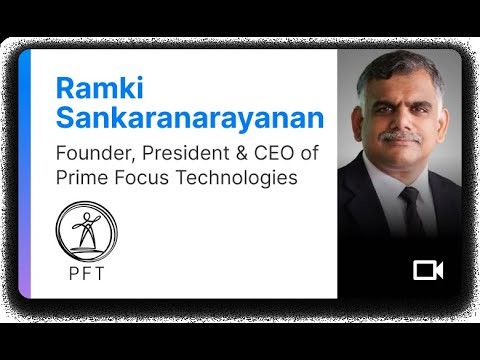
Ramki and his team are revolutionizing the entertainment supply chain with cutting-edge AI and automation. From end-to-end solutions to the transformative power of the Clear platform, the session explores the future of AI in content management.
Why is Prime Focus Technologies the Leader in Smart Tagging?
Prime Focus Technologies (PFT) has established itself as an industry benchmark through its CLEAR platform. By integrating AI-driven automation into the content lifecycle, PFT allows studios to manage assets at a scale that was previously impossible.
Their approach addresses the “Single Source of Truth” requirement. As noted in Vitrina’s market analysis, the lack of centralized data creates trust deficits in cross-border deals. PFT solves this by providing verifiable, real-time metadata across the global production pipeline.
ROI Case Study: Monetizing Archives with Smart Metadata
Consider the case of a major global broadcaster like SBT Brazil. By leveraging custom supply chain solutions to streamline content acquisition and library management, they curating a library of acclaimed films and series for viewers efficiently.
When libraries are “smart tagged,” discovery leads can find regional content 5x faster. This strategic shift transforms partner discovery from a manual, high-risk art into a data-driven science, as showcased by Vitrina AI’s work with Getty Images to enhance video supply-chain mapping.
“The industry is moving beyond the ‘Walled Garden’ era. Strategic intelligence platforms connect data points across the supply chain to provide actionable insights that drive ROI on every frame of content.”
Bridging Technical Gaps in Supply Chain Automation
The biggest challenge facing technical service providers is the “fragmentation paradox.” While production is globalized, data remains siloed in legacy spreadsheets. AI smart tagging bridges this gap by creating a unified data taxonomy.
By mapping over 140,000 companies and 30 million industry relationships, Vitrina AI provides the critical intelligence layer. For providers, this means identifying active productions in the development or post-production stage before they are even announced in trade publications.
Moving Forward
The transformation of metadata from a clerical task to a strategic asset is reshaping the entertainment supply chain. By adopting smart tagging, companies can address the data trust deficit and navigate the complexities of weaponized distribution.
Whether you are a post-production studio looking to upsell AI services, or an acquisition lead trying to source regional hits, data-driven intelligence is your competitive moat.
Outlook: Over the next 18 months, “Authorized Data” markets for generative AI training will drive a massive surge in demand for hyper-accurate, frame-level metadata.
Frequently Asked Questions
What is smart tagging in video metadata?
How does Prime Focus Technologies automate the supply chain?
Why is AI-enhanced metadata important for streamers?
What are video embeddings?
What is “Weaponized Distribution”?
How can Vitrina AI help technical service providers?
What is a vertical AI in entertainment?
What is the “data trust deficit”?
Find Film+TV Projects, Partners, and Deals – Fast.
VIQI matches you with the right financiers, producers, streamers, and buyers – globally.
Producers Seeking Financing, Co-Pros, or Pre-Buys?
Vitrina Concierge helps producers reach the right financiers, commissioners, distributors, and co-production partners — with precision outreach, not cold pitching.
Join Industry Briefings Trusted by Leaders
Format Adaptations: Global Trends
Where formats are traveling, which adaptations are breaking out, and how streamers are backing remakes in 2025–2026.

Books, Novels & Comics Adaptations: Global Trends
Books, webtoons, and manga driving the next global screen hits. Discover how in this webinar.

Micro-Dramas & Mobile-First Storytelling
Micro-dramas are building real audiences and revenue. Understand the platforms, buyers, and economics behind the growth.

Navigating Global Content Licensing Trends
How global content licensing is shifting beyond flat fees to flexible, deal-driven models.