About Innovation Hub
 Global Content Pulse (Webinars)


 Global Production Financing
(Webinars)
Global Production Financing
(Webinars)  LeaderSpeak Podcast
  Global Entertainment Digest (Newsletter)
  About Vitrina
 About VIQI
 Our Story
 Our Solutions 🔥
 Film+TV Projects Tracker 🚀
 Case Studies
 Our Profile
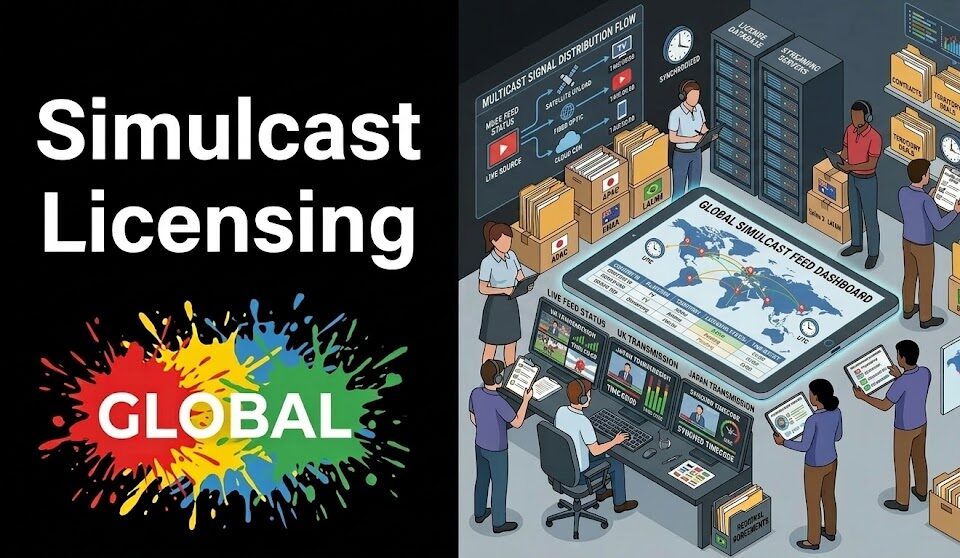
An episode of Demon Slayer airs in Japan at 11:15pm on a Sunday night. By 1:30am—still that same Sunday—it’s live on Crunchyroll in North America, subtitled in English. That two-hour turnaround isn’t an accident. It’s the end result of a simulcast anime licensing deal that was negotiated months before a single frame was animated, and a localization pipeline that runs on a near-impossible clock.
Most coverage of simulcasting focuses on what fans experience. This article focuses on what actually happens in the deal room—how simulcast anime licensing deals between Japan and the US get structured, who’s at the table, what the rights actually cost, and why some titles get real-time global access while others sit behind weeks-long delays.
In This Article
- What Simulcast Licensing Actually Means
- The Production Committee’s Role at the Start of Every Deal
- How a Japan-US Simulcast Agreement Gets Structured
- The Localization Sprint: Subtitling an Episode in Under 2 Hours
- What Simulcast Rights Cost Versus Delayed Deals
- Who Controls the Simulcast Market Right Now
- Why Some Titles Never Get Simulcast Treatment
- How Netflix Rewrote the Simulcast Playbook
- FAQ: Simulcast Anime Licensing Explained
Track Simulcast Deals Before They Close
Ask VIQI—Vitrina’s AI—which titles are actively seeking US simulcast partners this season, which rights windows are opening, and which distributors are bidding. Join 140,000+ companies already using Vitrina’s real-time intelligence to stay ahead of the anime acquisition market.
No credit card required
What Simulcast Licensing Actually Means
The term gets used loosely, so let’s be precise. A simulcast anime license grants a non-Japanese platform the right to stream each episode of a series simultaneously—or near-simultaneously—with its original Japanese broadcast. “Simultaneously” in practice means within a few hours. The episode airs in Japan, a pre-delivered video file is unlocked on the platform’s servers, and subtitles (generated in advance from a script provided by the licensor) go live for international viewers.
That’s different from a standard delayed license—where a platform acquires rights to a completed season after it’s finished airing in Japan. Delayed deals are cheaper. They’re also commercially inferior in a market where spoilers travel at social media speed. By the time a delayed title arrives in your territory, the conversation has already moved on.
Simulcast rights are therefore premium rights. They require earlier deal-making, tighter delivery logistics, and—critically—a relationship with the Japanese licensor that’s already established before production wraps. You don’t walk into a simulcast deal cold. The real dynamic here is that the best simulcast slots go to buyers who are already known quantities to the rights committee in Tokyo.
For context on how the broader rights architecture surrounding these deals works, our anime licensing and distribution guide covers the full contractual framework that simulcast deals sit inside.
The Production Committee’s Role at the Start of Every Deal
Every major anime series is controlled by a seisaku iinkai—a production committee—typically assembled before a single episode enters production. The committee might include the manga publisher (Shueisha, Kodansha, Kadokawa), the animation studio, a music label, a toy or merchandise company, and sometimes a broadcast network. Each stakeholder funds a slice of production in exchange for a slice of rights.
International streaming rights—including simulcast—are usually held collectively by the committee and sub-licensed through a single designated international sales agent. Aniplex (a Sony subsidiary) handles this for some of the biggest titles, including Demon Slayer and Sword Art Online. Bandai Namco Filmworks (formerly Sunrise) manages rights for the Gundam franchise. Toho‘s animation division controls titles from its own slate.
The committee model creates a structural challenge for international buyers. You can’t negotiate directly with the animation studio—ufotable, say, or MAPPA. The studio is a service vendor to the committee, not the rights holder. All conversations about simulcast access have to go through the designated licensor. And that licensor may be running simultaneous negotiations with Crunchyroll, Netflix, and Amazon for different territory packages at the same time.
But here’s what the trades don’t always report: the committee’s decision about who gets simulcast rights isn’t purely financial. Reputation matters. A platform with a demonstrated ability to deliver clean English subtitles on a 2-hour clock, maintain streaming stability during episode launches, and build an engaged subscriber base—that platform is a safer bet for a rights holder than an unknown buyer offering a slightly higher MG.
How a Japan-US Simulcast Agreement Gets Structured
A simulcast anime licensing deal between Japan and the US typically includes several distinct components—each of which has to be negotiated, not assumed.
First: the territory definition. The US license is usually packaged with Canada, and sometimes Latin America, depending on the rights holder’s strategy. What’s sold as “North America” isn’t always the same set of countries deal to deal. Some licensors carve out Brazil as a separate territory; others bundle it in. Your acquisition team needs to confirm exactly which countries are inside the deal before signing.
Second: the window structure. The simulcast clause specifies the permitted delay between Japanese broadcast and international availability—typically expressed in hours. Standard simulcast deals allow a window of 1-8 hours. Premium simulcast deals compress that to under 60 minutes. The window matters commercially: shorter windows command higher MGs and drive higher subscriber conversion.
Third: script and asset delivery. This is where many deals get complicated. The licensor must deliver—before each episode airs—a Japanese script, video file, and timing data to the international platform. The platform’s subtitling team translates in parallel with the broadcast window. If the script arrives late, the subtitle misses the window. Most simulcast contracts include penalty clauses for late asset delivery from the Japanese side, which creates its own negotiation complexity.
Fourth: the exclusivity terms. Simulcast rights are almost always exclusive within the licensed territory. If Crunchyroll holds simulcast rights for North America, no other platform can stream the same episodes in that window—legally. Sub-licensing to third parties during the simulcast window is typically prohibited, though library access after the season completes may have different terms.
License periods for simulcast deals run 3-7 years for most mid-tier titles. Top-tier IP from Aniplex or Shueisha often commands shorter terms—giving rights holders the flexibility to re-price at renewal when subscriber data makes the title’s value clearer. A title that looked like a solid mid-range acquisition in year one can become a top-three driver of subscriber growth by year three. Rights holders know this. Renewal negotiations reflect it.

Your AI Assistant, Agent, and Analyst for the Business of Entertainment
VIQI AI helps you plan content acquisitions, raise production financing, and find and connect with the right partners worldwide.
- Find active co-producers and financiers for scripted projects
- Find equity and gap financing companies in North America
- Find top film financiers in Europe
- Find production houses that can co-produce or finance unscripted series
- I am looking for production partners for a YA drama set in Brazil
- I am looking for producers with proven track record in mid-budget features
- I am looking for Turkish distributors with successful international sales
- I am looking for OTT platforms actively acquiring finished series for the LATAM region
- I am seeking localization companies offer subtitling services in multiple Asian languages
- I am seeking partners in animation production for children's content
- I am seeking USA based post-production companies with sound facilities
- I am seeking VFX partners to composite background images and AI generated content
- Show me recent drama projects available for pre-buy
- Show me Japanese Anime Distributors
- Show me true-crime buyers from Asia
- Show me documentary pre-buyers
- List the top commissioners at the BBC
- List the post-production and VFX decision-makers at Netflix
- List the development leaders at Sony Pictures
- List the scripted programming heads at HBO
- Who is backing animation projects in Europe right now
- Who is Netflix’s top production partners for Sports Docs
- Who is Commissioning factual content in the NORDICS
- Who is acquiring unscripted formats for the North American market
The Localization Sprint: Subtitling an Episode in Under 2 Hours
The commercial terms are one challenge. The operational execution is another entirely. And it runs on a clock that doesn’t care about your team’s time zone.
Here’s how a standard Crunchyroll simulcast workflow runs. The Japanese licensor delivers the episode video file and script—often 3-4 hours before broadcast, sometimes less. The translation team works from the script while the broadcast window opens in Japan. The translated subtitle file gets timed, reviewed for quality control, and pushed to the platform’s distribution system. By the time the Japanese broadcast ends, the international version is live or within minutes of going live.
That’s a fundamentally different operation from standard localization work. Traditional subtitling on a completed series might involve multiple translation passes, cultural review, editorial polish, and quality sign-off over days or weeks. Simulcast compresses that entire pipeline into a 90-120 minute sprint. The tradeoff is quality tolerance—simulcast subs are known to be rougher than polished post-season translations. Fans accept this. They’d rather have fast and slightly imperfect than perfect and delayed by six weeks.
What’s changed recently is the role of AI-assisted translation in this pipeline. Platforms are using machine translation as a first pass—reducing the human translator’s job to review, correction, and cultural accuracy rather than raw translation from scratch. The $6.5 billion video localization market is being reshaped by exactly this kind of AI-augmented workflow, and anime simulcast is one of its most demanding test cases. Tighter windows are now commercially feasible that simply weren’t possible five years ago.
Map Every Open Simulcast Window in Your Territory
Vitrina tracks 400,000+ projects across the global content market. Use 200 free credits to surface acquisition opportunities in your region right now—no credit card required.
What Simulcast Rights Cost Versus Delayed Deals
The MG premium for simulcast over delayed rights varies by title—but it’s real and it’s consistent. Insiders recognize a rough rule: simulcast rights for a mid-tier title typically command an MG 30-50% higher than a delayed deal for the same territory. For top-tier seasonal titles—the ones generating social conversation before a single episode airs—that premium can exceed 100% of the delayed-license equivalent.
Why so much? Subscriber conversion. A title that arrives simultaneously with Japan drives acquisition—viewers subscribe specifically to watch that episode on release night. A title that arrives three months after the season completes in Japan finds a much colder audience. The incremental subscriber value of simulcast exclusivity is measurable, and rights holders have gotten much better at pricing against it over the last decade.
And it’s not just the MG. Simulcast deals typically include operational guarantees that add cost: minimum subtitle quality standards, technical delivery specifications, episode availability SLAs, and sometimes marketing commitment minimums. A Japanese rights holder selling simulcast rights to a platform isn’t just licensing content—they’re licensing a launch event. They want that launch executed at a certain level. Contractual minimums protect that standard.
For acquisition teams assessing ROI: the math on simulcast only works if subscriber lift exceeds the MG premium. That’s why the biggest simulcast investments—Crunchyroll bidding aggressively on seasonal shounen titles, Amazon locking in The Eminence in Shadow with same-day access—target titles with demonstrated pre-production social traction. No smart acquisitions team pays a simulcast premium for an unknown title. The data has to justify it first. For a sharper view of how streaming platforms are approaching these acquisition decisions, our strategic playbook on exclusive anime acquisition breaks down the platform-by-platform logic.
Who Controls the Simulcast Market Right Now
Crunchyroll owns the simulcast market by volume. Following Sony’s acquisition and the 2022 Funimation merger, Crunchyroll consolidated the two largest Western anime licensees—giving it the relationship depth with Japanese rights holders that no competitor can currently match. The platform simulcasts over 900 titles per year, covering the vast majority of major seasonal releases across North America, Latin America, Europe, and parts of Asia-Pacific.
But volume doesn’t mean exclusivity everywhere. Netflix holds simulcast-equivalent rights on the titles it co-produces—where it funds production directly with studios like Production I.G and MAPPA. Those titles don’t go through the committee licensing process. Netflix controls the window globally from day one. That’s a different mechanism, but the viewer experience is identical: episode drops worldwide on release day.
Amazon Prime Video has positioned itself as a selective simulcast player—fewer titles, higher MGs, cleaner exclusives. Its approach targets titles with crossover appeal beyond the core anime audience. HIDIVE (Sentai Filmworks) competes on catalog depth and serves a more dedicated niche, holding simulcast rights for titles that Crunchyroll passes on or misses in a given season. And then there are regional platforms—Bilibili in China operating under its own parallel licensing structure, Muse Asia serving Southeast Asia, Wakanim (now absorbed into Crunchyroll in Europe) previously holding direct simulcast deals in French and German markets.
The result? A competitive bidding market that benefits Japanese rights holders enormously. Top anime distributors globally are now competing for a fixed seasonal supply of high-demand titles—driving MGs up across the category every year.
Why Some Titles Never Get Simulcast Treatment
Not every seasonal title gets a simulcast deal. Some don’t get licensed internationally at all during their broadcast run. Why not?
The most common reason is commercial viability. A 12-episode niche title airing on a late-night Japanese broadcast block might have a passionate domestic audience but limited international awareness. No Western platform is going to pay a simulcast MG for a title that won’t drive meaningful subscriber acquisition. The economics don’t work—and rights holders know it. Better to wait for season performance data and license retrospectively.
A second reason is rights complexity. Some titles have pre-existing deals—regional distributors who acquired physical media or early streaming rights years before simulcast was a commercial priority. Those legacy agreements can block new simulcast deals until the window expires. The title you’re wondering about might not be available for simulcast in your region simply because someone else’s 2016 deal hasn’t run out yet.
And some licensors deliberately delay international licensing. Certain rights holders prefer to build domestic momentum—Blu-ray sales, merchandise revenue, event screenings—before opening international negotiations. They’re not ignoring the global market. They’re sequencing it deliberately. This is exactly the kind of rights intelligence gap that creates what Vitrina calls The Fragmentation Paradox™: 600,000+ companies in the anime supply chain, but no centralized source of intelligence on which titles are actively unlicensed and where.
For acquirers, these gaps represent the most valuable opportunities in the category. A title that missed simulcast in its original season—but built a cult following on social media—is frequently a better acquisition target than a high-profile title competing for the same attention. The anime streaming acquisition strategy guide covers how to identify and act on exactly these windows.
How Netflix Rewrote the Simulcast Playbook
The traditional simulcast model assumes a finished production that gets licensed territory by territory. Netflix broke that assumption when it began funding anime co-productions directly—committing capital to Production I.G, Wit Studio, David Production, and others in exchange for worldwide streaming rights from day one.
The result isn’t a simulcast deal in the traditional sense. There’s no licensor negotiation, no MG, no territory-by-territory bidding. Netflix owns the rights globally from the moment of commissioning. Episodes drop worldwide simultaneously on Netflix’s own schedule. No competitor can license the title because there are no rights to acquire.
But Netflix’s model creates a gap. Co-productions require capital commitments 18-24 months before release. Netflix is essentially predicting which titles will resonate globally before an episode airs or the full script is locked. That’s a different risk profile from acquiring a completed season with audience data. And it’s why Netflix’s anime co-production slate has produced both massive successes—Castlevania, Aggretsuko—and commercially disappointing releases that received limited marketing support after launch.
The Weaponized Distribution™ dynamic is visible here too. Some Netflix anime co-productions have subsequently been licensed to Crunchyroll for catalog access after the exclusivity window compresses—extracting additional revenue from the IP by treating a competitor as a customer. It’s the same logic WBD applied with its HBO/Netflix licensing strategy, adapted to the anime category. Strategic players understand this is where content ownership intersects with distribution flexibility.
Need Help Securing Simulcast Rights in Your Territory?
Vitrina’s concierge team works with acquirers, distributors, and streaming platforms to identify open simulcast windows, connect with Japanese rights holders, and structure deals before the bidding competition closes. Trusted by Netflix, Warner Bros, and Paramount teams across the global supply chain.
FAQ: Simulcast Anime Licensing Deals Explained
What exactly is a simulcast anime licensing deal between Japan and the US?
A simulcast anime licensing deal grants a US platform the right to stream each episode of an anime series within hours of its Japanese broadcast. The licensor—typically the production committee or its designated international sales agent—delivers video files and scripts to the platform in advance, allowing subtitles to be prepared in parallel with the broadcast window. It’s a premium license structure that commands a higher MG than delayed deals.
How much more do simulcast rights cost than delayed licenses?
For mid-tier titles, simulcast rights typically command minimum guarantees 30-50% higher than equivalent delayed licenses in the same territory. For high-demand seasonal titles with strong pre-production social traction, the simulcast premium can exceed 100%. The differential reflects subscriber conversion value: simulcast drives acquisition; delayed titles don’t.
Who negotiates simulcast rights on behalf of the Japanese side?
International rights—including simulcast—are held by the production committee (seisaku iinkai) and sub-licensed through a designated international sales agent. For major titles, that’s often Aniplex (a Sony subsidiary), Bandai Namco Filmworks, or Toho Animation. The animation studio itself—MAPPA, ufotable, Wit Studio—is typically a service vendor to the committee, not the rights holder.
How are anime episodes subtitled so quickly for simulcast?
The licensor delivers the episode script to the platform’s localization team before broadcast. Translators work from the script in parallel with the Japanese airing, using the pre-delivered video file to sync timing. Increasingly, AI-assisted machine translation handles the first draft, with human translators focusing on review, correction, and cultural accuracy. The process compresses a standard multi-day subtitling workflow into a 90-120 minute sprint.
Why doesn’t every anime get a US simulcast deal?
Three main reasons. First, commercial viability: niche titles without international traction don’t justify the simulcast MG premium for any platform. Second, legacy rights: pre-existing deals from earlier licensing rounds may block new simulcast agreements in certain territories until windows expire. Third, deliberate sequencing by Japanese rights holders who prefer to build domestic momentum before opening international negotiations.
How is Netflix’s approach different from Crunchyroll’s simulcast model?
Crunchyroll licenses completed or in-production titles through the traditional production committee pipeline, paying MGs for territorial rights. Netflix typically co-produces—committing funding to the animation studio before production begins in exchange for global streaming rights from day one. Netflix owns the title outright rather than licensing it, which eliminates the territory-by-territory deal structure entirely. Both result in global same-day access for viewers, but through completely different business models.
How long do simulcast licensing deals typically last?
License periods for simulcast deals run 3-7 years for most titles, though terms vary significantly by rights holder strategy. Top-tier IP from major rights holders like Aniplex often commands shorter terms—typically 3-5 years—preserving the rights holder’s ability to re-price at renewal once subscriber performance data is available. At renewal, MG levels almost always increase if the title has proven its subscriber conversion value.
Can a simulcast deal cover multiple territories simultaneously?
Yes—and increasingly, major platforms negotiate multi-territory simulcast packages rather than single-country deals. Crunchyroll regularly secures simulcast rights covering North America, Latin America, and parts of Europe under a single agreement with the Japanese licensor. But territory bundles vary title by title: some rights holders prefer to sell territories separately to maximize total MG revenue across competing buyers.
The Deal Behind the Two-Hour Turnaround
That episode appearing on your screen two hours after its Japanese broadcast didn’t happen by magic. It happened because someone negotiated the rights months in advance, agreed to an MG premium that reflects real subscriber conversion value, and built a localization pipeline that operates on a professional sports timer. Simulcast anime licensing deals between Japan and the US are among the most operationally complex agreements in content distribution—and the competitive dynamics around them are only getting more intense.
For content professionals, the lesson is straightforward. Simulcast is a relationship business as much as a financial one. The platforms winning the best titles aren’t always the highest bidders—they’re the ones Japanese rights holders trust to execute the launch properly. Build those relationships before you need the rights. And track the market continuously, because the best simulcast windows open and close faster than any seasonal catalog.
Key Takeaways
- Simulcast is a premium right: Deals carry MG premiums of 30-100%+ over delayed licenses, justified by subscriber conversion data.
- Production committees control everything: You can’t negotiate with the animation studio—all simulcast deals go through the rights committee’s designated licensor.
- Localization runs on a sprint clock: Pre-delivered scripts and AI-augmented translation allow subtitles to go live within 90-120 minutes of a Japanese broadcast.
- Crunchyroll dominates by volume; Netflix by ownership: Two fundamentally different models—both producing same-day global access through entirely different deal structures.
- Unlicensed titles are acquisition opportunities: Titles that missed simulcast aren’t dead—they’re open windows for acquirers who move before the next bidding cycle opens.
Find Open Simulcast Windows Before Your Competitors Do
Vitrina’s intelligence covers 140,000+ companies and 400,000+ projects across the global content market. Start with 200 free credits—no credit card required.
Trusted by Netflix, Warner Bros, Paramount and acquisition teams across the global supply chain.
Find Film+TV Projects, Partners, and Deals – Fast.
VIQI matches you with the right financiers, producers, streamers, and buyers – globally.
Producers Seeking Financing, Co-Pros, or Pre-Buys?
Vitrina Concierge helps producers reach the right financiers, commissioners, distributors, and co-production partners — with precision outreach, not cold pitching.
Join Industry Briefings Trusted by Leaders

Format Adaptations: Global Trends
Where formats are traveling, which adaptations are breaking out, and how streamers are backing remakes in 2025–2026.

Books, Novels & Comics Adaptations: Global Trends
Books, webtoons, and manga driving the next global screen hits. Discover how in this webinar.

Micro-Dramas & Mobile-First Storytelling
Micro-dramas are building real audiences and revenue. Understand the platforms, buyers, and economics behind the growth.

Navigating Global Content Licensing Trends
How global content licensing is shifting beyond flat fees to flexible, deal-driven models.