About Innovation Hub
 Global Content Pulse (Webinars)


 Global Production Financing
(Webinars)
Global Production Financing
(Webinars)  LeaderSpeak Podcast
  About Vitrina
 Our Story
 Our Solutions 🔥
 Film+TV Projects Tracker 🚀
 Case Studies
 Our Profile
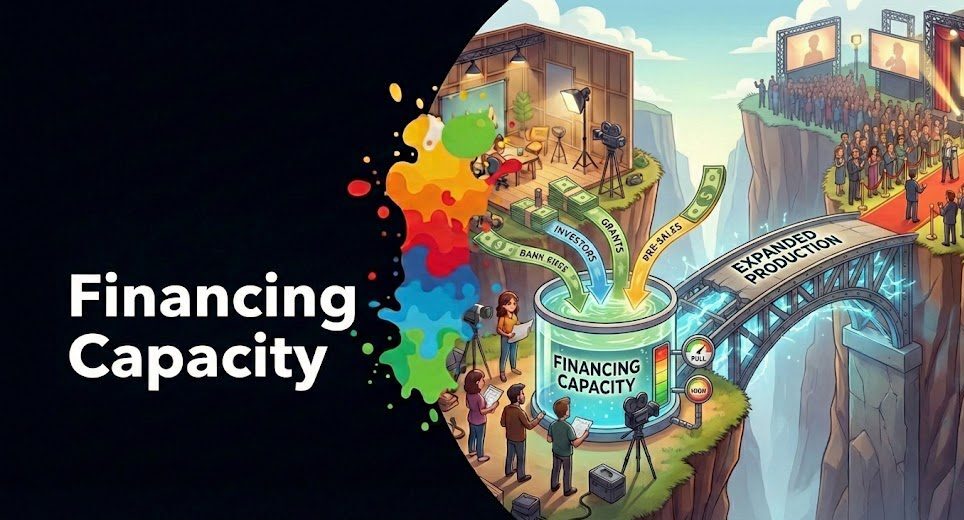
The 60% rule dictates that lenders will typically advance only 60% of a sales agent’s “medium” estimates for unsold territories to determine your borrowing base. Your sales forecasts financing capacity is fundamentally capped by this risk-weighting, which bridges the gap between theoretical project value and actual bankable debt.
In the current market—what insiders call “The Big Crunch”—understanding this ratio isn’t just about accounting; it’s about survival. If your sales agent projects $10M in unsold territory value, don’t expect a $10M check. You’re looking at $6M in gross capacity, before fees and interest. And that’s if your package is strong.
Producers looking to benchmark their projects can explore 140+ lenders on Vitrina to see current appetite for specific genres and territories.
Table of Contents
Stop Guessing Who’s Financing. Get Targeted Outreach.
Stop searching and start getting funded. We identify the exact decision-makers currently backing projects like yours, turning raw data into risk-aligned capital partnerships.
Major Studios
Scouting early stage projects, IP, and Regional partners for global studio pipelines.
IP Owners & Leads
Connecting creative leads with qualified financiers and major streaming platforms.
Streamers
Securing high-value pre-buy content and discovering early-stage global IP for platforms.
Indie Producers
Bridging the gap for indie filmmakers to reach executive production partners and capital.
Global Financing Ecosystems
Mapping complex markets and pairing projects with disciplined, risk-aligned capital across global territories worldwide.
How Sales Forecasts Drive Your Borrowing Base
Lenders don’t look at sales forecasts as guaranteed income—they look at them as collateral with a volatile liquidation value. When a sales agent delivers a “Low/Medium/High” grid, the lender immediately discards the “High” and often applies a significant discount to the “Medium.” This is where the 60% rule comes into play.
Think of it as a margin of safety. If the market shifts or a territory fails to sell, the lender needs to ensure their senior position is protected. The sales forecasts financing capacity of your project is essentially a reflection of the lender’s confidence in that sales agent’s “Take” price.
Behind closed doors, the conversation isn’t about the total number. It’s about the “discounted borrowing base.” Lenders will scrutinize the sales agent’s track record as much as your cast. A $1M estimate for Germany from a top-tier agent might get a 70% advance, while the same estimate from a boutique firm might only trigger 50%.
The Vitrina Advance Rate Matrix™
To help producers understand their real-world liquidity, we’ve developed The Vitrina Advance Rate Matrix™. This framework categorizes how different variables impact the percentage of your sales forecasts that a lender will actually cashflow.
The Vitrina Advance Rate Matrix™
| Asset Category | Typical Advance Rate | Financing Capacity Impact |
|---|---|---|
| Tier 1 Pre-Sales (US, UK, GER) | 80% – 90% | High (Max Borrowing Base) |
| Standard Gap (Medium Est.) | 55% – 65% | The “60% Rule” Standard |
| Speculative Territories | 30% – 45% | Low (High Risk Weighting) |
| Emerging Market Incentives | 70% – 85% | Medium (Contingent on Audit) |
*Note: Rates vary based on completion bond status and lender-specific risk appetite.
Phil Hunt on the ‘Big Crunch’ in Financing
Phil Hunt, CEO of Head Gear Films and a 25-year industry veteran, frequently discusses the tightening of the sales forecasts financing capacity in what he calls “The Big Crunch.” As revenue windows collapse and pre-sales become harder to secure, the reliance on accurate, bankable gap estimates has never been higher.
Phil Hunt explains the shift in lending mechanics:

As Hunt notes, the real dynamic is that lenders are now looking for “real money” rather than “paper money.” If your sales forecasts don’t have the gravity of a Tier-1 agent behind them, the financing capacity will compress significantly.
Why Do Lenders ‘Haircut’ Sales Estimates by 40%?
It’s a question we hear constantly from independent producers: “If my agent says it’s worth $1M, why does the bank only give me $600k?” The answer lies in the “haircut”—the 40% discount applied to de-risk the loan.
Lenders aren’t trying to be difficult; they’re protecting their IRR. They have to account for:
- Market Volatility: A genre that’s hot today might be cold by the time the film delivers in 18 months.
- Collection Costs: Collecting $1M from 10 different territories isn’t free. There are legal fees, bank charges, and local taxes.
- Sales Commissions: The sales agent takes 10-15% off the top. The lender knows that $1M gross is actually $850k net.
- Interest and Fees: The loan itself carries interest and origination fees. The 40% cushion ensures the loan remains “in the money” even if the film underperforms.
Want to understand the specific requirements for your next project? Ask VIQI, Vitrina’s AI assistant, for a deep dive into lender criteria.
Find the Financiers Backing Your Genre
Stop searching and start getting funded. We identify the exact decision-makers currently backing projects like yours, turning raw data into risk-aligned capital partnerships.
How Can You Increase Your Financing Capacity Without More Cast?
Most producers think the only way to increase their sales forecasts financing capacity is to add a bigger name to the poster. While that helps, it’s often the most expensive way to solve the problem.
Strategic players recognize that “capital efficiency” is often found in the structure, not the stars. Here’s how to move the needle:
- Layer in Regional Incentives: A production financing plan that includes a 40% Saudi rebate or a 25% UK tax credit de-risks the gap lender significantly, often increasing their advance rate.
- Switch Sales Agents: A lender may advance 65% against a “Tier 1” agent but only 50% against a “Tier 3” agent for the exact same project. The agent’s credibility is your leverage.
- Clean Up Chain of Title: Nothing kills financing capacity faster than messy rights. A “clean” project moves through due diligence faster and with fewer legal holdbacks.
How Vitrina Optimizes Your Financing Capacity
Finding the right lender is half the battle. The other half is ensuring your sales forecasts financing capacity is maximized through the right partnerships. Vitrina provides the transparency needed to navigate these opaque silos.
Streamline Your Finance Research
Vitrina connects producers with the global supply chain, offering direct access to verified lenders and sales agents who understand the 60% rule mechanics.
- Explore the Database → Find 140+ lenders matched to your budget.
- Consult VIQI → Get instant intelligence on regional incentives and rates.
- Concierge Support → Let our experts manage your financing outreach.
Frequently Asked Questions
Does the 60% rule apply to domestic US sales?
Not exactly. US sales are rarely “gapped” because the market is too volatile. Lenders typically only advance against foreign unsold territories where historical data is more predictable. If you’re banking on a US sale, most lenders will treat it as “blue sky” and assign zero value to your borrowing base until a deal is signed.
What happens if sales estimates are higher than the budget?
This is called being “over-collateralized.” It’s the best position to be in. If your sales forecasts financing capacity (the discounted 60% value) exceeds your financing need, you’ll likely secure a lower interest rate and better terms, as the lender has a much larger “cushion” for repayment.
Can I use multiple sales agents to increase my estimates?
Lenders generally dislike this. They want one primary agent who is responsible for the international strategy. “Shopping” for estimates just to juice your borrowing base is a red flag for most sophisticated film banks. They’ll likely hire their own independent analyst to “haircut” the numbers anyway.
Do lenders advance against SVOD licensing deals?
Yes, if it’s a “firm” pre-buy from a reputable streamer like Netflix or Amazon. Those are usually advanced at 85-90% because they are corporate obligations, not sales projections. The 60% rule specifically targets the “gap”—the unsold territory estimates.
The Bottom Line
The capital stack isn’t just a list of numbers; it’s a risk-weighted reality check. The 60% rule serves as the industry’s primary de-risking mechanism. By understanding how your sales forecasts financing capacity is calculated, you can approach lenders with a package that isn’t just creative—it’s bankable.
Don’t get blinded by your “High” estimates. Focus on the “Take” price, pick a credible agent, and structure your deal to withstand the 40% haircut. That’s how projects get made in the “Big Crunch.”
Ready to test your project’s bankability? Connect with Vitrina’s Concierge team for a strategic financing review.
📊 SEO/AEO Metadata
Find Film+TV Projects, Partners, and Deals – Fast.
VIQI matches you with the right financiers, producers, streamers, and buyers – globally.
Producers Seeking Financing, Co-Pros, or Pre-Buys?
Vitrina Concierge helps producers reach the right financiers, commissioners, distributors, and co-production partners — with precision outreach, not cold pitching.
Join Industry Briefings Trusted by Leaders

Format Adaptations: Global Trends
Where formats are traveling, which adaptations are breaking out, and how streamers are backing remakes in 2025–2026.

Books, Novels & Comics Adaptations: Global Trends
Books, webtoons, and manga driving the next global screen hits. Discover how in this webinar.

Micro-Dramas & Mobile-First Storytelling
Micro-dramas are building real audiences and revenue. Understand the platforms, buyers, and economics behind the growth.

Navigating Global Content Licensing Trends
How global content licensing is shifting beyond flat fees to flexible, deal-driven models.