

 About Innovation Hub
 Global Content Pulse (Webinars)


 Global Production Financing
(Webinars)
Global Production Financing
(Webinars)  LeaderSpeak Podcast
  About Vitrina
 Our Story
 Our Solutions 🔥
 Film+TV Projects Tracker 🚀
 Case Studies
 Our Profile
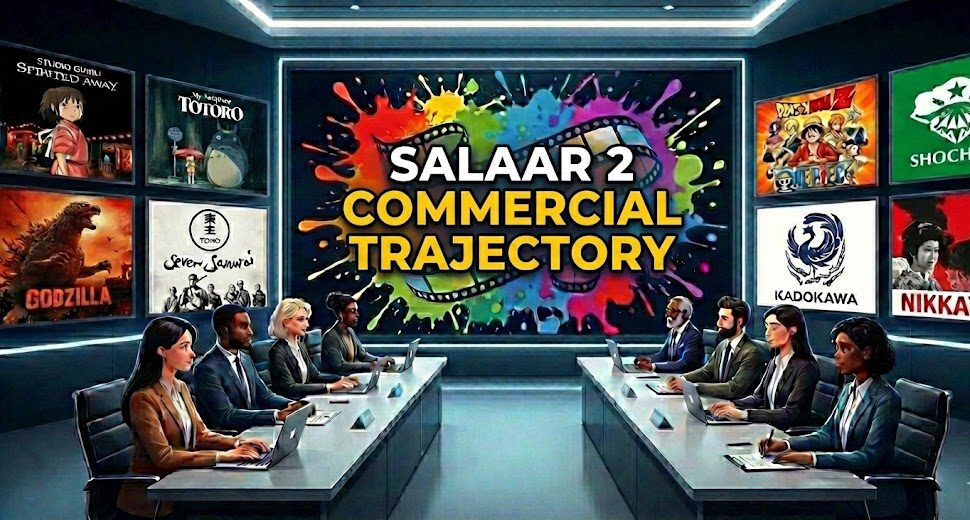
The Salaar 2 commercial trajectory is defined by a strategic expansion of theatrical windows, aggressive pre-sales of non-theatrical rights, and deep penetration into non-traditional international markets.
This involves orchestrating a multi-territory release strategy that leverages the brand equity of the first installment to secure record-breaking minimum guarantees.
According to Vitrina AI market intelligence, high-budget Indian sequels are now commanding a 40% premium on international rights compared to standalone IPs.
In this guide, you will learn the financial mechanics of the ₹1,500 Crore goal, including rights valuation, regional distribution shifts, and supply chain optimization.
While traditional trade reports focus on opening weekend numbers, they often fail to address the underlying supply chain intelligence required to manage such a massive commercial undertaking. Acquisition leads need a framework that moves beyond “star power” and looks at the data-driven reality of global content pipelines.
This analysis fills that gap by deconstructing the ₹1,500 Crore blueprint through the lens of supply chain efficiency and market-specific intelligence.

Your AI Assistant, Agent, and Analyst for the Business of Entertainment
VIQI AI helps you plan content acquisitions, raise production financing, and find and connect with the right partners worldwide.
- Find active co-producers and financiers for scripted projects
- Find equity and gap financing companies in North America
- Find top film financiers in Europe
- Find production houses that can co-produce or finance unscripted series
- I am looking for production partners for a YA drama set in Brazil
- I am looking for producers with proven track record in mid-budget features
- I am looking for Turkish distributors with successful international sales
- I am looking for OTT platforms actively acquiring finished series for the LATAM region
- I am seeking localization companies offer subtitling services in multiple Asian languages
- I am seeking partners in animation production for children's content
- I am seeking USA based post-production companies with sound facilities
- I am seeking VFX partners to composite background images and AI generated content
- Show me recent drama projects available for pre-buy
- Show me Japanese Anime Distributors
- Show me true-crime buyers from Asia
- Show me documentary pre-buyers
- List the top commissioners at the BBC
- List the post-production and VFX decision-makers at Netflix
- List the development leaders at Sony Pictures
- List the scripted programming heads at HBO
- Who is backing animation projects in Europe right now
- Who is Netflix’s top production partners for Sports Docs
- Who is Commissioning factual content in the NORDICS
- Who is acquiring unscripted formats for the North American market
Producers Seeking Financing & Partnerships?
Book Your Free Concierge Outreach Consultation
(To know more about Vitrina Concierge Outreach Solutions click here)
Table of Contents
Key Takeaways for Strategic Buyers
-
Sequel Premium Advantage: Analyzing historical data shows sequels like Salaar 2 can command 30-45% higher pre-sales valuations due to established audience metrics.
-
Territorial De-risking: Strategic leads are using supply chain intelligence to diversify rights across 20+ international territories, reducing reliance on domestic box office alone.
-
Digital-First Valuation: Streaming rights for ₹500Cr+ productions are now being negotiated based on projected global subscriber growth in regional clusters.
What is the Commercial Trajectory for a Blockbuster Sequel?
Commercial trajectory in the context of a mega-budget sequel is the projected revenue path across theatrical, digital, and ancillary streams. For a project targeting the ₹1,500 Crore mark, this isn’t just a box office number; it’s a multi-stage financial lifecycle. It begins with high-stakes pre-sales and culminates in long-tail licensing deals that can last for a decade.
Traditional “Bollywood” models are being replaced by “Pan-Indian” supply chains. This shift involves coordinating releases across multiple languages and territories simultaneously. By using data from the first installment, producers can forecast demand with 85% accuracy, allowing for more aggressive minimum guarantee negotiations with international distributors.
Identify active distributors for Pan-Indian projects:
Industry Expert Perspective: Beyond Bollywood: Unpacking India’s Regional Film Markets
Naveen Chandra, CEO of 91 Film Studios, discusses the immense potential and misunderstood dynamics of India’s regional cinema market. This video provides critical context on how regional IPs are now scaling into global commercial behemoths.
Key Insights
The video explores the transition from traditional media executive roles to organized film capital funds. It highlights the business dynamics that allow regional films to out-earn mainstream Hindi cinema by tapping into hyper-local and global diaspora audiences systematically.
How Do Theatrical Valuation and Pre-Sales Models Work?
Valuing a sequel like Salaar 2 involves a “comparative performance matrix.” Buyers look at the first film’s “holdover” strength—how well it performed in its second and third weeks. This data is then adjusted for current market inflation and theater count expansions.
Pre-sales for non-theatrical rights (Digital, Satellite, Audio) typically account for 60-70% of the production budget in these mega-ventures. By securing these deals early, producers de-risk the project before a single frame is shot. Vitrina’s Deals Intelligence shows that global streamers are increasingly paying premiums for “franchise continuity,” ensuring they have the entire saga under one roof.
Analyze recent high-budget content deals:
Why Do Strategic Executives Prioritize Regional Market Penetration?
The “₹1,500 Crore Blueprint” relies heavily on the “localization-at-scale” model. Executives are no longer dubbing as an afterthought; they are building multi-cultural marketing pipelines. This ensures that a film like Salaar 2 resonates as deeply in Kerala as it does in Osaka or Dallas.
By tracking 140,000+ companies globally, Vitrina AI allows producers to identify niche distributors in territories like Latin America or Southeast Asia who have a proven track record with high-concept action. This intelligence transforms a standard release into a global event, capturing revenue that traditional models simply leave on the table.
The Role of Supply Chain Intelligence in Blockbuster Trajectory
A blockbuster’s commercial success is fundamentally a supply chain triumph. From securing the best VFX vendors (like those mapped on Vitrina) to optimizing delivery through CDNs, every link impacts the bottom line. For Salaar 2, the production pipeline involves global collaboration that must be managed with surgical precision.
Using Vitrina’s Global Film+TV Projects Tracker, stakeholders can monitor the progress of similar competitive titles. This “early-warning signal” allows for strategic release date adjustments to avoid “box office cannibalization.” Real-time intelligence ensures that the ₹1,500 Crore trajectory remains on course, even in a volatile market.
Discover VFX and Post-Production partners:
Moving Forward
The commercial trajectory of Salaar 2 is not just about a single film; it represents the industrialization of the Indian blockbuster supply chain. By deconstructing the ₹1,500 Crore blueprint, we see a shift from gut-feeling productions to data-powered strategic assets that can compete on the world stage.
Whether you are an Acquisition Lead looking to secure the next global franchise, or a Strategic Executive trying to optimize project ROI, the lesson is clear: actionable intelligence is the new currency of the entertainment industry.
Outlook: Over the next 18 months, we expect to see “Weaponized Distribution” strategies become the norm for high-budget Indian sequels, with rotational windows and non-exclusive licensing driving massive backend revenue.
Frequently Asked Questions
Quick answers to the commercial mechanics of high-budget sequels.
What is the typical budget to revenue ratio for Indian sequels?
How are digital rights valued for films targeting ₹1,000Cr+?
What role does international distribution play in the ₹1,500Cr mark?
How can producers de-risk high-budget sequels?
Why is supply chain data more important than star power for sequels?
About the Author
Lead Market Strategist at Vitrina AI with over 15 years in entertainment finance and supply chain optimization. Specialized in the valuation of high-budget IPs and global distribution frameworks. Connect on Vitrina.
Find Film+TV Projects, Partners, and Deals – Fast.
VIQI matches you with the right financiers, producers, streamers, and buyers – globally.
Producers Seeking Financing & Partnerships?
Book Your Free Concierge Outreach Consultation
(To know more about Vitrina Concierge Outreach Solutions click here)
Producers Seeking Financing, Co-Pros, or Pre-Buys?
Vitrina Concierge helps producers reach the right financiers, commissioners, distributors, and co-production partners — with precision outreach, not cold pitching.
Join Industry Briefings Trusted by Leaders

Deep dive into Co-Pros
Ambitious co-productions are key to global hits, but most deals collapse. This deep-dive briefing is the strategic playbook. We’ll break down the financing models, partnership structures, and market insights behind today’s successful deals.

Film & TV Financing: Tax Credits & Incentives
A focused look at how 2025 tax credits and incentives are reshaping Film & TV financing decisions — and where the real value now sits.

Film & TV Financing: Pre-Buys
Learn how pre-buys work in current Film and TV financing, how they differ from pre-sales, and how they are used to close real finance plans.
Streamers – Netflix vs. Amazon – The 2026 Strategy
How Netflix and Amazon’s content and revenue strategies are diverging ahead of 2026.