About Innovation Hub
 Global Content Pulse (Webinars)


 Global Production Financing
(Webinars)
Global Production Financing
(Webinars)  LeaderSpeak Podcast
  About Vitrina
 Our Story
 Our Solutions 🔥
 Film+TV Projects Tracker 🚀
 Case Studies
 Our Profile
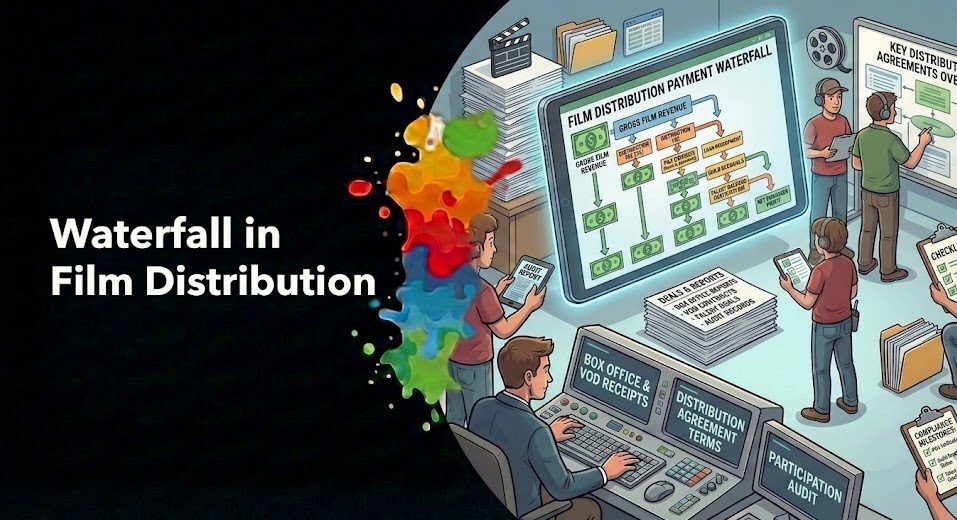
Most films that generate revenue never pay their equity investors a single dollar. Not for lack of box office. Not for lack of streaming deals. Because the film distribution revenue waterfall—the sequence that determines who gets paid, in what order, from every dollar a film earns—is structured so that equity sits dead last. By the time six other stakeholders take their cuts, there’s often nothing left. That’s not Hollywood myth. That’s contract mechanics.
Here’s the thing: understanding the waterfall isn’t just academic. It’s the difference between structuring a capital stack that actually returns capital and signing a deal that looks good on paper but hemorrhages value before it reaches you. Whether you’re a producer negotiating with lenders, an executive building a slate, or a financier evaluating risk, the waterfall is your first map—and most people read it wrong.
This guide breaks down all seven tiers. We’ll show you who sits where, why each position exists, what it actually costs, and how streaming platforms have begun to rewrite rules that held for decades. And then—critically—we’ll show you how to weaponize your waterfall position before the deal closes, not after.
Table of Contents
- What Is the Film Distribution Revenue Waterfall?
- Tier 1: Distribution Fees Come Off the Top (20–35%)
- Tier 2: P&A Recoupment—The Marketing Machine That Eats First
- Tier 3: Senior Debt—Bank Loans and Their Iron-Clad Priority
- Tier 4: Gap Financing—Mezzanine Position, Mezzanine Risk
- Tier 5: Tax Credits and Soft Money—The Underrated Wildcard
- Tier 6: Equity Investors—Highest Risk, Last in Line
- Tier 7: Deferred Fees and Net Profit Participation
- How Streaming Has Rewritten the Waterfall Rules
- How to Weaponize Your Waterfall Position as a Producer
- FAQ
- Conclusion
Ask VIQI: Where Does Your Project Sit in the Waterfall?
VIQI is Vitrina’s AI assistant—trained on 1.6 million titles, 360,000 companies, and 5 million entertainment professionals. Ask it which financiers are actively seeking your project type, what their typical recoupment terms look like, and how comparable films have fared in distribution.
✓ Included with 200 free credits | ✓ No credit card needed
What Is the Film Distribution Revenue Waterfall?
The film distribution revenue waterfall is the contractually defined sequence in which every dollar a film earns gets allocated to stakeholders. Revenue flows in at the top—from theatrical receipts, streaming fees, broadcast licensing, home video, and ancillary rights. It then cascades down through successive tiers, with each tier fully or partially satisfied before the next receives anything.
Think of it as a waterfall carved into rock. Water—revenue—pours in at the summit. It fills the first pool. Then it overflows into the second. Then the third. By the time it reaches the bottom pools, the upper pools have usually absorbed most of what came in. Equity investors and profit participants sit at the bottom. They’re hoping for overflow. Often, they wait years.
The standard waterfall structure breaks down into seven distinct tiers, each with its own contractual basis, typical percentages, and risk profile. As Vitrina’s detailed recoupment waterfall guide explains, the order isn’t arbitrary—it reflects the risk-return bargain each party struck when they came into the deal. Higher risk means you wait longer. Lower risk means you get paid first.
And here’s what most financing conversations leave out: the waterfall isn’t just about when you get paid. It’s about whether you get paid at all. Misunderstand your position in it—and you could be last in line on a film that earned $15 million.
Tier 1: Distribution Fees Come Off the Top (20–35%)
Before any investor, lender, or producer sees a dollar, the distributor takes their fee. This is the first and most immovable tier. Distribution and sales agent fees typically run 20–35% of gross receipts—and that’s off the top, not off net. The distributor isn’t sharing in your risk. They’re being compensated first for putting the film in front of audiences.
This fee covers the cost of distribution infrastructure—rights management across territories, accounting, collections from exhibitors, and the machinery of releasing a film into the market. The percentage varies by deal type and territory. A domestic theatrical deal with a major US distributor might run 30–35%. An international sales agent handling foreign territory licensing typically charges 10–20% of territory MGs, plus reimbursable expenses—usually capped at $50,000–$75,000 per market cycle.
What catches producers off guard? Expenses. Distribution fees cover the distributor’s time and infrastructure. They don’t cover the actual cost of physically releasing the film. Those go into the next tier—and they’re a separate beast entirely.

Your AI Assistant, Agent, and Analyst for the Business of Entertainment
VIQI AI helps you plan content acquisitions, raise production financing, and find and connect with the right partners worldwide.
- Find active co-producers and financiers for scripted projects
- Find equity and gap financing companies in North America
- Find top film financiers in Europe
- Find production houses that can co-produce or finance unscripted series
- I am looking for production partners for a YA drama set in Brazil
- I am looking for producers with proven track record in mid-budget features
- I am looking for Turkish distributors with successful international sales
- I am looking for OTT platforms actively acquiring finished series for the LATAM region
- I am seeking localization companies offer subtitling services in multiple Asian languages
- I am seeking partners in animation production for children's content
- I am seeking USA based post-production companies with sound facilities
- I am seeking VFX partners to composite background images and AI generated content
- Show me recent drama projects available for pre-buy
- Show me Japanese Anime Distributors
- Show me true-crime buyers from Asia
- Show me documentary pre-buyers
- List the top commissioners at the BBC
- List the post-production and VFX decision-makers at Netflix
- List the development leaders at Sony Pictures
- List the scripted programming heads at HBO
- Who is backing animation projects in Europe right now
- Who is Netflix’s top production partners for Sports Docs
- Who is Commissioning factual content in the NORDICS
- Who is acquiring unscripted formats for the North American market
Tier 2: P&A Recoupment—The Marketing Machine That Eats First
P&A—prints and advertising—is where films go to get expensive. Fast. For a wide theatrical release at a major studio level, P&A can equal or even exceed the production budget itself. Studios have historically spent $100 million or more on domestic marketing campaigns for tentpole releases. Even at independent scale, a limited theatrical release can run $500,000–$2 million in P&A before a single ticket is sold.
P&A recoupment sits in tier two because it’s framed as a cost advance—the distributor (or in some deals, a third-party P&A fund) has laid out real cash to put your film in front of audiences. They want it back before anyone else profits. And the contract will say so plainly.
But here’s the strategic tension. The producer often doesn’t control P&A spend. The distributor decides how much to spend, and you—the producer—may be on the hook for recouping it before your equity investors see a cent. That’s why smart producers negotiate P&A caps in their distribution deals. Without a cap, a $10 million marketing blitz on a $5 million film can wipe out any recoupment scenario for equity.
Understanding how P&A factors into your film capital stack before you sign a distribution deal isn’t optional. It’s the first thing your CFO should be modeling.
Track Who’s Financing—Before Your Competition Does
Trusted by Netflix, Warner Bros, and Paramount. Join 140,000+ companies tracking the global entertainment supply chain—active financiers, their deal terms, and which projects are in their current pipeline.
✓ 200 free credits | ✓ No credit card required | ✓ Full platform access
Tier 3: Senior Debt—Bank Loans and Their Iron-Clad Priority
After the distributor takes their fee and marketing costs are recovered, senior debt is next. Senior production loans from entertainment banks—institutions like Comerica Bank and City National Bank—sit in the most protected position in the debt stack. They lend against pre-sale contracts and tax incentive receivables, and their recoupment position reflects the security of that collateral.
Joshua Harris, CEO of Peachtree Media, describes the fundamental logic precisely: “We know there is a definitive ticking clock as to when that distributor has to repay us.” Every notice of assignment attached to a distribution agreement is a contractual obligation—the distributor must pay on delivery. Senior lenders structure their loans around those certainties.
But the risk isn’t whether you get paid. It’s when. As Harris notes, a film can’t be released internationally until it’s been released domestically—because the domestic market retains that right. Every foreign pre-sale payment is effectively gated behind a domestic theatrical release. That’s why senior lenders at Peachtree build in 15–18 months of interest reserves—not because they expect default, but because timing risk is the core variable they’re pricing.
For producers, this means your senior lender’s clock starts ticking from the day they fund. Interest accrues daily. A delayed domestic release doesn’t just hurt your box office—it pushes your entire recoupment timeline and costs you real money in accumulated interest.
Tier 4: Gap Financing—Mezzanine Position, Mezzanine Risk
Gap financing occupies the mezzanine position in the waterfall—senior to equity but subordinate to senior bank debt. It’s the tier that closes the funding gap between what pre-sales and tax incentives cover and what the film actually costs. Understanding its waterfall position explains both its appeal and its cost.
Gap lenders advance against the value of unsold territories—they’re lending into uncertainty, which is why their rates run 8–15% annually on principal, plus origination fees of 7–15% of the loan amount. On an 18-month deal, the all-in cost can reach 22–24% of the original loan. That’s mezzanine pricing for mezzanine risk.
Phil Hunt, Founder and CEO of Head Gear Films—which has financed over 550 films and operates at a volume of 35–40 films per year—describes the gap/senior equity hybrid as the point where “the material has to completely work.” Unlike pure debt lenders who focus on collateral, gap and senior equity providers are evaluating commercial viability. When the material doesn’t work, that tier of the waterfall gets squeezed hardest.
The practical implication: if you’re relying on gap financing to close your budget, you want it repaid quickly. Interest accrues daily. The faster your film moves from delivery to distribution—and the faster that domestic theatrical release comes—the less your gap loan costs in real terms. Our dedicated gap financing guide covers the full mechanics of how to structure this for maximum efficiency.
Tier 5: Tax Credits and Soft Money—The Underrated Wildcard
Tax incentives and soft money recoupment sit in tier five—and this is where savvy producers can meaningfully de-risk their capital stack. Production incentives ranging from 20–40% of qualifying spend are available across dozens of jurisdictions globally. They’re not profit—they’re cost offsets. But how you structure their recoupment position matters enormously.
Here’s the advantage over other waterfall tiers: tax incentives are typically earned on spend, not on release. As Harris at Peachtree explains, “Tax incentives are not usually directly correlated with the domestic release of a film—they’re earned based off of spend.” That makes them the most predictable instrument in your capital stack. Once production wraps and qualified expenditures are certified, the incentive is effectively receivable. You can borrow against it at 80–90% of face value from banks willing to take that certification as collateral.
The waterfall logic: soft money recoups before equity but after debt—because it’s structured as a return of cost, not a return of investment. It’s a narrow but critical distinction when you’re negotiating the inter-party agreements that govern your capital stack.
Tier 6: Equity Investors—Highest Risk, Last in Line
Equity sits in position six. After distribution fees, P&A, senior debt plus interest, gap financing plus interest, and tax credit recoupment—what’s left flows to equity. This is the position that captures all the upside when a film overperforms. And it absorbs all the loss when one doesn’t.
Equity investors typically target a 120–125% return—principal plus a 20–25% premium—as their minimum acceptable outcome. At 150% of principal (a 50% return), they’re doing well. And they know going in that the recoupment timeline is 18–24 months at minimum, often stretching to 3–5 years for full realization.
Here’s the reality that gets glossed over in equity pitch decks: “net profits” in film are a contractual definition, not an accounting term. What constitutes net—and what gets deducted before you reach it—is entirely determined by the contract. Net profit can legally equal zero on a commercially successful film if the upper tiers have absorbed enough. Hollywood accounting exists because the waterfall permits it.
But equity isn’t all downside. A film like The King’s Speech—produced for $15 million and grossing $400 million+ worldwide—repaid its gap loan rapidly and delivered meaningful returns to equity. The upside is real. The position is simply honest about its risk.
Investors who understand this structure ask different questions. Not “will the film make money?” but “how much revenue does it need to generate before my tier activates?” That’s a recoverable number. Model it before the deal closes.
Tier 7: Deferred Fees and Net Profit Participation
At the bottom of the waterfall sit deferred fees—compensation owed to writers, directors, producers, and sometimes cast who agreed to take reduced upfront pay in exchange for backend participation—and net profit participation for talent. These are the last to receive anything. They’re effectively a bet on the film’s commercial success after all other claims are settled.
Gross participation is the rarer, more powerful instrument. Only the most bankable talent secures a percentage of gross receipts—meaning their payment flows from the top, ahead of or alongside distribution fees, rather than from the bottom. This is why a film can theoretically be “in net loss” on paper while still paying a top-billed actor millions. Different definitions. Different positions in the same waterfall.
Adjusted gross sits between gross and net—calculated after distribution fees but before costs. It’s more favorable to talent than net profits, more expensive for producers than gross. The contract definition is everything. There’s no universal standard. Every deal draws the line differently.
Producers negotiating deferred deals should be candid about what tier seven actually means in their specific waterfall. A deferred fee on an independent drama with $2 million in P&A and a $500,000 gap loan is a very different instrument than a deferred fee on a well-packaged genre film with $800,000 in total senior debt.
Need the Right Financiers for Your Project? We’ll Find Them.
Vitrina Concierge is your Virtual Agent. We don’t give you a list—we make warm introductions directly to decision-makers actively seeking your type of content.
- Korean animation studio → Netflix Adult Animation (week one)
- LA producer → Netflix UK, Fifth Season, Fox Entertainment (48 hours)
- Middle Eastern studio → Legendary Pictures (direct access)
How Streaming Has Rewritten the Waterfall Rules
The traditional film revenue waterfall was built for a world of sequential windows—theatrical, then pay-per-view, then premium cable, then broadcast, then home video. Each window was a new pool of revenue. By the time a film had cycled through all six or seven windows, there were multiple bites at the apple. The waterfall had more water flowing through it, even if the upper pools still drank first.
Streaming has collapsed those windows dramatically. Phil Hunt at Head Gear Films is direct about it: the pandemic “sped up where we were going to go anyway.” Theatrical as a revenue window has never fully recovered post-COVID. The industry’s shift toward streaming exclusivity—where a platform like Netflix or Amazon buys worldwide rights upfront—has fundamentally changed the revenue geography of the waterfall.
Phil Hunt (Founder & CEO, Head Gear Films) discusses how these dramatic shifts in revenue windows have reshaped financing decisions for independent producers:
But streaming buyouts aren’t just a distribution story. They’re a waterfall story. When a streamer acquires worldwide rights for a flat fee—say, a $12 million all-in deal for a $7 million film—the waterfall collapses into a single payment event. Distribution fees are built into the acquisition price. There’s no P&A to recoup separately. Senior debt gets repaid at close. Gap loans clear within weeks. And equity? If the acquisition price covers the capital stack, equity can recoup faster than any traditional theatrical release would have allowed.
This is the Fragmentation Paradox at play in the waterfall—the same fragmentation of distribution channels that has squeezed traditional window revenue has also created a new fast lane for recoupment. Understanding which of your projects fits the streaming acquisition model versus the traditional multi-window release model is a core strategic decision, not just a distribution one.
As Kirsty Bell, founder and CEO of Goldfinch, notes in Vitrina’s LeaderSpeak series, the most resilient independent producers today build their capital structures around diverse revenue streams—not single-window bets. That diversity shows up directly in how the waterfall functions in practice.
According to Deadline, streaming platforms are now involved in some capacity in more than 60% of international independent film financing discussions at major markets—a figure that would have seemed extraordinary a decade ago. The waterfall hasn’t disappeared. But it flows faster, and the pools are arranged differently.
How to Weaponize Your Waterfall Position as a Producer
The waterfall isn’t just a sequence you inherit. It’s a structure you negotiate. And producers who understand every tier before the deal closes have a meaningful advantage over those who treat it as boilerplate. Here are the five positions where you have real leverage:
1. Negotiate P&A Caps Before You Sign
You can’t negotiate distribution fees out of existence—but you can cap P&A spend. A hard cap of $1.5 million on a limited release or $3 million on a wider rollout protects your equity recoupment scenario from being buried under marketing costs you didn’t control. Get this in the distribution agreement, not as a verbal commitment.
2. Structure Tax Incentives as First-Money-In
When you monetize your production incentive against a rebate loan, you can structure that repayment as a senior-position return of capital—meaning when the rebate pays out, it flows directly to repay the loan, independent of the rest of the waterfall. This de-risks your lender, lowers your interest rate, and accelerates your overall recoupment timeline. It’s the smartest risk-management tool most independent producers underuse.
3. Hold Back Key Territories for Post-Completion Sales
Don’t pre-sell everything. Holding back major markets—the UK, Germany, or Japan—gives you leverageable assets post-completion. A theatrical performance or festival win can dramatically increase MG values in those territories, which flows into the waterfall at a moment when your equity investors need volume. Smart sales agents hold back 20–30% of territorial value for post-completion premium pricing.
4. Build Interest Reserves Into Your Budget—Not Your Hopes
Joshua Harris’s point about 15–18 months of interest reserve isn’t just a lender’s self-protection mechanism. It’s sound producer practice. Budget your gap financing costs at an effective rate of 22–24% of the loan over an 18-month cycle. If you get repaid faster, that’s upside for equity. If you don’t, you’re not scrambling.
5. Model the Recoupment Break-Even Before You Greenlight
Know the number. What gross revenue does your film need to generate before equity recoups at 120%? On a $5 million film with a $1.5 million gap loan, $700,000 in tax incentives, and $300,000 in P&A, the break-even for equity recoupment might sit at $8–10 million in total gross receipts depending on distribution fee structures. That’s a target. That’s what you’re building toward. Model it on day one. Revisit it every time the capital stack changes. Platforms like Vitrina can surface comparable project performance data that helps you stress-test those numbers against what’s actually happened in the market.
Frequently Asked Questions
What is the film distribution revenue waterfall and how does it work?
The film distribution revenue waterfall is the contractually defined sequence in which a film’s gross revenue is allocated to different stakeholders. Revenue flows from top to bottom through seven tiers: distribution fees (20–35%), P&A recoupment, senior debt plus interest, gap financing plus interest, tax credit recoupment, equity recoupment, and finally net profit participation. Each tier must be fully or partially satisfied before the next receives anything. Equity investors and talent backend participants sit at the bottom—they benefit from overflow after all senior claims are settled.
Why do distribution fees come first in the waterfall?
Distribution fees come first because distributors bear the operational cost and infrastructure risk of releasing the film. They’re not sharing in investment risk—they’re charging for a service. Their fee (typically 20–35% of gross receipts) compensates for rights management, territory sales operations, accounting, and collections. This position is non-negotiable in standard distribution agreements. What producers can negotiate is the P&A cap that immediately follows, which has a bigger practical impact on whether equity ever recoups.
How long does it take equity investors to recoup in a typical film deal?
Equity recoupment typically takes 18–24 months at minimum from delivery, and often 3–5 years for full realization. The timeline depends heavily on how quickly the domestic theatrical release is secured, since foreign pre-sale payments are gated behind the US release. On a streaming acquisition deal where the platform buys global rights upfront, recoupment can happen much faster—sometimes within weeks of delivery. The structure of your deal determines the timeline as much as the film’s performance does.
What is the difference between gross and net profit participation in the waterfall?
Gross participation flows from the top of the waterfall—a percentage of gross receipts before distribution fees, P&A, or any other deductions. Only the most bankable talent secures this. Net profit participation sits at the very bottom—it’s revenue after every other tier has been satisfied. The contractual definition of “net” varies by deal and is frequently drafted in ways that make it difficult to reach. Adjusted gross is the middle ground—calculated after distribution fees but before costs—and is more talent-favorable than net while more producer-friendly than true gross.
How does gap financing affect the film distribution revenue waterfall?
Gap financing sits in the mezzanine position of the waterfall—tier four, after senior bank debt. Gap lenders charge 8–15% annual interest plus origination fees of 7–15%, making the all-in cost 22–24% over an 18-month term. Because it recoups before equity, gap loan presence in your capital stack pushes equity recoupment further down the timeline. The faster your film generates revenue—through a strong domestic release or a streaming buyout—the lower your effective gap financing cost, and the sooner equity can begin to recoup.
How has streaming changed the traditional film distribution waterfall?
Streaming platforms like Netflix, Amazon, and Apple TV+ have compressed the multi-window model that defined traditional waterfall revenue. When a streamer acquires worldwide rights for a flat fee, all waterfall tiers collapse into a single payment event. Distribution fees, P&A, and debt can all recoup simultaneously at closing. This can dramatically accelerate equity recoupment—but it also eliminates backend upside from multiple revenue windows. The strategic question is whether your project’s risk profile makes the certainty of a flat-fee acquisition more valuable than the potential upside of a multi-window release.
Can producers negotiate their position in the film revenue waterfall?
Yes—and they should. While the broad tier structure is relatively standard, the details are highly negotiable. P&A caps protect equity from marketing overcost. Tax incentive structuring as first-money-in repayment de-risks lenders and lowers interest costs. Territory holdbacks preserve post-completion premium value. The inter-party agreement between lenders, distributors, and equity holders defines the exact mechanics of how each tier interacts. Experienced producers treat waterfall negotiation as a strategic exercise—not contract boilerplate. Firms like Head Gear Films exist precisely to help independent producers navigate this complexity at volume.
What is the recoupment break-even for an independent film?
The recoupment break-even is the total gross revenue a film must generate before equity investors receive their principal back. On a $5 million independent film with a $1.5 million gap loan, $700,000 in tax incentives, and $300,000 in P&A, equity break-even may sit at $8–10 million in total gross receipts depending on distribution fee structures. This number should be modeled before you greenlight the project—not after delivery. Stress-testing it against comparable films’ actual gross performance gives you a realistic probability of equity recoupment.
Conclusion: Know Your Tier Before You Sign the Deal
The film distribution revenue waterfall is the clearest expression of how risk is priced in film finance. Every tier—from the distributor’s first-position fee to the equity investor’s last-in-line recoupment—reflects a deal that was made before production started. Understanding that hierarchy doesn’t just help you explain your deal to investors. It helps you structure one that actually returns capital.
Key Takeaways:
- Distribution Fees Come First: 20–35% of gross receipts flow to the distributor before any other stakeholder—this position is largely non-negotiable, making the P&A cap your most critical distribution negotiation lever.
- Senior Debt Priority Reflects Collateral Strength: Bank lenders like Comerica and City National lend against pre-sale certainties; their priority position is compensation for lending at the lowest rates—and their timing risk (gated behind domestic release) is what drives 15–18 month interest reserves.
- Gap Financing Is Expensive Mezzanine Risk: All-in costs of 22–24% over 18 months mean gap loans must be repaid fast—the speed of your domestic release is the primary driver of your effective cost of capital in this tier.
- Equity at Tier Six Needs a Break-Even Number: Model the total gross revenue required for equity recoupment at 120% before you greenlight—on a $5 million film, that break-even typically sits at $8–10 million in gross receipts.
- Streaming Has Created a New Recoupment Fast Lane: Flat-fee worldwide acquisitions by Netflix, Amazon, and Apple TV+ collapse all waterfall tiers into a single payment event—faster equity recoupment, but no backend window upside. Know which model fits your project before you approach buyers.
The producers who succeed at independent financing—the ones running 35–40 films a year like Phil Hunt at Head Gear Films, or building institutional-grade deal pipelines like Joshua Harris at Peachtree—don’t treat the waterfall as a formality. They treat it as a competitive instrument. You should too. Start with the numbers. Model the break-even. Then build the deal around it.
Find Financiers Who Match Your Waterfall Position—in 48 Hours
Trusted by Netflix, Warner Bros, Paramount, and Google TV. Track 400,000+ projects. Access 3 million verified executives. Ask VIQI strategic questions about your market—including which lenders are actively seeking your project type and what their recoupment terms look like.
✓ 200 free credits | ✓ No credit card required | ✓ Cancel anytime
Find Film+TV Projects, Partners, and Deals – Fast.
VIQI matches you with the right financiers, producers, streamers, and buyers – globally.
Producers Seeking Financing & Partnerships?
Book Your Free Concierge Outreach Consultation
(To know more about Vitrina Concierge Outreach Solutions click here)
Producers Seeking Financing, Co-Pros, or Pre-Buys?
Vitrina Concierge helps producers reach the right financiers, commissioners, distributors, and co-production partners — with precision outreach, not cold pitching.
Join Industry Briefings Trusted by Leaders

Film & TV Financing: Pre-Buys
Learn how pre-buys work in current Film and TV financing, how they differ from pre-sales, and how they are used to close real finance plans.

Streamers – Netflix vs. Amazon – The 2026 Strategy
How Netflix and Amazon’s content and revenue strategies are diverging ahead of 2026.

Format Adaptations: Global Trends
Where formats are traveling, which adaptations are breaking out, and how streamers are backing remakes in 2025–2026.