About Innovation Hub
 Global Content Pulse (Webinars)


 Global Production Financing
(Webinars)
Global Production Financing
(Webinars)  LeaderSpeak Podcast
  About Vitrina
 Our Story
 Our Solutions 🔥
 Film+TV Projects Tracker 🚀
 Case Studies
 Our Profile
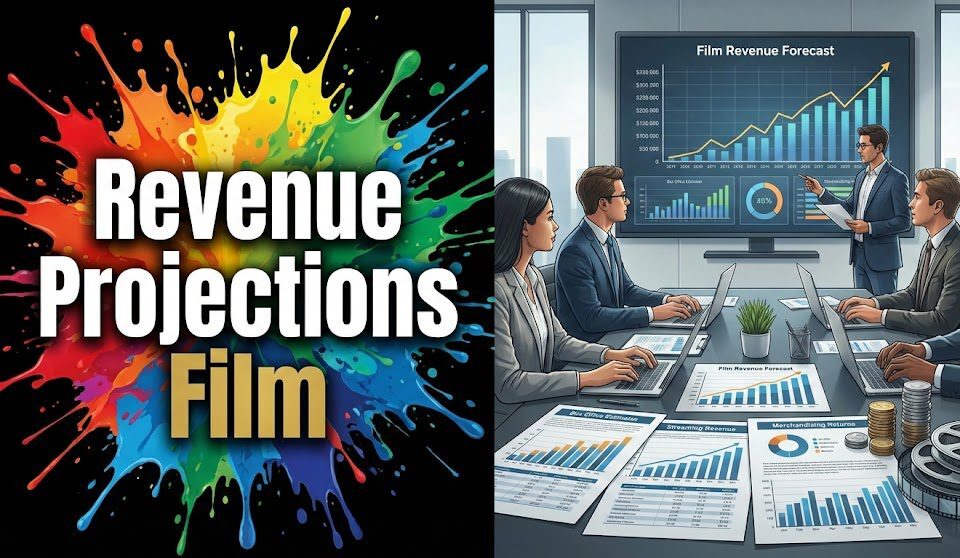
Revenue projections film data often falls into the “blockbuster trap”—a scenario where producers model independent film returns based on outlier successes rather than market averages.
A realistic revenue projection typically assumes a 50-70% discount on sales agent estimates and accounts for the “Big Crunch” in streaming license fees. In today’s market, “greenlight-ready” projections focus on territory-by-territory minimum guarantees (MGs) and soft money, rather than speculative “blue sky” numbers.
Let’s be honest: every producer wants to believe their $5M indie is the next Longlegs or Everything Everywhere All At Once. But if you’re building a financial model for investors or gap lenders based on those anomalies, you’re not projecting—you’re gambling. Behind closed doors, lenders are stripping away the “upside” to see if the project survives on its floor. If your model doesn’t, you won’t get the capital.
Table of Contents
Stop Guessing Who’s Financing. Get Targeted Outreach.
Stop searching and start getting funded. We identify the exact decision-makers currently backing projects like yours, turning raw data into risk-aligned capital partnerships.
Major Studios
Scouting early stage projects, IP, and Regional partners for global studio pipelines.
IP Owners & Leads
Connecting creative leads with qualified financiers and major streaming platforms.
Streamers
Securing high-value pre-buy content and discovering early-stage global IP for platforms.
Indie Producers
Bridging the gap for indie filmmakers to reach executive production partners and capital.
Global Financing Ecosystems
Mapping complex markets and pairing projects with disciplined, risk-aligned capital across global territories worldwide.
What is the Blockbuster Trap?
The Blockbuster Trap happens when a producer uses “comparative titles” (comps) that aren’t actually comparable. If you’re producing a $3M horror film and your comps are Smile or The Conjuring, your revenue projections film strategy is already flawed. Those films had $30M+ P&A (Prints and Advertising) spends and global studio machines behind them. Your indie doesn’t.
Insiders recognize that real projections must be grounded in the “median,” not the “max.” When you’re pitching to a CFO-level investor, they aren’t looking at the ceiling; they’re looking at the floor. They want to know the “Basis Point” differential between your project and a low-risk bond. If your “realistic” model relies on a viral marketing miracle, it’s not a business plan—it’s a prayer.
Producers looking to validate their market assumptions can ask VIQI for current territory sales benchmarks to see what projects are actually fetching in 2025.
The Mechanics of Revenue Projections Film
The process starts with sales estimates. A sales agent will provide three numbers for each territory: Low, Medium, and High (often called “Blue Sky”).
- Low Estimate: What a territory will pay if the film is “delivered” but fails to find an audience.
- Medium Estimate: A baseline based on cast bankability and genre demand.
- High Estimate: The “Blockbuster Trap” numbers that assume awards buzz or a theatrical breakout.
Lenders—especially those providing production financing—typically only lend against 50% of the Low estimate. Why? Because they know the waterfall is unforgiving. Between the sales agent’s 15-25% commission, expenses, and the distributor’s P&A recoupment, the actual net receipts returning to the producer can be surprisingly thin.
Phil Hunt, CEO of Head Gear Films, explains the “Big Crunch” in the current financing landscape:

As Hunt notes, the market has shifted. The capital reality is that “estimated” revenue is no longer enough to secure senior debt. You need hard data.
The Vitrina Revenue Reality Check™
To avoid the blockbuster trap, we’ve developed a framework to stress-test your revenue projections film models. Use this 5-point audit before presenting to investors.
The Vitrina Revenue Reality Check™ Framework
| SIGNAL | REALITY CRITERIA |
|---|---|
| 1. The MG Floor | Do you have at least 2 firm Minimum Guarantees (MGs) from “Anchor” territories? |
| 2. The 30% Discount | Have you discounted your Sales Agent’s “Low” estimates by an additional 30% for safety? |
| 3. P&A Cap | Is your waterfall structured to cap P&A recoupment before equity participations? |
| 4. Streaming License Floor | Does the model survive if the SVOD license fee is $0 (post-streamer pullback)? |
| 5. Soft Money Anchor | Is 40%+ of your budget covered by non-recoupable tax incentives? |
Find the Financiers Backing Your Genre
Stop searching and start getting funded. We identify the exact decision-makers currently backing projects like yours, turning raw data into risk-aligned capital partnerships.
The Death of the “Streaming Floor”
For years, revenue projections film models included a “Netflix/Amazon buyout” as a safety net. That floor has effectively collapsed. Streamers are moving away from broad licensing toward commissioned originals or hyper-specific “Weaponized Distribution™” models where they only buy what fits a narrow algorithm.
What’s actually happening? Strategic players understand that SVOD is now a “bonus,” not a “budget-closer.” If your financing depends on a streamer saving you at the finish line—you’re in trouble. ROI optimization now requires a multi-window strategy including TVOD, AVOD, and regional pay-TV before you even think about a global SVOD deal.
Producers can explore 140+ global lenders on Vitrina to find partners who understand this new windowing reality.
Frequently Asked Questions
How do you calculate realistic revenue projections film data?
To calculate realistic projections, take the aggregate of your sales agent’s “Low” estimates, subtract 20% for sales commissions, 10% for delivery/expenses, and then discount the remaining total by another 30% to account for market volatility. This “Floor” is what you should use for senior debt calculations.
What is the “blockbuster trap” in film financing?
The blockbuster trap is the tendency of producers to use extreme success stories (like Paranormal Activity) as their “base case” comps. It creates an EBITDA projection that looks great on paper but is rejected by sophisticated investors who know the statistical probability of such returns is less than 1%.
Are theatrical revenue projections still reliable in 2025?
Only for “Event” films. For mid-to-low budget indies, theatrical is often a “loss leader” used to drive TVOD and SVOD value. A realistic theatrical projection should often assume a net loss on the theatrical window itself, with profit generated in subsequent windows.
Why do gap lenders discount sales estimates so heavily?
Lenders de-risk their position because territory values can collapse if a lead actor is embroiled in scandal, or if a competing film in the same genre saturates the market. Their 50% discount ensures they get repaid even in a “failure” scenario.
How Vitrina Helps with Revenue Projections
Finding the right data to back up your revenue projections film model is the difference between a signed term sheet and a polite rejection. Vitrina provides the “Insider’s Insider” intelligence needed to de-risk your financing.
- Verify Territory Values: Access data on recent deals to see what lenders are actually valuing territories at today.
- Identify Qualified Lenders: Filter 140+ lenders who specialize in your genre and budget range.
- Strategic Guidance: Use our Concierge service to stress-test your waterfall before approaching senior debt partners.
The Bottom Line
Realistic revenue projections film models aren’t about being pessimistic—they’re about being “greenlight-able.” By avoiding the blockbuster trap and anchoring your model in MGs, tax incentives, and discounted sales estimates, you create a capital efficiency that lenders respect. The market signals are clear: capital flows toward projects where the floor is secured, not where the ceiling is imaginary.
Ready to de-risk your project? Vitrina’s Concierge team can help you structure a financing plan that survives the audit and secures the close.
Find Film+TV Projects, Partners, and Deals – Fast.
VIQI matches you with the right financiers, producers, streamers, and buyers – globally.
Producers Seeking Financing, Co-Pros, or Pre-Buys?
Vitrina Concierge helps producers reach the right financiers, commissioners, distributors, and co-production partners — with precision outreach, not cold pitching.
Join Industry Briefings Trusted by Leaders

Streamers – Netflix vs. Amazon – The 2026 Strategy
How Netflix and Amazon’s content and revenue strategies are diverging ahead of 2026.

Format Adaptations: Global Trends
Where formats are traveling, which adaptations are breaking out, and how streamers are backing remakes in 2025–2026.

Books, Novels & Comics Adaptations: Global Trends
Books, webtoons, and manga driving the next global screen hits. Discover how in this webinar.

Micro-Dramas & Mobile-First Storytelling
Micro-dramas are building real audiences and revenue. Understand the platforms, buyers, and economics behind the growth.