About Innovation Hub
 Global Content Pulse (Webinars)


 Global Production Financing
(Webinars)
Global Production Financing
(Webinars)  LeaderSpeak Podcast
  About Vitrina
 Our Story
 Our Solutions 🔥
 Film+TV Projects Tracker 🚀
 Case Studies
 Our Profile
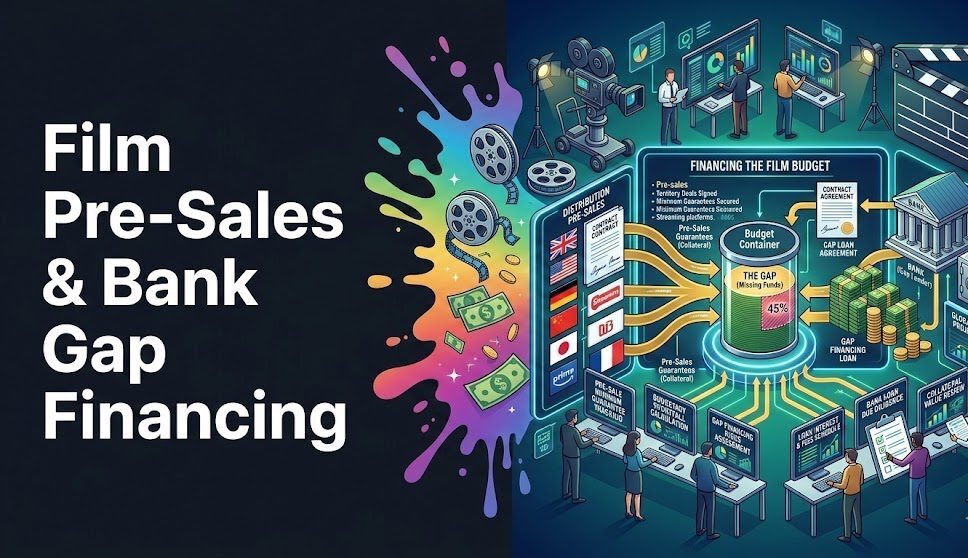
A distribution pre-sale is the process of licensing film or TV rights to a distributor before a project is completed, creating a bankable contract that can be collateralized for a production loan.
This mechanism allows producers to convert “paper promises” into immediate liquidity, bridging the gap between development and principal photography.
In the current “Streaming Wars” evolution, Vitrina AI tracks a shift from exclusive global buyouts back to fragmented territorial licensing, making the ability to identify “bankable” local distributors critical for project greenlights.
This guide examines how to structure pre-sale contracts for maximum collateral value, the technical nuances of bank discounting, and how supply chain intelligence identifies the 140,000+ companies currently active in the acquisition market.
While traditional pre-sales relied on “who you knew” at major markets, the data-driven era requires a precise understanding of buyer appetite and historical deal velocity.
Producers who solve the “data deficit” are 70% more likely to secure the pre-sales necessary for a fully funded debt stack.
Table of Contents

Your AI Assistant, Agent, and Analyst for the Business of Entertainment
VIQI AI helps you plan content acquisitions, raise production financing, and find and connect with the right partners worldwide.
- Find active co-producers and financiers for scripted projects
- Find equity and gap financing companies in North America
- Find top film financiers in Europe
- Find production houses that can co-produce or finance unscripted series
- I am looking for production partners for a YA drama set in Brazil
- I am looking for producers with proven track record in mid-budget features
- I am looking for Turkish distributors with successful international sales
- I am looking for OTT platforms actively acquiring finished series for the LATAM region
- I am seeking localization companies offer subtitling services in multiple Asian languages
- I am seeking partners in animation production for children's content
- I am seeking USA based post-production companies with sound facilities
- I am seeking VFX partners to composite background images and AI generated content
- Show me recent drama projects available for pre-buy
- Show me Japanese Anime Distributors
- Show me true-crime buyers from Asia
- Show me documentary pre-buyers
- List the top commissioners at the BBC
- List the post-production and VFX decision-makers at Netflix
- List the development leaders at Sony Pictures
- List the scripted programming heads at HBO
- Who is backing animation projects in Europe right now
- Who is Netflix’s top production partners for Sports Docs
- Who is Commissioning factual content in the NORDICS
- Who is acquiring unscripted formats for the North American market
Key Takeaways for Producers
-
Minimum Guarantees (MGs): Ensure your pre-sale includes a fixed MG, as banks cannot loan against purely performance-based (percentage only) deals.
-
Counterparty Risk: Banks only collateralize deals with “bankable” distributors—entities with audited financials and a history of honoring payment schedules.
-
Notice of Assignment (NOA): This legal document is essential for the bank to intercept distribution payments directly from the buyer to repay the loan.
-
Supply Chain Intel: Use Vitrina’s Deals Intelligence to identify which distributors are actively buying in your genre before starting your outreach.
The Mechanics: MGs, Long-Form Agreements, and Bankability
For a distribution deal to be “bankable,” it must contain a Minimum Guarantee (MG)—a fixed sum the distributor agrees to pay upon delivery of the film, regardless of how it performs at the box office. While a simple “Deal Memo” may suffice for creative announcements, a bank requires a Long-Form Agreement that explicitly outlines delivery requirements, payment triggers, and technical specifications. Furthermore, the distributor’s financial stability (bankability) is vetted; if the bank does not trust the distributor’s creditworthiness, they will not lend against the contract.
Identify bankable distributors for your project’s genre:
How Banks Discount Pre-Sales for Debt Financing
When a bank “discounts” a pre-sale, it does not loan 100% of the contract value. To account for the time value of money and financing fees, banks typically loan between 80% and 90% of the MG’s net value (after sales agent commissions). This margin provides the bank with a buffer to cover interest payments during the production period. The result is a specialized “bridge loan” that provides the actual cash needed to pay the crew, while the distributor’s payment is used to retire the debt upon completion.
Industry Expert Perspective: Media Finance and Bridge Lending
Matthew Helderman, CEO of BondIt Media Capital, explains the evolution of the bridge lending market. He highlights how specialized capital providers fill the gap between institutional banks and private equity, particularly when it comes to collateralizing pre-sales and tax credits to get productions into principal photography.
Matthew Helderman discusses the critical role of completion bonds and secured debt in modern film finance. He emphasizes that for independent producers, mastering the technicality of the “security interest” is the only way to attract professional-grade capital in a high-interest environment.
Weaponized Distribution: The Return of Territorial Licensing
As the “Streaming Wars” pivot toward profitability, major platforms are moving away from global buyouts (all-rights deals). This shift is giving birth to Weaponized Distribution, where producers can once again license projects territory-by-territory. This is a massive opportunity for debt financing: instead of one global contract, a producer can aggregate 10–15 territorial pre-sales (e.g., France, Germany, Japan), creating a diversified collateral pool that banks often view as lower risk than a single-counterparty deal.
Analyze territorial demand for your project’s genre:
Finding the Right Partners: Using Supply Chain Intel
In a market with 600,000+ companies, identifying which ones have the “bankability” required for a pre-sale is the ultimate challenge. Vitrina AI bridges this gap by providing verified profiles for over 140,000 companies. By using Vitrina’s Reputation Scores and Deal History, producers can qualify potential buyers 70% faster than manual research. This structured intelligence ensures that you spend your time pitching to distributors that banks will actually approve as collateral counterparts.
“The distance between a producer and a project greenlight is no longer a personal relationship; it’s a data point. If you can prove a buyer’s track record, you can prove the project’s bankability.”
Vet and profile potential distribution partners:
Frequently Asked Questions
Technical answers to common questions about distribution pre-sales and debt financing.
What is the difference between a pre-sale and a negative pickup?
Can I pre-sell to streaming platforms?
What is “discounting” a contract?
What if I have pre-sales but no completion bond?
What are “soft money” pre-sales?
What is a Notice of Assignment?
Can I pre-sell multiple territories to the same buyer?
How does Vitrina help in the pre-sale phase?
Moving Forward
The ability to collateralize pre-sales remains the most powerful tool in the independent producer’s financial arsenal. As the market transitions toward the data-driven precision of the global supply chain, those who can verify buyer appetite and track record through structured intelligence will win the race for liquidity. Stop relying on fragmented networks and start leveraging the “digital lighthouse” of Vitrina AI to identify the bankable partners your project deserves.
Master the pre-sale. Secure your debt. Unlock the liquidity to bring your creative vision to life.
Outlook: Over the next 12 months, expect a surge in specialized “bridge” funds that utilize AI-driven demand forecasting to discount pre-sales at more aggressive rates.
About the Author
Written by the Vitrina Strategic Finance Group. We specialize in mapping the intersections of entertainment IP and global finance, providing the data-driven signals that allow producers to navigate the complex world of distribution and debt. Join 140,000+ companies already using Vitrina AI.
Find Film+TV Projects, Partners, and Deals – Fast.
VIQI matches you with the right financiers, producers, streamers, and buyers – globally.
Producers Seeking Financing & Partnerships?
Book Your Free Concierge Outreach Consultation
(To know more about Vitrina Concierge Outreach Solutions click here)
Producers Seeking Financing, Co-Pros, or Pre-Buys?
Vitrina Concierge helps producers reach the right financiers, commissioners, distributors, and co-production partners — with precision outreach, not cold pitching.
Join Industry Briefings Trusted by Leaders

Film & TV Financing: Pre-Buys
Learn how pre-buys work in current Film and TV financing, how they differ from pre-sales, and how they are used to close real finance plans.
Streamers – Netflix vs. Amazon – The 2026 Strategy
How Netflix and Amazon’s content and revenue strategies are diverging ahead of 2026.
Format Adaptations: Global Trends
Where formats are traveling, which adaptations are breaking out, and how streamers are backing remakes in 2025–2026.