About Innovation Hub
 Global Content Pulse (Webinars)


 Global Production Financing
(Webinars)
Global Production Financing
(Webinars)  LeaderSpeak Podcast
  Global Entertainment Digest (Newsletter)
  About Vitrina
 About VIQI
 Our Story
 Our Solutions 🔥
 Film+TV Projects Tracker 🚀
 Case Studies
 Our Profile
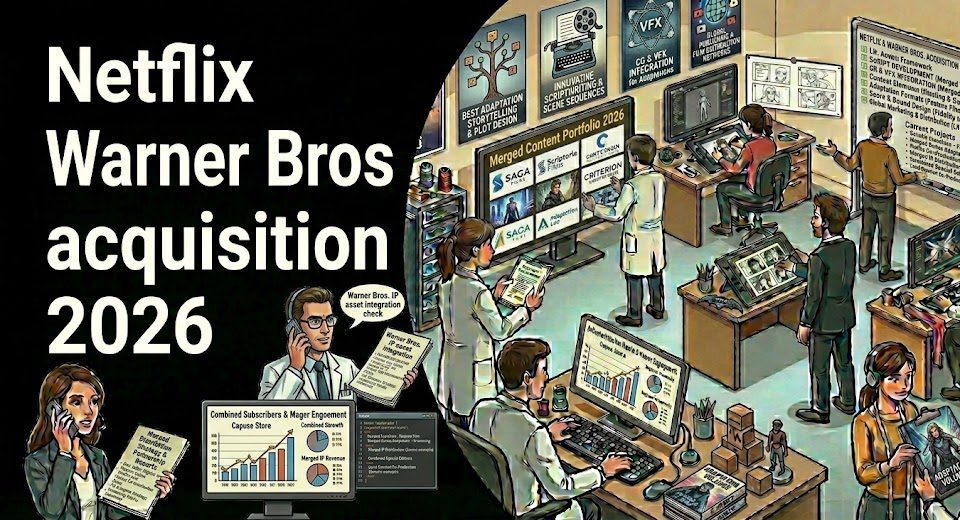
On December 5, 2025, the Netflix Warner Bros acquisition looked like the most consequential deal in Hollywood’s modern era. Netflix would absorb Warner Bros.‘ century-old studio — Harry Potter, Batman, HBO, the Friends library — for an enterprise value of $82.7 billion. Eighty-three days later, it was over. Paramount Skydance outbid everyone, and the entertainment supply chain you’ve been navigating shifted — again.
Here’s the thing: whether you’re a producer structuring a capital stack, a sales agent working pre-sales territory by territory, or a distributor trying to lock down output deals before the smoke clears — this bidding war isn’t background noise. It’s a signal. And if you’re not reading it correctly, you’re already behind.
This isn’t a recap of a press release. This is a breakdown of what the Netflix WBD deal collapse actually means for your projects, your pipeline, and your financing strategy in 2026.
Ask VIQI: “Who’s Acquiring Content Now That Paramount Controls WBD?”
Used by Netflix, Warner Bros, and Paramount executives. Get real-time deal intelligence on 140,000+ companies — instantly.
✓ 200 free credits | ✓ No credit card required | ✓ Instant answers
The $82.7 Billion Deal That Collapsed in 83 Days
Let’s run the timeline — because the speed of this thing is important context for anyone trying to assess stability in the current market.
November 2025: Warner Bros. Discovery begins evaluating strategic alternatives. Netflix, Comcast, and Paramount Skydance all submit formal bids. The underlying pressure? WBD was carrying approximately $33 billion in debt, its linear cable business was bleeding subscribers, and CEO David Zaslav needed a clean exit before the numbers got worse.
December 5, 2025: Netflix and WBD announce a definitive agreement — $27.75 per share, cash and stock, total enterprise value of $82.7 billion (equity value $72 billion). Co-CEOs Ted Sarandos and Greg Peters talk about “defining the next century of storytelling.” The WBD board recommends it unanimously. But Paramount — now run by David Ellison of Skydance — launches an unsolicited hostile tender offer just days later.
January 20, 2026: Netflix amends the agreement to an all-cash offer at the same $27.75 per share price, removing the stock component to simplify execution and accelerate the path to a stockholder vote. WBD targets an April 2026 vote. It looks, for a few weeks, like Netflix is going to win.
And then Paramount keeps sweetening. $30 per share. Then $31. An all-cash offer for the entire company — including the struggling cable channels Netflix specifically didn’t want. As reported by Variety, Sarandos was literally leaving a White House meeting on antitrust when the WBD board issued its “superior proposal” designation for Paramount’s bid. Netflix had four business days to match. It didn’t. On February 26, 2026, Netflix walked. Paramount won.

Your AI Assistant, Agent, and Analyst for the Business of Entertainment
VIQI AI helps you plan content acquisitions, raise production financing, and find and connect with the right partners worldwide.
- Find active co-producers and financiers for scripted projects
- Find equity and gap financing companies in North America
- Find top film financiers in Europe
- Find production houses that can co-produce or finance unscripted series
- I am looking for production partners for a YA drama set in Brazil
- I am looking for producers with proven track record in mid-budget features
- I am looking for Turkish distributors with successful international sales
- I am looking for OTT platforms actively acquiring finished series for the LATAM region
- I am seeking localization companies offer subtitling services in multiple Asian languages
- I am seeking partners in animation production for children's content
- I am seeking USA based post-production companies with sound facilities
- I am seeking VFX partners to composite background images and AI generated content
- Show me recent drama projects available for pre-buy
- Show me Japanese Anime Distributors
- Show me true-crime buyers from Asia
- Show me documentary pre-buyers
- List the top commissioners at the BBC
- List the post-production and VFX decision-makers at Netflix
- List the development leaders at Sony Pictures
- List the scripted programming heads at HBO
- Who is backing animation projects in Europe right now
- Who is Netflix’s top production partners for Sports Docs
- Who is Commissioning factual content in the NORDICS
- Who is acquiring unscripted formats for the North American market
Why Netflix Walked — The CFO Logic Behind the Decision
Don’t mistake discipline for defeat. The statement Sarandos and Peters released — “at the price required to match Paramount Skydance’s latest offer, the deal is no longer financially attractive” — is exactly how you’d expect a company with a disciplined capital allocation framework to talk. Netflix never wanted the whole company. It wanted the studio, the streaming assets, HBO, and the library. The cable channels were dead weight on the recoupment model.
Paramount’s offer — $110.9 billion for all of WBD — forced Netflix to either overpay for assets it didn’t want or walk. They walked. And their stock jumped 10% in extended trading the same night.
But here’s what you need to sit with: Netflix was prepared for a serious regulatory fight. The DOJ had opened antitrust scrutiny. The Writers Guild of America was lobbying to block it. AGC Studios chairman Stuart Ford delivered a keynote at the European Film Market in Berlin specifically calling out the Netflix deal — warning it could reduce backend participation and residuals for producers across the supply chain. That opposition was real, and the regulatory timeline was real.
Losing this deal may have actually de-risked Netflix’s near-term EBITDA position. They grow organically. They don’t take on $33 billion in someone else’s debt. And as MoffettNathanson analyst Robert Fishman noted, the deal “could have accelerated Netflix’s growth” — but it wasn’t existential. Netflix will be fine. What this really reshuffled was everyone else’s positioning.
Track Every WBD-Paramount Deal Move in Real Time
Join 140,000+ companies tracking content acquisitions, greenlit projects, and deal flow across the global entertainment supply chain.
✓ 200 free credits | ✓ No credit card required | ✓ Cancel anytime
What Paramount Actually Won — And What It’s Taking On
Let’s be clear about the prize. When Paramount Skydance closes this deal, it gets the Warner Bros. studio lot in Burbank — over 110 acres, 31 soundstages, 11 exterior sets. It gets the Warner Bros. UK facility near London — another 200 acres of production infrastructure. It gets DC, HBO, New Line Cinema, Cartoon Network, Adult Swim, Turner Classic Movies, Warner Bros. Games, and one of the deepest IP libraries in the history of the medium.
But it’s also walking into a structure that requires Paramount to absorb WBD’s ~$33 billion in existing debt, plus the $54 billion in committed debt financing from Bank of America Merrill Lynch, Citi, and Apollo Global Management — alongside $45.7 billion in equity from Larry Ellison. The combined entity would carry something close to $87 billion in total debt. That’s a capital stack that demands either rapid deleveraging through asset sales or sustained cash generation at a scale neither company has individually achieved.
Meanwhile, Discovery Global — the linear cable networks including CNN, TNT Sports, Food Network, HGTV, and Discovery+ — separates into a standalone public company in Q3 2026, as originally planned. Saudi, Qatari, and Abu Dhabi sovereign wealth funds are among the investors backing Paramount’s bid, per CNBC. That’s the Sovereign Content Hub™ dynamic playing out at M&A level — not just at the production rebate level anymore.
5 Supply Chain Shifts Every Executive Needs to Act On Now
This isn’t abstract geopolitics. The Netflix Warner Bros acquisition collapse and Paramount’s win creates concrete downstream effects — and the producers and financiers who move first will have negotiating leverage that late movers won’t. Here’s where you need to focus.
1. Output Deal Renegotiation Windows Are Opening
Every existing output deal structured with the assumption that Netflix owned WBD’s library is now under review. Production companies with multi-year first-look or output agreements tied to either platform need to understand how ownership change affects those terms. These windows don’t stay open long. Six weeks ahead of the regulatory approval timeline is when smart teams are already at the table — not after it hits the trades.
2. The Pre-Sales Market Gets a New Buyer Configuration
Netflix without WBD’s library still needs content. But their content strategy now shifts back to organic development and Weaponized Distribution™ — licensing valuable owned IP to drive subscriber engagement rather than acquiring a legacy library wholesale. For producers, that means Netflix’s appetite for pre-buys and output deals on new IP may actually increase short-term. But the MG structures and territorial terms will evolve. You need current deal flow intelligence — not the picture from six months ago.
3. Paramount-WBD Debt Load Creates a Co-Production Opportunity
A combined Paramount-WBD carrying $87 billion in debt will aggressively seek co-production structures that let it reduce its balance sheet exposure while maintaining creative control. That’s your opening. As we’ve covered in our analysis of the Netflix-WBD merger’s supply chain impact, consolidation at the top of the studio hierarchy historically pushes mid-tier production capital out into the independent market — where platforms still need content but are increasingly reluctant to fully finance it themselves.
4. HBO’s Prestige TV Mandate Gets a New Budget Reality
Both Netflix and Paramount publicly pledged to preserve HBO as a distinct prestige brand. Netflix co-CEO Ted Sarandos specifically committed to keeping HBO’s “focus on prestige television.” Paramount’s David Ellison made similar commitments in an open letter to the UK creative community. But a heavily leveraged parent company has less room for the kind of long-development, high-P&A spend that built HBO’s reputation. Watch how many season renewals at HBO get greenlit in the 18 months following deal close. That number will tell you everything about where the real creative commitment lands.
5. Sovereign Wealth Fund Influence in Hollywood Just Went Mainstream
The fact that Saudi, Qatari, and Abu Dhabi sovereign wealth funds are among Paramount’s capital backers isn’t a footnote. It’s a structural change in who holds leverage over the Hollywood content machine. For producers working in MENA Sovereign Content Hubs™ — Saudi Arabia’s Vision 2030 infrastructure, UAE free zone frameworks, Qatar’s co-production expansion — this deal validates what smart operators have been positioning for since 2023. MENA capital isn’t peripheral anymore. It’s in the capital stack of the entity that will now control DC, HBO, and the Warner Bros. studio lot.
For a deeper look at how platform consolidation reshapes content financing, see our guide to streaming platform consolidation and production financing.
Matthew Helderman (Co-founder & CEO, BondIt Media Capital) addressed exactly this kind of market shift in the LeaderSpeak series — how independent finance fills the gaps when major studio consolidation reshapes capital availability:
What This Means for Independent Producers Right Now
Let’s be direct. Every major consolidation cycle in the history of this industry has created compression at the top and opportunity in the middle. The question isn’t whether opportunities exist — it’s whether you have the intelligence to find them before everyone else does.
Phil Hunt, founder and CEO of Head Gear Films, has talked extensively about how the independent film landscape has shifted away from traditional pre-sales following the collapse of revenue windows. The Paramount-WBD deal accelerates that shift. But it also creates a specific co-production arbitrage window — because a debt-heavy combined studio will need creative partners who can bring tax incentives, territorial pre-sales, and co-production treaty structures to the table. That’s the capital stack conversation your development team needs to be having right now, not in Q4.
And if you’re working in APAC, MENA, or LATAM — where Sovereign Content Hubs™ have spent the last three years building infrastructure — your position may be stronger than you think. A Paramount-WBD entity with sovereign wealth fund backers has every incentive to drive production volume to the same regions those funds come from. That’s not altruism. That’s recoupment logic.
The Weaponized Distribution™ Lesson Nobody’s Talking About
Here’s the insight that gets buried in all the M&A drama: Netflix doesn’t actually need to own WBD’s library to access it. The original Netflix-WBD deal was itself a version of Weaponized Distribution™ — WBD would have been licensing HBO content to Netflix before the acquisition closed. That co-opetition model already existed. Now? Netflix and Paramount-WBD will negotiate licensing agreements on the open market, with Netflix retaining the flexibility that comes from not carrying $87 billion in debt.
The strategic lesson for everyone else in the supply chain: content ownership beats platform exclusivity as a long-term value driver. If you own your IP — genuinely own it, with clean chain-of-title, not buried in a net profit participation that will never recoup — you can extract value from whoever wins any given platform war. The IP owners who structured their deals correctly before this consolidation are in a fundamentally stronger position than those who traded rights for upfront cash. As we detailed in our guide to streamer consolidation and hybrid financing models, the operators who survive consolidation cycles are the ones who maintained rights flexibility throughout.
Why the Fragmentation Paradox™ Just Got More Expensive
The Fragmentation Paradox™ has always been the invisible tax on independent production: 600,000+ companies operating in opaque silos, creating information asymmetry that costs producers 15-20% margin through legacy markup and extended deal cycles. Now, with one of the largest content libraries in the world changing ownership, that opacity just got more acute.
Which WBD output relationships survive the ownership change? Which HBO development executives stay or leave? Which Paramount first-look deals get honored, restructured, or quietly shelved? If you’re relying on trade reports — which typically run four to six weeks behind actual deal flow — you’re making decisions with a rearview mirror. The producers who close faster, negotiate better, and identify the right partners aren’t working harder. They’re working with better real-time intelligence.
That’s exactly the Insider Advantage Vitrina is built to deliver — mapping 140,000+ active suppliers with verified capabilities, real-time capacity, and active deal tracking across the global supply chain.
Navigate the Paramount-WBD Transition With Expert Guidance
Vitrina’s Concierge Service puts a dedicated analyst in your corner — mapping deal opportunities, identifying the right partners, and de-risking your project positioning in a consolidating market.
✓ Used by executives at Netflix, Paramount, and Warner Bros
✓ No commitment required to start
What You Need to Do Before This Deal Closes
Regulatory approval for the Paramount-WBD deal isn’t guaranteed. The DOJ will examine theatrical competition, streaming consolidation, and the concentration of IP ownership — issues that applied to the Netflix deal too, but in a different configuration. There’s time. But not as much as you think.
The producers and financiers who use the next 90 days well — reassessing output relationships, stress-testing their capital stacks against a new ownership landscape, and identifying which acquirers are actively in the market right now — will be positioned to move when the dust settles. Those who wait for the trades to publish a “what the merger means” roundup will be six weeks behind the deals that actually matter.
Don’t let the Fragmentation Paradox™ cost you this cycle.
Key Takeaways
- Netflix walked away with discipline: Co-CEOs Sarandos and Peters declined to match Paramount’s $31/share bid, calling it “no longer financially attractive” — and their stock rose 10% that evening.
- Paramount-WBD faces an $87 billion debt reality: The combined entity’s leverage demands aggressive co-production strategies — which opens meaningful windows for independent producers with the right capital structures.
- Sovereign wealth capital is now inside Hollywood’s ownership layer: Saudi, Qatari, and Abu Dhabi funds backing Paramount’s bid validates the Sovereign Content Hub™ thesis at M&A scale.
- IP ownership beats platform exclusivity: The Weaponized Distribution™ model proves content ownership creates licensing optionality that pure platform plays never deliver.
- Real-time intelligence separates winners from waiters: The executives who act on current deal flow data — not six-week-old trade reports — will capture the co-production and output deal opportunities this consolidation creates.
Frequently Asked Questions: Netflix Warner Bros Acquisition
Did Netflix successfully acquire Warner Bros.?
No. Netflix announced a definitive agreement on December 5, 2025 to acquire Warner Bros. Discovery’s studio and streaming assets for a total enterprise value of $82.7 billion. However, on February 26, 2026, Netflix declined to match a revised offer from Paramount Skydance — which bid $31 per share for all of WBD — and withdrew from the deal. Paramount Skydance is now the buyer, pending regulatory approval.
Why did Netflix back out of the Warner Bros acquisition?
Netflix co-CEOs Ted Sarandos and Greg Peters stated the deal was “no longer financially attractive” at the price required to match Paramount’s revised bid. Netflix had originally offered $27.75 per share for Warner Bros.’ studio and streaming assets only — it didn’t want WBD’s linear cable channels, which Paramount’s offer included. Matching the $31/share bid for the entire company, including the cable assets Netflix specifically didn’t want, didn’t align with its disciplined capital allocation framework.
How much is the Warner Bros acquisition worth?
Netflix’s offer was valued at approximately $82.7 billion total enterprise value ($72 billion equity value). Paramount Skydance’s winning bid was approximately $110.9 billion — the highest offer in this bidding war — at $31 per share for the entire Warner Bros. Discovery company including its cable networks. The Paramount deal is backed by $54 billion in committed debt financing from Bank of America Merrill Lynch, Citi, and Apollo Global Management, plus $45.7 billion in equity from Larry Ellison.
What Netflix Warner Bros deal assets were included?
Netflix’s original agreement covered Warner Bros.’ film and television studios, HBO Max, HBO, New Line Cinema, and associated IP including DC Entertainment, Warner Bros. Games, and the studio’s century-long content library. The agreement specifically excluded WBD’s Global Linear Networks business — CNN, TNT, HGTV, Food Network, and related cable assets — which was being spun off as a separate public company, Discovery Global, expected to complete in Q3 2026.
What does the Netflix Warner Bros deal collapse mean for independent producers?
For independent producers, the deal’s collapse creates several strategic openings. A heavily leveraged Paramount-WBD will seek co-production structures to reduce balance sheet exposure, creating demand for partners who bring tax incentives, territorial pre-sales, and treaty co-production capital. Netflix, meanwhile, returns to its organic content growth strategy — potentially increasing its appetite for pre-buys and output deals on new IP. The transition period creates output deal renegotiation windows that typically close within 60-90 days of ownership change.
Will the Paramount Warner Bros acquisition face regulatory challenges?
Yes. The Paramount Skydance-WBD deal is subject to regulatory approval from the U.S. Department of Justice and other international jurisdictions. Regulators are expected to examine competition across film production, television distribution, and streaming — given the concentration of major studios, cable networks, and streaming services under a single corporate parent. The broader scope of Paramount’s all-company bid, compared to Netflix’s studio-focused offer, may attract closer antitrust scrutiny.
What happens to HBO under the Paramount Warner Bros deal?
Both Netflix (during its ownership bid) and Paramount’s David Ellison committed publicly to preserving HBO as a distinct prestige television brand. Ellison’s open letter to the UK creative community specifically pledged continued theatrical releases and HBO’s brand independence. However, the practical budget reality for a combined entity carrying approximately $87 billion in total debt will determine how those commitments translate into greenlight decisions and season renewal rates over the next two to three years.
How can I track Warner Bros and Paramount deal developments in real time?
Vitrina tracks active deal flow, content acquisitions, greenlit projects, and supply chain movements across 140,000+ companies globally — including Paramount, Warner Bros., Netflix, and the independent production companies that work with them. You can access real-time deal intelligence through the Vitrina platform with 200 free credits, no credit card required. For complex strategic questions about navigating this M&A transition, VIQI — Vitrina’s AI-powered Hollywood agent — provides instant, sourced answers at scale.
Get the Insider Intelligence Netflix and Paramount Executives Use
140,000+ entertainment companies. 400,000+ projects tracked. Ask VIQI anything — and get answers before they hit the trades.
✓ 200 free credits | ✓ No credit card required | ✓ Instant intelligence
Find Film+TV Projects, Partners, and Deals – Fast.
VIQI matches you with the right financiers, producers, streamers, and buyers – globally.
Producers Seeking Financing & Partnerships?
Book Your Free Concierge Outreach Consultation
(To know more about Vitrina Concierge Outreach Solutions click here)
Producers Seeking Financing, Co-Pros, or Pre-Buys?
Vitrina Concierge helps producers reach the right financiers, commissioners, distributors, and co-production partners — with precision outreach, not cold pitching.
Join Industry Briefings Trusted by Leaders

Format Adaptations: Global Trends
Where formats are traveling, which adaptations are breaking out, and how streamers are backing remakes in 2025–2026.

Books, Novels & Comics Adaptations: Global Trends
Books, webtoons, and manga driving the next global screen hits. Discover how in this webinar.

Micro-Dramas & Mobile-First Storytelling
Micro-dramas are building real audiences and revenue. Understand the platforms, buyers, and economics behind the growth.

Navigating Global Content Licensing Trends
How global content licensing is shifting beyond flat fees to flexible, deal-driven models.