About Innovation Hub
 Global Content Pulse (Webinars)


 Global Production Financing
(Webinars)
Global Production Financing
(Webinars)  LeaderSpeak Podcast
  Global Entertainment Digest (Newsletter)
  About Vitrina
 About VIQI
 Our Story
 Our Solutions 🔥
 Film+TV Projects Tracker 🚀
 Case Studies
 Our Profile
Minimum Guarantees (MGs) vs. Advances represent the two primary methods of securing content financing: an MG is a contractually guaranteed sum payable upon delivery, while an Advance is a portion of that sum paid upfront.
This distinction is critical for cash flow management, as Advances provide immediate production capital whereas MGs are primarily used to collateralize bank loans.
According to industry data, the post-streamer landscape has seen a 25% shift toward structured MGs as distributors seek to mitigate their own risk in an unpredictable theatrical market.
In this guide, you’ll learn the technical mechanics of both models, how to audit distributor reputation for payment reliability, and use supply chain intelligence to maximize the True Value of your international rights.
While legacy financing relied on opaque handshake deals and festival-driven speculation, the modern entertainment supply chain requires a data-first approach. Producers are currently facing a “fragmentation paradox” where global production is rising, but reliable capital remains siloed within complex territorial deal structures.
This guide fills critical market gaps by deconstructing the risk-reward profiles of MGs and Advances, enabling you to build a resilient financing slate.

Your AI Assistant, Agent, and Analyst for the Business of Entertainment
VIQI AI helps you plan content acquisitions, raise production financing, and find and connect with the right partners worldwide.
- Find active co-producers and financiers for scripted projects
- Find equity and gap financing companies in North America
- Find top film financiers in Europe
- Find production houses that can co-produce or finance unscripted series
- I am looking for production partners for a YA drama set in Brazil
- I am looking for producers with proven track record in mid-budget features
- I am looking for Turkish distributors with successful international sales
- I am looking for OTT platforms actively acquiring finished series for the LATAM region
- I am seeking localization companies offer subtitling services in multiple Asian languages
- I am seeking partners in animation production for children's content
- I am seeking USA based post-production companies with sound facilities
- I am seeking VFX partners to composite background images and AI generated content
- Show me recent drama projects available for pre-buy
- Show me Japanese Anime Distributors
- Show me true-crime buyers from Asia
- Show me documentary pre-buyers
- List the top commissioners at the BBC
- List the post-production and VFX decision-makers at Netflix
- List the development leaders at Sony Pictures
- List the scripted programming heads at HBO
- Who is backing animation projects in Europe right now
- Who is Netflix’s top production partners for Sports Docs
- Who is Commissioning factual content in the NORDICS
- Who is acquiring unscripted formats for the North American market
Table of Contents
Key Takeaways for Independent Producers
-
Immediate vs. Backend Liquidity: Advances solve immediate production deficits, while MGs provide the long-term contractual security needed to close mezzanine or gap financing deals.
-
Mitigating Default Risk: In a volatile market, an Advance in the bank is worth more than an MG on paper if the distributor’s creditworthiness is not verified through supply chain intelligence.
-
Strategic Revenue Stacking: Producers using deals intelligence track money movement to identify regions with high appetite for genre-specific pre-sales and MGs.
-
Reputation as Collateral: Using Vitrina’s reputation scores helps producers vet financing partners based on historical deal performance rather than social media noise.
What is the Technical Difference Between MGs and Advances?
A Minimum Guarantee (MG) is a distributor’s commitment to pay a fixed amount of money regardless of the content’s commercial performance. It serves as a floor for the producer’s revenue. Crucially, the full amount of an MG is often not paid until “delivery” of the final project, making it a powerful tool for producers to take to lenders to secure bank financing.
An Advance, by contrast, is a portion of that MG (or a separate royalty payment) that is paid upfront or in stages (e.g., signing, start of photography). For independent producers, Advances are the lifeblood of production cash flow, reducing the amount of debt interest paid to third-party lenders. Understanding this balance is the difference between a project that is “paper-rich” and one that is “cash-ready.”
Find active financing partners for your project:
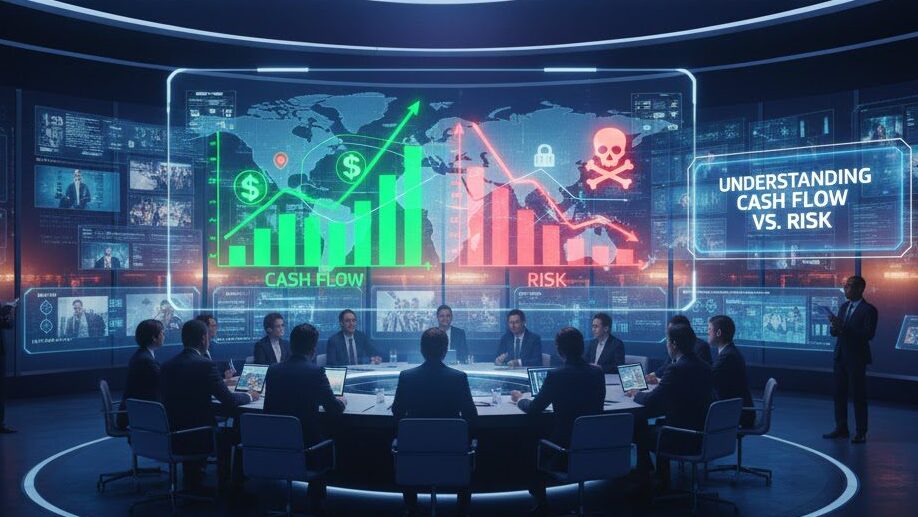
Cash Flow vs. Risk: Evaluating Distributor Commitments
The “fragmentation paradox” of the modern supply chain means that while global demand is high, the financial risk is distributed unevenly. A producer might secure a massive MG from a regional distributor, but if that distributor lacks the liquidity to pay upon delivery, the producer is left with an unfunded bank loan.
1. The Counterparty Risk Challenge
Traditional databases provide surface-level company listings but fail to provide the verified track records needed to audit a partner’s financial reputation. Producers need to know: Has this distributor defaulted on MGs in the last 24 months? Supply chain intelligence platforms reveal these deal-making patterns.
2. The ‘Big Crunch’ Pressure
As revenue windows collapse, distributors are offering smaller Advances and pushing more of the financial burden onto the producer’s backend. Producers who understand these licensing trends can hold out for higher MGs in territories where theatrical demand remains robust.
Industry Expert Perspective: Media Finance: Navigating a Post-Streamer World
Matthew Helderman, CEO of BondIt Media Capital, explains how the industry has transitioned from the credit crisis to a modern era where reliable data and passion-driven financial acumen are essential.
Producers must fill the gap in reliable capital by becoming “Gritty, Tenacious Diggers” for data. Understanding market trends and financing structures is the only way to navigate a world where streaming platforms have altered traditional revenue windows.
Using Supply Chain Intelligence to Vet Financing Partners
Vitrina AI functions as the definitive source of truth for the M&E supply chain, industrializing the “insider intelligence” that once defined Hollywood. For producers, this means moving beyond Anecdotal information to replacement with structured, real-time intelligence on over 140,000 companies.
By tracking Money movement through Deals Intelligence, producers can identify which distributors are actively issuing MGs for specific genres. For instance, a producer with a superhero IP can use Vitrina’s pairing engine to find active players with a verifiable track record of high-value co-production investments—compressing months of networking into days of targeted discovery.
“In a high-risk content market, the choice between an MG and an Advance is a litmus test for a producer’s supply chain intelligence. Your ability to vet counterparty risk is your most valuable asset.”
— Atul Phadnis, Founder & CEO at Vitrina AI
Moving Forward
The independent film distribution landscape has shifted from relationship-dependent networking to data-driven risk management. This transformation addresses the critical gap this guide explored: the need for technical precision in balancing cash flow through Advances and security through MGs.
Whether you are an independent producer looking to secure pre-sales financing, or a sales agent trying to optimize territory-by-territory value, understanding the counterparty risk is paramount. Actionable intelligence transforms distribution from speculation into strategy.
Outlook: Over the next 12-18 months, platform fragmentation will drive a resurgence in territorial MGs as regional streamers fight for “local-first” content exclusivity.
Frequently Asked Questions
Quick answers to common queries about content financing models.
What is a Minimum Guarantee (MG) in film?
What is an Advance in content distribution?
Which is better for indie producers, MG or Advance?
How can I verify if a distributor will pay the MG?
About the Author
Media Finance Strategist with 15+ years of experience in cross-border content licensing and distribution rights management. Connect on Vitrina.
Find Film+TV Projects, Partners, and Deals – Fast.
VIQI matches you with the right financiers, producers, streamers, and buyers – globally.
Producers Seeking Financing & Partnerships?
Book Your Free Concierge Outreach Consultation
(To know more about Vitrina Concierge Outreach Solutions click here)
Producers Seeking Financing, Co-Pros, or Pre-Buys?
Vitrina Concierge helps producers reach the right financiers, commissioners, distributors, and co-production partners — with precision outreach, not cold pitching.
Join Industry Briefings Trusted by Leaders

Format Adaptations: Global Trends
Where formats are traveling, which adaptations are breaking out, and how streamers are backing remakes in 2025–2026.

Books, Novels & Comics Adaptations: Global Trends
Books, webtoons, and manga driving the next global screen hits. Discover how in this webinar.

Micro-Dramas & Mobile-First Storytelling
Micro-dramas are building real audiences and revenue. Understand the platforms, buyers, and economics behind the growth.

Navigating Global Content Licensing Trends
How global content licensing is shifting beyond flat fees to flexible, deal-driven models.