About Innovation Hub
 Global Content Pulse (Webinars)


 Global Production Financing
(Webinars)
Global Production Financing
(Webinars)  LeaderSpeak Podcast
  About Vitrina
 Our Story
 Our Solutions 🔥
 Film+TV Projects Tracker 🚀
 Case Studies
 Our Profile
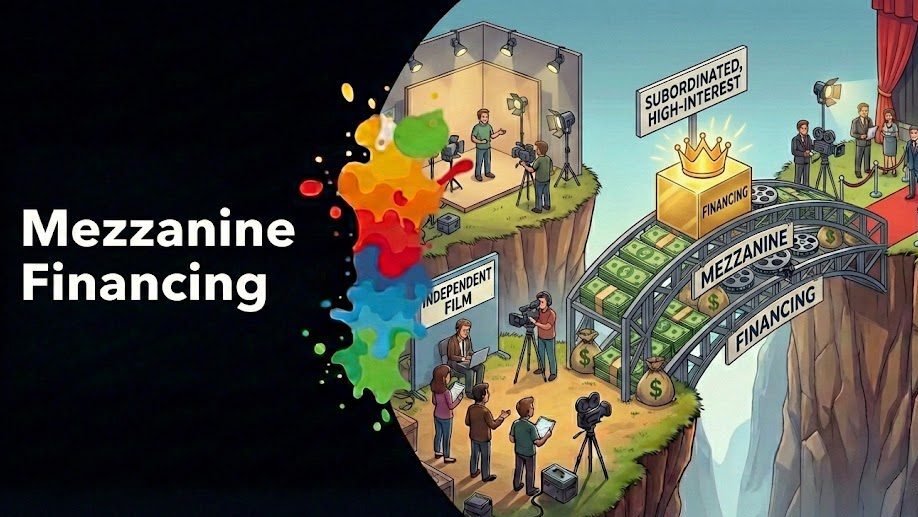
Mezzanine financing is the hybrid capital that sits in the “dead zone” of your film’s capital stack—the space between senior debt and pure equity. It’s essentially subordinated debt that acts a bit like equity.
It typically covers the final 10–15% of a budget when your senior lenders have hit their ceiling and you don’t want to dilute your ownership any further. In short? It’s the bridge of last resort that gets your project to the finish line.
Look, closing a $10M or $20M indie film budget in 2025 isn’t for the faint of heart. With streamers pulling back on licensing fees and senior lenders tightening their LTV (loan-to-value) ratios, that “hole” in your financing plan is getting harder to fill. That’s where mezzanine financing—or “mezz”—comes in. But it’s not cheap. You’re trading high interest rates and often a slice of the back-end for the liquidity you need to trigger your greenlight.
Table of Contents
Stop Guessing Who’s Financing. Get Targeted Outreach.
Stop searching and start getting funded. We identify the exact decision-makers currently backing projects like yours, turning raw data into risk-aligned capital partnerships.
Major Studios
Scouting early stage projects, IP, and Regional partners for global studio pipelines.
IP Owners & Leads
Connecting creative leads with qualified financiers and major streaming platforms.
Streamers
Securing high-value pre-buy content and discovering early-stage global IP for platforms.
Indie Producers
Bridging the gap for indie filmmakers to reach executive production partners and capital.
Global Financing Ecosystems
Mapping complex markets and pairing projects with disciplined, risk-aligned capital across global territories worldwide.
How Mezzanine Financing Actually Works
Behind closed doors, mezzanine is often called “junior debt.” It’s senior to the producers’ equity but junior to the bank or gap lender. If the project’s revenue falls short, the senior lender gets paid first, then the mezzanine lender, and if there’s anything left? That’s for the equity holders. Because of this “second-out” position, mezzanine lenders take on massive risk—and they price accordingly.
Strategic players understand that mezzanine isn’t just about the cash; it’s about the structure. It’s often used when a producer has a “soft” gap—maybe a pre-sale that isn’t quite bankable yet, or a tax incentive that’s still in the application phase. It de-risks the senior lender by providing a buffer. If you’re struggling to structure your production financing, mezzanine might be the lubricant that gets the senior lender to “yes.”
Phil Hunt, CEO of Head Gear Films, explains the shift in the financing landscape:

The Vitrina Capital Stack Risk Ladder™
To visualize where mezzanine sits, we’ve developed the Vitrina Capital Stack Risk Ladder™. This helps you see the cost-of-capital vs. the recoupment priority. It’s a fundamental de-risking tool for producers trying to optimize their IRR.
The Vitrina Capital Stack Risk Ladder™
| Layer | Recoupment Priority | Avg. Cost (2025) |
|---|---|---|
| Senior Debt (Bank) | 1st (Super Senior) | 7-10% |
| Gap Financing | 2nd | 12-16% |
| Mezzanine Debt | 3rd (Junior) | 18-24% + Warrants |
| Equity (Private/Soft) | 4th (Last Out) | Ownership stake |
As you can see, mezzanine is significantly more expensive than gap financing. Why? Because gap is collateralized by unsold territories, whereas mezzanine is often “naked” or subordinated to those very same territories. It’s high-octane fuel for your budget, but use it sparingly.
The Real Cost: Rates, Fees, and Warrants
Here’s what the trades don’t report: the “all-in” cost of mezzanine. While a lender might quote you 15% interest, the real number is usually north of 20% once you factor in the “kicker.”
Lenders in this space (think BondIt, Head Gear, or Three Point Capital) don’t just want interest; they want a “liquidity event” bonus. This usually takes the form of warrants—the right to buy a percentage of the film’s profits at a nominal price. (And that’s being generous; sometimes it’s just a straight percentage of the back-end.)
- Interest Rates: 15-20% per annum (compounded monthly).
- Origination Fees: 2-4% of the principal loan amount.
- Legal Fees: Expect $20k-$40k because mezzanine contracts are notoriously complex.
- The Equity Kicker: 2-5% of the film’s net profits (warrants).
Don’t let the headline rate fool you. If you’re actively looking for capital, you can explore 180+ verified lenders on Vitrina to compare these terms side-by-side.
Mezzanine vs. Gap Financing: What’s the Difference?
Producers often use these terms interchangeably. Don’t. They serve different purposes and have different costs. Gap financing is collateralized debt—it’s money lent against the estimated value of unsold territories. Mezzanine is subordinated debt—it’s money lent against the project’s overall ability to recoup, sitting behind everyone else.
If your sales agent says they can sell Japan for $500k, a gap lender might lend you $300k against that. A mezzanine lender? They’re looking at the whole waterfall. They’re betting that the film will perform well enough to pay off the bank, the gap lender, AND them. Because they’re taking that “tail-end” risk, they demand more control and higher returns.
The real question is: can your waterfall support the mezzanine interest? If your distribution licensing agreements are weak, the mezzanine interest will eat your equity for breakfast. Strategic players recognize that mezzanine should only be used to bridge a temporary hole, not as a permanent capital base.
Find the Financiers Backing Your Genre
Stop searching and start getting funded. We identify the exact decision-makers currently backing projects like yours, turning raw data into risk-aligned capital partnerships.
How Vitrina Helps with Mezzanine Financing
Finding a mezzanine lender isn’t just about finding cash; it’s about finding a partner who understands your genre and territory mix. Vitrina’s global supply chain database maps out who is actually active in the middle-tier market today.
- Explore our database to find lenders matching your budget range.
- Ask VIQI for specific requirements for mezzanine deals in 2025.
- Contact Concierge if you have a deal on the table and need to verify lender track records.
Frequently Asked Questions
What is mezzanine financing in film?
It’s a form of subordinated debt that sits between senior debt (banks) and equity. It’s typically used to fill the last 10-15% of a production budget when traditional sources are exhausted. It’s expensive but avoids the permanent dilution of equity.
How much does mezzanine financing cost?
In 2025, expect to pay 18-24% all-in IRR. This usually includes a 15-18% headline interest rate plus warrants or a small percentage of the net profits (usually 2-5%). Legal and origination fees also apply.
When should I use mezzanine debt instead of equity?
Use mezzanine when you are confident in your film’s recoupment but want to keep 100% of the long-term ownership. If you believe the film will be a “runaway hit,” mezzanine is cheaper than equity in the long run because you eventually pay the debt off, whereas equity holders stay on the cap table forever.
Is mezzanine financing senior to gap?
No. Almost always, gap financing (secured by territory rights) is senior to mezzanine debt. Mezzanine lenders are essentially “third in line” for repayment after the bank and the gap provider.
The Bottom Line
Mezzanine financing isn’t for every project—it’s high-risk, high-reward capital for producers who need to close a budget without surrendering their soul. But if your project has the velocity to overcome the 20%+ cost of capital, it can be the difference between a greenlight and a dead project.
Ready to optimize your capital stack? Consult with Vitrina’s Concierge team to match your project with specialized mezzanine lenders.
Find Film+TV Projects, Partners, and Deals – Fast.
VIQI matches you with the right financiers, producers, streamers, and buyers – globally.
Producers Seeking Financing, Co-Pros, or Pre-Buys?
Vitrina Concierge helps producers reach the right financiers, commissioners, distributors, and co-production partners — with precision outreach, not cold pitching.
Join Industry Briefings Trusted by Leaders

Format Adaptations: Global Trends
Where formats are traveling, which adaptations are breaking out, and how streamers are backing remakes in 2025–2026.

Books, Novels & Comics Adaptations: Global Trends
Books, webtoons, and manga driving the next global screen hits. Discover how in this webinar.

Micro-Dramas & Mobile-First Storytelling
Micro-dramas are building real audiences and revenue. Understand the platforms, buyers, and economics behind the growth.

Navigating Global Content Licensing Trends
How global content licensing is shifting beyond flat fees to flexible, deal-driven models.