About Innovation Hub
 Global Content Pulse (Webinars)


 Global Production Financing
(Webinars)
Global Production Financing
(Webinars)  LeaderSpeak Podcast
  About Vitrina
 Our Story
 Our Solutions 🔥
 Film+TV Projects Tracker 🚀
 Case Studies
 Our Profile
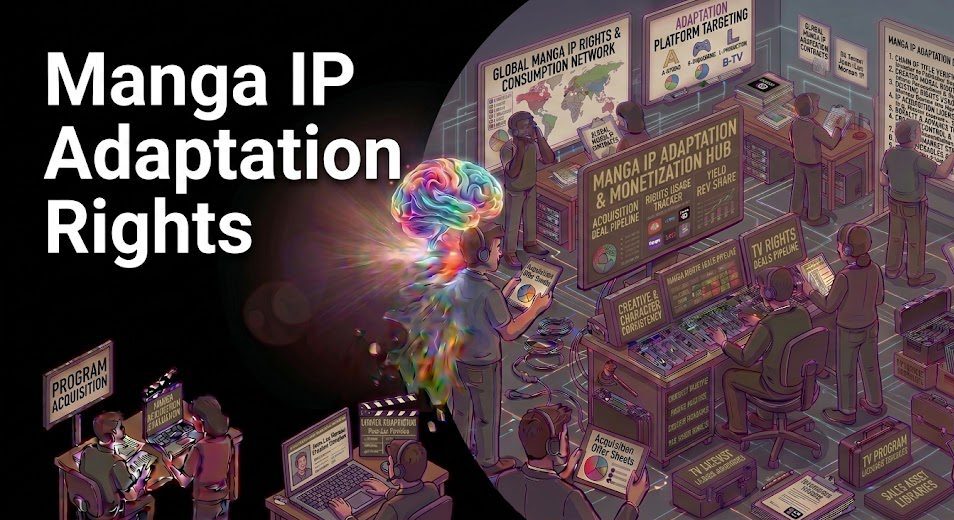
Manga IP adaptation rights are no longer a niche acquisition conversation. They’re the most contested IP category in global entertainment—and studios that don’t have a structured strategy for sourcing, optioning, and structuring these deals are already behind the ones that do.
Look at the deal flow. Will Smith’s Westbrook Studio partnered with Web3 anime platform Azuki to build original anime content around their IP. Sony deepened its vertical integration by acquiring a stake in Bandai Namco—a move that tightens its grip on one of Japan’s most valuable manga and game IP libraries. Toho opened a European headquarters specifically to manage international exploitation of its catalogue. And CJ ENM is deploying AI-powered animation pipelines to accelerate Korean webtoon-to-screen conversion at a pace traditional studios can’t match.
The market is moving. And the studios winning manga IP adaptation rights deals right now aren’t doing it through luck or relationships alone—they’re doing it with better intelligence, faster deal structures, and a clear-eyed read on what rights layers matter most when the source material comes from Tokyo or Seoul, not Los Angeles.
Here’s what the 2026 playbook looks like.
Table of Contents
- Why Manga IP Adaptation Rights Are the Hottest Asset Class in 2026
- The 4 Rights Layers Studios Get Wrong (And How They Cost You the Deal)
- Option vs. Full Purchase: Which Structure Fits Your Manga Acquisition Strategy
- Japan’s 50% Incentive and What It Means for Your Production Deal
- How Sony, Toho, and CJ ENM Are Vertically Integrating Around Manga IP
- The Fragmentation Paradox Is Killing Your Manga IP Pipeline
- 6 Moves to De-Risk Your Manga IP Adaptation Rights Strategy
- FAQ: Manga IP Adaptation Rights
- Key Takeaways
Ask VIQI: Which Manga Publishers Are Actively Licensing Adaptation Rights Right Now?
VIQI is Vitrina’s AI assistant—trained on 1.6 million titles, 360,000 companies, and 5 million entertainment professionals. Get real-time intelligence on manga IP availability, publisher contacts, and active adaptation deals before your competitors do.
✓ Included with 200 free credits | ✓ No credit card needed
Why Manga IP Adaptation Rights Are the Hottest Asset Class in 2026
The global anime market crossed $30 billion in 2024 and continues climbing, driven almost entirely by IP that started as ink on paper. But it’s not just anime. Hollywood live-action adaptations of manga properties—from Sony’s Ghost in the Shell to Netflix’s expanding slate of original anime series—have established a commercial thesis that the industry has finally stopped questioning: proven manga IP carries built-in audience demand that greenlit originals can’t replicate.
And the supply is real. Japan’s manga industry publishes over 13,000 new titles annually. South Korea’s webtoon market—the digital-first cousin of manga—has generated over 70 million active monthly readers globally. That’s an IP funnel studios haven’t been systematically tapping—because most don’t know how to navigate the Japanese publisher system, the digital-first Korean creator ecosystem, or the rights architecture that governs both.
But that’s changing fast. As our
analysis of how anime adaptations are changing global content strategies makes clear, the studios moving fastest aren’t waiting for manga IP to walk through their front door. They’re building systematic pipelines to source, vet, and option titles before they hit the English-language trades.
The 4 Rights Layers Studios Get Wrong (And How They Cost You the Deal)
Here’s the thing: manga IP adaptation rights aren’t a single layer. They’re four—and most studios negotiate the one that’s visible while leaving the other three to blow up in production or distribution.
1. Publishing Rights
The base IP sits with the publisher—Shueisha, Kodansha, Shogakukan in Japan; Naver Webtoon, Kakao Entertainment in Korea. They hold the source material rights and control what formats adaptation licenses cover: live-action, animated, or both. Don’t assume your live-action option covers an animated spin-off. It almost certainly doesn’t.
2. Creator/Author Rights
In Japan especially, the mangaka retains significant approval rights—over casting, script, character design, and sometimes distribution territory. A publisher can grant you an option. But the creator can still kill your adaptation if you don’t get their sign-off on the creative direction. This doesn’t show up in the deal memo. It surfaces six months into development.
3. Merchandising and Ancillary IP
The actual financial upside in major manga adaptations isn’t the film or series license fee—it’s the merchandise, gaming rights, and theme park exploitation that follows a successful title. Sony‘s acquisition of a stake in Bandai Namco was explicitly about securing access to this layer, not just the content. If your option agreement doesn’t address ancillary rights, you’ve licensed the least profitable part of the asset.
4. Digital and Platform-Specific Rights
Streaming platforms want global SVoD rights. Publishers want to retain AVOD, FAST, and short-form clip rights in Japan. These overlap in ways that create real conflict—especially as platforms like Netflix and Amazon commission anime originals that compete directly with the publisher’s own streaming ambitions on platforms like Crunchyroll. Get the platform-specific rights matrix sorted before you’re in post-production on a title with a contested Japanese streaming window.

Your AI Assistant, Agent, and Analyst for the Business of Entertainment
VIQI AI helps you plan content acquisitions, raise production financing, and find and connect with the right partners worldwide.
- Find active co-producers and financiers for scripted projects
- Find equity and gap financing companies in North America
- Find top film financiers in Europe
- Find production houses that can co-produce or finance unscripted series
- I am looking for production partners for a YA drama set in Brazil
- I am looking for producers with proven track record in mid-budget features
- I am looking for Turkish distributors with successful international sales
- I am looking for OTT platforms actively acquiring finished series for the LATAM region
- I am seeking localization companies offer subtitling services in multiple Asian languages
- I am seeking partners in animation production for children's content
- I am seeking USA based post-production companies with sound facilities
- I am seeking VFX partners to composite background images and AI generated content
- Show me recent drama projects available for pre-buy
- Show me Japanese Anime Distributors
- Show me true-crime buyers from Asia
- Show me documentary pre-buyers
- List the top commissioners at the BBC
- List the post-production and VFX decision-makers at Netflix
- List the development leaders at Sony Pictures
- List the scripted programming heads at HBO
- Who is backing animation projects in Europe right now
- Who is Netflix’s top production partners for Sports Docs
- Who is Commissioning factual content in the NORDICS
- Who is acquiring unscripted formats for the North American market
Option vs. Full Purchase: Which Structure Fits Your Manga Acquisition Strategy
Most studios default to option agreements on manga IP—and for good reason. Options give you control of a title for a defined period (typically 12–24 months, sometimes with a renewal right) while you develop the script, attach talent, and take the project to platform buyers. Full purchase before you have a deal is capital you can’t recover if the title doesn’t attract a greenlight.
But options on manga come with complications that book or screenplay options don’t.
Exclusivity periods are shorter. Top-tier manga titles—anything in Shueisha’s Weekly Shonen Jump catalogue, for instance—can generate competing interest from multiple studios and platforms simultaneously. Publishers won’t grant long exclusivity windows unless the option fee is significant. Budget for that.
Creative approval terms can function like a veto. The mangaka’s approval rights, if embedded in the option agreement, effectively give a creator the ability to reject your adaptation direction at any point before production commences. That’s not an option—it’s a conditional license. Know what you’re getting.
Sequel and spinoff rights need explicit negotiation. If you option Volume 1 of a 30-volume series and your adaptation succeeds, you don’t automatically control Volumes 2–30. Studios have been burned on this more than once. The
complete guide to buying film and TV rights in 2026 covers the full sequencing framework in detail.
Track Which Manga Publishers and Webtoon Platforms Are Actively Licensing IP
Trusted by Netflix, Warner Bros, Paramount, and Google TV. Join 140,000+ companies tracking active IP acquisition and licensing activity across the global entertainment supply chain.
✓ 200 free credits | ✓ No credit card required | ✓ Full platform access
Japan’s 50% Incentive and What It Means for Your Manga Production Deal
Japan recently launched a production incentive program offering up to 50% cash rebates on qualifying international productions—capped at approximately $6.7M (¥1B) per project. For studios optioning manga IP and considering Japanese production infrastructure, this changes the economics substantially.
But here’s where studios miss the play: the incentive isn’t just a cost offset—it’s a relationship signal. Shooting in Japan, even partially, demonstrates cultural investment to publishers and mangaka who are evaluating whether to trust a foreign studio with their IP. That’s not soft strategy. That’s actual deal leverage.
And Japan isn’t the only Sovereign Content Hub in play. South Korea—where Netflix committed $2.5 billion to local production—has become a fully operational animation and live-action production center. CJ ENM‘s AI-powered animation pipelines are compressing webtoon-to-screen timelines in ways that make Korean IP sourcing and production co-location genuinely competitive with traditional animation pathways. And Disney Japan’s landmark partnership with CJ ENM’s TVING for K-content distribution signals that the western studio appetite for APAC IP isn’t slowing down.
According to
The Hollywood Reporter, streaming platform investment in APAC original production has grown faster than any other region in the past 36 months—making the sourcing infrastructure in both Japan and South Korea directly relevant to any studio building a manga IP adaptation strategy.
How Sony, Toho, and CJ ENM Are Vertically Integrating Around Manga IP
The studios that are actually winning in manga IP adaptation aren’t just optioning titles—they’re building structures that own the full chain: publisher relationships, production infrastructure, distribution, and merchandise exploitation. That’s a different game than a one-off option agreement.
Sony’s stake in Bandai Namco gives it access to manga-origin IP alongside gaming and merchandise rights in a single structure. Crunchyroll—owned by Sony—provides the distribution pipeline that closes the loop. If you’re competing for IP that Sony also wants, you’re competing against a company that controls publishing access, production, distribution, and merchandise in a single integrated entity.
Toho‘s decision to establish a European headquarters represents a different vertical play—geographic integration, not sector integration. By planting a permanent flag in Europe, Toho can manage international IP licensing relationships locally rather than routing everything through Tokyo. Faster decisions, tighter control, and proximity to the European buyers and co-production partners who want their catalogue.
And then there’s the Web3 angle. Will Smith’s Westbrook Studio went after Azuki‘s anime IP specifically because the Azuki community represents a pre-built, globally distributed fanbase—audience demand without traditional distribution overhead. That’s a new kind of manga IP acquisition logic: buy the community, not just the characters. As our
strategic guide to anime licensing and distribution covers, the IP sourcing landscape has genuinely expanded beyond traditional publisher pipelines.
Meanwhile, Toonz Media Group and Japan’s 1st Place formed a global anime production alliance—explicitly designed to accelerate the path from manga sourcing to production completion for non-Japanese studios. And Utopai Studios partnered with Stock Farm Road on a multibillion-dollar AI venture specifically aimed at globalizing K-content production. These aren’t isolated deals—they’re infrastructure moves that compress the timeline between IP acquisition and finished content.
The Fragmentation Paradox Is Killing Your Manga IP Pipeline
The Fragmentation Paradox™ hits manga IP sourcing harder than almost any other content category. You’re dealing with 13,000+ new manga titles annually in Japan alone—plus tens of thousands of Korean webtoons across Naver, Kakao, and independent creator platforms. The universe of optionable IP is enormous. But the information infrastructure for navigating it is still built on personal relationships, trade press, and expensive market trips to Tokyo and Seoul.
That information gap costs real money. By the time a title surfaces in English-language trades as an adaptation target, the option competition is already intense—and the price has moved. Studios that found Attack on Titan, Demon Slayer, and Jujutsu Kaisen before they hit western radar didn’t do it through Deadline. They did it through systematic tracking of performance metrics in the Japanese domestic market, six to twelve months before international interest materialized.
As
Deadline has tracked repeatedly across recent anime adaptation announcements, the competitive intensity for A-tier manga titles means the deals that make news are rarely the deals that made money—because the margin got squeezed out by the time the bidding became public.
Vitrina maps 140,000+ companies across the M&E supply chain—including the publishers, talent agencies, production companies, and platform partners that sit inside the manga IP ecosystem. When a publisher starts fielding inquiries on a title, or when a Korean webtoon platform shifts its licensing strategy toward international adaptation partners, that signal appears in deal flow data before it hits the trades. That’s the Insider Advantage in action—and it’s the only reliable way to source manga IP adaptation rights before the window costs you three times what it should.
Need Direct Introductions to Manga Publishers and Webtoon IP Holders?
Vitrina Concierge is your Virtual Agent. We don’t give you a list—we make warm introductions directly to decision-makers at the publishers, platforms, and rights holders actively licensing adaptation rights.
- LA producer → Netflix UK, Fifth Season, Fox Entertainment (48 hours)
- Korean animation studio → Netflix Adult Animation (week one)
- Middle Eastern studio → Legendary Pictures (direct access)
6 Moves to De-Risk Your Manga IP Adaptation Rights Strategy in 2026
The studios closing smart manga IP adaptation rights deals in 2026 aren’t guessing. They’re running structured acquisition processes that compress timelines and protect capital. Here’s the framework:
- Build your IP sourcing funnel before you need it. By the time a title is on your radar as a live acquisition target, you’re already in a competitive auction. The studios winning at option stage are tracking domestic Japanese and Korean performance data—serialization velocity, reader volume, merchandise velocity—6–12 months before international interest materializes. Set up the tracking infrastructure now.
- Map all four rights layers before opening any negotiation. Publishing rights, creator approval rights, ancillary/merchandise rights, and platform-specific digital rights. Know who controls each layer and what their licensing history looks like before you’re across the table. Surprises in rights architecture are the number-one deal killer at the LOI stage.
- Build creator relationships as seriously as publisher relationships. In the Japanese market especially, the mangaka’s creative approval can functionally override a publisher license. Studios that invest in direct creator relationships—through in-person visits, cultural consultants, and long-term developmental partnerships rather than transactional option negotiations—close faster and with fewer post-signing surprises.
- Attach Japanese or Korean production partners early. Not just for co-production treaty benefits or access to Japan’s 50% incentive—but because a named domestic production partner signals cultural credibility to the publisher. It’s a rights negotiating advantage that costs less than you’d think and delivers more than most studios realize.
- Negotiate series rights, not single-volume rights. One-volume options on long-running series are landmines. If your adaptation succeeds and you don’t control the source material for subsequent seasons, you’re negotiating a sequel from a position of zero leverage. The publisher knows your audience now. Structure the series option at inception, even if you pay more for it upfront.
- Use platform intelligence to drive your acquisition priorities. Not all manga IP is equally attractive to all platforms. Netflix’s anime commissioning priorities differ from those of Amazon, Crunchyroll, and Disney+. Know which platforms are actively acquiring specific genres and formats—and source IP that matches those acquisition windows. Our
strategic guide to Korean animation IP acquisition and co-production maps the platform demand landscape across APAC genres in detail.
FAQ: Manga IP Adaptation Rights
What are manga IP adaptation rights?
Manga IP adaptation rights are the licensed permissions to adapt a manga series—Japanese comic-format storytelling—into another medium: typically live-action film, animated series, or live-action television. These rights are negotiated with the source material’s publisher and, critically, often require creator approval. They’re distinct from merchandising rights, gaming rights, and digital distribution rights—which require separate negotiation with different rights holders.
How do I option a manga title for adaptation?
Manga options are typically negotiated with the Japanese publisher—Shueisha, Kodansha, or Shogakukan for most major titles—rather than directly with the creator. Option periods run 12–24 months with renewal provisions. The option fee is applied against the full purchase price if you exercise. But be clear about what the option covers: live-action rights, animated rights, or both are usually treated as separate licenses. Creator approval clauses embedded in publisher contracts can function as additional veto rights that aren’t visible in the main option agreement.
What’s the difference between a manga adaptation and a webtoon adaptation?
Manga is the Japanese format—print-first, black-and-white, serialized in magazines before collection in tankōbon volumes. Webtoons are the Korean digital-first format—vertical scroll, full color, distributed natively through platforms like Naver Webtoon and Kakao Entertainment. The rights architecture differs significantly. Webtoon IP is often held by the platform rather than a traditional publisher, and creator contracts can leave adaptation rights ambiguous. Korean webtoon adaptation deals frequently require direct negotiation with both the platform and the original creator.
Why is the mangaka’s approval so critical in adaptation negotiations?
Japanese creative culture places significant weight on the creator’s connection to their work. Publisher contracts frequently embed mangaka approval rights over key creative decisions—casting, script, character design, and sometimes territory of distribution. These aren’t advisory preferences. They’re contractual rights that can delay or terminate a production that the creator finds misaligned with their vision. Studios that treat the mangaka relationship as secondary to the publisher relationship consistently hit problems six to twelve months into development.
How does Japan’s 50% production incentive affect manga adaptation deals?
Japan’s new cash rebate—offering up to 50% of qualifying production expenditure, capped at approximately $6.7M per project—meaningfully changes the economics of producing manga adaptations on Japanese soil. Beyond the financial offset, shooting in Japan signals cultural investment that influences publisher and creator willingness to grant favorable rights terms. Studios that combine IP acquisition with production co-location in Japan gain negotiating advantages in both the rights deal and the relationship dynamics that govern long-term franchise access.
What do streaming platforms pay for manga adaptation rights?
Adaptation license fees vary enormously based on the title’s existing audience, serialization history, and competitive interest. Library titles from established series with proven global readership can command option fees ranging from $50,000 to $500,000 for a 12-month exclusive period, with full purchase prices scaling from $250,000 to several million dollars for major IP. New titles from emerging creators can be optioned for significantly less. Platform commissioning budgets for anime originals based on optioned manga IP typically run $2M–$8M per episode for premium streaming series.
How do I find manga publishers and webtoon platforms actively licensing adaptation rights?
The traditional approach—trade show attendance, agent introductions, and publisher submissions—is slow and relationship-dependent. Vitrina maps 140,000+ companies including Japanese publishers, Korean webtoon platforms, anime production companies, and the sales agents who represent them internationally. VIQI, Vitrina’s AI intelligence assistant, can answer specific queries about which publishers are actively licensing adaptation rights, which titles have attracted recent platform interest, and which Korean webtoon properties have the domestic performance metrics that typically precede major adaptation deals.
What rights should I negotiate beyond the core adaptation license?
The core adaptation license gets you the screen rights. But the commercial upside in major manga adaptations lives in sequel and spinoff rights (negotiate series control, not single-volume control), remake rights for international local versions, gaming adaptation rights, merchandise and consumer products rights, and theme park or experiential exploitation rights. Sony‘s move on Bandai Namco was explicitly about securing the full bundle rather than piecemeal licensing—because piecemeal is where you lose value.
Key Takeaways: Manga IP Adaptation Rights in 2026
The competition for proven manga IP is intensifying on every axis—more studios bidding, faster deal timelines, more complex rights architectures, and vertically integrated incumbents like Sony and Toho that own the full exploitation chain. The studios that win aren’t just well-connected. They’re better informed, faster to source, and more disciplined in how they structure what they buy.
- Manga IP adaptation rights have four distinct layers—publishing, creator approval, ancillary/merchandise, and digital platform rights—all requiring separate negotiation strategies.
- Japan’s 50% production incentive changes the economics of manga adaptations produced on Japanese soil—and serves as relationship-building leverage with publishers and creators simultaneously.
- Vertical integration is the strategy of the incumbents—Sony/Bandai Namco, Toho/European HQ, CJ ENM/AI animation pipelines. Compete against that with better sourcing intelligence, not better relationships.
- The Fragmentation Paradox™ means most studios are negotiating with a fraction of their potential IP supplier pool—and paying inflated prices for titles that are already competitive by the time they appear in trades.
- Negotiate series rights at inception—single-volume options on long-running series are a structural mistake that costs real leverage if the adaptation succeeds.
Find Manga and Webtoon IP Holders Actively Licensing Rights—Right Now
Trusted by Netflix, Warner Bros, Paramount, and Google TV. Track 400,000+ projects. Access 3 million verified executives. Identify the publishers and webtoon platforms licensing adaptation rights in your genre before the window closes.
✓ 200 free credits | ✓ No credit card required | ✓ Cancel anytime
Need warm introductions to Japanese publishers or Korean webtoon platforms? Explore Concierge Service →
Find Film+TV Projects, Partners, and Deals – Fast.
VIQI matches you with the right financiers, producers, streamers, and buyers – globally.
Producers Seeking Financing & Partnerships?
Book Your Free Concierge Outreach Consultation
(To know more about Vitrina Concierge Outreach Solutions click here)
Producers Seeking Financing, Co-Pros, or Pre-Buys?
Vitrina Concierge helps producers reach the right financiers, commissioners, distributors, and co-production partners — with precision outreach, not cold pitching.
Join Industry Briefings Trusted by Leaders

Film & TV Financing: Pre-Buys
Learn how pre-buys work in current Film and TV financing, how they differ from pre-sales, and how they are used to close real finance plans.
Streamers – Netflix vs. Amazon – The 2026 Strategy
How Netflix and Amazon’s content and revenue strategies are diverging ahead of 2026.
Format Adaptations: Global Trends
Where formats are traveling, which adaptations are breaking out, and how streamers are backing remakes in 2025–2026.