About Innovation Hub
 Global Content Pulse (Webinars)


 Global Production Financing
(Webinars)
Global Production Financing
(Webinars)  LeaderSpeak Podcast
  About Vitrina
 Our Story
 Our Solutions 🔥
 Film+TV Projects Tracker 🚀
 Case Studies
 Our Profile

Boardroom Ready
Licensing Negotiation Strategies 2026 have shifted from relationship-driven haggling to a clinical science powered by AI Contract Analytics. As the industry faces the “Big Crunch” of cooling subscriber growth, the “Data Deficit” in contract value has become a terminal liability for legacy studios. By weaponizing real-time Data-Driven Valuations, CXOs are now de-risking deals through automated audit trails and predictive recoupment modeling. The strategic advantage in 2026 lies in the “Human-AI Handshake,” where agentic AI executes multi-step contract workflows—identifying 15-20% margin leakage before signatures are ever dry. In Sovereign Content Hubs across MENA and APAC, this intelligence is being used to bypass opaque vendor markups, accelerating deal velocity by 40% and ensuring every production dollar is synchronized with verified global demand.
⚡ Executive Strategic Audit
EBITDA Impact
+18% via Leakage Elimination
Recoupment Cycle
40% Faster Cycle Completion

Your AI Assistant, Agent, and Analyst for the Business of Entertainment
VIQI AI helps you plan content acquisitions, raise production financing, and find and connect with the right partners worldwide.
- Find active co-producers and financiers for scripted projects
- Find equity and gap financing companies in North America
- Find top film financiers in Europe
- Find production houses that can co-produce or finance unscripted series
- I am looking for production partners for a YA drama set in Brazil
- I am looking for producers with proven track record in mid-budget features
- I am looking for Turkish distributors with successful international sales
- I am looking for OTT platforms actively acquiring finished series for the LATAM region
- I am seeking localization companies offer subtitling services in multiple Asian languages
- I am seeking partners in animation production for children's content
- I am seeking USA based post-production companies with sound facilities
- I am seeking VFX partners to composite background images and AI generated content
- Show me recent drama projects available for pre-buy
- Show me Japanese Anime Distributors
- Show me true-crime buyers from Asia
- Show me documentary pre-buyers
- List the top commissioners at the BBC
- List the post-production and VFX decision-makers at Netflix
- List the development leaders at Sony Pictures
- List the scripted programming heads at HBO
- Who is backing animation projects in Europe right now
- Who is Netflix’s top production partners for Sports Docs
- Who is Commissioning factual content in the NORDICS
- Who is acquiring unscripted formats for the North American market
Licensing Negotiation Strategies 2026: The Algorithmic Valuation Engine
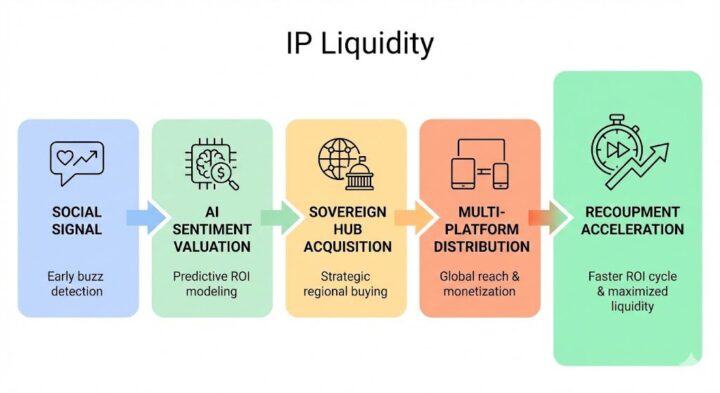
In 2026, content valuation has transitioned from a creative “black box” to an audited industrial science. We are seeing the rise of Data-Driven Valuations that factor in real-time sentiment, emotional metadata, and cross-platform consumption patterns from Sovereign Content Hubs like India and Brazil. Negotiation is no longer about the “highest bidder” but about the “highest yield” across complex windowing cycles.
For CXOs, the priority is identifying “EBITDA leakages” before the term sheet is even drafted. Static valuation reports—often six months out of date—are being discarded in favor of vertical AI engines like VIQI that track 140,000+ real-time company mappings. This ensures that every licensing fee is benchmarked against the actual market capacity of the region, de-risking the acquisition from day one.
Arash Pendari from Vionlabs notes that AI is transforming video content analysis into an emotional data layer that defines audience response before a deal is signed. This de-risks Licensing Negotiation Strategies 2026 by providing a predictive ROI map that replaces speculative valuation with verified cultural resonance.
By December 2025, over 65% of major streamers in APAC have integrated “Sentiment-to-Value” algorithms into their acquisition desks. This technology allows negotiators to adjust offers based on how specific IP segments (e.g., K-Drama vs. Telenovelas) are performing in high-growth markets, ensuring that “Weaponized Distribution” strategies are always synchronized with actual consumer demand.
Contract Analytics as Strategic Weaponry
The “Legal Friction” of the past is being replaced by AI Contract Analytics. In 2026, contracts are no longer static documents; they are dynamic data sources. Agentic AI is being deployed to scan thousands of historical agreements, identifying “landmine clauses” that previously caused 15-20% margin erosion through unoptimized backend participation and opaque reporting standards.
This “Smart Dialogue” approach allows procurement teams to walk into negotiations with a 100% transparent view of past vendor performance. If a VFX house in Eastern Europe has a history of 20% budget overruns, the AI flags this as a “Financial Liability” during the contract drafting phase. This automated due diligence is the “Insider Handshake” that bridges the gap between global studios and local specialists.
Furthermore, Authorized AI ensures that these contract workflows are legally bulletproof. By using licensed training data for contract generation, firms avoid the “IP Chain-of-Title” risks that plagued early-gen generative AI. This ensures that every clause is compliant with evolving global regulations like the EU AI Act, protecting the long-term value of the licensed assets.
Negotiating with Sovereign Hub Leverage
Negotiation power has shifted toward Sovereign Content Hubs. Regions like MENA (Saudi Arabia/UAE) and LATAM (Brazil/Mexico) are now using their capital reserves to dictate terms that favor co-production and “Rotational Windowing.” Negotiators must now understand the “Rebate Arbitrage” available in these hubs to maximize ROI.
For example, a deal with a MENA-based distributor in 2026 often includes clauses for local crew integration and virtual production subsidies. These incentives can de-risk a project’s budget by up to 40%. Without real-time data on these shifting incentive structures, negotiators leave millions on the table. Vitrina’s technical vault tracks these “Sovereign Signals” daily, providing the clinical data needed to weaponize these regional advantages during the handshake.
Licensing Negotiation Strategies 2026: The Strategic Path Forward
The transition to data-powered negotiation is no longer optional; it is a prerequisite for financial survival. By integrating AI Contract Analytics and Data-Driven Valuations into your core workflow, you eliminate the “Data Deficit” that leads to margin leakage. The future belongs to those who treat every contract not as a piece of paper, but as a strategic information layer.
The Bottom Line Weaponize your legal stack with AI-driven analytics immediately to capture a 15% EBITDA advantage and protect your recoupment cycles against the volatility of the 2026 market.
Deploy Intelligence via VIQI
Select a prompt to run a real-time negotiation audit for 2026 slates:
Insider Intelligence: Licensing Negotiation Strategies 2026 FAQ
What is the primary cause of EBITDA leakage in content licensing deals?
The primary cause is “Data Asymmetry”—the lack of real-time visibility into vendor capacity, reporting accuracy, and regional demand. AI Contract Analytics solves this by benchmarking every deal against a global verified dataset, identifying unoptimized backend terms that typically leak 15-20% of the deal’s value.
How does “Rotational Windowing” affect 2026 negotiation strategy?
Rotational Windowing is a core component of “Weaponized Distribution.” It involves licensing premium content to rivals 18-24 months post-release. Negotiators in 2026 must ensure that exclusivity clauses are time-bound and flexible, allowing for maximum recoupment across multiple platform ecosystems without violating chain-of-title.
Can AI replace human negotiators in 2026?
AI serves as an “Augmentation Layer,” not a replacement. While agentic AI can execute the “drudge work” of contract scanning and valuation benchmarking, the final “Handshake” still requires human judgment and relationship management. The most successful negotiators use AI to create a “Trust-by-Verification” environment.
How does Vitrina de-risk licensing valuations?
Vitrina maps 30 million industry relationships and real-time deal data to provide an “Early Warning Signal” for IP value. This prevents over-valuation based on legacy “hype” and ensures that every licensing offer is backed by clinical, cross-border performance data.
Find Film+TV Projects, Partners, and Deals – Fast.
VIQI matches you with the right financiers, producers, streamers, and buyers – globally.
Producers Seeking Financing, Co-Pros, or Pre-Buys?
Vitrina Concierge helps producers reach the right financiers, commissioners, distributors, and co-production partners — with precision outreach, not cold pitching.
Join Industry Briefings Trusted by Leaders

Format Adaptations: Global Trends
Where formats are traveling, which adaptations are breaking out, and how streamers are backing remakes in 2025–2026.

Books, Novels & Comics Adaptations: Global Trends
Books, webtoons, and manga driving the next global screen hits. Discover how in this webinar.

Micro-Dramas & Mobile-First Storytelling
Micro-dramas are building real audiences and revenue. Understand the platforms, buyers, and economics behind the growth.

Navigating Global Content Licensing Trends
How global content licensing is shifting beyond flat fees to flexible, deal-driven models.