

 About Innovation Hub
 Global Content Pulse (Webinars)


 Global Production Financing
(Webinars)
Global Production Financing
(Webinars)  LeaderSpeak Podcast
  About Vitrina
 Our Story
 Our Solutions 🔥
 Film+TV Projects Tracker 🚀
 Case Studies
 Our Profile
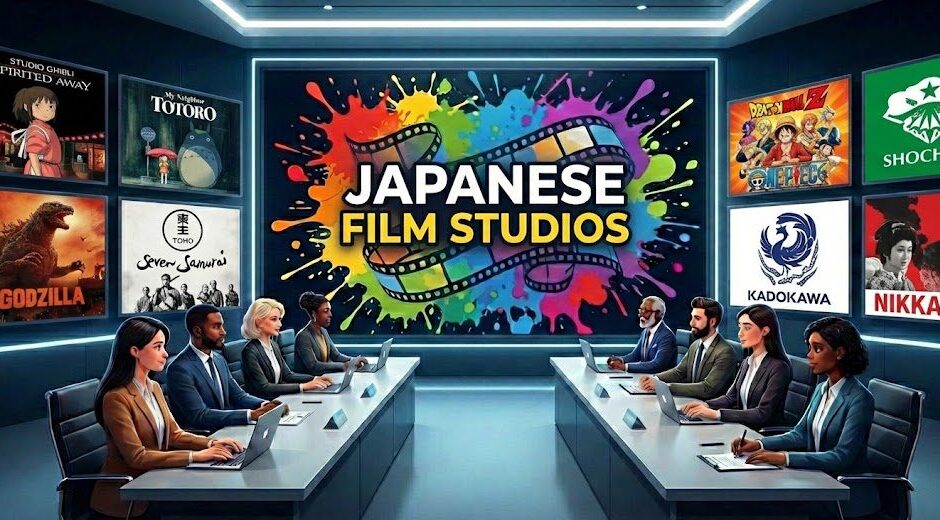
Japanese film studios are the architectural pillars of one of the world’s most influential cinematic landscapes, historically defined by the “Big Four” majors—Toho, Toei, Shochiku, and Kadokawa.
This ecosystem involves a unique blend of traditional theatrical distribution, the globally dominant anime sector, and a sophisticated production committee system that manages financial risk across diverse stakeholders.
According to the Motion Picture Producers Association of Japan, the domestic box office reached approximately $1.35 billion in 2024, with Japanese-made films capturing over 75% of the market share.
In this guide, you’ll learn how to navigate the historical prestige of these studios while leveraging modern supply chain intelligence to identify co-production partners and distribution pathways.
While most informational resources provide basic lists of companies, they fail to address the cultural nuances, historical shifts, and practical “how-to” steps required for international creators to successfully collaborate with the Japanese market.
This comprehensive analysis fills those gaps by exploring the evolution of Japanese cinema—from the Golden Age of Kurosawa to the modern anime-led resurgence—and provides a data-driven roadmap for global production teams.

Your AI Assistant, Agent, and Analyst for the Business of Entertainment
VIQI AI helps you plan content acquisitions, raise production financing, and find and connect with the right partners worldwide.
- Find active co-producers and financiers for scripted projects
- Find equity and gap financing companies in North America
- Find top film financiers in Europe
- Find production houses that can co-produce or finance unscripted series
- I am looking for production partners for a YA drama set in Brazil
- I am looking for producers with proven track record in mid-budget features
- I am looking for Turkish distributors with successful international sales
- I am looking for OTT platforms actively acquiring finished series for the LATAM region
- I am seeking localization companies offer subtitling services in multiple Asian languages
- I am seeking partners in animation production for children's content
- I am seeking USA based post-production companies with sound facilities
- I am seeking VFX partners to composite background images and AI generated content
- Show me recent drama projects available for pre-buy
- Show me Japanese Anime Distributors
- Show me true-crime buyers from Asia
- Show me documentary pre-buyers
- List the top commissioners at the BBC
- List the post-production and VFX decision-makers at Netflix
- List the development leaders at Sony Pictures
- List the scripted programming heads at HBO
- Who is backing animation projects in Europe right now
- Who is Netflix’s top production partners for Sports Docs
- Who is Commissioning factual content in the NORDICS
- Who is acquiring unscripted formats for the North American market
Producers Seeking Financing & Partnerships?
Book Your Free Concierge Outreach Consultation
(To know more about Vitrina Concierge Outreach Solutions click here)
Table of Contents
- 01What is the History of the Japanese Studio System?
- 02Who are the “Big Four” Japanese Film Studios?
- 03How has Anime Transformed Japanese Studio Dominance?
- 04How Do Production Committees Work in Japan?
- 05When Should Producers Target Japanese Partnerships?
- 06Industry Perspective: Localization and Global Growth
- 07Key Takeaways
- 08FAQ
Key Takeaways for Producers
-
Studio Sovereignty: Understanding the Big Four (Toho, Toei, Shochiku, Kadokawa) is essential as they control the majority of domestic distribution and screen availability.
-
Risk Mitigation Models: The “Production Committee” (Seisaku Iinkai) system is the standard for funding, allowing studios to share risk with broadcasters and agencies.
-
Co-Production Advantage: Independent producers can leverage supply chain data to identify active Japanese partners looking for international story hooks and tax incentive synergies.
What is the History of the Japanese Studio System?
The Japanese film industry emerged at the turn of the 20th century, deeply intertwined with traditional theatrical forms like Kabuki and the live narration of Benshi storytellers. Unlike the Hollywood model, which centralized around West Coast production hubs, the Japanese studio system developed as a dialogue between the tradition-rich Kyoto and the urban, modernizing Tokyo. This dual identity allowed studios to alternate between “Jidaigeki” (period dramas) and “Gendaigeki” (contemporary stories), creating a diverse content slate that resonated both locally and internationally.
By the 1930s, the “majors” had consolidated their power, establishing a vertically integrated structure that controlled production, distribution, and exhibition. Following the devastation of the 1923 Great Kanto Earthquake, studios like Nikkatsu and Shochiku rebuilt with a focus on modern narrative techniques, laying the groundwork for what would become the “Golden Age” of the 1950s. This era saw directors like Akira Kurosawa and Yasujiro Ozu achieve global acclaim, proving that deeply local Japanese stories could possess universal emotional resonance.
Find historical production partners in Japan:
Who are the “Big Four” Japanese Film Studios?
To effectively navigate the Japanese market, producers must understand the distinct identities of the “Big Four” majors that comprise the Motion Picture Producers Association of Japan (MPPAJ). Toho is the undisputed leader, holding a massive 33.7% distribution share and serving as the home of iconic franchises like Godzilla and the global distributor for Studio Ghibli. Their urban, producer-centric management model has made them the most commercially resilient studio in the post-war era.
- Shochiku: Historically known for its “new theater” principles and focus on domestic family dramas (Shomingeki), it granted directors like Ozu significant creative freedom.
- Toei: A powerhouse in the 1950s for Jidaigeki, Toei now leads the animation sector through Toei Animation, producing hits like Dragon Ball and One Piece.
- Kadokawa: Originally a publishing house, Kadokawa disrupted the industry in the 1970s with high-concept “blockbuster” strategies and later spearheaded the J-horror wave with Ringu.
In 2025, these studios have evolved into diversified media conglomerates. They no longer rely solely on ticket sales; they manage massive IP portfolios that span manga, gaming, and character licensing. For independent producers, these studios represent both the primary hurdle to wide distribution and the most valuable potential co-financing partners for high-budget projects.
Identify active acquisition leads at Toho and Toei:
How has Anime Transformed Japanese Studio Dominance?
The modern commercial apex of the Japanese film industry is defined by animation. As of 2025, the top 16 highest-grossing Japanese films worldwide are all anime. Studios like Studio Ghibli, Toei Animation, and more recently, MAPPA and Wit Studio, have shifted the industry’s center of gravity from live-action period pieces to high-concept, visually stunning animation that commands a global fanbase.
This “Anime Monopoly” is driven by massive franchises. In 2025, Demon Slayer: Kimetsu no Yaiba Infinity Castle broke records by grossing over ¥38 billion, reinforcing that the theatrical experience in Japan is often synonymous with event-style anime releases. This trend has attracted global streamers like Netflix, which recently secured major licensing deals for Studio Ghibli’s library, further globalizing the reach of Japanese animation studios.
Industry Expert Perspective: Deepdub Decoded: AI and Global Content Discovery
As Japanese studios seek to expand their global footprint, localization technology has become a critical bottleneck. In this conversation, DeepDub CEO Ofir Krakowski explores how AI-driven voice technology is accelerating the speed at which Japanese content reaches international audiences while maintaining emotional authenticity.
Ofir shares the journey of building DeepDub to power global content discovery. The discussion highlights how emotional AI voice stacks enable authentic multilingual storytelling, a vital tool for Japanese studios aiming to bypass traditional sub-vs-dub barriers in Western markets.
How Do Production Committees Work in Japan?
The “Production Committee” (Seisaku Iinkai) system is the defining financial framework of the Japanese studio world. Instead of a single studio financing a project entirely, a group of companies—often including a studio, a broadcaster, an advertising agency like Dentsu, a publisher, and a record label—forms a temporary entity to share the investment and the risk. This model allows for massive cross-media promotion, ensuring that a film’s release is supported by manga tie-ins, TV broadcasts, and soundtrack marketing.
For international producers, the committee system presents a complex web of rights and decision-making. Negotiating with a committee requires understanding the priorities of each member, from theatrical windowing to merchandising rights. However, for those who successfully enter these circles, it provides a stable, multi-channel marketing engine that few other global markets can replicate.
Research recent production committee structures:
When Should Producers Target Japanese Partnerships?
Collaborating with Japanese film studios is most effective when a project offers unique “information gain” or cultural crossover potential. Kyoto Filmmakers Lab and the Japan Film Commission (JFC) are the primary entry points for international filmmakers, providing support for location scouting, local production services, and navigating non-tax incentives. Since 2024, there has been a significant push for international co-productions, supported by the Ministry of Economy, Trade and Industry (METI).
Independent producers should start their outreach 12-18 months before primary photography. Using supply chain intelligence platforms like Vitrina allows you to identify which studios are actively diversifying their slates or looking for international IP to adapt. Successful co-productions, like the Korean-Japanese collaboration Kokuho (2025), demonstrate that blending Japanese cultural heritage with international narrative expertise can result in record-breaking box office success.
Moving Forward
The Japanese film studio ecosystem is undergoing a structural renaissance, moving from a domestic-first focus to a globally competitive model powered by anime prestige and strategic co-productions. This transformation addresses the historical opacity of the market, opening new doors for data-literate international producers.
Whether you are an independent producer looking to secure a Japanese distribution deal, or a studio lead trying to identify trending IP for adaptation, the path to success lies in verified supply chain intelligence. Understanding who is financing, who is acquiring, and who is collaborating transforms high-risk networking into a strategic science.
Outlook: Over the next 18 months, expect a surge in AI-assisted anime production and more “Authorized Data” deals as Japanese studios leverage their vast IP libraries for global streaming partnerships.
Frequently Asked Questions
Quick answers to common queries regarding the Japanese film industry.
Which studio is the oldest in Japan?
What are Jidaigeki and Gendaigeki?
How do I film in Japan as a foreigner?
Who handles distribution for Studio Ghibli?
Is there a tax credit for filming in Japan?
What is the “Big Four”?
What role does anime play in the studio system?
How can Vitrina AI help with Japanese production?
About the Author
Written by the Vitrina Editorial Team, specializing in entertainment supply chain intelligence and global market analysis. Our data powers strategic decision-making for 600,000+ industry professionals. Connect on Vitrina.
Find Film+TV Projects, Partners, and Deals – Fast.
VIQI matches you with the right financiers, producers, streamers, and buyers – globally.
Producers Seeking Financing & Partnerships?
Book Your Free Concierge Outreach Consultation
(To know more about Vitrina Concierge Outreach Solutions click here)
Producers Seeking Financing, Co-Pros, or Pre-Buys?
Vitrina Concierge helps producers reach the right financiers, commissioners, distributors, and co-production partners — with precision outreach, not cold pitching.
Join Industry Briefings Trusted by Leaders

Deep dive into Co-Pros
Ambitious co-productions are key to global hits, but most deals collapse. This deep-dive briefing is the strategic playbook. We’ll break down the financing models, partnership structures, and market insights behind today’s successful deals.

Film & TV Financing: Tax Credits & Incentives
A focused look at how 2025 tax credits and incentives are reshaping Film & TV financing decisions — and where the real value now sits.

Film & TV Financing: Pre-Buys
Learn how pre-buys work in current Film and TV financing, how they differ from pre-sales, and how they are used to close real finance plans.

Streamers – Netflix vs. Amazon – The 2026 Strategy
How Netflix and Amazon’s content and revenue strategies are diverging ahead of 2026.