About Innovation Hub
 Global Content Pulse (Webinars)


 Global Production Financing
(Webinars)
Global Production Financing
(Webinars)  LeaderSpeak Podcast
  Global Entertainment Digest (Newsletter)
  About Vitrina
 About VIQI
 Our Story
 Our Solutions 🔥
 Film+TV Projects Tracker 🚀
 Case Studies
 Our Profile
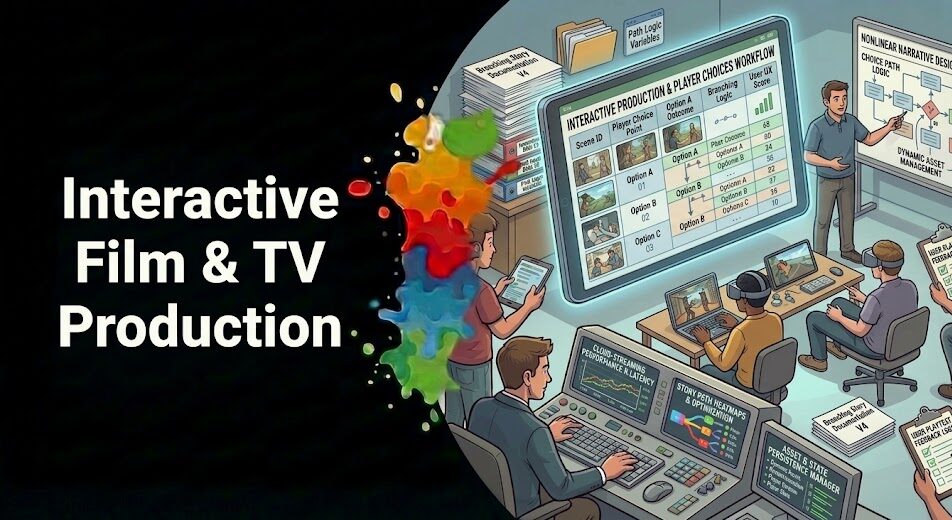
The term interactive film and TV production got battered into meaninglessness between 2018 and 2022. Everyone claimed to be doing it. Almost nobody was doing it well. And after Netflix’s Black Mirror: Bandersnatch generated headlines without generating a commissioning wave, a lot of executives quietly filed the whole category under “interesting experiment, not a business.”
That filing cabinet is now being reopened. But the formats inside look nothing like the 2018 vintage. Interactive production in 2026 isn’t just choose-your-own-adventure with a bigger budget—it’s a spectrum of participatory formats that includes AI-driven narrative branching, live audience-influence programming, shoppable entertainment, gamified unscripted, and transmedia IP designed to move fluidly between screen, game engine, and immersive experience. The production infrastructure behind it has matured. The commissioning logic has sharpened. And the cost realities are finally being spoken about honestly.
If you’re a producer, commissioner, or content investor evaluating where interactive formats sit in your 2026 slate strategy, this is the intelligence briefing you need before walking into that pitch.
Table of Contents
- What “Interactive” Actually Means in 2026 Production
- The 5 Interactive Formats Getting Commissioned Right Now
- What Interactive Production Actually Costs
- Who Is Commissioning Interactive Content in 2026
- The Capital Stack Problem: Why Interactive Is Hard to Finance
- Voice AI and Synthetic Performance: The Production Wildcard
- Finding the Right Interactive Production Partners
- FAQ
- Conclusion
Ask VIQI: Who Is Commissioning Interactive Content in Your Territory Right Now?
VIQI is Vitrina’s AI assistant—trained on 1.6 million titles, 360,000 companies, and 5 million entertainment professionals. Get real-time answers on interactive format commissioning before the trades pick it up.
✓ Included with 200 free credits | ✓ No credit card needed
What “Interactive” Actually Means in 2026 Production
Here’s the thing: “interactive” as a production category has splintered. And if you’re pitching or evaluating projects without a clear taxonomy, you’ll find yourself talking past every commissioner in the room. So let’s ground this.
In 2026, interactive film and TV production covers at least five distinct format architectures—each with its own production logic, cost structure, and commissioning home. They share one characteristic: the audience isn’t purely passive. Beyond that, the similarities break down fast.
The clearest way to think about the spectrum is by asking: at what point in the production process does audience input shape the content? Pre-produced branching narratives lock in all possible story paths before release. Live audience-influence formats respond to viewer choices in real-time during broadcast. AI-generative experiences create never-identical content for each viewer. Participatory formats—think reality shows where audiences vote to influence outcomes—sit in a hybrid middle ground. And transmedia interactive IP spans all of it, designing the story universe to be experienced across game, screen, and immersive format simultaneously.
That last category—transmedia—is where the real strategic money is moving in 2026. As we’ve covered in our analysis of game adaptations and Hollywood’s evolving IP strategy, the most commercially durable interactive projects aren’t built as standalone experiments. They’re engineered as multi-platform IP ecosystems from the development stage. That changes the production budget, the rights structure, and—critically—who you’re pitching to.
The 5 Interactive Formats Getting Commissioned Right Now
Not all interactive formats are created equal—and commissioners aren’t treating them equally either. Here’s an honest breakdown of what’s actually moving in 2026 and what’s still mostly talk.
1. Branching Narrative Series
The most structurally mature format. Pre-production locks in every branch point, every alternate scene, every ending variant—which means writing 3-5x more script pages than a linear equivalent and producing 30-60% more shooting days to cover all pathways. The post-production complexity is significant: editorial has to manage hundreds of conditional content states. Netflix pioneered this with Bandersnatch, then quietly pulled back on commissioning volume as the ROI case proved harder to build than the PR case. But the format hasn’t died—it’s matured. The projects now in development are tighter, with fewer branches and higher-quality decision points that genuinely change story outcomes.
2. Live Audience-Influence Formats
This is the most rapidly scaling interactive format in 2026. Reality and competition formats with real-time audience voting have existed for decades—Pop Idol is older than most streaming platforms. What’s changed is the infrastructure: second-screen integration, companion app voting mechanics, and live social aggregation now allow audience influence to alter format outcomes in production-level ways, not just eliminate contestants. The commissioning home is primarily broadcast and FAST channels with live programming mandates, not on-demand streamers. Production budgets are close to—or slightly above—equivalent non-interactive formats because the complexity lives in broadcast operations, not in additional shoot days.
3. AI-Generative Narrative Experiences
The most experimental category. Instead of pre-producing all content states, AI-generative formats create unique story paths for each viewer session—meaning no two experiences are identical. The production challenge is monumental: you’re not making a show, you’re building a narrative engine. The content rules, character voice logic, world constraints, and story state machine all need to be authored before a single frame is rendered. Fable Studios’ Showrunner is the most discussed example—a platform that allows users to generate animated TV episodes through prompts. It’s less a traditional production company and more a creative AI infrastructure project. But that’s exactly where the format lives right now: on the boundary of production and technology product.
4. Shoppable and Commerce-Integrated Entertainment
Don’t underestimate this one. Shoppable TV—where viewers can purchase products featured in-content via interactive overlays—has grown from a novelty into a genuine commissioning priority for platforms with e-commerce ambitions. Amazon Prime Video‘s X-Ray feature already enables in-content product discovery. The format is expanding beyond lifestyle and fashion programming into drama and unscripted. For producers, this creates a new revenue layer that changes the financing conversation: brand integration fees and performance-based commerce revenue can materially alter the capital stack for a format that might struggle on license fee alone. As reported by Deadline, commerce-enabled formats are now a specific mandate in several platform content strategies for 2026—not just a nice-to-have overlay.
5. Transmedia IP Ecosystems
The most strategically sophisticated play. Here, the core IP is designed from the ground up to be experienced across linear TV, a companion game, an interactive streaming experience, and potentially a live/immersive format—with each platform contributing unique story layers rather than just repurposing the same content. The canonical 2026 example? The way Sony’s acquisition of Peanuts IP is being managed—library titles feeding streaming, new interactive experiences feeding kids gaming platforms, live events feeding experiential revenue. That’s transmedia architecture at work. The interactive layer is designed in, not bolted on.
Map Interactive Format Commissioners Across 140,000+ Companies
Trusted by Netflix, Warner Bros, and Paramount. Join 140,000+ companies tracking real-time commissioning activity across the global content supply chain.
✓ 200 free credits | ✓ No credit card required | ✓ Full platform access
What Interactive Production Actually Costs
This is where most pitches fall apart. And I’ll be direct: interactive production costs more than linear. Full stop. Anyone telling you otherwise is either working in a format category that doesn’t require significant branching complexity—or hasn’t actually budgeted an interactive project.
The cost premium varies significantly by format type. Here’s the practical breakdown:
The EBITDA implication here is real. If you’re packaging an interactive branching series at a budget of $3M per episode when the linear equivalent would cost $1.5M—you need a commissioning partner whose license fee reflects the interactive premium, or you need to close that gap with brand/commerce revenue, a transmedia co-production structure, or both. Most interactive projects that collapse in development do so not because the creative isn’t strong—but because the capital stack was built on a linear valuation for a non-linear cost.
Tax incentives are—so far—format-agnostic in most jurisdictions. If your interactive project qualifies as an eligible production in the UK, Canada, Australia, or Germany, the rebate or credit applies to qualifying spend regardless of interactivity. That’s meaningful: a branching narrative series shot in the UK can still access the Enhanced UK Audio-Visual Expenditure Credit at up to 34% on qualifying spend. But verify jurisdiction-by-jurisdiction—some territories are still clarifying whether AI-generated content states qualify for post-production credits.

Your AI Assistant, Agent, and Analyst for the Business of Entertainment
VIQI AI helps you plan content acquisitions, raise production financing, and find and connect with the right partners worldwide.
- Find active co-producers and financiers for scripted projects
- Find equity and gap financing companies in North America
- Find top film financiers in Europe
- Find production houses that can co-produce or finance unscripted series
- I am looking for production partners for a YA drama set in Brazil
- I am looking for producers with proven track record in mid-budget features
- I am looking for Turkish distributors with successful international sales
- I am looking for OTT platforms actively acquiring finished series for the LATAM region
- I am seeking localization companies offer subtitling services in multiple Asian languages
- I am seeking partners in animation production for children's content
- I am seeking USA based post-production companies with sound facilities
- I am seeking VFX partners to composite background images and AI generated content
- Show me recent drama projects available for pre-buy
- Show me Japanese Anime Distributors
- Show me true-crime buyers from Asia
- Show me documentary pre-buyers
- List the top commissioners at the BBC
- List the post-production and VFX decision-makers at Netflix
- List the development leaders at Sony Pictures
- List the scripted programming heads at HBO
- Who is backing animation projects in Europe right now
- Who is Netflix’s top production partners for Sports Docs
- Who is Commissioning factual content in the NORDICS
- Who is acquiring unscripted formats for the North American market
Who Is Commissioning Interactive Content in 2026
The commissioning landscape for interactive TV and film is not what the 2019 hype cycle suggested it would be. It’s smaller, more specific, and—if you know where to look—genuinely actionable.
Netflix
Netflix built the branching narrative infrastructure—and has since become the most selective interactive commissioner in the market. They’re not issuing open calls for interactive projects. What they’re looking for is proven IP with audience attachment that justifies the production cost premium—and a production partner with credible experience executing non-linear story architecture at scale. Their interactive slate in 2026 is focused primarily on children’s content (where engagement metrics for interactive outperform linear significantly) and one-off event formats rather than ongoing series. But don’t pitch them branching drama unless you can defend the cost structure with hard recoupment math. They’ve seen every deck in that genre.
Amazon Prime Video
Amazon is the most commercially aggressive interactive commissioner—because they’re the only major platform that can directly close the commerce revenue loop. X-Ray Interactive and their shoppable content infrastructure mean that interactive formats deliver measurable EBITDA contribution beyond the content licensing fee. Their commissioning interest skews toward lifestyle, fashion, food, sports, and music-adjacent programming where the commerce integration is natural rather than forced. If you’re pitching interactive to Amazon in 2026 and your deck doesn’t model commerce revenue, you’re presenting to the wrong stakeholder.
Regional Platform Players
This is where the genuinely underserved opportunity sits. Rolla Karam, Head of Content at OSN—the MENA region’s leading streaming platform—has articulated a clear mandate for original content development built specifically for Arab audiences across 23 different countries. Their commissioning priority in 2026 is scripted series with strong cultural resonance—and format adaptation is an explicit part of the mandate. That’s a door. Particularly for interactive format owners whose core narrative logic can be adapted to Arabic cultural contexts without losing the interactive architecture.
Similarly, platforms like Viu across Southeast Asia, iQiyi in APAC, and Globo in Brazil are actively commissioning formats with participatory or audience-influence mechanics. The live audience-influence format, in particular, maps well onto existing viewer behaviors in markets where social second-screen engagement is already deeply embedded in how audiences consume programming.
Gaming-Adjacent Platforms and IP Studios
This is the commissioning home that most traditional television producers haven’t fully mapped yet. Gaming studios with IP libraries—think the infrastructure behind franchises like those Sony is building post-Bandai Namco acquisition—are actively commissioning transmedia content that bridges screen and game. They don’t commission through traditional television buyer relationships. They commission through IP licensing and co-development frameworks that look more like studio deals than broadcast commissions. And they’re specifically looking for production companies that can execute narrative world consistency across multiple media simultaneously—a skill set that’s rarer than it sounds. As covered in our piece on the rise of co-commissioning models, the financing architecture for these projects is increasingly hybrid—part platform commission, part IP studio investment, part brand integration revenue.
The Capital Stack Problem: Why Interactive Is Hard to Finance
Let’s be honest about the funding gap in interactive production. It’s real, and it’s structural.
Traditional presale financing relies on territory-by-territory distribution rights generating a minimum guarantee floor against which gap lenders or equity investors can be secured. Interactive content doesn’t presale cleanly. Why? Because most international distributors aren’t yet equipped to monetize interactive rights in their territories—the technical infrastructure to deliver branching content, the windowing logic for interactive versus linear rights, and the licensing framework for AI-generated content variations are all still being worked out market by market.
But the Fragmentation Paradox™ adds another layer of complexity here. The interactive production ecosystem—specialist interactive studios, narrative design companies, game engine studios, AI content platforms, immersive experience producers—is highly fragmented across 600,000+ companies globally, most without verified deal histories in standard industry databases. A producer assembling a transmedia co-production package doesn’t just need to find a financing partner—they need to vet an interactive technology vendor, a game narrative studio, a platform SDK integration specialist, and a localization partner who can handle non-linear content states. Each of those searches runs the same risk: 15-20% margin leakage from information asymmetry and legacy markup structures.
The capital stack architecture that’s actually working for interactive projects in 2026 looks like this: a platform commission covering 40-60% of budget (typically from a tier-1 streamer or major broadcaster with interactive infrastructure), a brand integration layer covering 15-25% (particularly strong for commerce-adjacent formats), a tax incentive capture covering 10-30% depending on territory, and a co-production equity partner covering the remainder. Gap financing against presales is largely unavailable for pure interactive plays—which means the equity layer needs to be found and verified early. As explored in our guide to modern film financing models, the key is building the capital stack before production, not hoping to close it after a platform commitment arrives.
De-Risk Your Interactive Project’s Capital Stack With Real-Time Intelligence
Trusted by Netflix, Warner Bros, Paramount, and Google TV. Track 400,000+ projects, access 3 million verified executives, and find co-production partners before the trades announce them.
✓ 200 free credits | ✓ No credit card required | ✓ Cancel anytime
Need direct introductions to interactive content financiers? Explore Concierge Service →
Voice AI and Synthetic Performance: The Production Wildcard
There’s a production variable in interactive content that most budget templates still don’t price correctly. Voice AI—specifically synthetic voice performance—is becoming a structural component of scalable interactive production, not an experimental add-on.
Think about the scope problem in branching narrative or AI-generative formats. If a character appears in 12 different story paths with unique dialogue in each branch, traditional voiceover production means booking that actor 12 times—or more, if localization across multiple language tracks is built into the format. The recoupment math on that voice production cost alone can sink a budget.
Alex Serdiuk, CEO of Respeecher, has articulated exactly how synthetic voice technology is unlocking new possibilities for interactive and immersive media formats—enabling authentic voice experiences across multiple languages and platforms at a fraction of the traditional ADR and localization cost. For producers building interactive content that needs to scale across territories, this isn’t a technology curiosity. It’s a budgetary instrument.
Alex Serdiuk (CEO, Respeecher) on how synthetic voice technology is opening new production possibilities for interactive and immersive entertainment:
But—and this is important—Authorized AI™ frameworks apply here. Interactive productions using synthetic voice need clear IP licensing agreements that cover all possible content states the voice will be used in, not just the linear edit. If your branching narrative has 6 possible endings, your talent contract and your AI voice license need to explicitly cover all 6. Get this wrong and you’ve created a distribution blocker that no completion bond will solve.
As we’ve explored in our coverage of AI in interactive storytelling, the productions that are navigating this cleanly are those that build IP clearance frameworks before entering production—not after. The upfront legal cost is significant. The back-end exposure if you skip it is existential.
Finding the Right Interactive Production Partners
The supply chain for interactive production is genuinely difficult to navigate. Not because the talent and technology don’t exist—but because the Fragmentation Paradox™ hits this segment especially hard.
A transmedia co-production package in 2026 typically requires: a lead production company with non-linear editorial experience, a narrative design studio with game writing credentials, a platform technology integration partner, an AI voice or generative content vendor with cleared IP frameworks, and a localization specialist who can handle non-linear content state trees across multiple language tracks. That’s five specialized vendor categories—each with their own capability verification problem.
The producers who are closing interactive deals fastest in 2026 aren’t the ones with the best creative. They’re the ones who built a Smart Pairing capability—meaning they can surface and verify qualified vendors across all five categories in weeks, not the three to six months that traditional relationship-based sourcing requires. Vitrina’s platform maps 360,000+ companies across the global entertainment supply chain with verified capability data and deal histories—including the tech-adjacent production companies that don’t show up in traditional entertainment databases. And VIQI can answer specific supply chain queries in real time: which post-production companies in Europe have delivered branching narrative projects for Netflix? which AI voice vendors have cleared IP for multi-territory interactive rights?
According to Variety, the production companies winning the most interactive commissions in 2025-2026 share one characteristic: they had pre-existing technology vendor relationships that compressed their production timeline significantly compared to competitors building those relationships from scratch during development. That’s not luck. That’s intelligence infrastructure—and the gap between those who have it and those who don’t is only widening.
Frequently Asked Questions
What is interactive film and TV production?
Interactive film and TV production refers to content formats where the audience has some form of agency over the story, presentation, or outcome. In 2026, this spans five major categories: branching narrative series, live audience-influence formats, AI-generative narrative experiences, shoppable commerce-integrated entertainment, and transmedia IP ecosystems designed for multi-platform interaction. Each has a distinct production logic, cost structure, and commissioning home—and they’re not interchangeable when building a package or pitching a platform.
How much does interactive TV production cost compared to linear?
Interactive production consistently costs more than linear equivalents. Branching narrative series run 200-300% of linear cost due to additional script volume, extra shoot days, and non-linear editorial complexity. AI-generative formats can reach 150-400% because the narrative engine itself needs to be built and quality-assured. The most affordable interactive upgrade is live audience-influence formats, which typically run 110-130% of linear cost because the complexity sits in broadcast operations rather than additional production days.
Which streaming platforms are commissioning interactive content in 2026?
Netflix commissions selectively—primarily interactive children’s content and one-off event formats. Amazon Prime Video is the most commercially aggressive, commissioning shoppable and commerce-integrated formats that can leverage its X-Ray infrastructure. Regional platforms including OSN in MENA, Viu in Southeast Asia, and Globo in Brazil are commissioning audience-influence and format adaptation projects. Gaming-adjacent platforms and IP studios represent an emerging commissioning pathway for transmedia projects that need co-development frameworks rather than traditional broadcast deals.
Why is interactive content hard to finance through traditional presales?
Traditional presale financing depends on distributors buying territory rights against a minimum guarantee floor. Most international distributors can’t yet monetize interactive rights in their territories—they lack the technical infrastructure for branching content delivery, the windowing logic for interactive versus linear rights, and clarity on AI-generated content variations under local licensing frameworks. This means gap financing is largely unavailable for pure interactive projects, and capital stacks must be built from platform commissions, brand integration revenue, and co-production equity rather than territory-by-territory presales.
What is transmedia IP and how does it differ from a regular interactive series?
Transmedia IP is a franchise architecture designed from development to be experienced across multiple platforms—linear TV, streaming, gaming, and live/immersive—with each platform contributing unique story layers rather than repurposing the same content. Unlike a standard interactive series, transmedia IP requires narrative world consistency across mediums, meaning the game canon cannot contradict the TV canon. The production cost premium is 175-500% of equivalent linear content because you’re essentially producing multiple content products simultaneously under a shared story architecture. The commissioning home is typically a combination of a platform partner and a gaming or IP studio co-investor.
Do tax incentives apply to interactive production?
In most jurisdictions, tax incentives and rebates are format-agnostic—meaning qualifying spend on an interactive production receives the same credit or rebate as a linear production in the same territory. The UK’s Enhanced Audio-Visual Expenditure Credit, Canada’s CAVCO programs, and Australia’s Screen Australia rebates all apply to eligible interactive projects. The exception to watch is AI-generated content: some territories are still clarifying whether AI-generated content states within a branching series qualify as post-production spend for credit purposes. Always verify with a local production attorney before locking your financing structure.
What is shoppable TV and which platforms commission it?
Shoppable TV is a format where viewers can purchase products featured in-content via interactive overlays, second-screen integrations, or platform-native commerce tools. Amazon Prime Video is the most advanced commissioner in this space through its X-Ray Interactive feature. The format works best for lifestyle, fashion, food, and music-adjacent programming where commerce integration is natural rather than intrusive. Production cost runs 115-140% of linear equivalents, but the commerce revenue layer—performance-based commissions on viewer purchases—can substantially offset the premium and sometimes generate positive ROI above license fee alone.
How do you find verified production partners for interactive content?
Building an interactive production supply chain requires vetting five distinct vendor categories: non-linear editorial specialists, narrative design studios with game writing credentials, platform SDK integration partners, AI voice or generative content vendors with cleared IP frameworks, and localization specialists who can handle non-linear content states. Vitrina’s platform maps 360,000+ companies across the global entertainment supply chain with verified capability data—including the tech-adjacent companies that don’t appear in traditional entertainment databases. VIQI can answer specific vendor queries for interactive formats in real time, surfacing verified options in days rather than the months that traditional relationship-based sourcing requires.
Conclusion: Interactive Production Is a Real Business—If You Do the Maths First
The hype cycle for interactive film and TV burned itself out between 2019 and 2022 because too many people treated it as a creative experiment rather than a production business. The projects closing deals in 2026 are built by people who did the maths first—cost models, capital stacks, IP clearance frameworks, and vendor supply chains—and then sold the creative.
Key Takeaways:
- Five distinct format categories: Branching narrative, live audience-influence, AI-generative, shoppable commerce, and transmedia IP—each with its own production logic, cost structure, and commissioning home. They’re not interchangeable.
- Cost premiums are real and significant: Branching narrative runs 200-300% of linear equivalent cost. AI-generative formats can reach 400%. Price your project correctly or don’t pitch it.
- Commissioning is more specific than you think: Netflix is selective, Amazon is commerce-first, and the most underserved opportunities are with regional platform players—OSN, Viu, Globo—and gaming-adjacent IP studios commissioning transmedia co-development.
- Traditional presales don’t work here: Interactive capital stacks run on platform commissions (40-60%), brand/commerce integration (15-25%), tax incentives (10-30%), and co-production equity—not territory presales against MG floors.
- Authorized AI frameworks are non-negotiable: Synthetic voice and AI-generative content in interactive formats need IP clearance covering all content states before production starts. Post-production legal problems in branching narratives are structurally harder to fix than in linear content.
The window to build genuine expertise in interactive production before it becomes a crowded commissioning category is narrowing. The producers who get in now—with rigorous cost modelling, verified supply chains, and clear IP architecture—will own the pipeline relationships when the commissioning volume scales. The ones who wait for the format to “prove itself” will be negotiating from a weaker position every year they delay.
Find Interactive Format Commissioners and Production Partners—Before the Deals Close
Trusted by Netflix, Warner Bros, Paramount, and Google TV. Join 140,000+ companies tracking real-time commissioning activity and deal flow across the global entertainment supply chain.
✓ 200 free credits | ✓ No credit card required | ✓ Cancel anytime
Need direct introductions to interactive content commissioners and financiers? Explore Concierge Service →
Find Film+TV Projects, Partners, and Deals – Fast.
VIQI matches you with the right financiers, producers, streamers, and buyers – globally.
Producers Seeking Financing & Partnerships?
Book Your Free Concierge Outreach Consultation
(To know more about Vitrina Concierge Outreach Solutions click here)
Producers Seeking Financing, Co-Pros, or Pre-Buys?
Vitrina Concierge helps producers reach the right financiers, commissioners, distributors, and co-production partners — with precision outreach, not cold pitching.
Join Industry Briefings Trusted by Leaders
Format Adaptations: Global Trends
Where formats are traveling, which adaptations are breaking out, and how streamers are backing remakes in 2025–2026.

Books, Novels & Comics Adaptations: Global Trends
Books, webtoons, and manga driving the next global screen hits. Discover how in this webinar.

Micro-Dramas & Mobile-First Storytelling
Micro-dramas are building real audiences and revenue. Understand the platforms, buyers, and economics behind the growth.

Navigating Global Content Licensing Trends
How global content licensing is shifting beyond flat fees to flexible, deal-driven models.