About Innovation Hub
 Global Content Pulse (Webinars)


 Global Production Financing
(Webinars)
Global Production Financing
(Webinars)  LeaderSpeak Podcast
  About Vitrina
 Our Story
 Our Solutions 🔥
 Film+TV Projects Tracker 🚀
 Case Studies
 Our Profile
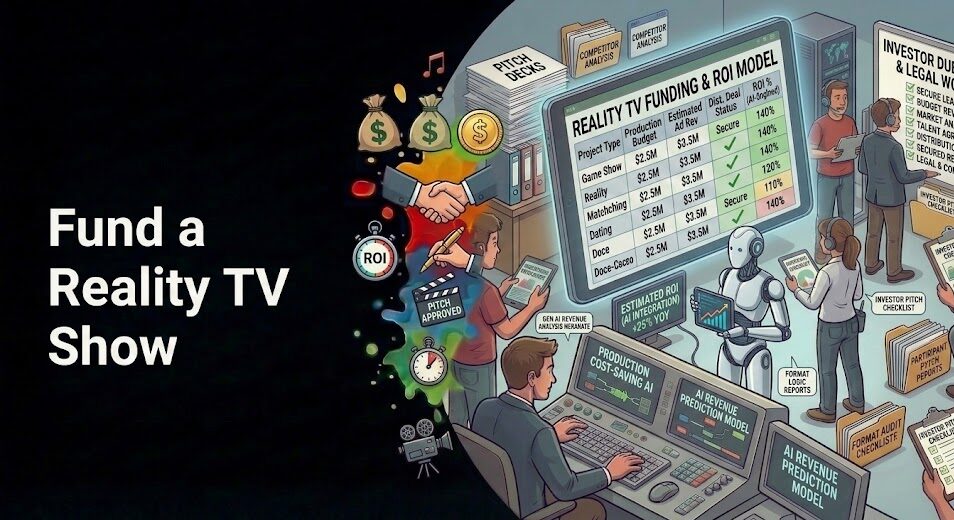
Funding a reality TV show in 2026 is nothing like it was five years ago. And if you’re still approaching your capital stack the way producers did in 2019—leading with a broadcaster commission and hoping to fill the gaps from there—you’re already behind.
Here’s the blunt reality: the post-COVID production financing crunch Phil Hunt, Founder and CEO of Head Gear Films, described so plainly—”the whole industry has become much, much harder in terms of getting movies off the ground and getting movies sold”—applies just as hard to unscripted as it does to scripted. Pre-sale values have compressed. Broadcaster development budgets are tighter. And the traditional waterfall of commission → pre-sale → gap financing that funded a generation of reality shows simply doesn’t hold its shape anymore.
But here’s what has changed in your favor: the number of financing mechanisms available to reality TV producers in 2026 is larger than it’s ever been. Streaming commissions now compete with linear broadcasters for format acquisition. Brand integration deals have evolved from afterthought add-ons into legitimate production financing instruments. Sovereign wealth capital from Saudi Arabia and the UAE is actively co-funding productions in ways that simply didn’t exist before 2020. And private film finance lenders—filling the gap left by commercial banks retreating from the space—are advancing against future territory value before distribution deals are even executed.
This guide gives you the complete picture: what each reality TV financing source actually delivers in 2026, how to structure them into a capital stack that closes, and where the fastest money is right now for unscripted producers who know where to look.
Table of Contents
- The Reality TV Financing Landscape in 2026
- Broadcaster Pre-Sales: How the MG Mechanic Actually Works
- Streaming Commissions: Netflix, Amazon, and Platform-First Reality
- Brand Integration as Financing: Beyond Product Placement
- Tax Incentives and Soft Money: The Non-Dilutive Layer
- Gap Financing and Private Lenders: Closing the Capital Stack
- Sovereign Hub Capital: MENA and APAC Funding for Reality Producers
- How to Structure Your Reality TV Capital Stack in 2026
- FAQ
- Conclusion
Find Which Broadcasters and Streamers Are Actively Commissioning Reality TV Right Now
Trusted by Netflix, Warner Bros, and Paramount. Vitrina’s VIQI intelligence engine tracks active commissioning signals across 140,000+ companies before they hit the trades.
✔ 200 free credits | ✔ No credit card required | ✔ Full platform access
The Reality TV Financing Landscape in 2026
Let’s start with the market conditions you’re actually operating in—because funding a reality show means understanding why the capital landscape shifted and where new money entered the space to replace what left.
The “Big Crunch” in independent production finance—the hangover from 2021–2022’s revenge production boom, when capital was cheap and streaming platforms were commissioning at historically elevated volumes—hit unscripted producers in 2024 and has not meaningfully reversed. Pre-sale values fell 20–35% across major territories as streaming platforms pulled back on non-exclusive content deals and linear broadcasters managed tighter commissioning budgets. The commercial banks that once funded against those pre-sale contracts—firms like City National Bank—retracted from entertainment lending, creating what Joshua Harris, President of Peachtree Media Partners, called “an enormous gap in the marketplace” that private capital is now filling.
But there’s a flip side. The structural demand for unscripted content has never been stronger—and it’s pulling new money into the sector from directions that weren’t viable options even three years ago. Brands are allocating production budgets directly into shows rather than just buying ad spots. Government-backed Sovereign Content Hubs in Saudi Arabia and the UAE are co-funding productions with local adaptation potential. Private lenders like Peachtree are advancing against future territory value before distribution agreements are executed—something commercial banks simply won’t do.
The producers closing financing in this environment aren’t necessarily raising more money. They’re building smarter capital stacks—layering five or six sources rather than relying on two or three, sequencing their asks strategically, and using real-time market intelligence to find buyers before the competition does. That’s what this guide is designed to help you do. For a broader picture of today’s TV show financing landscape, our full 2026 guide covers scripted and unscripted production structures in depth.
Broadcaster Pre-Sales: How the MG Mechanic Actually Works
A broadcaster pre-sale—or broadcaster commission, depending on whether it comes with a production contribution—remains the most important financing anchor for reality TV in 2026. Not because it’s the largest piece of the budget (it rarely is), but because it’s the piece that makes every other piece possible.
Here’s the mechanic that matters. When a broadcaster commits to a show, they’re issuing a Minimum Guarantee (MG)—a fixed payment for the right to air the content in their territory. The standard structure is 10% paid on signature, 90% paid on delivery. That 90% isn’t in your bank account during production. But the signed contract is bankable. Lenders—both traditional entertainment banks and private firms like Peachtree—will advance against that MG at 70–90% of its face value, depending on the broadcaster’s creditworthiness. A BBC, ITV, or Channel 4 pre-sale is worth significantly more to a lender than a regional broadcaster deal, precisely because major broadcasters have demonstrated payment track records that lenders are comfortable underwriting.
For reality TV specifically, two broadcaster categories matter most in 2026. Linear free-to-air broadcasters (BBC, ITV, Channel 4, TF1, ProSieben, RTL) are still commissioning unscripted content as a scheduling staple—but their MG levels have softened as ad revenue pressures compress their content budgets. Expect £50,000–£200,000 per hour from UK public service broadcasters for a typical factual entertainment format, with higher per-episode fees for returning hit series. Regional and satellite broadcasters in new markets—Discovery-branded channels, OSN, Zee TV, MBC—are often more flexible on co-commissioning structures that let you retain international rights.
The strategic play in 2026 is not to lead with your biggest territory. It’s to close your fastest territory first. Rolla Karam, SVP of Content Acquisition at OSN—which covers 23 countries across MENA—has been explicit about the platform’s appetite for factual entertainment and reality formats. A pre-sale to OSN moves quickly (government-backed regional platforms have faster decision cycles than legacy European broadcasters) and gives you a bankable contract to leverage for gap financing while you pursue your higher-value UK or US commissions in parallel.
Don’t leave pre-sale territories on the table. Cover 50–70% of your production budget via pre-sales and broadcaster commissions combined before you approach gap lenders—that’s the threshold at which financing conversations become genuinely productive rather than theoretical.
Phil Hunt (Founder & CEO, Head Gear Films)—who has financed 550+ productions in 25 years—on why securing the right financing structure matters more than ever in the current production crunch:

Streaming Commissions: Netflix, Amazon, and Platform-First Reality
Streaming platforms changed the financing calculus for reality TV in one fundamental way: a worldwide streaming commission from Netflix or Amazon Prime Video can replace your entire pre-sale strategy in a single deal. They pay full production budgets—sometimes plus a margin—in exchange for global rights. No territory-by-territory selling, no multi-currency MG management, no gap financing required.
But the reality of getting there in 2026 is that the bar has moved significantly. Netflix greenlit 850+ hours of unscripted content globally in 2025, but the overwhelming majority came from established prodcos with proven format track records or from established talent packages. First-time or emerging producers pitching unscripted formats to Netflix face a near-impossible direct commission path without either an established development partner or documented ratings proof from a prior market.
The smarter play is a hybrid streaming strategy. Secure a linear broadcaster commission in a major market—UK, Australia, Germany—and use that airing as your proof-of-concept data. Then approach streamers for a second-window streaming deal or a direct commission for an adaptation. Netflix’s acquisition of multiple BBC formats over the last three years confirms this path works. And it’s a much faster route to a streaming commission than a cold pitch, even with a brilliant format concept.
There’s also a middle tier worth targeting. Peacock, Paramount+, Apple TV+, and Disney+ are all actively commissioning reality and factual entertainment content with smaller development slates than Netflix—meaning less competition for commissioning slots and faster greenlight decisions for the right projects. As reported by Deadline, mid-tier streaming platforms committed to doubling unscripted content volume in 2026 as a cost-efficient alternative to expensive scripted drama originals.
Track Streaming Platform Commissioning Activity in Real Time—Not 6 Months Later
Netflix, Warner Bros, and Paramount use Vitrina to monitor the global supply chain. Join 140,000+ companies tracking commissioning signals, format acquisition activity, and broadcaster deal flow before it hits the trades.
✔ 200 free credits | ✔ No credit card required | ✔ Cancel anytime
Brand Integration as Financing: Beyond Product Placement
Brand money in reality TV used to mean a logo on a water bottle and a fee that covered maybe 5% of your production budget. That era is over. In 2026, sophisticated brand integration financing is structuring deals that cover 15–40% of production budgets for reality formats where the brand story and show premise are genuinely aligned.
The difference is the commercial model. Traditional product placement is a media buy—the brand pays to be seen on screen, the fee reflects audience size, and it’s priced off the broadcaster’s rate card. Brand integration financing is a co-investment model—the brand contributes production capital in exchange for creative integration rights, content ownership of adjacent assets (social clips, digital shorts, behind-the-scenes content), and in some structures, a royalty share on international format sales where the brand travels with the format. Kirsty Bell, founder and CEO of Goldfinch, has built her company’s entire model around bridging brand capital with production value in exactly this way—from brand integration to vertical series where the brand is woven into the show’s DNA.
Which reality formats attract serious brand integration financing? The categories that consistently close brand deals are cooking and food formats (obvious category alignment, global brand appetite), lifestyle transformation shows (home, fitness, fashion), skills and craft competitions (tool brands, material brands, heritage brands), and travel and adventure formats (automotive, hospitality, outdoor gear). Dating formats—the volume leader for territory licensing—are actually the weakest category for brand co-financing because the emotional content reduces brand integration opportunity. Keep that in mind as you structure your capital strategy.
The pitch to a brand in 2026 is not “we’ll show your product on screen.” It’s a business case: here’s the content ROI compared to your current media spend, here’s the social amplification data from comparable integrations, and here’s why your brand’s association with this format IP creates value that extends beyond the initial broadcast window. Brands with dedicated content budgets—separate from their advertising budgets—are your target. Major FMCG companies, automotive brands, and lifestyle conglomerates are actively seeking these partnerships. But they move on timeline cycles tied to their marketing calendar, not your production timeline. Start brand conversations 9–12 months before you need the money.

Your AI Assistant, Agent, and Analyst for the Business of Entertainment
VIQI AI helps you plan content acquisitions, raise production financing, and find and connect with the right partners worldwide.
- Find active co-producers and financiers for scripted projects
- Find equity and gap financing companies in North America
- Find top film financiers in Europe
- Find production houses that can co-produce or finance unscripted series
- I am looking for production partners for a YA drama set in Brazil
- I am looking for producers with proven track record in mid-budget features
- I am looking for Turkish distributors with successful international sales
- I am looking for OTT platforms actively acquiring finished series for the LATAM region
- I am seeking localization companies offer subtitling services in multiple Asian languages
- I am seeking partners in animation production for children's content
- I am seeking USA based post-production companies with sound facilities
- I am seeking VFX partners to composite background images and AI generated content
- Show me recent drama projects available for pre-buy
- Show me Japanese Anime Distributors
- Show me true-crime buyers from Asia
- Show me documentary pre-buyers
- List the top commissioners at the BBC
- List the post-production and VFX decision-makers at Netflix
- List the development leaders at Sony Pictures
- List the scripted programming heads at HBO
- Who is backing animation projects in Europe right now
- Who is Netflix’s top production partners for Sports Docs
- Who is Commissioning factual content in the NORDICS
- Who is acquiring unscripted formats for the North American market
Tax Incentives and Soft Money: The Non-Dilutive Layer
Every serious reality TV producer in 2026 is treating tax incentives as a non-negotiable layer of the capital stack. Not a bonus if you qualify. A required line item that you design your production structure around from day one.
The competitive landscape for production incentives is extraordinary right now. The UK offers a 25.5% High-End TV Tax Relief for qualifying productions. Australia increased its producer offset to 40% for television drama and factual content in 2024. Abu Dhabi offers up to 50% cash rebate—the highest headline rate globally. Saudi Arabia’s 40% cash rebate under Vision 2030 is specifically designed to attract international productions that have local adaptation potential. And within Europe, combinations like Ireland + Germany or France + Belgium can stack 35–45% of eligible costs across a co-production structure.
For reality TV specifically, the qualifying costs question matters a lot. Most incentive programs cover qualifying production expenditure (QPE)—crew costs, location fees, equipment rental, post-production. But reality TV’s cost structure often includes significant above-the-line talent costs (celebrity hosts, judges) and extensive travel costs that vary in eligibility by jurisdiction. Hire a local production accountant with specific incentive experience before you budget—not after. A 15–20% swing in qualifying costs can make the difference between an incentive that covers genuine budget gaps and one that barely covers its own administration cost.
But here’s the cash flow reality that catches producers off-guard: incentives are backend money. You won’t see the rebate until 6–18 months after production wraps, after audits are completed. You need to finance against it during production using what’s called a rebate loan—typically available at 80–90% of the approved incentive value from specialist lenders. Factor the interest cost of the rebate loan into your effective incentive calculation. A 40% headline rate can reduce to a net 33–35% once financing costs are accounted for. Still exceptional—but plan for it. Our global film and TV incentives tracker covers current rates across 50+ jurisdictions.
Gap Financing and Private Lenders: Closing the Capital Stack
This is where the 2026 financing landscape has changed most dramatically—and where producers who understand the new landscape have the biggest advantage over those still working from outdated playbooks.
Traditional gap financing works like this: once you’ve secured the primary layers of your capital stack (broadcaster commissions, equity, tax incentives), a gap lender advances against the unsold territory value—the rights not yet contracted—to close the remaining budget gap. Standard gap lending covers 10–30% of production budgets. It costs 15–22% all-in (upfront fees plus interest) for a 12–18 month loan. It requires a completion bond. And it requires that you’ve secured at least 60–80% of your budget from other confirmed sources before most lenders will engage.
But the more interesting development is what private lenders like Peachtree Media Partners are doing differently. As Joshua Harris explains directly: “We will take the value of certain territories or the value of future distribution and before a distribution agreement is executed, we will advance that to production.” That’s a fundamentally different risk calculus from what commercial banks do. Banks lend against executed contracts. Peachtree lends against projected territorial value before those contracts exist—enabling producers to maintain more creative control and upside while accessing production capital earlier in the process. Their fund structure—a $50M raise scaling to $100M, with 80 cents borrowed from a back-leverage commercial bank for every 20 cents from the fund—gives their capital extraordinary reach: a $100M fund covers approximately $500M worth of productions.
For reality TV producers, the practical implication is that the old requirement of “get your pre-sales locked before you go to a lender” is less absolute than it used to be—if you’re working with the right lender. You still need a strong package (format track record, broadcaster interest letters, quality sales agent). But a format with credible territory projections from a reputable sales agent can unlock advance financing from private lenders even before those territory deals close. That’s a meaningful acceleration of your production timeline.
Equity financing rounds out the picture. Andrea Scarso, Managing Partner of IPR VC, frames it clearly: “When you hit a successful IP, the upside can be greater than the overall risk you’re taking on a portfolio.” Equity investors in reality TV take the highest risk and expect the highest return—typically 20–30% IRR on a successful format across multiple territory licenses. They come in after you’ve demonstrated concept viability (a pilot edit, broadcaster interest, social proof data) and want meaningful upside participation, not just interest. Structure equity participation carefully—it sits behind all debt in the recoupment waterfall, meaning it’s last to recover capital if the show underperforms. Find investors who understand the format licensing upside story, not just the pilot production budget. See how production financing models are evolving in 2026 for the full equity and debt landscape.
Find Verified Financing Partners for Your Reality TV Production in 48 Hours
Netflix UK accessed Vitrina intelligence in 48 hours. Join 140,000+ companies using Vitrina to identify active financiers, co-production partners, and broadcaster opportunities across 400,000+ tracked projects globally.
✔ 200 free credits | ✔ No credit card required | ✔ Full platform access
Sovereign Hub Capital: MENA and APAC Funding for Reality Producers
If you’re not factoring Sovereign Content Hub capital into your reality TV financing strategy, you’re leaving real money on the table—and potentially giving your competition a structural funding advantage you won’t recover from easily.
Saudi Arabia’s Content Development Fund (CDF) is co-investing in international productions with MENA adaptation potential. The CDF doesn’t just offer incentives. It co-develops—meaning it can contribute capital at the development stage (pre-broadcaster commission) in exchange for adaptation rights for the Saudi market. For reality producers with formats that have clear Saudi cultural adaptation potential—cooking, skills, family formats—this is a development funding source that can bridge the gap between concept and first broadcaster interest letter. The Saudi market itself hit $584M in 2024 and is projected to reach $950M by 2030. There’s both funding capital and a destination market in one conversation.
UAE’s Abu Dhabi Film Commission offers up to a 50% cash rebate—the highest headline rate globally—with a minimum spend of just $70,000 for features and series. For reality productions with any MENA location component, Abu Dhabi shoots are worth building into your format’s production model simply as an incentive optimization strategy. Dubai, separately, has the infrastructure, the international crew base, and the zero-tax free zone structures that make it a compelling production hub for shows requiring premium-looking location content.
In APAC, South Korea’s government body KOFIC supports international co-productions with Korean production companies—and given that Korean unscripted content (survival, competition, and entertainment formats) now commands premium streaming valuations globally, a Korean co-production partnership can simultaneously fund your production, improve your streaming platform pitch, and open a major territory market in one deal structure. India offers similar multi-dimensional logic: co-production access to the world’s largest film output market, strong domestic broadcaster commissioning budgets, and a streaming platform ecosystem that includes Hotstar, JioCinema, and Amazon Prime Video India all actively acquiring reality content.
How to Structure Your Reality TV Capital Stack in 2026
Here’s the practical architecture. A well-structured reality TV capital stack in 2026 typically layers 5–7 sources across a defined sequence. The sequence matters—because each layer you secure changes your leverage position for the next conversation.
Layer 1: Broadcaster Commission or Streaming Pre-Buy (30–50% of budget)
Your anchor. Close this first. Even a soft expression of interest from a broadcaster—technically pre-commission, not a signed MG—changes every other conversation. The key is choosing which broadcaster to approach first based on decision speed, not prestige. In 2026, a fast close from a regional broadcaster in MENA or a mid-tier European network is often more valuable to your financing sequence than a slow maybe from a UK public service broadcaster.
Layer 2: Tax Incentives and Soft Money (15–30% of budget)
Non-dilutive. Design your production structure to maximize incentive eligibility—location selection, spend allocation, co-production treaty access. Stack where legally possible (federal + regional in Canada, national + regional in Germany). Finance against the rebate during production via a rebate loan rather than waiting for the backend payment.
Layer 3: Brand Integration Capital (10–25% of budget)
Start brand conversations early. The 9–12 month lead time requirement means brand money needs to be in development at the same time as your broadcaster pitch, not as an afterthought once you have a commission. Target brands with dedicated content budgets. Structure the deal as co-investment, not product placement—you’ll get 3–5× more money from the same brand if you’re offering content ownership rather than just on-screen presence.
Layer 4: International Pre-Sales (10–20% of budget)
Territory-by-territory MG deals across secondary markets. Hold your major territories (UK, US, Germany, France) back as long as possible if your show is performing—post-broadcast sales command significantly higher MGs than pre-production deals. Sell smaller territories (MENA regional packages, APAC bundles, LATAM) early to build your bankable collateral pool.
Layer 5: Gap Financing or Private Debt (10–20% of budget)
The closing layer. Once you’ve secured 60–70% of your budget through layers 1–4, gap lenders and private debt providers have enough collateral to work with. Budget 15–22% all-in cost for gap financing and factor it into your EBITDA projections. The Fragmentation Paradox applies to lender identification too—the market has 600,000+ companies in the global supply chain, and only a handful of active gap lenders at any given time. Finding the right lender at the right moment requires current market intelligence, not just a list of historically active firms.
Layer 6: Equity (Optional, 5–15% of budget)
Use equity sparingly, and only once you’ve maximized non-dilutive sources. Equity is expensive in terms of return expectations and sits last in the recoupment waterfall. But equity from a strategically aligned investor—a brand partner taking an equity stake, a Sovereign Hub fund with distribution interests, or a streaming platform taking a co-investment position—can bring more than just capital. The strategic value of the right equity partner often exceeds the financial cost of their return expectations. Our guide to brand partnership financing covers strategic equity structures in detail.
Frequently Asked Questions
How much does it cost to fund a reality TV show in 2026?
Reality TV production costs vary enormously by format, scope, and territory. A typical single-series unscripted format runs £200,000–£800,000 per episode for UK production, with factual entertainment at the lower end and competition formats with celebrity talent at the higher end. Streaming platform commissions tend to push per-episode budgets higher (Netflix reality shows often budget $500,000–$2M per episode). Local adaptations in MENA or India cost significantly less—often 30–50% of equivalent Western production budgets—which is part of what makes format licensing economically compelling for both producers and buyers.
What is a broadcaster pre-sale and how does it work for reality TV financing?
A broadcaster pre-sale is a commitment from a broadcaster to air—and pay for—your show before production is complete. The payment structure is typically 10% on contract signature and 90% on delivery of the finished episodes. The signed contract is bankable: lenders will advance 70–90% of the contract’s face value during production, bridging the cash flow gap until delivery payments arrive. A pre-sale from a major broadcaster (BBC, ITV, Channel 4) carries higher lending value than smaller or regional broadcasters because lenders assess broadcaster creditworthiness when deciding how much to advance.
Can brand deals actually fund a significant portion of a reality TV show’s budget?
Yes—but only when structured as brand integration financing rather than traditional product placement. Brands with dedicated content production budgets (separate from advertising budgets) can contribute 15–40% of production costs for reality formats where the format premise and brand identity are genuinely aligned. Cooking formats, lifestyle transformation shows, skills competitions, and adventure formats attract the most brand co-investment. The key shift is pitching brands as co-investors with content ownership rights over social assets and digital clips, not just as advertisers paying for on-screen presence. Start brand conversations 9–12 months before production—brand budget cycles don’t align with production timelines.
What tax incentives are available for reality TV productions in 2026?
The competitive incentive landscape in 2026 includes: UK: 25.5% High-End TV Tax Relief; Australia: 40% producer offset for qualifying television content; Abu Dhabi: up to 50% cash rebate; Saudi Arabia: 40% cash rebate under Vision 2030; and multiple European co-production structures that stack federal and regional incentives to reach 35–45% of eligible costs. Important note: incentives are backend money—you typically wait 6–18 months post-production for payment. Finance against the approved incentive during production using a rebate loan at 80–90% of its value. Budget the interest cost of the rebate loan into your effective incentive calculation.
What is gap financing and does it work for reality TV productions?
Gap financing is a loan secured against a production’s unsold territorial rights—the territories not yet contracted to distributors or broadcasters. For reality TV, it works well for shows with established format track records and credible territory projections from a reputable sales agent. Most gap lenders require 60–80% of the production budget to be confirmed from other sources before they’ll engage. The all-in cost is typically 15–22% of the loan amount over 12–18 months (upfront fees plus interest). A completion bond is mandatory. Private lenders like Peachtree Media Partners will advance against future territory value even before distribution agreements are executed—a more flexible approach than traditional commercial bank gap lending.
How is Saudi Arabia funding involved in reality TV productions?
Saudi Arabia’s Content Development Fund (CDF) co-invests in international productions with MENA adaptation potential—including reality and unscripted formats. Producers can access CDF capital at development stage (before broadcaster commission) in exchange for Saudi adaptation rights. Separately, Saudi Arabia offers a 40% cash rebate for qualifying production expenditure in-kingdom. The Saudi entertainment market hit $584M in 2024 and is projected to grow to $950M by 2030. For reality TV producers whose formats have clear Saudi cultural adaptability (cooking, skills, family), the CDF represents a genuine development funding source that simultaneously opens a fast-growing destination market.
Do I need a completion bond for reality TV financing?
A completion bond is mandatory for gap financing and most structured debt financing. It adds 3–6% to your production budget but is non-negotiable with most lenders—it guarantees the show will be delivered on time and on budget, which is the lender’s primary risk concern. For broadcaster commissions, a completion bond isn’t always required (it depends on the broadcaster’s relationship with the producer and the deal structure). For first-time producers, expect broadcasters to require more financial controls and guarantees than they would ask of an established prodco. Budget the completion bond from day one—it’s not optional if you’re using debt financing of any kind.
How many funding sources does a typical reality TV production use in 2026?
Well-structured reality TV productions in 2026 typically layer 5–7 funding sources across their capital stack. A common structure combines: broadcaster commission (30–50%), tax incentives or soft money (15–30%), brand integration (10–25%), international pre-sales (10–20%), and gap financing or private debt (10–20%). The optimal number isn’t fixed—it depends on format type, production territory, and broadcaster interest. But single-source or two-source financing is a significant risk concentration that most experienced production finance advisors would flag. The Fragmentation Paradox means that finding and coordinating multiple sources requires real-time market intelligence, not just historical market relationships.
Conclusion: Your Reality TV Financing Strategy Starts Before the Pitch
Funding a reality TV show in 2026 is harder than it was—but it’s not harder for everyone equally. Producers with real-time market intelligence, multi-layered capital stacks, and a clear understanding of how each financing source interacts with the others are closing deals that producers working from outdated playbooks can’t. The money is there. The brands, the sovereign funds, the private lenders, the streaming platforms—all actively looking for the right projects. Your job is to find them before your competition does, and arrive with a structure that makes their yes inevitable.
Key Takeaways:
- Lead with speed, not prestige: Close your fastest broadcaster pre-sale first to anchor your capital stack—a quick MENA or mid-tier European commission is worth more to your financing sequence than a slow maybe from a major UK broadcaster.
- Tax incentives are design decisions: With Abu Dhabi at 50%, Saudi Arabia at 40%, and the UK at 25.5%, production location is a core capital stack decision—not an afterthought. Finance against rebates during production via rebate loans.
- Brand money requires 9–12 months lead time: Structure brand integration as co-investment (15–40% of budget) rather than product placement—it’s worth 3–5× more and creates content IP that travels with your format.
- Private lenders fill the commercial bank gap: Peachtree and similar private lenders advance against future territory value before distribution agreements close—a meaningfully more flexible approach than traditional gap financing.
- Sovereign Hub capital is real and accessible: Saudi Arabia’s CDF offers development co-investment for formats with MENA adaptation potential. The $950M 2030 market projection is both a funding source and a destination market in the same conversation.
Get Direct Introductions to Reality TV Financiers, Broadcasters, and Co-Production Partners
Trusted by Netflix, Warner Bros, and Paramount. Vitrina’s Concierge Service delivers verified introductions to active financiers and commissioners—no cold calls, no wasted trips, no guesswork.
✔ Verified introductions | ✔ 140,000+ companies tracked | ✔ Active deal flow intelligence
Start for free instead: Get 200 free credits—no credit card required →
Find Film+TV Projects, Partners, and Deals – Fast.
VIQI matches you with the right financiers, producers, streamers, and buyers – globally.
Producers Seeking Financing, Co-Pros, or Pre-Buys?
Vitrina Concierge helps producers reach the right financiers, commissioners, distributors, and co-production partners — with precision outreach, not cold pitching.
Join Industry Briefings Trusted by Leaders
Streamers – Netflix vs. Amazon – The 2026 Strategy
How Netflix and Amazon’s content and revenue strategies are diverging ahead of 2026.

Format Adaptations: Global Trends
Where formats are traveling, which adaptations are breaking out, and how streamers are backing remakes in 2025–2026.

Books, Novels & Comics Adaptations: Global Trends
Books, webtoons, and manga driving the next global screen hits. Discover how in this webinar.

Micro-Dramas & Mobile-First Storytelling
Micro-dramas are building real audiences and revenue. Understand the platforms, buyers, and economics behind the growth.