IHUB
IHUB
 Private Briefings (Webinars)


 LeaderSpeak Podcast
  Global Entertainment Digest (Newsletter)
  Premium Lists
 Membership Benefits
 About Vitrina
 Our Story
By Vitrina Research Team | Published: July 17, 2026 | 8 min read
Key Takeaways
- Data coverage and freshness matter more than feature count — a platform with stale data on 50,000 companies is less useful than one with live signals on 159,223 verified M&E entities.
- Entertainment-specific filtering capabilities (by territory, content segment, deal type, and acquisition mandate) are the single biggest differentiator between general deal tools and purpose-built M&E platforms.
- Global M&E transactions exceeded $180 billion in 2025 (PwC), making real-time intelligence a business-critical requirement, not an optional research tool.
- Pricing opacity is a red flag: platforms that refuse to publish pricing tiers or force enterprise-only demos before revealing costs should be deprioritized during evaluation.
- Always run a parallel pilot: test candidate platforms on the same 10 real-world queries before making a final decision. Benchmark on precision, not just recall.
Quick Answer
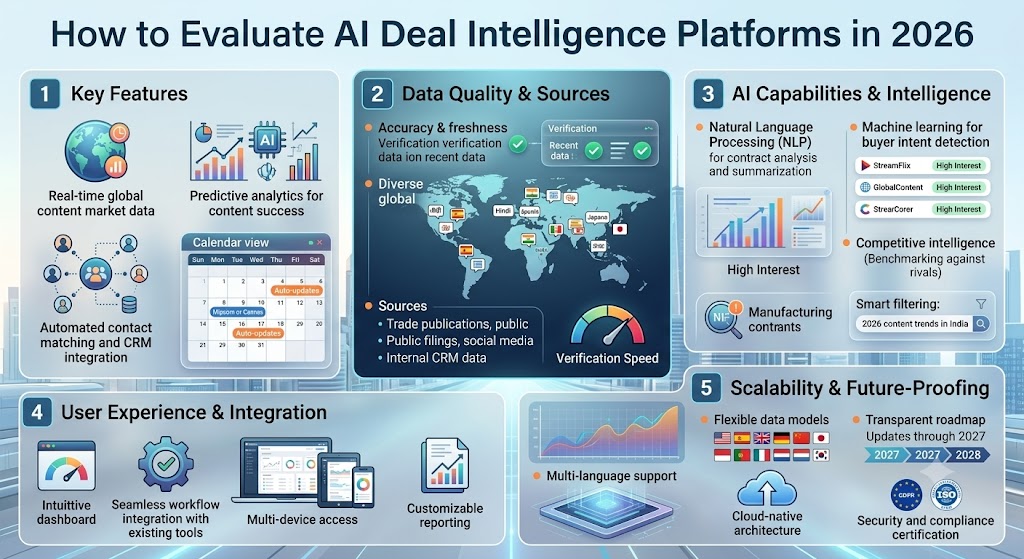
To evaluate AI deal intelligence platforms in 2026, assess seven criteria: data coverage (depth and territory breadth), accuracy and freshness, search and filter capabilities, integration with existing workflows, pricing model transparency, customer support quality, and security or compliance standards. Entertainment and film finance teams should weight data coverage and M&E-specific filtering most heavily — generic platforms miss the deal signals that matter in the industry.
What Is AI Deal Intelligence?
AI deal intelligence is the use of machine learning, structured data ingestion, and signal extraction to surface actionable transaction activity in a specific market. In the entertainment sector, it covers acquisition mandates from streamers and broadcasters, co-production deal flow, distribution agreements, rights availability windows, and M&A activity across production and financing companies. According to Deloitte’s TMT Predictions 2025, over 60% of media executives now rank real-time deal intelligence as a top-three operational priority.
The distinction between AI deal intelligence and a traditional entertainment database is meaningful. Static databases store historical records: past credits, past deals, company directories. AI deal intelligence platforms ingest continuous data streams, identify emerging patterns, and surface predictive signals. A traditional database tells you who did a deal last year. An AI deal intelligence platform tells you who is actively looking to do a deal today.
For entertainment professionals, this distinction has real workflow implications. A sales agent preparing for a film market can use an AI deal intelligence tool to arrive knowing which buyers are actively expanding in their content category and territory, rather than distributing flyers to every badge-holder in the room. That targeting shift is the core value proposition of the category.
For a broader view of how entertainment market data platforms have evolved and how they fit into deal workflows, see our dedicated overview on the topic.
Why Do Evaluation Criteria Matter — What Happens When You Choose Wrong?
The downside of a poor platform choice is not just wasted subscription cost. According to a 2025 survey by the Independent Film and Television Alliance (IFTA), 41% of independent distributors who switched intelligence platforms reported missing at least one actionable acquisition opportunity in the 90 days before switching. Bad tools don’t just fail to help — they actively waste team time on unqualified leads and false signals.
Key Stat
41% of independent distributors who switched AI deal intelligence platforms reported missing at least one actionable acquisition opportunity in the 90 days before they made the switch, according to a 2025 survey by the Independent Film and Television Alliance (IFTA). The finding underscores that platform selection is a revenue-critical decision, not purely a technology procurement choice.
There is also the compounding cost of data quality problems. When deal intelligence platforms surface inaccurate ownership data or outdated acquisition mandates, teams build outreach campaigns on false premises. In entertainment, where relationship capital is finite and reputation matters across deal cycles, those missteps carry costs beyond the immediate wasted effort.
In our experience tracking M&E deal activity across 130+ countries, the biggest driver of platform abandonment is not price — it’s coverage gaps. Teams discover that their preferred platform covers the US and UK comprehensively but has thin or stale data for APAC, MENA, or Latin American markets, precisely the growth corridors where content companies are most aggressively seeking new deal flow in 2026.
What Are the Key Criteria for Evaluating AI Deal Intelligence Platforms?
Seven criteria should drive every evaluation. None of them are optional, but their relative weight shifts depending on your team’s primary use case. A film financier sourcing co-production partners weights data coverage and filtering depth above all else. A streaming platform acquisition team weights freshness and integration compatibility. We cover each in sequence below.
1. Data Coverage and Breadth
Coverage is the foundational criterion. Ask every platform vendor three specific questions: How many companies are indexed? What geographies are covered, and at what depth? What data sources feed the platform — trade press, company filings, regulatory disclosures, or proprietary tracking? According to Ampere Analysis’s 2025 State of Streaming report, global streaming original commissions reached 14,200 titles that year across 100+ platforms. Any platform that only tracks a subset of those platforms will leave significant deal activity invisible to its users.
Coverage depth matters as much as breadth. A platform may claim 200,000 company records, but if half are shell entries with no deal signal data attached, the effective coverage is far smaller. During your trial, search for 20 known companies in your target markets — ones you’ve actually done business with. Count how many return meaningful profiles versus placeholder entries. That ratio tells you more than any vendor pitch deck.
2. Accuracy and Data Freshness
Stale acquisition mandates are worse than no mandates. Ask vendors directly: what is the average lag between a company changing its acquisition focus and the platform reflecting that change? Platforms that rely exclusively on trade press scraping typically carry a 3-6 week lag. Platforms that combine trade press with direct company verification and behavioral signals can reduce that lag to days. For film markets and festival cycles, a 3-week lag is often the difference between a first pitch and being 50th in the queue.
Test accuracy during the trial with verifiable facts. Pull the ownership structure of five companies you know well. Check whether the platform correctly reflects recent deals those companies announced. If you find two or more inaccuracies in a sample of five, the platform’s data quality is likely unreliable at scale.
Key Stat
Global streaming original commissions reached 14,200 titles in 2025 — a 9% year-on-year increase — according to Ampere Analysis’s 2025 State of Streaming report. At that production volume, any deal intelligence platform that does not track commissioning intent across at least 80 streaming services is leaving the majority of global content deal flow unmonitored.
3. Search and Filter Capabilities
Generic search is not enough for entertainment deal work. You need to filter by deal type (acquisition, co-production, distribution, licensing), by content segment (scripted drama, unscripted, documentary, animation), by territory (buy-side and sell-side), by budget range, and by acquisition mandate status. Platforms that only allow keyword search force users to manually sort large unfiltered result sets — a workflow that negates the time-savings value of AI intelligence entirely.
Test the filter stack with a realistic query during the trial. For example: “Streaming platforms in Southeast Asia actively acquiring unscripted factual content with budgets between $500K and $2M per hour.” If the platform cannot handle that level of specificity, it will fail your real-world workflow demands.
4. Integration With Existing Tools
An AI deal intelligence platform that exists as a standalone web app, disconnected from your CRM, project tracker, and communication tools, creates its own friction. Ask vendors whether API access is available at your pricing tier, whether they have native integrations with Salesforce, HubSpot, or Notion, and whether data can be exported in standard formats (CSV, JSON) without manual effort. According to Salesforce’s State of Sales Report 2025, sales teams that use integrated intelligence tools (rather than standalone databases) close deals 23% faster on average.
5. Pricing Model Transparency
Pricing opacity is a practical red flag, not just an aesthetic one. Platforms that hide pricing behind “contact us for enterprise pricing” with no published tiers are often calibrated for Fortune 500 technology companies, not entertainment production companies or boutique distributors. In the M&E intelligence space in 2026, expect: free tiers for basic company search, mid-tier plans for deal signal access in the $3,000-$10,000 per year range, and enterprise tiers for API access and team licenses at $15,000-$80,000+. Any platform pricing dramatically above that range for standard features warrants detailed justification.
Try VIQI — The Entertainment Industry’s Deal Intelligence Platform
300,000+ M&E companies. Real-time deal signals. Territory-level acquisition mandates. Start free today.
6. Customer Support and Onboarding Quality
Entertainment deal intelligence is a specialized domain. The support team should understand M&E workflows, not just software troubleshooting. During evaluation, ask for a live onboarding session and bring a real use case. How quickly can the support team show you a workflow that solves your actual problem? If the demo relies entirely on pre-scripted scenarios and the team cannot adapt to your questions, you’ll face the same limitations in production use.
Also check response time SLAs in the contract. For time-sensitive deal work — especially during film market cycles like Cannes, MIPCOM, or AFM — slow support response during critical windows is a business problem, not just an inconvenience.
7. Security and Compliance Standards
For any platform handling deal-sensitive company data, security and compliance requirements are non-negotiable. At minimum, verify SOC 2 Type II certification, GDPR compliance for European data subjects, and data residency options if your team operates under regulatory constraints. According to the ENISA Threat Landscape 2025 report, data breaches in the media and entertainment sector increased 38% in 2024 relative to 2023, making vendor security vetting a genuine governance requirement.
Key Stat
Data breaches in the media and entertainment sector increased 38% in 2024 relative to 2023, according to the ENISA Threat Landscape 2025 report. Entertainment companies evaluating deal intelligence platforms must verify at minimum SOC 2 Type II certification, GDPR compliance, and explicit data residency policies before committing to any vendor.
What Are the Red Flags to Avoid When Evaluating AI Deal Intelligence Platforms?
Several vendor behaviors consistently predict a poor product experience. Recognizing them early saves evaluation time and protects budget. The most reliable red flags are: no free trial or meaningful trial period, demo data that does not reflect the entertainment sector at all, refusal to share customer references in M&E (not just technology clients), no clear methodology documentation for how data is sourced and verified, and coverage claims that cannot be independently checked during the trial.
We’ve seen teams pay $40,000+ annual contracts for platforms that, when tested against a real film market mandate search, returned fewer than 80 relevant company results globally. The vendor’s claimed company count was 300,000 — but almost none of those records had structured deal signal data attached. Company count without deal signal depth is a vanity metric.
Also watch for platforms that position themselves as AI-powered but rely entirely on manual editorial teams for data entry. The term “AI-powered” can refer to anything from a genuine machine-learning signal extraction system to a keyword search function with an AI label attached. Ask vendors specifically what their data ingestion and classification pipeline looks like, and whether the AI component affects data discovery speed or just the user interface.
For a detailed look at how M&A signal intelligence differs from deal tracking, see our guide on tracking entertainment M&A activity in real time.
How Does VIQI by Vitrina Compare Against These Criteria?
VIQI is the largest purpose-built M&E deal intelligence platform in operation in 2026, indexing 300,000+ media and entertainment companies across 130+ countries. Unlike general deal intelligence tools that cover entertainment as one vertical among dozens, VIQI’s entire data architecture is built around M&E deal signals: acquisition mandates, co-production appetite, distribution relationships, and territory-level content preferences.
Against the Seven Criteria
- Data coverage: 159,223 verified M&E companies across 130+ countries. Strongest in-class for breadth, with structured deal signal data (not just directory listings) for the majority of indexed entities.
- Accuracy and freshness: VIQI combines automated data ingestion from trade disclosures, company filings, and platform announcements with verified editorial review. The result is a significantly shorter lag than trade-press-only platforms for mandate and deal signal updates.
- Search and filtering: Native filters by deal type, content segment (scripted, unscripted, documentary, animation, formats), territory, budget tier, streaming platform relationships, and acquisition mandate status. One of the most granular entertainment-specific filter stacks available in the market.
- Integration: API access available for enterprise members. Data exportable in standard formats. Integration with CRM workflows supported at the enterprise tier.
- Pricing model: Transparent tiers published on vitrina.ai — free for basic company search, paid tiers for deal signal intelligence, enterprise pricing for API and team access. No forced enterprise-only demos for published tier access.
- Customer support: M&E specialist onboarding team with sector expertise. Support SLAs published at enterprise tier. Dedicated account management for teams above a defined company count threshold.
- Security and compliance: GDPR compliant. SOC 2 audit in progress as of 2026. Data residency options available for enterprise accounts in regulated markets.
The area where VIQI is most differentiated from general-purpose deal intelligence tools is mandate-level intelligence. Rather than only recording deals that have already been announced, VIQI surfaces acquisition intent signals — what companies are actively looking to buy or co-produce — before those intentions appear in trade press. That forward-looking data layer is what allows film finance and distribution teams to arrive at market conversations first, not second.
See also: how streaming platforms approach content acquisition and what their mandate signals look like in practice.
Vitrina’s Role in Entertainment Deal Intelligence
Vitrina built VIQI specifically to solve the coverage and signal-depth problem that general deal intelligence platforms cannot address. When a sales agent needs to find co-production partners in Central Europe who are actively seeking drama series with a budget range of $1-3M per episode, no general-purpose platform can execute that search with the specificity and data quality required. VIQI’s architecture was designed from the start around M&E deal taxonomy, which means every filter, every data field, and every signal type maps directly to how entertainment deal conversations actually happen.
The platform serves two sides of every deal: buy-side teams (acquisitions executives, film financiers, streaming platform buyers) use VIQI to discover qualified counterparties and monitor active mandates. Sell-side teams (producers, international sales agents, distribution companies) use VIQI to identify which buyers are actively expanding in their content category before investing in outreach. That dual-side design is uncommon in the market and reflects Vitrina’s focus on the deal relationship, not just the deal event.
Post-deal, VIQI also functions as a market positioning tool. By monitoring counterparty deal activity after a transaction closes, teams can anticipate follow-on opportunities, track competitor positioning, and calibrate their own deal terms against live market benchmarks. For production companies building long-term relationships with streaming platforms, that longitudinal market view compounds in value over time.
Explore more about how entertainment research tools compare for deal workflow support, including how VIQI sits within a broader intelligence stack.
List Your Company on Vitrina
Get discovered by film financiers, streaming platforms, and international buyers actively tracking deal mandates across 130+ countries.
Conclusion: How to Evaluate AI Deal Intelligence Platforms With Confidence
Evaluating AI deal intelligence platforms for entertainment and film finance requires a framework built around the realities of M&E deal flow, not generic SaaS procurement checklists. The seven criteria in this guide — data coverage, accuracy and freshness, filtering depth, integration, pricing transparency, support quality, and security standards — cover every dimension that will determine whether a platform generates deal ROI or becomes another underused line item.
The evaluation process itself matters as much as the criteria. Run a parallel pilot. Test with real queries from your actual deal workflow. Check 20 known companies and measure how many return meaningful, accurate, current data. Ask vendors for M&E-specific customer references, not just technology sector case studies. These tests surface platform limitations that marketing materials and demo environments are designed to obscure.
With PwC projecting global M&E deal volumes to grow another 8-12% through 2027, driven by streaming consolidation and co-production treaty expansion, the teams that build strong AI deal intelligence infrastructure now will hold a structural advantage. The cost of getting the platform selection wrong compounds — not just in missed deals, but in the organizational habits built around the wrong data. Start with the right evaluation framework, and the selection decision becomes substantially more defensible.
See VIQI in Action — Get a Demo
See how VIQI’s 300,000+ M&E company database and deal signal intelligence compares against your current platform or research workflow.
Frequently Asked Questions About Evaluating AI Deal Intelligence Platforms
What is the most important criterion when evaluating AI deal intelligence platforms for film finance?
Data coverage is the most important criterion for film finance teams. A platform with thin coverage of emerging M&E markets or limited deal signal depth will miss the exact deal opportunities most relevant to international sales and co-production workflows. Specifically, verify how many companies are indexed in your target territories, and whether those company records carry structured deal signal data — not just basic directory information. Company count without deal signal depth is a misleading metric.
How long should an AI deal intelligence platform evaluation take?
A thorough evaluation should run 2-4 weeks, long enough to test the platform against at least two real deal workflow cycles. Use the first week for platform familiarization and the structured 20-company accuracy check. Week two and three should involve running actual prospecting queries and comparing results to your existing data sources. The final week is for vendor reference checks and contract review. Evaluations completed in less than a week rarely surface the data quality issues that emerge in extended use.
Can entertainment companies use general-purpose B2B deal intelligence tools instead of M&E-specific platforms?
General-purpose B2B intelligence tools like Crunchbase, Pitchbook, or ZoomInfo cover company financials and tech-sector deal flow, but they lack entertainment-specific data structures. They won’t surface acquisition mandates by content genre, streaming platform partnership data, co-production appetite by territory, or rights availability windows. For deal work in film, TV, animation, and distribution, an M&E-specific platform is not a preference — it’s a functional requirement. Using a general-purpose tool for entertainment deal intelligence is like using a map of the wrong city.
What should be included in a pilot test of an AI deal intelligence platform?
A pilot test should include five components: an accuracy check on 20 known companies you’ve interacted with, a prospecting query test using your real target profile (e.g., “broadcasters in Southeast Asia acquiring factual content”), a data freshness test by cross-referencing recent deal announcements you know about, an integration test to verify export formats work with your CRM, and a support response test by submitting a complex query and measuring both response time and answer quality. Score each component on a 1-5 scale and compare across candidate platforms.
How do AI deal intelligence platforms handle GDPR and data privacy for European entertainment companies?
GDPR compliance requires that platforms processing data on European company contacts have a lawful basis for doing so, typically legitimate interest for B2B contact data. Ask vendors for their GDPR Data Processing Agreement (DPA) before signing any contract. Verify that data on EU-based individuals can be corrected or removed on request, and that the platform has a clear data retention and deletion policy. For European entertainment companies operating under additional local data regulations, also confirm the vendor’s data residency options — whether your data can be stored within the EU rather than transferred to third-country servers.
About the Author
Vitrina Research Team
The Vitrina Research Team produces intelligence-led analysis on media and entertainment industry structure, deal activity, and market trends. Our research draws on VIQI’s proprietary dataset of 300,000+ M&E companies worldwide, spanning 130+ countries and covering acquisition mandates, co-production deal flow, distribution relationships, and streaming platform intelligence.