About Innovation Hub
 Global Content Pulse (Webinars)


 Global Production Financing
(Webinars)
Global Production Financing
(Webinars)  LeaderSpeak Podcast
  Global Entertainment Digest (Newsletter)
  About Vitrina
 About VIQI
 Our Story
 Our Solutions 🔥
 Film+TV Projects Tracker 🚀
 Case Studies
 Our Profile
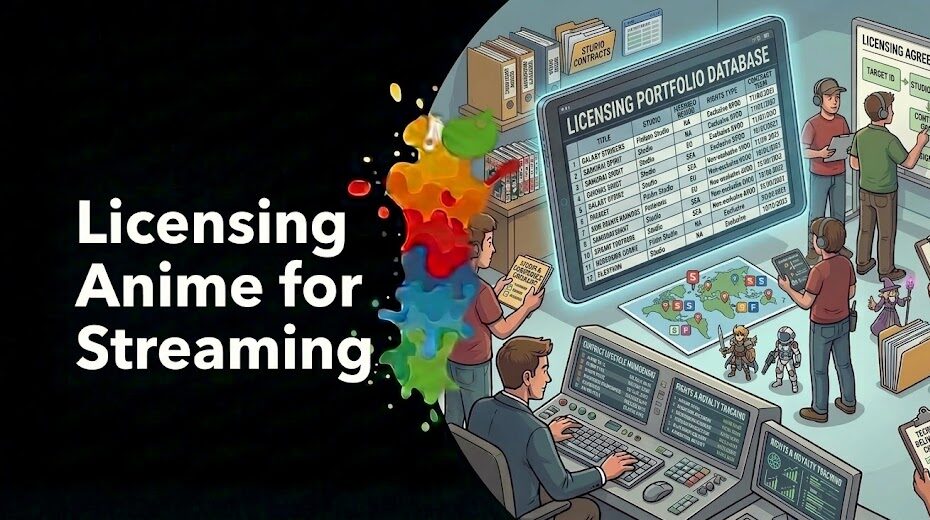
If you’ve ever asked how much it costs to license anime for streaming and gotten a vague non-answer, that’s not an accident. Pricing in this market is deliberately opaque. Rights holders don’t publish rate cards. Platforms don’t disclose deal terms. And the spread between what a regional SVOD pays for a mid-tier catalog title versus what Netflix commits for a simulcast exclusive is wide enough to make your eyes water.
But the numbers exist—and industry insiders work with them every day. This breakdown draws on established distribution deal structures, minimum guarantee mechanics from the film and TV rights market, and the specific dynamics of the anime licensing market in 2026 to give you real ranges, not marketing speak. Whether you’re a platform executive evaluating your first anime acquisition, a producer assessing what your catalog is worth, or a CFO stress-testing a content budget, this is the breakdown you actually need.
The anime rights market hit an estimated $28 billion globally in 2024—with streaming rights representing its fastest-growing revenue slice. The stakes are real. So are the costs.
Table of Contents
- How Anime Licensing Deals Are Priced
- The Three Cost Tiers: Catalog, Mid-Tier, and Premium Simulcast
- What Drives Anime Licensing Costs Up (And Down)
- The Hidden Cost Nobody Talks About: Localization
- How Smaller Platforms Compete Against Deep-Pocketed Giants
- The ROI Math: What Does a Licensed Anime Title Actually Need to Return?
- FAQ
- Conclusion
Ask VIQI: What Are Platforms Currently Paying for Anime Rights in Your Territory?
VIQI is Vitrina’s AI assistant—trained on 1.6 million titles, 360,000 companies, and 5 million entertainment professionals. Ask it about active anime acquisition deals, rights windows, and what similar titles are fetching in today’s market.
✓ Included with 200 free credits | ✓ No credit card needed
How Anime Licensing Deals Are Priced
Anime licensing deals for streaming follow the same fundamental mechanics as broader television rights markets—but with a few structural quirks specific to Japan’s production committee model that push costs and timelines in directions other content categories don’t.
The core pricing unit is the Minimum Guarantee (MG): a fixed upfront payment the licensee commits to the rights holder for the right to distribute the title in a specified territory, on a defined platform type, for a set window. The MG isn’t a rental fee—it’s a floor. Once the platform’s royalty revenue to the rights holder (typically 15–30% of net streaming revenue attributed to the title) clears the MG amount, the rights holder starts receiving additional royalty payments on top. Below the MG threshold, the platform absorbs the shortfall.
That structure matters when you’re modelling content ROI. A platform doesn’t just need a title to perform—it needs it to perform enough to justify the MG it committed. Title-by-title, that math drives acquisition strategy in ways the public never sees. And it explains why platforms occasionally let titles lapse at renewal even when subscriber engagement is decent: the renewal MG crept above what the title’s projected contribution can realistically clear.
For anime specifically, the MG is further influenced by which committee member is acting as international rights lead, how many territories are being bundled versus carved individually, whether simulcast rights are included, and—critically—whether exclusivity is on the table. Each variable has a measurable cost impact. Exclusivity alone can double the MG for a premium title in a major territory. Worth knowing before you walk into negotiations.
As our guide to minimum guarantees in distribution deals covers in detail, the way MGs are structured—10% on signature, 90% on delivery—also creates a cash-flow dynamic that acquisition teams need to model carefully, not just at deal signing.

Your AI Assistant, Agent, and Analyst for the Business of Entertainment
VIQI AI helps you plan content acquisitions, raise production financing, and find and connect with the right partners worldwide.
- Find active co-producers and financiers for scripted projects
- Find equity and gap financing companies in North America
- Find top film financiers in Europe
- Find production houses that can co-produce or finance unscripted series
- I am looking for production partners for a YA drama set in Brazil
- I am looking for producers with proven track record in mid-budget features
- I am looking for Turkish distributors with successful international sales
- I am looking for OTT platforms actively acquiring finished series for the LATAM region
- I am seeking localization companies offer subtitling services in multiple Asian languages
- I am seeking partners in animation production for children's content
- I am seeking USA based post-production companies with sound facilities
- I am seeking VFX partners to composite background images and AI generated content
- Show me recent drama projects available for pre-buy
- Show me Japanese Anime Distributors
- Show me true-crime buyers from Asia
- Show me documentary pre-buyers
- List the top commissioners at the BBC
- List the post-production and VFX decision-makers at Netflix
- List the development leaders at Sony Pictures
- List the scripted programming heads at HBO
- Who is backing animation projects in Europe right now
- Who is Netflix’s top production partners for Sports Docs
- Who is Commissioning factual content in the NORDICS
- Who is acquiring unscripted formats for the North American market
The Three Cost Tiers: Catalog, Mid-Tier, and Premium Simulcast
The anime rights market isn’t monolithic. Pricing breaks into three distinct tiers—and the gap between them is larger than most first-time buyers expect.
Tier 1: Catalog Titles (Older, Non-Simulcast)
Catalog titles—shows completed more than two to three years ago, without active simulcast demand—are the most negotiable segment of the market. For a non-exclusive streaming license covering a single major territory (US, UK, Germany, or France), MGs typically range from $5,000 to $50,000 per title, depending on episode count, franchise recognition, and how long the window runs.
A 12-episode season from a mid-tier studio with solid but not mainstream recognition? You’re probably in the $10,000–$25,000 range for a two-to-three-year non-exclusive US streaming window. Less-known titles from the late 2000s and early 2010s can come in under $10,000. Classic franchise titles with ongoing merchandise value—think legacy Toei Animation properties—command more, even without simulcast.
This is the segment where HIDIVE and smaller regional streamers compete effectively. At these price points, a platform with modest subscriber numbers can build genuine catalog depth without committing budgets that only Crunchyroll or Netflix can sustain.
Tier 2: Mid-Tier Active Titles (Recent, Simulcast-Adjacent)
This is where it gets expensive fast. Recent titles—within one to two years of Japanese broadcast, with active fanbases—carry MGs in the range of $50,000 to $500,000 per title per major territory. Simulcast rights (same-day or within-24-hours release) push the upper end of that range consistently.
A strong seasonal title from a respected studio like MAPPA, Ufotable, or CloverWorks—with proven streaming demand in the preceding season—will typically land in the $150,000–$350,000 range for a major territory exclusive simulcast window of two to three years. Non-exclusive deals come in meaningfully lower, but exclusivity is what drives subscriber differentiation, so platforms generally don’t fight the premium hard.
Season extensions—the second and third seasons of a hit show where audience demand is already demonstrated—often carry a 30–50% premium over the original season MG. Rights holders know you can’t tell the second half of the story without them. The math is obvious.
Tier 3: Premium Simulcast and Franchise IP
The top of the market. Premium simulcast titles—marquee IP from established franchises with documented global demand—start at $500,000 per territory and scale from there. For multi-territory packages, seven-figure MGs for a single title are not unusual at this level.
According to Variety, Netflix’s committed investment in original Japanese anime production has exceeded $300 million—and that figure covers only original productions, not licensed acquisitions on top. When you factor in the MGs Netflix and Crunchyroll each commit for competitive acquisition of simulcast-eligible titles across North America, Europe, and APAC, total annual spend for the top two platforms alone runs into hundreds of millions of dollars per year.
Global rights packages—covering North America, Europe, Latin America, and APAC in a single deal—can carry MGs north of $5 million for top-tier franchise continuations. These aren’t hypothetical numbers. They reflect the competitive bidding dynamics around titles like ongoing seasons of Jujutsu Kaisen, One Piece, and Attack on Titan. Rights holders in that tier know exactly what they have—and they price accordingly.
Know What Anime Rights Cost Before You Negotiate—Not After
Trusted by Netflix, Warner Bros, and Paramount. Vitrina tracks 400,000+ projects, active rights windows, and deal activity across 140,000+ companies—so your team arrives at the table with real market intelligence.
✓ 200 free credits | ✓ No credit card required | ✓ Full platform access
What Drives Anime Licensing Costs Up (And Down)
The spread within each tier is wide. A mid-tier title can land anywhere in a 10x range depending on how the following factors combine. Understanding them is what separates acquisition teams that consistently overpay from those that build efficient libraries.
Factors That Push Cost Up
- Exclusivity — The single biggest cost driver. An exclusive simulcast window in North America can carry a 2x–3x premium over the equivalent non-exclusive deal. Rights holders know platforms need differentiating content. They charge for it accordingly.
- Simulcast timing — Same-day-as-Japan delivery commands the highest rates. Day-and-date with Japanese broadcast requires operational commitments that rights holders value, and that platforms pay for. Drop-down to a seven-day delay and the MG typically comes in 20–40% lower.
- Territory scope — Single major territory versus regional bundle versus global rights. Global packages are increasingly common for top-tier titles, but they require MGs that only the largest platforms can commit. Regional bundles—say, all of Southeast Asia in one deal—are mid-market and increasingly competitive.
- Franchise continuation — Second and third seasons of established hits carry a sequel premium. The audience is already there and documented. Rights holders price accordingly.
- Competing bids — When Crunchyroll, Netflix, and Amazon are all in the room for the same title, the MG goes up. Full stop. Rights holders time their go-to-market to maximize competitive pressure. The best acquisitions teams engage before that auction dynamic kicks in—ideally 6–12 months before the season completes in Japan.
Factors That Push Cost Down
- Non-exclusive rights — Accepting co-licensing across multiple platforms in the same territory reduces MG substantially. Acceptable for catalog; rarely strategic for new releases.
- Shorter windows — A one-year window costs less than a five-year window, but renewal uncertainty is the trade-off. Shorter terms also tend to trigger more frequent renegotiations, which consumes operational time.
- Smaller territory scope — Licensing Southeast Asia or MENA without North America or Europe cuts the MG significantly. Relevant for regional platforms building depth in their home market without global ambitions.
- Pre-production commitment — Platforms that engage rights holders before production is complete can negotiate lower MGs in exchange for early certainty. This is the Smart Pairing approach in practice: earlier commitment, better terms, less competition at the finish line.
- Catalog packages — Bundling 10–20 catalog titles into a single deal gives the rights holder a larger guaranteed cheque and gives the platform per-title pricing that individual title deals don’t reach.
The Hidden Cost Nobody Talks About: Localization
The MG is the headline number. But the real cost of licensing anime for streaming—what your CFO should see on the budget sheet—includes localization. And on a per-title basis, localization adds costs that first-time acquirers consistently underestimate.
Here’s what a full localization package actually looks like for a standard 12-episode season:
- Subtitling (one language) — $3,000–$8,000 per 12-episode season, depending on complexity and turnaround speed. Faster turnaround for simulcast costs 40–60% more than standard timelines.
- Full English dub (actors + studio + direction) — $80,000–$200,000 per 12-episode season. Premium voice talent attached to recognized franchises pushes toward the top of that range. This is where Crunchyroll’s in-house dub capability gives it a real cost advantage over smaller competitors.
- Multi-language subtitle package (5 languages) — $15,000–$35,000 per season. Regional platforms covering diverse language markets can’t avoid this cost.
- Multi-language dub package (3 languages) — $250,000–$600,000 per season when you’re covering English, Spanish, and Portuguese. That’s the Latin American market minimum for platforms serving the region seriously.
Anton Dvorkovich, CEO of Dubformer, discusses how AI-powered localization is beginning to shift these economics in the Vitrina LeaderSpeak series. The full conversation covers the $6.5 billion video localization market and how AI dubbing is creating new options for platforms that previously couldn’t justify per-title dub budgets at scale:
Anton Dvorkovich (CEO, Dubformer) discusses how AI localization is changing content economics for streaming platforms:
The localization point matters for a specific reason: it changes the true cost floor for any streaming license. A catalog title with a $15,000 MG that requires English subtitling, Spanish subtitling, and a basic English dub for the North American market can have a total delivered cost of $110,000–$130,000. That’s the number that needs to appear in your ROI model—not the MG in isolation.
Platforms that treat localization as a separate budget item rather than part of the cost-of-acquisition calculation consistently underperform on content ROI. The math gets worse when you’re also absorbing delivery and QC costs, which can add another $5,000–$15,000 per title depending on platform technical specifications.
For a broader picture of how content licensing costs stack up across different genres and territories, our streaming licensing costs guide for acquisition leads covers the full cost architecture in 2026.
How Smaller Platforms Compete Against Deep-Pocketed Giants
The honest answer is: not by going head-to-head on premium simulcast titles. That’s a losing battle when Crunchyroll has 13 million+ paid subscribers underwriting its MG commitments and Netflix has a global content budget measured in billions. Smaller platforms that try to outbid on Tier 3 titles destroy their ROI before the season even airs.
But smaller platforms can win—and several do—through strategies that larger platforms structurally can’t replicate.
Catalog depth in niche genres. Niche sub-genres—mecha, magical girl, sports anime, isekai from specific eras—have passionate subscriber bases that will pay for depth that generalist platforms don’t bother building. HIDIVE’s entire business model demonstrates this works. At $4.99/month, they’ve built a service where catalog titles that cost under $20,000 in MG contribute meaningfully to subscriber retention because no one else has them.
Regional-first strategy. A platform covering Southeast Asia, MENA, or Latin America doesn’t need to compete for North American or European rights. Rights holders are often happy to close regional deals quickly at lower MGs rather than wait for the big platforms to make up their minds. The window moves faster, the relationship builds, and the per-title cost stays manageable.
Pre-production engagement. This is where the real opportunity lives. Connecting with Japanese rights holders—or the studios producing upcoming titles—before a show completes gives smaller platforms access to deals that haven’t entered competitive bidding yet. The MG is negotiated on the basis of potential, not demonstrated demand. That’s a significant pricing advantage. And it requires intelligence infrastructure that most smaller platforms don’t currently have—which is exactly where tools like Vitrina’s production tracker create asymmetric advantage.
Package deals. Bundling 10–20 catalog titles into a single negotiation gives smaller platforms the per-title economics that individual negotiations don’t reach. Rights holders—especially those managing large back catalogs—respond to the certainty of a package deal. You’re often looking at 30–50% lower per-title MG compared to individual negotiation on the same titles.
For producers and studios wondering what their catalog might be worth to a streaming platform, our anime licensing and distribution strategy guide covers valuation mechanics from both sides of the table.
The ROI Math: What Does a Licensed Anime Title Actually Need to Return?
This is the question CFOs ask and acquisition teams sometimes struggle to answer cleanly. Here’s a working framework.
Start with total cost of acquisition: MG + localization + delivery + QC + promotional allocation. For a mid-tier simulcast title in a single major territory, that’s realistically $300,000–$600,000 all-in. For a premium franchise title with global rights and full dub packages, you’re past $2 million before the first episode airs.
ROI calculation then runs through two channels: direct attribution (subscriber acquisition driven by the title) and retention contribution (existing subscribers who stay partly because of the title). Both are real. Both are measurable with the right analytics infrastructure. But platforms that model only acquisition and ignore retention consistently undervalue their anime catalog—which leads to under-investment and gaps that competitors fill.
The industry benchmark most platforms use internally—though they don’t publish it—is that a licensed title needs to contribute to the LTV (lifetime value) of subscribers in an amount that clears 2x–3x the total acquisition cost over the license window to be considered a successful acquisition. A title that clears the MG on royalties alone and generates measurable subscriber growth is the gold standard. Titles that perform below 1x cost in subscriber contribution are the ones that quietly disappear at renewal.
As The Hollywood Reporter has noted, the shift from volume acquisition strategies toward ROI-disciplined curation has accelerated since 2023 across all major streaming platforms—anime included. The era of “license everything available” is over. What replaced it is data-driven acquisition prioritization—and the platforms that do it best are the ones with access to rights intelligence before competitive pressure drives MGs up.
See our guide to streaming content ROI calculation for a full framework on attributing subscriber value to specific licensed titles.
Need Direct Access to Japanese Anime Rights Holders? We’ll Make the Introduction.
Vitrina Concierge connects you directly to decision-makers at production committees and rights-holding entities actively seeking international streaming partners—before competitive bidding inflates MGs.
- LA producer → Netflix UK, Fifth Season, Fox Entertainment (48 hours)
- Korean animation studio → Netflix Adult Animation (week one)
- Middle Eastern studio → Legendary Pictures (direct access)
Frequently Asked Questions
How much does it cost to license anime for streaming in the US?
Costs vary widely by title tier. Catalog titles (older, non-simulcast) typically carry minimum guarantees of $5,000–$50,000 for a non-exclusive US streaming window. Mid-tier active titles with simulcast rights range from $50,000 to $500,000 per season. Premium franchise titles—top IP from studios like MAPPA or Ufotable with global demand—start at $500,000 per territory and can reach into seven figures for exclusive global packages. These figures cover the MG only; add localization, delivery, and QC costs on top for total acquisition cost.
What is a minimum guarantee in anime licensing?
A minimum guarantee (MG) is the fixed upfront payment a streaming platform commits to a rights holder for the right to distribute a title in a specified territory, on a defined platform type, for a set window period. It functions as a floor: once royalty payments from streaming revenue clear the MG amount, the rights holder begins receiving additional royalties. Below the MG threshold, the platform absorbs the shortfall. It’s typically paid 10% on signing and 90% on content delivery.
Why does anime simulcast cost more to license than catalog titles?
Simulcast rights—delivering new episodes to subscribers within hours of Japanese broadcast—carry a premium for two reasons. First, the operational commitment is greater: platforms must have localization pipelines, quality control, and delivery infrastructure running continuously during the simulcast window. Second, audience demand is highest at broadcast and drops over time, so rights holders price the immediacy accordingly. Same-day simulcast exclusives can cost 2x–3x the MG of the equivalent non-exclusive, time-delayed deal.
How much does dubbing add to anime licensing costs?
A full English dub for a standard 12-episode season typically costs $80,000–$200,000, depending on cast, studio, and production timeline. Multi-language dub packages covering English, Spanish, and Portuguese for Latin American markets can add $250,000–$600,000 per season on top of the MG. Subtitling is cheaper—$3,000–$8,000 per language per season—but simulcast speed requirements push that cost up 40–60%. Total delivered cost, including MG and full localization, consistently runs 3–5x the MG figure alone.
Can small streaming platforms afford to license anime?
Yes—but through different strategies than large platforms use. Catalog titles, regional-only rights, non-exclusive deals, and bundled package negotiations all offer significantly lower per-title economics than premium simulcast acquisitions. A regional platform can build a credible anime catalog for $200,000–$500,000 in annual acquisition spend by focusing on these segments. The key is pre-production engagement and catalog packaging—not competing with Crunchyroll and Netflix on the titles they’ve already targeted.
How long do anime streaming licenses typically last?
Anime streaming licenses typically run two to seven years, with three-to-five-year windows most common at the mid-tier and premium levels. Catalog deals can include longer windows. When the window expires, rights revert to the holder—which is why titles disappear from platforms without warning. Renewal negotiations typically begin six to twelve months before expiration; failing to start that process early enough often results in a renewal MG inflated by renegotiation leverage the rights holder now holds.
Does exclusivity significantly increase anime licensing costs?
Yes—exclusivity is the single biggest cost driver in anime licensing negotiations. An exclusive simulcast window in a major territory can carry a 2x–3x premium over the equivalent non-exclusive deal for the same title. Rights holders know that exclusive content is the primary subscriber differentiation tool for streaming platforms, and they price that value accordingly. For catalog titles, exclusivity matters less and the premium is smaller—typically 20–40%.
The Bottom Line: Know Your Numbers Before You Negotiate
The real cost of licensing anime for streaming isn’t a single number—it’s a stack. MG. Localization. Delivery. QC. Promotional spend. And it ranges from under $20,000 all-in for a catalog non-exclusive to north of $5 million for a premium global simulcast franchise deal. The tier you’re operating in determines your strategy, your negotiating leverage, and what ROI your acquisitions realistically need to deliver.
But here’s the number that matters most—and it’s rarely discussed in public: the cost differential between engaging a rights holder before competitive bidding begins versus after it’s fully underway. Six months of early intelligence can mean a 40–60% lower MG on the same title. That’s not a marginal gain. On a five-title slate, it’s the difference between a budget that works and one that doesn’t.
Platforms that De-risk their acquisition spend do it by getting into the market early, with real rights intelligence, before the Fragmentation Paradox makes every deal a competitive bidding situation. That’s the operational advantage Vitrina’s platform is built to provide.
Key takeaways:
- Catalog titles cost $5,000–$50,000 in MG per major territory; total delivered cost with localization adds 3–5x.
- Mid-tier simulcast titles run $50,000–$500,000 MG per territory; exclusivity adds 2x–3x premium.
- Premium franchise simulcasts start at $500,000 per territory; global packages cross $5 million at the top.
- Localization costs are non-negotiable—$80,000–$200,000 for a single English dub, $250,000–$600,000 for a multi-language package.
- Pre-production engagement is the most effective cost-reduction lever available—and it requires intelligence infrastructure most platforms don’t currently have.
Accelerate Your Anime Acquisition Strategy—Start With the Right Intelligence
Trusted by Netflix, Warner Bros, Paramount, and Google TV. Track 400,000+ projects. Access 3 million verified executives. Understand rights windows and deal activity before competitive bidding inflates your MG.
✓ 200 free credits | ✓ No credit card required | ✓ Cancel anytime
Need warm introductions to Japanese rights holders directly? Explore Concierge Service →
Find Film+TV Projects, Partners, and Deals – Fast.
VIQI matches you with the right financiers, producers, streamers, and buyers – globally.
Producers Seeking Financing, Co-Pros, or Pre-Buys?
Vitrina Concierge helps producers reach the right financiers, commissioners, distributors, and co-production partners — with precision outreach, not cold pitching.
Join Industry Briefings Trusted by Leaders
Format Adaptations: Global Trends
Where formats are traveling, which adaptations are breaking out, and how streamers are backing remakes in 2025–2026.

Books, Novels & Comics Adaptations: Global Trends
Books, webtoons, and manga driving the next global screen hits. Discover how in this webinar.

Micro-Dramas & Mobile-First Storytelling
Micro-dramas are building real audiences and revenue. Understand the platforms, buyers, and economics behind the growth.

Navigating Global Content Licensing Trends
How global content licensing is shifting beyond flat fees to flexible, deal-driven models.