About Innovation Hub
 Global Content Pulse (Webinars)


 Global Production Financing
(Webinars)
Global Production Financing
(Webinars)  LeaderSpeak Podcast
  Global Entertainment Digest (Newsletter)
  About Vitrina
 About VIQI
 Our Story
 Our Solutions 🔥
 Film+TV Projects Tracker 🚀
 Case Studies
 Our Profile
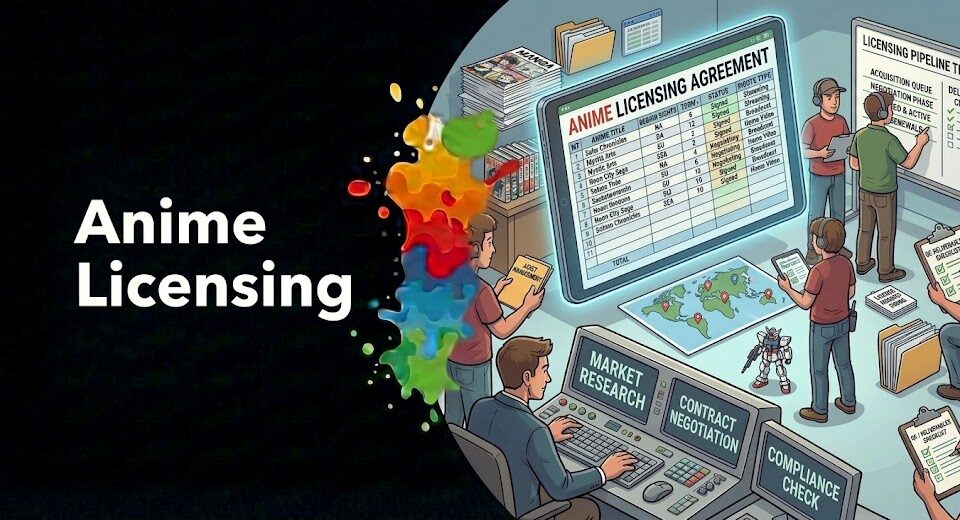
You’ve watched a show on Crunchyroll, seen it vanish without warning, or noticed the same title available in Europe but not the US. If you’ve ever wondered how anime licensing works—really works, under the hood—you’re not alone. Acquisition teams, streaming executives, and content buyers wrestle with this system every day. And honestly? It’s messier than most people expect.
The anime licensing process starts in Japan, passes through a web of rights holders before it ever reaches a global platform, and gets carved up by territory, window, and medium along the way. Getting it wrong costs real money. Getting it right—quickly—can lock you into titles your competitors won’t have access to for months.
This guide breaks down the full chain: who holds the rights, how deals get structured, why certain shows disappear from platforms, and what smart buyers are doing differently in 2026. If you’re navigating anime rights acquisitions professionally, this is the breakdown you actually need.
Table of Contents
Ask VIQI: Which Anime Rights Are Available in Your Territory Right Now?
VIQI is Vitrina’s AI assistant—trained on 1.6 million titles, 360,000 companies, and 5 million entertainment professionals. Ask it about available rights windows, active distributors, and which Japanese studios are seeking international partners.
✓ Included with 200 free credits | ✓ No credit card needed
The Production Committee: Who Actually Owns Anime Rights
Here’s the thing most Western buyers don’t fully grasp when they first engage with Japanese rights holders. You’re almost never dealing with a single studio. Most anime titles—especially mid-budget and premium productions—are owned by a seisaku iinkai, or production committee. This is a consortium of companies that co-financed the original production: a manga publisher, a game developer, a music label, a toy manufacturer, a broadcaster, and sometimes the animation studio itself.
Each committee member holds a slice of the IP. And each slice maps to a specific revenue stream. The toy company controls merchandise. The music label controls the soundtrack. The broadcaster controls domestic linear rights. None of them can approve an international deal unilaterally—which is exactly why negotiations take longer than you’d expect.
The practical implication? When you’re asking how does anime licensing work at the deal level, you’re really asking: who speaks for the committee? In most cases, one member—often the publisher or a dedicated rights-management entity—is designated as the international licensing lead. That’s your contact. But getting them to move fast still requires internal alignment among all shareholders. Six to twelve weeks for a first response isn’t unusual, even for straightforward catalog titles (and that’s being generous).
For buyers used to negotiating with a US studio’s single acquisitions desk, this is a real adjustment. It requires patience—but also strong intelligence on who the actual decision-maker is before you even send the first inquiry.
Our complete guide to anime licensing and distribution covers committee navigation strategies in depth, including how to identify the lead rights holder before the first conversation.

Your AI Assistant, Agent, and Analyst for the Business of Entertainment
VIQI AI helps you plan content acquisitions, raise production financing, and find and connect with the right partners worldwide.
- Find active co-producers and financiers for scripted projects
- Find equity and gap financing companies in North America
- Find top film financiers in Europe
- Find production houses that can co-produce or finance unscripted series
- I am looking for production partners for a YA drama set in Brazil
- I am looking for producers with proven track record in mid-budget features
- I am looking for Turkish distributors with successful international sales
- I am looking for OTT platforms actively acquiring finished series for the LATAM region
- I am seeking localization companies offer subtitling services in multiple Asian languages
- I am seeking partners in animation production for children's content
- I am seeking USA based post-production companies with sound facilities
- I am seeking VFX partners to composite background images and AI generated content
- Show me recent drama projects available for pre-buy
- Show me Japanese Anime Distributors
- Show me true-crime buyers from Asia
- Show me documentary pre-buyers
- List the top commissioners at the BBC
- List the post-production and VFX decision-makers at Netflix
- List the development leaders at Sony Pictures
- List the scripted programming heads at HBO
- Who is backing animation projects in Europe right now
- Who is Netflix’s top production partners for Sports Docs
- Who is Commissioning factual content in the NORDICS
- Who is acquiring unscripted formats for the North American market
How Anime Licensing Deals Are Structured
Once you’ve identified the rights holder, the deal itself breaks down along three core axes: territory, medium, and window. Get these wrong and you’ll find yourself owning rights that don’t actually cover the distribution you planned.
Territory defines where you can distribute—Japan, North America, Southeast Asia, MENA, LATAM. These can be carved up granularly. A Chinese platform might hold mainland China rights only, while a separate deal covers Hong Kong and Taiwan. The granularity is intentional—it lets rights holders maximize per-territory revenue—but it creates headaches for platforms seeking pan-regional coverage.
Medium defines how: streaming (SVOD, AVOD, FAST), theatrical, home video, broadcast, digital download. Each is a separate right. You can hold streaming rights for a title without holding theatrical rights. A deal that doesn’t specify clearly—or that leaves certain windows unaddressed—is a deal waiting to cause problems at launch.
Window is where it gets interesting. Rights come with time constraints. A sub-licensing window might be two years, four years, or seven—depending on how much the buyer paid and how the rights holder calculates MG (minimum guarantee) recovery. After the window closes, rights revert. That’s why shows disappear from platforms without warning. It’s not a glitch. The window expired.
Deals are typically structured around a minimum guarantee paid upfront, plus a royalty rate applied to platform revenue. Premium titles from studios like Toei Animation, Madhouse, or MAPPA command MGs in the mid-six figures for major territories—sometimes more for global streaming rights on tentpole IP. Catalog titles are far more negotiable, especially for lesser-known markets.
And the royalty split? It varies. But standard international deals often run 15-30% of net revenue back to the rights holder, with the licensee absorbing localization costs—dubbing, subtitling, compliance cuts—entirely.
Track 1.6 Million Titles and Identify Available Anime Rights Instantly
Trusted by Netflix, Warner Bros, and Paramount. Join 140,000+ companies tracking the global entertainment supply chain on Vitrina.
✓ 200 free credits | ✓ No credit card required | ✓ Full platform access
Territorial Rights and the Region Problem
One of the most frustrating realities of anime rights is that the same title can have completely different licensees across markets—sometimes with competing platform strategies. Crunchyroll might hold North American rights while a European streamer holds EMEA rights, and an entirely separate operator covers Southeast Asia. That’s three companies making three distinct calls about pricing, release dates, and dubbing languages.
For rights holders, this is ideal. It’s the maximum-value approach: extract MGs from each territory rather than sell global rights at a discount. But for platforms aiming for international consistency, it’s a constant coordination problem. And for viewers? It’s why geo-blocking exists, and why your VPN-using subscribers complain constantly.
According to Variety, the global demand for anime content has grown sharply—particularly in markets like Southeast Asia, Latin America, and the Middle East—creating fierce competition among regional platforms for exclusive rights packages. That competition drives MG prices up, especially for simulcast rights (releasing globally the same day as Japan).
Simulcast rights command a premium. Full stop. If you’re negotiating a deal and simulcast matters to your audience, build that into your budget from day one—because adding it in negotiations after the fact almost never saves you money.
For a practical breakdown of how different anime distributors operate across territories, see our guide to the top anime distributors operating in 2026.
What Streaming Did to Anime Licensing
Before streaming, the anime international licensing market was relatively predictable. A US distributor—typically Funimation or Viz Media—would license a title, dub it, release it on home video six to twelve months after Japan, and that was the model. Small but functional.
Then Netflix, Crunchyroll, and Amazon Prime Video entered the picture. Everything accelerated—and compressed. Suddenly, rights holders could demand global deals with windows measured in seasons, not years. Platforms started co-producing original anime (Netflix’s investment in original Japanese production has been widely reported at over $300 million in commitments). And the old catalog model, where distributors sat on libraries and slowly monetized them, gave way to a platform arms race for exclusives.
As The Hollywood Reporter has documented, this shift created a two-tier market: premium simulcast titles with real international demand, and a vast back-catalog where rights are often undervalued and available—if you know where to look.
But the streaming surge didn’t solve the Fragmentation Paradox—it made it worse. More platforms, more territorial splits, more competing windows across the same title. Acquisition teams at mid-sized streamers now spend a disproportionate amount of time untangling rights before they can even begin deal negotiations.
This is also where platform-level intelligence tools have become essential. Knowing which rights are already committed—and to whom—before you engage a rights holder can save weeks of wasted negotiation time. Vitrina’s platform tracks 400,000+ projects and their associated rights statuses, so your team isn’t flying blind when they pick up the phone.
If you’re comparing platforms for anime content acquisition, our anime streaming platform comparison maps the key players and their current acquisition strategies.
Why Some Anime Never Leaves Japan
Not every anime title is available for international licensing. Some never will be. And it’s not always about market interest or production budget—it’s about the rights structure.
A few reasons why titles stay locked:
- Tangled committee ownership — When one or more committee members objects to international licensing (often for competitive or contractual reasons with domestic partners), the deal can’t proceed regardless of external demand.
- Pre-existing domestic broadcast commitments — A Japanese broadcaster that holds exclusivity over certain windows can block international deals that conflict with their airing schedule or holdback clauses.
- Music rights complications — Opening and ending themes are often owned separately by the music publisher. If those rights can’t be cleared internationally at a reasonable cost, some distributors take the title off the table rather than deal with the localization workaround.
- IP sensitivity — Titles based on politically or culturally sensitive IP—certain historical dramas, ultra-niche game adaptations—may simply have no rights holder willing to engage with the compliance requirements of foreign markets.
None of this is obvious from the outside. But it’s exactly why experienced acquisition teams do their intelligence work before initiating formal outreach—not after. Walking into a rights conversation without knowing the ownership map is a rookie mistake that costs time neither side has.
For deeper intelligence on navigating the Japanese market specifically, our Japanese anime acquisition guide covers the sourcing and outreach strategies that cut through committee complexity.
How to Find and Acquire Anime Titles in 2026
The old approach—waiting for market screenings at MIPCOM, MipTV, or AnimagiC to discover titles—hasn’t disappeared. But it’s no longer sufficient on its own. By the time a title hits a market booth, the premium window is often already committed. The deals that actually move the needle get done months earlier, through direct producer relationships and intelligence gathered well before the trades pick up the story.
Here’s how sophisticated buyers are approaching anime rights acquisition in 2026:
- Pre-production tracking — The best deals happen when you’re engaging a rights holder before production wraps. Identifying titles in production pipeline—6 to 12 months before completion—gives you negotiating leverage and first-mover advantage on rights windows.
- Committee mapping — Before outreach, map who holds what. Identify the international licensing lead versus the full committee. You’re looking for the person who can actually move the deal—not the committee member who’ll stall it.
- Rights status verification — Confirm which territories are already committed and which are available. A title might look perfect for your platform until you discover North American streaming rights were signed last year with a competitor.
- Platform intelligence — Know where the title is already streaming before you negotiate. Platforms like Vitrina let you verify rights distribution across 3 million verified entertainment professionals and 140,000+ companies, so your team has a clear rights map before the first conversation.
The difference between teams that close good anime deals and those that don’t often comes down to information—how much they had, and how early they had it. The Smart Pairing approach means knowing exactly who to contact, what they hold, and what window is available before you ever send the first message.
Discover Available Anime Rights—Before Your Competitors Do
Vitrina tracks 400,000+ projects and their rights status across global markets. Know what’s available, who holds it, and how to reach the right contact—in hours, not weeks.
✓ 200 free credits | ✓ No credit card required | ✓ Cancel anytime
Frequently Asked Questions About Anime Licensing
How does anime licensing work for streaming platforms?
Streaming platforms license anime from Japanese rights holders—usually a production committee—by negotiating territory-specific deals that define where the title can be distributed, on which platform type (SVOD, AVOD, FAST), and for how long. The deal typically includes a minimum guarantee paid upfront plus royalties. Simulcast rights (same-day release as Japan) cost more but are increasingly expected by audiences in 2026. Most deals run two to seven years before rights revert to the holder.
Who owns the rights to anime?
Anime rights are typically held by a production committee (seisaku iinkai)—a consortium of companies including publishers, broadcasters, music labels, toy manufacturers, and sometimes the animation studio itself. Each member holds a share of specific revenue streams. For international deals, one member usually acts as the licensing lead, but all major decisions require committee alignment, which is why negotiations can take longer than expected.
What does an anime sub-license mean?
A sub-license is when a licensee that holds anime rights in a territory grants a secondary license to another company. For example, a rights holder might license a title to a major distributor like Sony Pictures Entertainment, who then sub-licenses streaming rights to a regional platform. Sub-licensing is common in markets where the original rights holder doesn’t have local distribution infrastructure. It adds a layer to the rights chain but doesn’t change what the end platform can and can’t do under its agreement.
Why do anime shows disappear from streaming platforms?
When an anime title vanishes from a platform, it’s almost always because the licensing window expired. Rights deals are time-limited—typically two to seven years. When the window ends, rights revert to the original holder unless renewed. If the platform and the rights holder don’t reach a renewal agreement before expiration, the title comes down. Music rights complications—where the soundtrack publisher and video rights holder are separate—can also force early removal in certain territories.
How long does an anime licensing deal take to close?
It depends heavily on the title and the rights structure. For catalog titles with a clear international rights lead, a straightforward deal can close in four to eight weeks after first contact. Premium titles with complex committee structures—multiple holders, active domestic commitments, contested territories—can take three to six months or more. Starting outreach early, understanding the committee structure, and knowing which territories are already committed before your first conversation shortens the process considerably.
What is the difference between exclusive and non-exclusive anime rights?
Exclusive rights mean you’re the only platform that can distribute the title in your territory—or across all territories—during the window period. Non-exclusive rights mean the same title can appear on multiple competing platforms simultaneously. Exclusivity commands a higher MG and is more difficult to negotiate with rights holders who see value in broad reach. For premium or simulcast titles, exclusivity is often the differentiating factor in platform wars—but it comes at a real cost to the acquiring platform’s content budget.
The Bottom Line: Anime Licensing Is an Intelligence Game
So, how does anime licensing work? At its core, it’s a multi-layered rights system built around Japan’s production committee model—fragmented by design, profitable by structure, and genuinely complex to navigate without the right intelligence. Every deal touches territory, medium, window, and committee alignment. Miss any one of them, and you’re either overpaying or underdelivering to your audience.
But here’s what separates the buyers who close good deals from those who spend months chasing the wrong titles: they know what’s available before they ask. They’ve mapped the rights holder. They’ve verified the territorial status. They’re not surprised by a competing commitment that should have been visible six weeks earlier.
Key takeaways from this guide:
- Production committees own most anime rights—not a single studio. Committee alignment determines deal speed.
- Rights are carved by territory, medium, and window—each dimension needs to be negotiated explicitly.
- Simulcast rights command a premium and must be budgeted upfront if they’re a priority.
- Streaming accelerated market fragmentation—the same title can have five different licensees across five markets.
- Pre-production intelligence is the single biggest advantage in competitive rights markets—start 6-12 months ahead.
Find Available Anime Rights in Your Territory—in Hours, Not Months
Trusted by Netflix, Warner Bros, Paramount, and Google TV. Track 400,000+ projects. Access 3 million verified executives. Ask VIQI strategic questions about anime rights and market availability.
✓ 200 free credits | ✓ No credit card required | ✓ Cancel anytime
Need direct introductions to Japanese rights holders? Explore Concierge Service →
Find Film+TV Projects, Partners, and Deals – Fast.
VIQI matches you with the right financiers, producers, streamers, and buyers – globally.
Producers Seeking Financing & Partnerships?
Book Your Free Concierge Outreach Consultation
(To know more about Vitrina Concierge Outreach Solutions click here)
Producers Seeking Financing, Co-Pros, or Pre-Buys?
Vitrina Concierge helps producers reach the right financiers, commissioners, distributors, and co-production partners — with precision outreach, not cold pitching.
Join Industry Briefings Trusted by Leaders

Format Adaptations: Global Trends
Where formats are traveling, which adaptations are breaking out, and how streamers are backing remakes in 2025–2026.

Books, Novels & Comics Adaptations: Global Trends
Books, webtoons, and manga driving the next global screen hits. Discover how in this webinar.

Micro-Dramas & Mobile-First Storytelling
Micro-dramas are building real audiences and revenue. Understand the platforms, buyers, and economics behind the growth.

Navigating Global Content Licensing Trends
How global content licensing is shifting beyond flat fees to flexible, deal-driven models.