About Innovation Hub
 Global Content Pulse (Webinars)


 Global Production Financing
(Webinars)
Global Production Financing
(Webinars)  LeaderSpeak Podcast
  About Vitrina
 Our Story
 Our Solutions 🔥
 Film+TV Projects Tracker 🚀
 Case Studies
 Our Profile
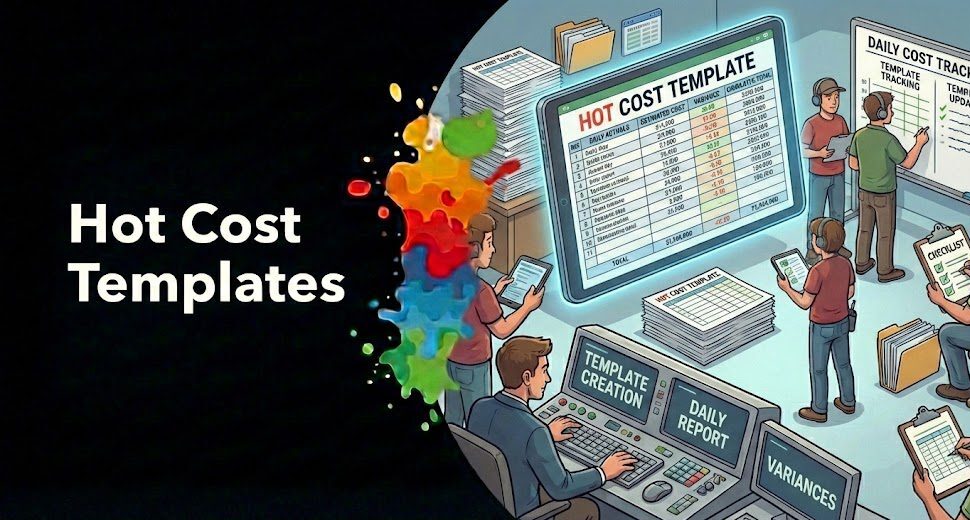
Hot cost templates are daily production accounting tools used to track the previous day’s labor and variable expenses against the locked budget.
Unlike bi-weekly cost reports, hot costs provide a 24-hour feedback loop on set efficiency—calculating overtime, meal penalties, and fringes for the crew and cast before they become uncontrollable overages. For producers, they’re the ultimate “check engine” light for a production’s financial health.
In the high-pressure environment of principal photography, waiting for a weekly cost report is a recipe for bankruptcy. By the time you see the red ink on Friday, the damage from Monday’s 14-hour day is already baked in.
That’s why top-tier line producers lean on precise hot cost templates to weaponize their data. It’s not just about tracking spending; it’s about making real-time tactical adjustments to the shooting schedule to protect the margin.
Inside the Article
Stop Guessing Who’s Financing. Get Targeted Outreach.
Stop searching and start getting funded. We identify the exact decision-makers currently backing projects like yours, turning raw data into risk-aligned capital partnerships.
Major Studios
Scouting early stage projects, IP, and Regional partners for global studio pipelines.
IP Owners & Leads
Connecting creative leads with qualified financiers and major streaming platforms.
Streamers
Securing high-value pre-buy content and discovering early-stage global IP for platforms.
Indie Producers
Bridging the gap for indie filmmakers to reach executive production partners and capital.
Global Financing Ecosystems
Mapping complex markets and pairing projects with disciplined, risk-aligned capital across global territories worldwide.
How Hot Cost Templates Actually Work
The logic is simple: compare the actual cost of yesterday’s shoot with the budgeted cost for that specific day. But the execution? That’s where it gets granular. A functional hot cost template pulls data directly from the Daily Production Report (DPR)—specifically the in/out times for every crew member, the lunch breaks, and the travel periods.
It’s not just “gross pay.” A sophisticated template must calculate fringe benefits (payroll taxes, union contributions) and penalties (rest violations or “turnaround”). If your 1st AD pushes for one last shot and breaks the crew’s 12-hour rest window, the hot cost template should immediately surface that 5-figure penalty. Producers looking to optimize production accounting services often use these reports as the primary KPI for their accounting teams.
Matthew Helderman, CEO of BondIt Media Capital, explains the financial lens on production:

The Vitrina Overrun Prevention Matrix™
To help producers navigate the noise of daily data, we’ve developed a strategic framework. The Vitrina Overrun Prevention Matrix™ categorizes daily variances based on their impact on the overall production financing plan.
The Vitrina Overrun Prevention Matrix™
| Variance Type | Trigger | Strategic Response |
|---|---|---|
| Volume Variance | Unplanned day players/labor | Review department head headcount logic. |
| Rate Variance | Higher-than-budgeted kit fees | Audit vendor contracts vs. line items. |
| Efficiency Variance | Massive Overtime / MPVs | Schedule compression or scene deletion. |
When the matrix signals a “High Intensity” variance, the line producer knows it’s not a one-off error—it’s a systemic failure in the shooting plan. That’s the moment to pivot. Maybe you collapse a scene or move a complex rig to the second unit. Without the hot cost surfacing this, you’re flying blind.
Find the Financiers Backing Your Genre
Stop searching and start getting funded. We identify the exact decision-makers currently backing projects like yours, turning raw data into risk-aligned capital partnerships.
Why Excel is the Accountant’s Best Friend (and Worst Enemy)
Most feature films still run on massive, macro-heavy Excel workbooks. Why? Because every production is a unique tax entity with its own chart of accounts and union requirements. An incentive-heavy shoot in Saudi Arabia has different fringe math than a non-union shoot in Georgia. Excel allows for that customization.
But here’s the catch: manual entry is slow. If your production accountant is spending 4 hours a day “fussing” with the hot cost, they’re not analyzing the data—they’re just clerking it. Strategic players recognize that the real value lies in automation. Modern software like Entertainment Partners or Wrapbook can auto-populate these templates from digital timecards, but the “Top Sheet” summary still needs a human eye to catch the nuance.
The real dynamic behind closed doors? Studios don’t just want the number; they want the supporting schedules. They want to see exactly which actor triggered a “forced call” and why. If you can’t justify the overage with data, you’re not getting more capital from the bank. It’s that simple.
How Vitrina Helps with Set Monitoring
Efficiency on set starts with the right partners. Vitrina’s global database allows you to de-risk your BTL spending by identifying pre-vetted production accounting firms and vendors with verified track records in specific geographic markets.
- Find Verified Partners: Explore 400+ accounting specialists on Vitrina →
- Get Project Guidance: Ask VIQI about hot cost requirements for streamers →
- Expert Concierge: Request a vetted Line Producer match within 48 hours →
Frequently Asked Questions
What is the primary purpose of a hot cost report?
The primary purpose is to provide a daily comparison between actual labor costs and the budgeted amount. It allows producers to see variances in overtime, meal penalties, and headcount in real-time, enabling tactical schedule adjustments during principal photography.
Are hot cost templates used for post-production?
Usually, no. Hot costs are designed for the high-intensity period of principal photography where labor costs are highly variable on a daily basis. Post-production costs are typically tracked through weekly cost reports since edit and VFX schedules are more predictable week-to-week.
Do hot cost reports include fixed costs like camera rentals?
Traditional hot costs focus only on variable labor (cast and crew). However, many modern producers “sneak” in high-variance items like kit fees, location overages, or transportation fuel costs to get a more comprehensive snapshot of the daily spend.
The Bottom Line
Hot cost templates aren’t just accounting paperwork—they’re a strategic survival tool. In a world where margins are razor-thin, the ability to catch a $5,000 overtime spike on Tuesday allows you to save that $5,000 on Thursday. If you aren’t monitoring your hot costs daily, you’re essentially handing the keys of your budget to the 1st AD. Don’t do that. Use the data, de-risk the set, and protect your capital. Ready to staff up your accounting team? Vitrina’s Concierge team can match you with qualified specialists in 48 hours.
Find Film+TV Projects, Partners, and Deals – Fast.
VIQI matches you with the right financiers, producers, streamers, and buyers – globally.
Producers Seeking Financing, Co-Pros, or Pre-Buys?
Vitrina Concierge helps producers reach the right financiers, commissioners, distributors, and co-production partners — with precision outreach, not cold pitching.
Join Industry Briefings Trusted by Leaders

Format Adaptations: Global Trends
Where formats are traveling, which adaptations are breaking out, and how streamers are backing remakes in 2025–2026.

Books, Novels & Comics Adaptations: Global Trends
Books, webtoons, and manga driving the next global screen hits. Discover how in this webinar.

Micro-Dramas & Mobile-First Storytelling
Micro-dramas are building real audiences and revenue. Understand the platforms, buyers, and economics behind the growth.

Navigating Global Content Licensing Trends
How global content licensing is shifting beyond flat fees to flexible, deal-driven models.