About Innovation Hub
 Global Content Pulse (Webinars)


 Global Production Financing
(Webinars)
Global Production Financing
(Webinars)  LeaderSpeak Podcast
  About Vitrina
 Our Story
 Our Solutions 🔥
 Film+TV Projects Tracker 🚀
 Case Studies
 Our Profile
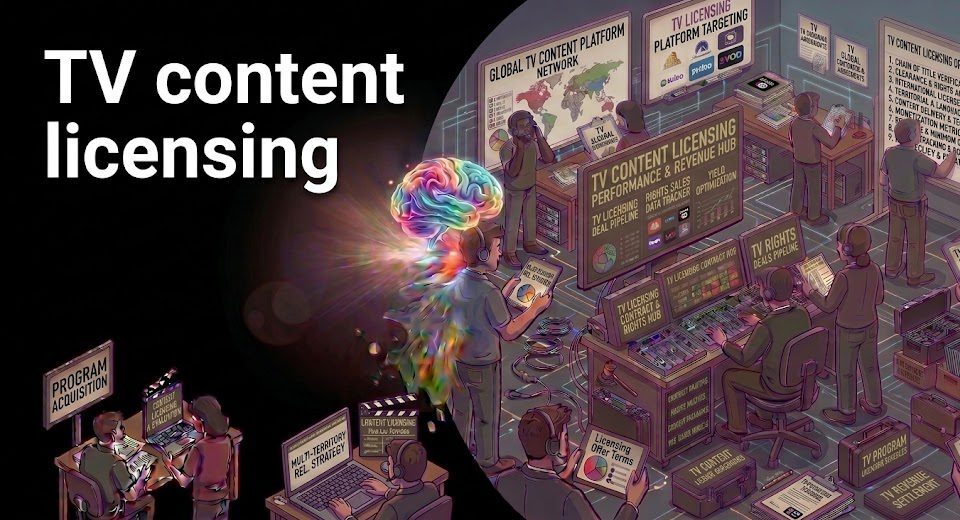
Free ad-supported streaming TV content licensing is no longer the consolation prize for content that didn’t close an SVoD deal. In 2026, it’s where smart rights holders are stacking recurring ad revenue on catalogue titles that would otherwise sit dormant—while subscription fatigue hammers the premium platforms that used to fight over those same titles.
Here’s the thing: Tubi crossed 80 million monthly active users. Pluto TV’s content partners collect ad-revenue splits on library titles long past their theatrical recoupment. Fremantle extended its partnership with Pluto TV to launch 25 dedicated ad-supported streaming TV channels across 13 new international markets—titles like Baywatch and Three’s Company building fresh income streams decades after initial release. But most producers and distributors still approach FAST licensing the way they approached cable syndication in 2003. That gap is costing real money.
This guide covers what you need to know about free ad-supported streaming TV content licensing in 2026—deal structures, revenue mechanics, rights windows, and how to find the right platform partners before six months slip past.
Table of Contents
- Why Free Ad-Supported Streaming TV Is Winning in 2026
- The 3 FAST Licensing Deal Structures You’re Probably Getting Wrong
- How Tubi, Pluto TV, and Fremantle Are Actually Doing It
- Territory, Window, and Exclusivity: The 3 Revenue Levers
- The Fragmentation Paradox Is Killing Your FAST Margins
- 7 Proven Strategies to Close FAST Channel Deals Faster
- Your FAST Discovery Pipeline Needs an Upgrade
- FAQ: Free Ad-Supported Streaming TV Content Licensing
- Key Takeaways
Ask VIQI: Which FAST Platforms Are Actively Acquiring in Your Genre Right Now?
VIQI is Vitrina’s AI assistant—trained on 1.6 million titles, 360,000 companies, and 5 million entertainment professionals. Get real-time acquisition intelligence on FAST buyers before your competitors do.
✓ Included with 200 free credits | ✓ No credit card needed
Why Free Ad-Supported Streaming TV Is Winning in 2026
The numbers don’t lie. The global FAST market surpassed $6 billion in ad revenue by 2025, and that trajectory hasn’t slowed. Viewer minutes on FAST platforms grew 35% year-over-year as audiences discovered that free beats friction—every single time.
And from the supply side? Studios and distributors are sitting on massive content libraries with depreciating value on SVoD platforms. Netflix and Amazon don’t renew everything. When a title falls off a premium platform’s schedule, FAST becomes the natural next window—and the ad revenue from that window is consistently underestimated by the rights holders who could be capturing it.
Tim Cutting, who leads strategic revenue initiatives at Gracenote and shapes content distribution strategy across North America, EMEA, LATAM, and APAC, makes a sharp point in our
FAST channel monetization strategies discussion: visibility, consumption, and monetization are three separate problems. And most content owners are only solving one of them. That’s the gap—and it’s costing real recoupment opportunity.

Your AI Assistant, Agent, and Analyst for the Business of Entertainment
VIQI AI helps you plan content acquisitions, raise production financing, and find and connect with the right partners worldwide.
- Find active co-producers and financiers for scripted projects
- Find equity and gap financing companies in North America
- Find top film financiers in Europe
- Find production houses that can co-produce or finance unscripted series
- I am looking for production partners for a YA drama set in Brazil
- I am looking for producers with proven track record in mid-budget features
- I am looking for Turkish distributors with successful international sales
- I am looking for OTT platforms actively acquiring finished series for the LATAM region
- I am seeking localization companies offer subtitling services in multiple Asian languages
- I am seeking partners in animation production for children's content
- I am seeking USA based post-production companies with sound facilities
- I am seeking VFX partners to composite background images and AI generated content
- Show me recent drama projects available for pre-buy
- Show me Japanese Anime Distributors
- Show me true-crime buyers from Asia
- Show me documentary pre-buyers
- List the top commissioners at the BBC
- List the post-production and VFX decision-makers at Netflix
- List the development leaders at Sony Pictures
- List the scripted programming heads at HBO
- Who is backing animation projects in Europe right now
- Who is Netflix’s top production partners for Sports Docs
- Who is Commissioning factual content in the NORDICS
- Who is acquiring unscripted formats for the North American market
The 3 FAST Licensing Deal Structures You’re Probably Getting Wrong
Not all free ad-supported streaming TV content licensing deals are built the same. You’ll run into three primary structures—each carrying very different margin implications for your capital stack.
Revenue Share Deals
The platform carries your content, runs ads against it, and splits CPM revenue with you. Splits typically land between 50/50 and 70/30 in the platform’s favor. Your upside depends entirely on how aggressively the platform promotes your title and how well your content performs in their algorithmic recommendations. Don’t sign these blind without viewership projections.
Flat Fee Licensing
You license a specific title or catalogue for a fixed fee—no ongoing revenue share. Easier to underwrite, faster to close. But you’re leaving real upside on the table if your content performs well. Flat fees make sense when you’ve got no performance data to argue with.
Hybrid Models
A guaranteed floor—minimum fee—plus revenue share above a threshold. This is the structure serious FAST deals are moving toward in 2026. Bell Media‘s arrangement with Tubi for Canadian digital ad inventory control is exactly this kind of structured partnership, where both parties carry defined economic exposure rather than pure upside/downside asymmetry. Both sides have skin in the game. That aligns incentives.
Tim Cutting (Senior Director, Strategic Revenue, Gracenote) breaks down how FAST channel owners drive visibility, consumption, and monetization across global markets—and why metadata quality is the hidden lever most content owners miss:
How Tubi, Pluto TV, and Fremantle Are Actually Doing It
The FAST platforms making headlines aren’t waiting for content to come to them—and the smart content owners aren’t waiting for platforms to call. Tubi commissioned four original films from Hartbeat—Kevin Hart’s production company—a clear signal that ad-supported streaming is no longer a pure library play. Original commissions on FAST platforms are now viable economic propositions when CPM rates hold and viewership scales.
Pluto TV‘s approach is catalogue-first but channel-packaged. And Fremantle didn’t just license individual titles to Pluto TV—they built 25 dedicated FAST channels across 13 international markets. Baywatch gets its own channel. Three’s Company gets its own channel. That’s not just licensing—it’s a distribution strategy that wrings ongoing revenue from IP that’s already fully recouped.
As Deadline has tracked across multiple FAST partnership announcements, the channel-as-product model is becoming the standard for library-heavy distributors—not the exception. The aggregation play beats the title-by-title pitch every time on FAST.
Vitrina clients tracking this activity in real time don’t miss these windows. With 140,000+ companies mapped and 400,000+ projects tracked across the platform, you can see which catalogues are moving into FAST windows—and position your titles accordingly—before the deal closes elsewhere.
Track Which FAST Platforms Are Buying—Before They Stop Buying
Trusted by Netflix, Warner Bros, Paramount, and Google TV. Join 140,000+ companies tracking active acquisition patterns across the global entertainment supply chain.
✓ 200 free credits | ✓ No credit card required | ✓ Full platform access
Territory, Window, and Exclusivity: The 3 Revenue Levers
Let’s talk deal architecture. The margin difference between a good FAST deal and a bad one almost always comes down to three variables.
Territory: FAST is a North American phenomenon—for now. Samsung TV Plus operates across 24 countries. LG Channels reaches audiences in 28 markets. Pluto TV and Tubi are accelerating European rollouts. If you’re licensing global FAST rights for one flat fee, you’re mispricing your asset—badly.
Rolla Karam, SVP of Content Acquisition at OSN—which covers 23 countries across MENA—makes a point that applies directly to FAST sellers: committing to long output deals without understanding market-by-market performance data is a trap. “I don’t like to commit to long deals,” she says. Smart FAST sellers take the same position on territorial bundling. Don’t give away global rights when you haven’t benchmarked regional CPM rates.
Window: Your FAST window positioning matters. A title coming off a Netflix exclusive needs breathing room before FAST licensing—or you’re undermining your SVoD negotiating position on the next renewal cycle. Get window sequencing wrong and you’re accelerating recoupment at the cost of future deal leverage.
Exclusivity: True exclusivity on FAST is increasingly rare—most platforms accept non-exclusive deals for library content. But non-exclusive deals in the same territory fragment your negotiating position for future SVoD deals. The cleanest FAST structures are non-exclusive by territory. Run Tubi for the US, Samsung TV Plus for Europe, and keep clean window separation in each market. That’s Smart Pairing in action—matching your content to the right platform in the right territory at the right time.2026 content licensing models analysis covers the full window sequencing framework for FAST vs SVOD vs linear deals.
The Fragmentation Paradox Is Killing Your FAST Licensing Margins
Here’s the problem nobody talks about honestly. There are now 1,500+ FAST channels in the US alone. Globally, that number runs toward 6,000+. And the companies operating them—from major studio-backed platforms to independent channel operators—aren’t uniformly trackable through conventional industry databases.
That’s the Fragmentation Paradox™ at work in real time. 600,000+ companies in the M&E supply chain operate in opaque silos. For free ad-supported streaming TV content licensing specifically, this creates a discovery deficit: you don’t know which platform is actively acquiring in your genre, which operators have budget in Q3, or which international FAST channels are building out catalogue in your territory.
The cost? You negotiate with the two FAST platforms you already know. You miss the 15 platforms that would have competed for your content. And your per-title revenue reflects that narrowed deal flow. That’s not a market problem—that’s an intelligence problem.
According to Variety, the FAST market’s growth is outpacing traditional deal-finding infrastructure—with new channel operators entering globally at a pace that legacy relationship networks simply can’t track. The producers capturing FAST revenue at scale aren’t relying on relationships built in 2019. They’re using real-time market intelligence.
7 Proven Strategies to Close FAST Channel Deals Faster
Here’s what the most effective FAST channel content licensing playbooks look like in 2026:
- Lead with data, not screeners. FAST platforms make acquisition decisions based on viewership analytics, not aesthetic quality. Come with your content’s prior performance history from any previous distribution window. Genre-specific CPM benchmarks matter more than your trailer.
- Package by channel, not by title. Fremantle’s model is the template. Bundle 50+ related episodes into a themeable channel. FAST platforms can build a dedicated feed around it—which drives algorithmic promotion you’d never get from a single-title license.
- Map your FAST window against your full rights strategy first. Don’t commit FAST rights before you know your SVoD, linear, and international sales sequencing. A mis-sequenced FAST window kills your leverage in every subsequent deal.
- Target 3-4 platforms per territory, not one. Non-exclusive FAST deals allow parallel licensing. Your library content can run on Tubi AND Pluto TV AND Samsung TV Plus simultaneously in non-competing, territory-specific revenue share structures.
- Negotiate metadata standards into the contract. Poor metadata is the silent killer of FAST content performance. If the platform can’t surface your content in discovery, you don’t earn ad revenue. Require metadata quality standards as a contract term—not an afterthought.
- Benchmark CPMs before signing any flat-fee deal. FAST CPMs range from $8 to $25 depending on genre, platform, and territory. Know the range before you sign flat. You’ll only make that mistake once.
- Use platform acquisition trackers to find active buyers. FAST platforms cycle their acquisition priorities quarterly. A genre that wasn’t on Tubi’s list in Q1 may be a priority in Q3. You need real-time acquisition intelligence—not a static vendor list from last year.
Our content acquisition best practices for broadcasters and platforms covers the platform-by-platform acquisition patterns in more detail.
Your FAST Content Discovery Pipeline Needs an Upgrade
Carol Hanley, CEO of Whip Media, frames the operational problem clearly: FAST channel owners need streaming analytics that track royalties, revenue, and audience insights in real time—not quarterly reports. But content sellers on the other side of those deals have the same intelligence gap. You don’t know which platforms are performing, which are scaling, and which are about to churn their content strategy—until the acquisition window has already closed.
Vitrina’s intelligence maps active acquisition patterns across 140,000+ M&E companies globally. When a FAST platform shifts acquisition priorities—say, pivoting from library content to original commissions, or opening up international catalogue acquisition for a new territory rollout—that signal appears in real-time deal flow data. Not in a trade report six weeks later.
That’s the difference between proactive FAST licensing and reactive licensing. And in a market with 6,000+ competing channels, being proactive isn’t optional—it’s the only way to negotiate from strength.
For rights holders sitting on catalogue, the question isn’t whether free ad-supported streaming TV content licensing makes financial sense. In 2026, it clearly does. The question is whether you’re sourcing partners and structuring deals with the same rigor you’d apply to an SVoD presale. Start by benchmarking your current approach against our
ultimate guide to sourcing content for OTT platforms.
Find Active FAST Buyers for Your Catalogue—In 48 Hours
Trusted by Netflix, Warner Bros, Paramount, and Google TV. Vitrina maps real-time acquisition activity across 1,500+ FAST channels globally. One LA-based producer connected with Netflix UK, Fifth Season, and Fox Entertainment in under 48 hours.
✓ 200 free credits | ✓ No credit card required | ✓ Cancel anytime
FAQ: Free Ad-Supported Streaming TV Content Licensing
What is free ad-supported streaming TV content licensing?
Free ad-supported streaming TV (FAST) content licensing is the process of granting a streaming platform—like Tubi, Pluto TV, or Samsung TV Plus—rights to distribute your film or TV content to viewers at no charge, in exchange for a share of the advertising revenue generated against your content. Unlike SVoD licensing, there’s no subscriber paywall. Revenue comes entirely from CPM-based ad sales against your content’s viewership.
How much can I earn from FAST channel content licensing?
Earnings depend on three variables: your content’s viewership, the platform’s CPM rates, and your revenue share split. FAST CPMs range from $8 to $25 depending on genre, platform, and territory. Premium genres—crime, documentary, and reality—typically command higher rates. A catalogue title driving 500,000 monthly views at a $12 CPM on a 50/50 revenue share generates roughly $3,000 per month. Scale that across 30 titles in a channel package and the numbers shift materially.
What’s the difference between FAST, AVOD, and SVOD licensing?
FAST (Free Ad-Supported Streaming TV) delivers linear-style channels—scheduled programming—without a subscription. AVOD (Advertising Video on Demand) is ad-supported but on-demand, like YouTube or Tubi’s VOD library. SVoD (Subscription Video on Demand) requires a monthly fee—Netflix, HBO Max. Content can and does appear across all three, with different window sequencing and exclusivity terms governing each deal. FAST and AVOD rights are often bundled in the same license, but they should always be negotiated separately when you have catalogue leverage.
How long are FAST channel content licensing deals typically?
Deals typically run one to three years, with shorter terms increasingly common as platforms want flexibility to refresh channels and rights holders want to preserve leverage for future windows. Multi-year flat-fee deals are generally better for platforms than for content owners—unless your content’s performance is uncertain and you need guaranteed floor income. Rolla Karam of OSN articulates exactly this logic for her platform: she no longer commits to long output deals because content strategy evolves too fast. FAST sellers should apply that same discipline.
Can I license the same content to multiple FAST platforms simultaneously?
Yes—if you negotiate non-exclusive deals, which most FAST platforms accept for library content. Non-exclusive FAST rights let you place the same title on Tubi, Pluto TV, and Samsung TV Plus at the same time in the same territory. But don’t assume non-exclusivity without confirming it in the contract. Some platforms—particularly those building branded genre channels—will push for exclusivity, especially for premium catalogue or originals. Know what you’re giving up before you agree.
What content performs best on FAST platforms in 2026?
Catalogue series—particularly procedural crime, reality competition, documentary, and classic entertainment—consistently outperform on FAST. Episodic series drive repeat viewing and channel loyalty in ways that films don’t. That’s why Fremantle’s channel-packaging model works so well: Baywatch as a FAST channel drives daily viewing habits, not one-time title discovery. True crime and nature documentary also command premium CPMs from advertisers. Sports-adjacent content is emerging as a FAST growth category across international markets.
How do I find FAST channels actively acquiring content in my genre?
This is where the Fragmentation Paradox™ hits hardest. With 1,500+ FAST channels in the US and 6,000+ globally, you can’t track active acquisition patterns through relationships or trade press alone. Vitrina maps real-time deal flow and acquisition activity across 140,000+ M&E companies—including FAST channel operators across North America, Europe, and APAC. You can filter by genre, territory, budget, and acquisition window to identify which platforms are actively buying right now—not six months ago.
Do FAST platforms commission original content?
Yes—and it’s growing. Tubi’s deal for four original films from Hartbeat is the clearest recent signal. But original FAST commissions still represent a small fraction of overall FAST content deals. Most original commissions are lower-budget than SVoD originals—expect budgets in the $1M–$5M range for film and series. But as CPM rates rise and FAST audience scale increases, the original commission model becomes progressively more viable for platforms that want to differentiate their channel offering beyond library aggregation.
Key Takeaways: FAST Channel Content Licensing in 2026
The FAST market is real, it’s growing, and it’s where smart catalogue owners are building revenue streams that weren’t available five years ago. But the deals don’t close themselves—and the fragmentation of the channel market means most rights holders are negotiating with a fraction of their potential buyer pool.
- Free ad-supported streaming TV content licensing has crossed $6 billion in global ad revenue—and it’s the natural next window for content exiting SVoD deals.
- Hybrid deal structures (guaranteed floor + revenue share) are becoming the standard for serious FAST licensing negotiations in 2026.
- Channel packaging—not title-by-title licensing—is the model that drives the highest per-episode revenue for library-heavy distributors.
- Territory, window, and exclusivity are the three levers that determine whether your FAST deal accelerates or undermines your broader rights strategy.
- Real-time acquisition intelligence is the only way to navigate 6,000+ FAST channels and find active buyers before the window closes.
Discover Active FAST Buyers Across 140,000+ M&E Companies
Trusted by Netflix, Warner Bros, Paramount, and Google TV. Track 400,000+ projects. Access 3 million verified executives. Find the FAST channel operators actively buying your genre—right now.
✓ 200 free credits | ✓ No credit card required | ✓ Cancel anytime
Need direct introductions to FAST platform decision-makers? Explore Concierge Service →
Find Film+TV Projects, Partners, and Deals – Fast.
VIQI matches you with the right financiers, producers, streamers, and buyers – globally.
Producers Seeking Financing, Co-Pros, or Pre-Buys?
Vitrina Concierge helps producers reach the right financiers, commissioners, distributors, and co-production partners — with precision outreach, not cold pitching.
Join Industry Briefings Trusted by Leaders

Format Adaptations: Global Trends
Where formats are traveling, which adaptations are breaking out, and how streamers are backing remakes in 2025–2026.

Books, Novels & Comics Adaptations: Global Trends
Books, webtoons, and manga driving the next global screen hits. Discover how in this webinar.

Micro-Dramas & Mobile-First Storytelling
Micro-dramas are building real audiences and revenue. Understand the platforms, buyers, and economics behind the growth.

Navigating Global Content Licensing Trends
How global content licensing is shifting beyond flat fees to flexible, deal-driven models.