IHUB
IHUB
 Private Briefings (Webinars)


 LeaderSpeak Podcast
  Global Entertainment Digest (Newsletter)
  Premium Lists
 Premium Reports
 Membership Benefits
 About Vitrina
 Our Story
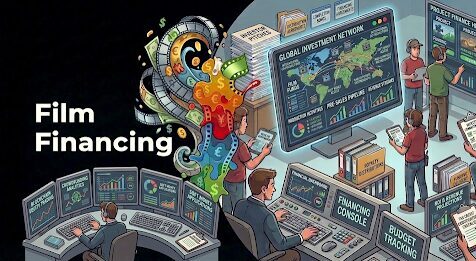
Film financing is the process by which producers secure the capital required to develop, produce, and distribute a film or TV project. Funding structures include equity investment, debt financing, pre-sales, co-production treaties, government grants, and tax incentives. Most independent films are financed through a combination of two to four of these sources.
By Vitrina Research Team | Updated: July 2026 | 14 min read
Key Takeaways
- The global film and entertainment industry is projected to reach $2.9 trillion in value by 2029, according to PwC’s Global M&E Outlook 2025, making film financing a high-stakes discipline for producers at every budget level.
- Most independent films (under $5M) rely on a mix of pre-sales, tax incentives, and soft money grants rather than a single investor or studio deal.
- Ireland (32%), UK (25-40%), and Canada (up to 40% combined) offer the highest film tax incentive rates among major production territories in 2026.
- Gap financing, which bridges the difference between pre-sold territory value and total budget, typically carries interest rates of 8-12% per annum and requires a credible sales agent to unlock.
- Vitrina tracks 300,000+ M&E companies worldwide, including active film financiers, co-production partners, and production service companies across 100+ territories.
Quick Answer
What is film financing? Film financing is the multi-source process of assembling the capital needed to make and distribute a film. Producers combine equity from private investors, pre-sales to distributors, government tax incentives, co-production funds, and bank debt to fill the total budget. Each source carries different risk and recoupment terms, and the order of repayment is governed by a recoupment waterfall agreed before production begins.
What Is Film Financing?
Film financing covers every mechanism a producer uses to secure capital for a project. According to the Producers Guild of America, fewer than 5% of feature films receive a single-source, fully funded greenlight. The remaining 95% require producers to assemble multiple funding layers before a camera rolls, combining public and private sources in a carefully negotiated structure.
A film financier’s role varies significantly depending on the type of capital they provide. Equity investors own a percentage of the film and share in profits. Debt lenders such as gap finance providers advance money against collateral and expect repayment with interest regardless of box office performance. Distributors advance against specific territories, while governments provide non-recoupable grants or tax rebates that don’t require repayment at all.
The International Film and Television Alliance (IFTA) estimates that pre-sales remain the single most critical financing tool for independent productions, accounting for 30-50% of a typical independent film’s budget in the mid-budget range. Without at least one confirmed territory pre-sale, most gap lenders will not engage with a project.
Film financing has grown more complex over the past decade. Streaming platforms have altered traditional pre-sale markets. Some streamers now act as both financier and distributor, offering all-rights deals that simplify packaging but reduce producer control over long-term revenue. Understanding the full spectrum of film financing options for independent producers is more important than ever.
Citation Capsule
The global film and TV industry generated approximately $2.3 trillion in combined revenues in 2024 and is forecast to reach $2.9 trillion by 2029, per the PwC Global M&E Outlook 2025. Despite this scale, independent film producers still rely on multi-source financing structures, with IFTA reporting pre-sales accounting for 30-50% of independent budgets.
The 8 Main Types of Film Financing
There are eight established mechanisms through which a film financer or film financier provides or unlocks capital for production. The European Audiovisual Observatory’s 2024 report found that European co-productions used an average of 3.4 distinct financing sources per project. Each type carries different risk profiles, recoupment positions, and eligibility requirements that producers must understand before approaching investors.
| Type | Capital Source | Typical Share | Recoupment | Best For |
|---|---|---|---|---|
| Equity | Private investors | 20-60% | Waterfall | All budgets |
| Gap Finance | Banks/lenders | 10-30% | First position | Pre-sold projects |
| Pre-Sales | Distributors | 15-40% | Against territories | Mid-budget+ |
| Co-Production | Partner studio | 20-50% | Negotiated | International content |
| Tax Incentive | Government rebate | 10-40% | Non-recoupable | Any eligible production |
| Soft Money | Grants/funds | 5-25% | Non-recoupable | Qualifying criteria |
Equity Financing
Equity financing means selling ownership stakes in a film or production company to private investors in exchange for capital. Investors accept the risk that if the film doesn’t perform, their investment is lost. In return, they participate in the recoupment waterfall once revenues come in. For a deeper comparison, see film financing vs equity financing.
Equity typically fills the gap after all other sources are confirmed. Sophisticated equity investors review the recoupment waterfall closely, checking their position relative to gap lenders and tax credit holders. Producer’s equity is usually the last to be repaid, which explains why many producers offer enhanced back-end percentages to attract early-stage capital.
Return expectations vary by investor type. Private, individual investors in independent film typically look for 15-25% annual returns given the high-risk nature of the asset class, while institutional equity investors and dedicated film funds often accept a more conservative 8-15% return in exchange for greater seniority in the recoupment waterfall. Producers can also lower the effective cost of equity capital through tax-advantaged investment vehicles: the UK’s Enterprise Investment Scheme (EIS) and Seed EIS, and France’s SOFICA funds, each offer investors income tax relief that reduces their required return. Entertainment law firm Lee & Thompson has cited a sobering benchmark for equity investors to understand going in: only 3.8-4% of UK independent films ever reach net profits, which is why experienced equity investors treat film as patient, high-risk capital rather than a short-term return play.
In practice, independent producers encounter four distinct types of equity investor, and each expects a different pitch. Angel investors are high-net-worth individuals writing personal checks of roughly $50,000-$500,000, often motivated as much by passion for the project as by return and sometimes seeking a producer credit. Film investment funds take a portfolio approach, committing $500,000-$5 million per title while spreading risk across a slate of projects. Family offices vary widely in mandate but typically bring longer investment horizons and a genuine interest in the cultural asset alongside the financial return. Private equity firms generally require $10 million or more and focus on slate financing or company-level equity rather than single-project deals. What moves capital at every level is the same: a clean chain of title, signed deal memos rather than letters of intent, a completion bond commitment, and transparent waterfall modeling under conservative, base, and upside scenarios.
Debt and Gap Financing
Debt financing for film is a loan structure where a bank or specialist lender advances capital against a specific collateral asset, usually pre-sale contracts or confirmed tax credits. Film gap financing is a subset of debt finance. It covers the “gap” between the value of contracted pre-sales and the total production budget, lending against unsold territory value that a sales agent certifies.
Gap lenders typically charge 8-12% annual interest and take first recoupment position. That means they are repaid before equity investors. Common gap lenders include Comerica Entertainment Group, East West Bank, and specialty film finance arms of mid-size banks. A completion bond is almost always required alongside gap lending, adding approximately 1-3% to production costs. Once origination fees (typically 1-2% of the loan) and legal costs are factored in, the fully loaded cost of a gap facility over an 18-month production and financing cycle can run 15-22% of the loan principal, a figure producers should model before relying on gap finance to close a budget.
Two related debt structures are worth distinguishing from gap finance. A negative pickup deal is a commitment from a major distributor or studio to acquire the completed film for a fixed sum once delivered; the producer then uses that guarantee as collateral for a production loan, shifting much of the financing risk onto the eventual distributor rather than a pool of equity investors. A P&A (prints and advertising) line is a separate credit facility, advanced against a signed distribution agreement specifically to fund a theatrical release’s marketing campaign rather than production itself. Banks also discount minimum guarantee (MG) contracts differently depending on the distributor’s creditworthiness: a major, well-capitalized territorial distributor’s MG might be discounted to around 85-90% of face value for lending purposes, while a smaller or less established buyer’s MG might only be creditable at around 70%.
Pre-Sales and Distribution Advances
A pre-sale is an advance license fee paid by a territorial distributor before the film is completed. In exchange, the distributor acquires exclusive distribution rights in their territory for a defined period. These contracts are then used as collateral with a bank or gap lender to unlock production funds. According to IFTA, pre-sales from established markets such as Germany, France, and Japan typically yield the highest minimum guarantees for mid-budget independent films.
Co-Production Financing
Co-production agreements allow producers in different countries to combine budgets and qualify for each partner’s domestic incentives. The European Audiovisual Observatory recorded 785 international co-productions in Europe alone in 2023. Official co-productions under bilateral treaties unlock additional soft money and may qualify a project for domestic content status in multiple territories simultaneously.
The treaty network behind this is substantial and worth understanding before choosing a co-production partner. Canada alone has bilateral co-production treaties with 60+ countries and processes 60+ official co-productions a year worth roughly $500M CAD combined. The UK holds treaties with Australia, Canada, France, India, and more than a dozen other territories, while France maintains 61 bilateral treaties and runs joint production funds with specific partners, including a France-Italy fund worth €1M annually. The revised European Convention on Cinematographic Co-Production (updated 2018) now lets multilateral co-productions across 43 European countries proceed with a minimum partner contribution as low as 5% of the budget, a far lower bar than the 20%+ minimums typical of older bilateral treaties. What matters to regulators and auditors in any of these structures is genuine creative and financial contribution from each partner; a shell arrangement that exists only to access tax benefits can fail regulatory scrutiny and invalidate the entire financing structure.
Government Grants and Soft Money
Soft money refers to non-recoupable funding from public film bodies, typically structured as grants, development loans, or production subsidies. Major soft money sources include the BFI Film Fund in the UK, Film4 Productions, the CNC in France, the SABC-backed NFVF in South Africa, and state-level development funds across India. These funds are competitive and often tied to cultural content requirements, cast and crew nationality thresholds, or subject matter criteria.
Tax Incentives and Rebates
Tax incentives are cash rebates or tax credits that governments offer to attract film production spending. Unlike grants, they are generally tied to actual qualifying expenditure rather than content. Ireland’s Section 481 (32%), the UK’s High-End TV and Film Tax Relief (25-40%), and Canada’s combined federal-provincial credit (up to 40%) consistently rank among the most valuable. Producers often choose shoot locations primarily based on incentive rates available.
Two mechanics matter for cash-flow planning around any tax incentive. First, most incentive payments are backend money: they are paid out only after production wraps and an audit confirms qualifying expenditure, so they cannot fund principal photography directly. Second, because a confirmed incentive is a quantifiable, near-certain receivable once a production completes, specialist entertainment lenders will advance against it. A rebate loan typically advances 80-90% of the incentive’s face value, giving producers access to that capital during the shoot rather than waiting six to eighteen months for the government payment to arrive. Incentives are also stackable: a properly structured co-production can access two or more territories’ programs simultaneously, and a UK-Ireland combination, for example, can push combined incentive coverage to 35-45% of the total budget before any pre-sale or equity dollar is raised.
Crowdfunding
Crowdfunding platforms such as Kickstarter, Indiegogo, and Seed&Spark allow producers to raise smaller sums directly from audiences. While crowdfunding rarely covers more than 5-15% of even a micro-budget film’s total cost, it provides proof of audience interest that can attract other investors. The Producers Guild of America notes that a successful crowdfunding campaign also functions as a marketing asset and early community-building exercise.
Brand and Product Placement Finance
Brand integration deals allow a producer to sell prominent product placement or brand partnership rights as a financing mechanism. High-budget commercial genre films, action titles, and family content attract the most brand interest. Branded entertainment deals are typically structured as either cash fees, contra deals (services in exchange for screen time), or co-financing arrangements where the brand becomes an equity partner with specific creative approvals.
Find Active Film Financiers Across Every Territory
Vitrina tracks 300,000+ M&E companies worldwide, including verified film finance companies, co-production partners, and production service providers.
How the Film Financing Recoupment Waterfall Works
The recoupment waterfall is the contractually agreed order in which each financing party receives payment from a film’s revenues. According to the British Film Institute’s production finance guidelines, waterfall disputes are among the top three causes of post-production legal conflicts on independent films. Getting the waterfall structure right before production begins protects every party and determines which investors get paid first when money comes in.
Film Revenue Recoupment Waterfall
Note: Deferred fees (cast, crew) typically sit between steps 6 and 7.
A typical independent film recoupment waterfall flows as follows:
Box Office and All Revenue Streams
Theatrical, home entertainment, streaming, TV sales, and ancillary revenues flow into the collection account.
Distributor Fees and Distribution Expenses
Distributor takes 20-25% as their fee, plus all recoupment of P&A (print and advertising) costs before passing funds upstream.
Gap Lender (First Position)
Gap lenders receive full principal repayment plus accrued interest before any other investor. Their first-position security is non-negotiable.
Completion Bond Holder
If the bond company covered a cost overrun, they recoup that advance here before equity participants are paid.
Equity Investors (Pari Passu)
Multiple equity investors recoup their invested capital simultaneously on a proportional (pari passu) basis before any profit participation begins.
Deferred Fees
Cast and crew who deferred portions of their fees (common on micro and indie budget films) receive payment from this pool.
Producer Net Profit
Whatever remains after all parties above are fully recouped is split between producers and profit participants as defined in the financing agreements.
Why does the waterfall matter so much? Because most independent films never reach step 5. Distribution fees and P&A costs consume a large share of revenue, which is why equity investors in independent films are considered high-risk capital. Structuring a favorable waterfall is as important as securing the funding itself.
Citation Capsule
The British Film Institute’s production finance guidelines identify recoupment waterfall disputes as one of the top three post-production legal conflicts on independent films. Distributor fees of 20-25%, combined with P&A cost recoupment, typically consume 40-60% of a film’s first-position revenues before equity investors see any return.
Find verified film financiers active in your territory. Search Vitrina’s database of 300,000+ M&E companies to identify active film finance companies and gap lenders by region. Search film financiers free →
Film Financing by Budget Level
The right financing mix depends heavily on a film’s total budget. The MPAA’s 2024 theatrical market data showed that films under $5M represent roughly 40% of all releases but generate only 8% of total domestic box office, which shapes how financiers assess their risk exposure. Budget level determines which financing tools are available, which investors are appropriate, and what combination of sources is realistic to close.
| Budget Level | Typical Mix | Lead Source |
|---|---|---|
| Under $500K | Grants + crowdfunding + micro-equity | Film commission grants |
| $500K–$5M | Pre-sales + soft money + equity | Sales agent pre-sales |
| $5M–$30M | Pre-sales + gap finance + co-production | Gap lender |
| $30M+ | Studio equity + output deal + bank debt | Studio/distributor |
Micro-Budget (Under $500K)
Indie film financing at micro-budget level is almost entirely built on soft money and personal capital. Film commissions in over 40 US states offer production incentives or grants starting at budgets under $100K. At this tier, crowdfunding serves a dual purpose: it provides modest capital and demonstrates audience interest to regional film funds. Sales agent pre-sales are rarely achievable without an established producer or name cast, so the financing strategy focuses on qualifying for grants first.
Many micro-budget films are financed on deferred deals, where cast and crew work below their standard rates and receive additional payment if and when the film generates revenue. Horror is one genre where micro-budget financing has a proven track record, with films like “Paranormal Activity” (made for $15,000) demonstrating the outsized return potential. For genre-specific strategies, see the full guide to funding horror films.
Independent ($500K–$5M)
The $500K to $5M range is the most competitive band of independent film financing. A sales agent becomes essential at this level, because pre-sales to distributors in key markets (Germany, Japan, France, Benelux, and Scandinavia) are the primary financing driver. Expect to spend 6-12 months assembling this package. Tax incentives can contribute a significant portion, particularly if the production qualifies for UK, Irish, or Canadian credits. Learn more about film financing options for independent producers at this budget tier.
Mid-Budget ($5M–$30M)
Mid-budget productions typically require a gap lender to close the financing. At this level, the producer will have confirmed pre-sales, a tax credit certificate, and possibly a co-production partner before approaching a gap lender. Co-productions become viable here because partner territories can contribute meaningful sums and unlock their own domestic incentives. Finding international co-production partners at this budget level opens access to substantially larger combined incentive pools.
Studio-Adjacent ($30M+)
Films above $30M rarely operate without at least one major studio or streaming platform involved as either equity partner or domestic distributor. At this budget level, studio output deals, slate financing arrangements, and senior bank debt are the primary mechanisms. The studio or platform typically controls P&A spending and distribution, significantly influencing the recoupment timeline for co-investors. Producers at this level should understand entertainment financing in a streaming-first world, where platform deals increasingly replace traditional theatrical pre-sales.
This is also where studio financing diverges structurally from everything described above, not just by scale. Studios fund films from a corporate balance sheet, allocating capital with the expectation that the title contributes to overall slate performance rather than succeeding on its own terms. That allows a studio to absorb individual losses that would end an independent production, and it means studios rarely build an external recoupment waterfall at all, since they are not assembling financing from multiple outside parties the way an independent producer is. The trade-off is creative control: studio financing typically comes with development notes, test screenings, and final cut rights that independent financing structures do not impose.
Slate financing is the specific mechanism behind much of this studio-adjacent capital. Institutional investors, such as private equity firms or hedge funds, pool money to fund a portfolio of five to ten films from a single studio or production company rather than backing one title at a time. Spreading the investment across a slate means a single underperforming film does not sink the fund, which is why this structure relies heavily on the distributor’s or platform’s track record of consistent output rather than on any individual project’s merits.
Find co-production partners matched to your budget level. Vitrina’s database covers 100+ territories and includes co-production partners, gap lenders, and sales agents at every budget tier. Search co-production partners →
Film Financing for First-Time Filmmakers: A Practical Sequence
The financing tools described above assume a producer with a track record, and most of them are gated accordingly: gap lenders require proven producer credits and a completion bond, sales agents want commercial packages with recognizable talent, and equity funds often evaluate slates rather than individual first projects. A parallel path exists for first-time filmmakers that does not require a previous credit, built instead on a different sequence: budget first, soft money second, private investors third, pre-sales and tax incentives last. Working the steps out of order is the most common reason a debut feature’s financing stalls.
Lock the Budget Before Any Funding Conversation
A budget is also a credibility signal: an over-inflated number signals inexperience, and an unrealistically low one signals the producer hasn’t thought through post-production, insurance, or delivery requirements. Independent films under $1 million typically break down as roughly 20-30% above-the-line (director, writers, principal cast), 40-50% below-the-line production (crew, equipment, locations), 20-25% post-production, and a 10% contingency that should never be cut. Every line item should be researched, not estimated, before it reaches an investor’s desk.
Soft Money and Crowdfunding Before Equity
Grants from national and regional film funds, cultural and arts council grants, broadcaster development funds, and festival labs (Sundance Collab, Gotham Film & Media Institute, IFFR Rotterdam, Berlinale Talents) don’t require equity or a track record, only a compelling project and a credible application. Regional arts council grants rarely exceed $25,000-$50,000 individually, but stacked together they meaningfully reduce the equity a first film needs to raise. Crowdfunding is best treated as proof of concept rather than a primary funding source: a successful campaign demonstrates to future private investors that real audiences will pay for the project before it exists, which is a more valuable signal than the cash itself. For most first-time filmmakers without an existing audience, crowdfunding realistically tops out around $50,000-$100,000.
A Realistic $500,000 First-Film Capital Stack
Notice what is absent from a first-film budget compared with the budget tiers above: gap financing, pre-sales, and institutional debt are not in the picture. Those tools require a track record and a sales agent that a debut project generally does not yet have.
| Funding Source | Amount | % of Budget |
|---|---|---|
| Regional film fund grant | $75,000 | 15% |
| Crowdfunding campaign | $30,000 | 6% |
| Private investor (angel) | $150,000 | 30% |
| Personal / family contributions | $50,000 | 10% |
| Tax incentive (rebate loan bridge) | $100,000 | 20% |
| Deferred crew payments | $95,000 | 19% |
Deferred payments deserve a specific mention: experienced crew sometimes work on first films for reduced or deferred fees as a calculated risk, not charity. They get a credit and the experience, and they get paid from revenue if the film finds distribution — an arrangement that should always be papered by a production lawyer rather than agreed on a handshake.
Team and Relationships Are Part of the Financing Package
Private investors and grant panels evaluate a first-time project largely through execution risk: who is actually going to make this film, and can they deliver it. An experienced line producer attached early reduces perceived risk even when the director is unknown, and a production lawyer handling chain of title and investor documents before any money changes hands is non-negotiable in most jurisdictions, since equity offerings are generally regulated as securities. Phil Hunt, Founder and CEO of Head Gear Films — a company that has financed over 550 films in 25 years — frames the underlying challenge bluntly: “The whole industry has become much, much harder in terms of getting movies off the ground and getting movies sold.” His view is that projects the market genuinely wants, packaged by teams who’ve done their homework, remain financeable even without a first credit, provided the sequence is right. Andrea Scarso, Managing Partner at IPR VC, a fund that has co-financed more than 15 films with A24 alone, makes a related point about any investor conversation regardless of budget level: “The challenge in the industry right now is not on deal flow, it’s on the quality of investing, it’s on how you structure the investment.”
Find grant bodies and first-check investors before you pitch. Vitrina’s database of 300,000+ M&E companies includes regional film funds, festival labs, and angel investors active at the first-film budget level. Search funders free →
Film Financing Companies: Who Provides Film Finance?
Film finance companies operate across equity investment, gap lending, pre-sales, and co-production, and identifying the right partner for your project type is critical. Vitrina’s database currently tracks 300,000+ M&E companies globally, including hundreds of verified film financing companies and active film financiers operating across North America, Europe, the UK, and Asia. The right film financer for a $2M drama is very different from the right partner for a $25M action thriller.
Equity and Gap Finance Companies
Several major film financing companies operate across both equity and gap finance. Voltage Pictures is one of the most active international sales and finance companies, handling gap lending alongside worldwide sales. CAA Media Finance, the financing arm of Creative Artists Agency, structures slate deals and equity packages for mid-to-high budget independent films. Endeavor Content, before its restrucuring, was a major force in content financing and sales. Myriad Pictures operates as both a sales company and equity financer, particularly active in the genre and commercial independent space.
NEON and A24 represent a different model. Both companies act as distributors who acquire films for cash rather than traditional equity co-investors. A24’s financing approach is frequently cited as a template for independent film success: the company evaluates commercial and awards potential simultaneously, acquiring films early (often at festival) or co-developing them from the script stage. Good Deed Entertainment and Gravitas Ventures fill the distribution-led finance gap for smaller independent titles.
Film Financing Companies in India
India has one of the world’s most active domestic film financing ecosystems. Bollywood film financing is dominated by studio arms and vertically integrated entertainment companies rather than independent financiers. Zee Studios, the production and co-financing arm of Zee Entertainment, is among the most active film financiers in India for Hindi-language theatrical content. Reliance Entertainment has co-financed both domestic productions and major international co-productions, including projects with DreamWorks. Tips Films, one of India’s oldest entertainment companies, provides equity and co-production financing for commercial Hindi films.
PVR Pictures, the distribution arm of PVR INOX (India’s largest multiplex chain), acquires theatrical rights and in some cases provides advance-based financing. Excel Entertainment, founded by Ritesh Sidhwani and Farhan Akhtar, represents a model of producer-led equity financing in the Hindi film space. The Indian film financing landscape also includes state-level government film development corporations in Maharashtra, Tamil Nadu, Karnataka, and Kerala, which provide subsidies and soft loans for regional language productions. Vitrina’s database tracks over 4,000 Indian M&E companies, including active film financing companies in India at both national and regional levels.
Film Financing Companies in the US (Los Angeles)
Los Angeles remains the world’s primary hub for film financing companies, particularly for English-language commercial independent content. CAA Media Finance and its competitor WME Independent structure deals for agency-represented talent packages. Bankside Films (US-facing), Limelight (acquired talent), and smaller boutique financiers cluster around Wilshire Boulevard and Century City. Film financing companies in Los Angeles also include specialist equity funds that operate outside the studio system, raising capital from high-net-worth individuals and family offices interested in entertainment as an alternative asset class.
Specialty distributors with co-financing capacity include IFC Films, Magnolia Pictures, and Oscilloscope Laboratories, all of which occasionally co-invest in productions they plan to distribute domestically. For producers raising capital outside LA, understanding the full range of raising capital for film and TV mechanisms across the US market is essential before approaching LA-based film financiers.
Film Financing Companies in the UK
The UK has a particularly strong ecosystem of film financiers supported by the BFI Film Fund, Film4 Productions, and BBC Films. UK film financiers such as Protagonist Pictures combine sales representation with equity co-investment on selected projects. Altitude Film Entertainment finances and distributes UK content across theatrical and streaming platforms. Bankside Films operates as a co-production and sales entity working primarily with European and UK-based producers. HanWay Films, part of the Independent Film Company, is an internationally active sales and co-financing company with a strong European arthouse focus.
BFI Film Fund, funded partly through National Lottery proceeds, provided over £26 million in direct funding to UK productions in 2023 according to BFI annual report data. Film4 Productions, the film financing and production arm of Channel 4, co-finances features with cultural or commercial British relevance, investing in productions from development through to principal photography. These UK film financiers are particularly well positioned for producers structuring official UK co-productions under bilateral treaties.
Citation Capsule
The BFI Film Fund provided over £26 million in direct production funding in 2023, per BFI annual report data. UK film financiers such as Film4, Protagonist Pictures, HanWay Films, and Altitude Film Entertainment collectively financed 30+ independent British features that year, making the UK one of the most active independent film financing ecosystems globally.
Real-World Deal Structure Example
Real-World Deal Structure Example
£3M British Drama Co-Production
- 35% — BFI / Film4 soft money
- 30% — UK HETV Tax Relief
- 25% — Pre-sales via UK sales agent
- 10% — Private equity investor
A £3M British drama co-production structured as: 35% BFI/Film4 soft money, 30% UK tax relief (HETV), 25% pre-sales via UK sales agent across Scandinavia and Germany, and 10% equity from a private investor. This structure is typical for projects with cultural content credentials, a BAFTA-eligible cast, and a confirmed sales agent willing to back minimum guarantees in at least two major European territories.
Search 159,223 M&E Companies Including Verified Film Financiers
Find verified film financiers, co-production partners, and distribution companies across 100+ territories. Search by territory, budget range, and financing type.
Best Countries for Film Tax Incentives in 2026
Government tax incentives represent some of the most reliable non-recoupable capital in a film’s financing package. The European Audiovisual Observatory’s 2024 data shows that 35 of the 40 largest film-producing countries now offer some form of production incentive, rebate, or tax credit. Ireland, the UK, and Canada consistently attract the most international productions because of their combination of high rebate rates, low eligibility thresholds, and strong local production infrastructure.
| Territory | Incentive | Rate | Eligibility Threshold |
|---|---|---|---|
| UK | BFI/HETV Tax Relief | 25-40% | £1M+ budget, 80% UK spend |
| France | CNC Tax Rebate (TRIP) | 30% | 50% French spend |
| Germany | DFFF | 20-25% | €2M+ budget |
| Canada | CPTC + Provincial | 16-40% combined | Canadian content |
| Australia | PDV Offset / Location Offset | 20-30% | AUD $500K+ |
| India | Various state incentives | 10-25% | State-specific |
| Spain | ICAA + Regional | 20-35% | Spanish content |
| South Africa | NFVF | 22% | ZAR 10M+ budget |
| New Zealand | SPIF / NZSPG | 20-25% | NZD $15M+ |
| Ireland | Section 481 | 32% | €50K+ Irish spend |
| Georgia (USA) | Transferable tax credit | 30% | No annual cap |
| Japan | Production incentive | Up to 50% | ¥1B cap per project |
| Saudi Arabia | Vision 2030 rebate | 40% | Qualifying spend |
| Abu Dhabi | Production rebate | Up to 50% | Qualifying spend |
| Czech Republic | Film Incentive | 25% (35% animation) | Qualifying spend |
Ireland’s Section 481 stands out as the highest single-rate tax relief available in any major English-language production territory. With a relatively low spend threshold and no upper cap on the rebate amount, it attracts both large-budget studio productions and smaller independent projects that need every percentage point of rebate to close their finance gap. Productions shooting primarily in Ireland and co-producing with UK partners can potentially combine Section 481 with UK HETV relief to maximize non-recoupable returns.
Canada’s combined federal-provincial incentive is particularly powerful for projects with genuine Canadian content. A production qualifying for both the CPTC (federal) and the Ontario Media Development Corporation’s OFTTC or Quebec’s SODEC can achieve an effective rebate of 35-40% on Canadian labor spend. This makes Canadian locations and crew highly attractive for international co-productions with North American appeal.
The competition among jurisdictions to attract international productions has intensified sharply since 2024, and the highest rates are no longer concentrated only in Europe and North America. Gulf territories have entered the market aggressively: Abu Dhabi’s production rebate reaches up to 50% of qualifying spend, and Saudi Arabia’s Vision 2030-linked program offers 40%. Japan’s national incentive can also reach up to 50%, though it is capped at roughly ¥1 billion per project, which limits its value on larger budgets. The Czech Republic raised its standard incentive to 25%, with a 35% rate specifically for animation. Producers evaluating shoot locations in 2026 should treat these newer, higher-rate programs as genuine competitors to the established UK, Ireland, and Canadian incentives, not as fringe options.
A practical caution applies to every incentive in this table: the headline rate is not the effective rate. Each program’s percentage applies only to qualifying spend, which commonly excludes non-resident above-the-line costs, marketing expenses, and in many jurisdictions, post-production performed outside the territory. Producers should have a production accountant with specific incentive experience model the actual effective rate before locking a shoot location based on a headline number alone.
Find production service companies in incentive-rich territories. Vitrina tracks verified production companies across all major incentive territories. Search free and identify local partners who can support your tax credit application. Search incentive-territory companies →
ESG in Film Financing: What’s Changing
A decade ago, “sustainability on set” meant a recycling bin outside catering. Today it means a green production certificate in the deal file, a carbon calculator started at greenlight, and in some cases a financing condition attached to a public fund or broadcaster commission before a project is approved. ESG — environmental, social, and governance criteria borrowed from institutional investing — is not yet a single global standard in entertainment financing, but environmental certification, inclusion commitments, and carbon disclosure are moving from “nice to have” toward conditions of funding for a growing share of the industry.
In film and TV financing, “environmental” generally means carbon footprint measurement and green production practices. “Social” covers labor conditions and diversity and inclusion in cast and crew. “Governance” covers transparent accounting and chain-of-title/compliance screening. What has changed is who is asking: public funders such as the BFI and Eurimages have written sustainability conditions into award contracts, some broadcasters and streamers require carbon calculators as a condition of commissioning, and a smaller but growing set of impact funds, family offices, and studio-adjacent equity screen deals against ESG criteria before committing capital. None of this is centrally coordinated, so a producer stacking a UK broadcaster deal, a European co-production fund, and a US equity investor can face three different sets of ESG requirements on the same film.
Green Production Certification
BAFTA Albert is the dominant environmental certification standard in the UK and increasingly beyond it. Grown out of a 2009 BBC carbon calculator and formalized as a BAFTA-led standard in 2011, it measures emissions across pre-production, filming, and post-production and awards a 1-, 2-, or 3-star rating. BBC, ITV, Channel 4, UKTV, Sky, and Netflix productions made in the UK are all required to register their carbon footprint through the Albert calculator, which makes certification a functional condition of commissioning rather than a voluntary initiative. In the US, the Environmental Media Association’s Green Seal for Production uses a 200-point scorecard covering energy efficiency, waste reduction, and sustainable resource management; a production needs 75 points for a Green Seal and 125+ for the higher Gold Seal. Public funders have gone further still and attached environmental conditions directly to money: the BFI expects sustainability planning and carbon footprinting from development onward, Eurimages runs a formal sustainability strategy adopted in 2021, and Austria’s Film Institute requires Green Filming compliance plus a final environmental report as a grant condition.
Diversity and Inclusion Riders, and Carbon Disclosure Down the Supply Chain
The “social” pillar shows up most concretely through inclusion riders, contract clauses setting minimum representation targets for cast and crew, which have moved from a 2018 talking point into standard contract language at some production companies. Some US state tax incentive programs now attach a diversity-linked bonus credit, for example an additional 2% on top of the base rate for hiring trainees from underserved-community job programs, which changes a project’s net financing economics directly rather than just its casting optics. On the environmental side, both Netflix and Disney now publish sustainability reports and have identified production activity as a major source of their supply-chain emissions — over two-thirds of Netflix’s operational carbon footprint comes from running sets, vehicles, and generators — and both studios are pushing carbon disclosure down into vendor and production relationships as a result. The EU’s Corporate Sustainability Reporting Directive (CSRD), phased in from January 2024 and now scoped to companies with 1,000+ employees and turnover above €450 million, rarely applies to production companies directly, but CSRD-obligated broadcasters, studios, and financiers increasingly pass standardized sustainability data requests down their supply chain regardless.
Given how fragmented these requirements still are, the practical move for a producer is to treat ESG readiness as a due-diligence file rather than a single certificate: a carbon footprint plan started at greenlight, a written sustainability plan covering energy, transport, food, and materials, an honest statement of inclusion commitments in hiring (including an acknowledgment where figures aren’t tracked yet rather than an invented percentage), and awareness of territory-specific diversity-linked incentive bonuses. None of this replaces a strong script or a bankable package, but for financiers who do screen on ESG criteria, showing up with the file already assembled shortens the diligence cycle — and for financiers who don’t, the preparation isn’t wasted, since most of it doubles as standard production planning.
Track which funds and financiers attach ESG conditions to their money. Vitrina’s database covers public funds, studios, and private financiers across every major production territory, so you can confirm funding conditions before you build your application. Search ESG-aware financiers →
How to Build a Film Financing Package (Step by Step)
Assembling a film financing package is a sequential process, and the order of steps matters significantly. According to the Producers Guild of America’s production guidelines, producers who approach equity investors before confirming tax incentives and pre-sales consistently take longer to close their financing and offer worse terms. Getting the sequence right reduces the total time to greenlight by an average of four to six months on mid-budget productions.
Step 1Confirm Budget and Financing Gap
Lock your total budget with a line producer or UPM. Identify all confirmed soft money (grants, tax credits you qualify for) and calculate the remaining financing gap. This gap figure is what you need to fill through pre-sales, debt, and equity. Without a clean gap figure, no lender will engage.
Step 2Attach a Sales Agent and Get Territory Estimates
A credible sales agent is the single most important early attachment for any independently financed film. Their territory-by-territory minimum guarantee estimates form the foundation for pre-sale contracts and gap lending. Without a sales agent letter of commitment, gap lenders will not provide a credit indication. Choose a sales agent with documented recent sales in the genre and budget range of your project.
Step 3Apply for Applicable Tax Incentives
File applications with national and regional film bodies early, because tax incentive paperwork takes 6-12 weeks to process. Apply before you’re ready to shoot. Confirmed tax credit applications can sometimes be used as partial collateral with gap lenders even before the rebate is received, provided the lender accepts tax credit bridging on their credit line.
Step 4Approach Gap Lenders with Pre-Sale Letters
Bring your pre-sale agreements (not just letters of intent) and the sales agent commitment letter to your shortlisted gap lenders. Lenders will conduct their own assessment of territory values, typically discounting the sales agent’s estimates by 20-30%. Expect to provide a completion bond, full chain of title documentation, and a detailed budget before any credit is offered.
Step 5Close Equity Investors with Term Sheets
Equity investors take the highest-risk position. Present a detailed business plan, the full recoupment waterfall showing their position, a comparable sales analysis from the sales agent, and the producer’s track record. Never approach equity before the other layers are at least partially confirmed: an investor who sees that 60% of the budget is already secured is far more likely to commit than one being asked to fund into a vacuum.
Step 6Engage a Collection Account Manager (CAM)
A collection account manager such as Fintage House or Freeway Entertainment manages all incoming revenues from every territory and distribution deal, then distributes to each party according to the agreed waterfall. Engaging a CAM early reassures lenders and equity investors that revenue flows will be transparent and correctly allocated. CAM fees are typically 0.5-1% of total revenues managed.
Step 7Execute Financing Agreements and Trigger Production
Once all financing agreements are signed, funds are confirmed or escrowed, and the completion bond is in place, the production can greenlight and begin principal photography. Never start shooting before all agreements are fully executed: partial financing at the start of production is the most common cause of productions halting mid-shoot and losing all invested capital.
Vet potential film financing partners before you sign. Access verified company intelligence on film financiers, sales agents, and gap lenders. Confirm their recent deal activity and territory coverage before committing to any representation agreement. Access verified company intelligence →
Common Film Financing Mistakes and How to Avoid Them
Most film financing failures are avoidable. The Producers Guild of America identifies the premature spend of investor capital before all financing is closed as the single most common error leading to abandoned productions. Understanding the typical mistakes producers make, and building processes to prevent them, is as important as knowing the mechanics of each financing type.
Approaching investors in the wrong order. Equity investors expect to see confirmed soft money, tax credits, and pre-sales before they commit. Approaching them too early signals inexperience and weakens your negotiating position. Always confirm your lowest-risk capital sources first.
Signing a sales agent without vetting their recent track record. A sales agent attached to your project will directly influence gap lending terms and territory pre-sale values. An agent who hasn’t made verifiable sales in your budget range and genre in the past 24 months will not generate credible territory estimates. Verify their recent sales before signing any representation agreement.
Underestimating legal and financing costs. Entertainment lawyers, collection account managers, gap lending arrangement fees, completion bond premiums, and bank charges typically add 15-20% to the total cost of a production beyond the line budget. Producers who build a “tight” budget with no room for financing costs frequently discover mid-process that the project is underfunded.
Confusing a letter of intent with a binding pre-sale. A letter of intent from a distributor has limited value as financing collateral. Only fully executed distribution agreements with confirmed payment schedules will satisfy a gap lender’s collateral requirements. Don’t count a LOI as confirmed financing in your budget breakdown.
Not engaging a film finance lawyer early enough. Chain of title issues, unresolved rights clearances, or poorly structured investor agreements can block a financing close at the last moment. Engaging a specialist entertainment lawyer from the development stage, not the financing stage, prevents costly delays and renegotiations when a deal is under offer.
Missing documentation financiers expect as standard. Financiers conduct exhaustive due diligence, and a gap in the paperwork is read as a lack of producer professionalism, not a minor oversight. The baseline package includes creative documents (final screenplay, director’s statement, lookbook), financial documents (line-by-line budget, financing plan, cash flow and revenue projections), clean chain-of-title and talent agreements, and marketing materials such as a pitch deck and comparable analysis. Assembling this package before approaching financiers, not during negotiations, keeps a close from stalling over paperwork.
Ignoring red flags on both sides of the table. On the financier side, warning signs include requests for high upfront fees before funding is secured, unwillingness to provide references, and vague answers about funding timelines. On the deal-structure side, watch for unrealistic recoupment terms such as investors expecting 200%+ returns before other parties participate, excessive management fees that erode the budget, and demands for personal guarantees from the producer. Either pattern should slow a deal down, not speed it up.
Access Vitrina’s film financing partner database. Find verified, credible film financiers whose recent deal activity is confirmed. Avoid unvetted contacts and identify active film finance companies across every major territory. Find verified financiers →
How Vitrina Supports Film Financing Intelligence
Finding the right film financing partner requires current, verified data on who is actively financing projects in your territory, budget range, and genre. Outdated contact lists and trade databases frequently feature companies that have gone inactive, changed focus, or merged. Vitrina’s M&E intelligence platform tracks 300,000+ companies across the global media and entertainment industry, updated continuously from primary source data.
Producers use Vitrina to identify active film finance companies and co-production partners, verify company credentials before a pitch meeting, map competitive deal activity in key territories, and build outreach lists for sales agent introductions. The platform covers film financiers, production companies, distributors, and sales agents across 100+ countries, with searchable filters for territory, company type, budget range, and content genre.
For producers building an international co-production, Vitrina’s co-production partner search tool allows filtering by treaty partner country, production type, and deal history. For producers researching UK film financiers or Indian film financing companies, territory-specific search cuts directly to relevant active contacts rather than requiring manual research across dozens of film market directories.
Conclusion
Film financing in 2026 is a multi-layered process that rewards producers who understand the mechanics of each funding source and approach the financing sequence in the right order. Soft money, tax incentives, and pre-sales form the stable foundation of any independent film’s budget. Gap finance bridges the remaining gap, and equity closes the deal. Getting the waterfall right before production begins protects every party.
The global film financing landscape continues to evolve. Streaming platforms have reshaped pre-sale markets, state-level incentive programs are becoming more competitive, and international co-productions are attracting greater interest as producers seek to combine incentive pools across multiple territories. Producers who stay current on active film financing companies, territory-specific incentives, and gap lending terms have a clear competitive advantage.
The key takeaways: confirm soft money first, attach a credible sales agent early, apply for tax incentives before you need them, approach gap lenders with contracts not letters of intent, and close equity investors last. Follow the sequence, get the waterfall right, and engage verified financing partners whose deal activity you’ve confirmed.
Start Building Your Film Financing Package
Search Vitrina’s database of 300,000+ verified M&E companies. Find active film financiers, co-production partners, sales agents, and production service companies across 100+ territories.
Frequently Asked Questions About Film Financing
What is film financing and how does it work?
Film financing is the process of securing capital to develop, produce, and distribute a film. It typically combines equity investment, pre-sales to distributors, tax incentives, and debt financing. Each source carries different recoupment terms. Producers manage multiple simultaneous funding streams to close the total budget, usually taking 6-18 months for mid-budget independent productions. See the full guide to film financing options for independent producers for budget-specific strategies.
What are the main types of film financing?
The eight main types are: equity financing, debt and gap financing, pre-sales and distribution advances, co-production financing, government grants and soft money, tax incentives and rebates, crowdfunding, and brand or product placement finance. Most independent films use three to four of these simultaneously. The European Audiovisual Observatory found European co-productions used an average of 3.4 distinct financing sources per project in 2024.
How do I find film financing companies?
Verified film financing companies operate in every major territory. In the US: Voltage Pictures, CAA Media Finance, and Myriad Pictures. In the UK: Bankside Films, HanWay Films, and Film4. In India: Zee Studios and Reliance Entertainment. Industry databases and film market directories are a starting point, though verifying current deal activity is essential before outreach. Vitrina tracks 300,000+ M&E companies, including active film financiers across 100+ territories. For a full guide, see raising capital for film and TV.
What is a film financing recoupment waterfall?
A recoupment waterfall is the contractually agreed order in which each financing party receives payment from a film’s revenues. Distributor fees come first (typically 20-25%), then P&A costs, then gap lenders in first position, then completion bond holders, equity investors on a pari passu basis, deferred fees, and finally net profit for producers. The BFI identifies waterfall disputes as one of the top three post-production legal conflicts on independent films.
Which countries have the best film tax incentives in 2026?
Ireland’s Section 481 offers 32% on qualifying spend, one of Europe’s highest single-rate cash rebates. The UK offers 25-40% through BFI/HETV relief. Canada combines CPTC with provincial credits for a potential 16-40% combined rate. Australia offers 20-30% through its PDV and Location offsets, and France provides a 30% rebate through the CNC’s TRIP scheme. The European Audiovisual Observatory confirmed that 35 of the top 40 film-producing countries now offer production incentives.
How much does it cost to finance an independent film?
Independent films typically cost $500,000 to $5 million to produce. But financing costs beyond the line budget include legal fees (1-2%), sales agent commissions (10-15%), gap lending interest (8-12% per annum), completion bond premiums (1-3%), and collection account management fees (0.5-1%). Producers should budget an additional 15-20% above production costs for financing and deal expenses. Rushing to minimize these costs often leads to structural errors that delay the close by months.
Do first-time filmmakers qualify for gap financing?
Almost never without a track record. Gap financing requires a proven producer, a reputable sales agent, and a completion bond, none of which a debut project typically has. The accessible path for a first film is grants, small private equity, crowdfunding as proof of concept, and tax incentives rather than gap finance or pre-sales, which only become realistic once a project has built credibility through earlier steps.
Are ESG requirements now standard in film financing?
Not uniformly, but they are no longer niche. BAFTA Albert carbon certification is effectively mandatory for BBC, ITV, Channel 4, UKTV, Sky, and Netflix UK productions, and public funders including the BFI, Eurimages, and Austria’s Film Institute attach environmental conditions to award contracts. There is no single global ESG standard for entertainment financing yet, so producers should confirm requirements financier by financier and territory by territory rather than assume one set of rules applies everywhere.
About the Author
Vitrina Research Team
The Vitrina Research Team produces intelligence-led analysis on media and entertainment industry structure, deal activity, and market trends. Our research draws on VIQI’s proprietary dataset of 300,000+ M&E companies worldwide.