IHUB
IHUB
 Private Briefings (Webinars)


 LeaderSpeak Podcast
  Global Entertainment Digest (Newsletter)
  About Vitrina
 About VIQI
 Our Story
 Our Solutions 🔥
 Film+TV Projects Tracker 🚀

| Strategic Pillar | Executive Insight |
|---|---|
| The 90% VAT Refund | Productions exceeding $500k in local spend qualify for a 90% refund on the 13% VAT, effectively lowering costs by ~11.7%. |
| Income Tax Waiver | Full exemption on income tax for foreign personnel (cast/crew) provided salaries originate from non-Costa Rican funds. |
| Import Tax Suspension | 100% suspension of import duties and guarantee deposits for all production equipment via the PROCOMER gateway. |
| Vitrina Relevance | Access the project tracker to identify co-production partners in Costa Rica with active Law 10.123 certifications. |
Strategic Roadmap
The Architecture of Law 10.123: Understanding the 90% Refund
In the hyper-competitive world of international production, the Filming in Costa Rica framework has evolved from a general “support” model to a high-precision fiscal tool. Law 10.123, enacted to attract foreign audiovisual investment, provides a structured environment where tax exemptions are not just “offered” but legally guaranteed to non-domiciled entities.
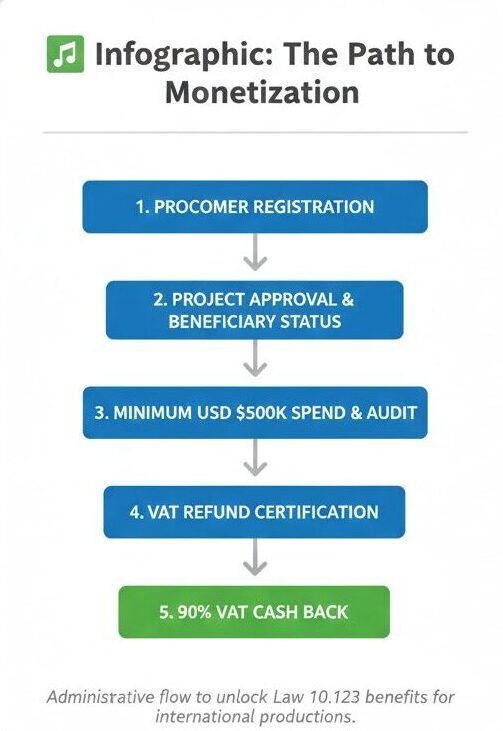
According to data from PROCOMER (Costa Rica’s Foreign Trade Promoter), the centerpiece of this law is the 90% refund of the Value Added Tax (VAT). In Costa Rica, the standard VAT rate is 13%. For productions that meet the minimum spend threshold, 11.7% of their total qualified expenditure (QPE) is effectively returned to the capital stack. This is a critical distinction for production accountants: it is not a “discount” at the point of sale, but a post-production refund designed to incentivize transparent local accounting.
The remaining 10% of the VAT paid is allocated directly to the National Fund for the Development of Audiovisual and Cinematography. This dual-purpose mechanism ensures that while international studios save on costs, they are also contributing to the long-term sustainability of the local crew base and infrastructure.
Qualification Gates: Minimum Spend and Eligibility Criteria
Not every production qualifies for the high-level incentives of Law 10.123. To filter for high-impact investments, the Costa Rican government has established “Qualification Gates.” For international feature films, series, documentaries, and commercials, the minimum local spend is USD $500,000.
However, there is a strategic “side door” for specialized services. Post-production, digital animation, and video game development projects can also qualify under the Free Trade Zone (FTZ) regime, which offers different but equally lucrative benefits for projects with long-term infrastructure footprints.
According to industry reports from the Costa Rica Film Commission, eligibility extends to:
- Short and long-form features (Fiction, Documentary, Animation).
- Reality TV and music videos.
- Commercials and advertising content.
- Post-production services (editing, color grading, VFX).
The project must be “totally or partially” executed in Costa Rica, and all applicants must register as a “Beneficiary” with PROCOMER before the commencement of principal photography to ensure the audit trail is preserved.
Operational Logistics: VAT, Income Tax, and Customs Waivers
The logistical efficiency of Filming in Costa Rica hinges on three operational pillars that go beyond the 90% VAT refund. For executives, managing the movement of personnel and gear is often the highest friction point; Costa Rica has codified solutions for both.
1. The Income Tax Shield: Law 10.123 provides a total waiver of income tax on personal dependent or independent work for foreign personnel. This includes directors, cast, and technical HODs. The catch is that these salaries must not be paid from Costa Rican source funds—they must be external remittances. Furthermore, these payments are exempt from the standard withholding tax for remittances abroad, creating significant savings on the “Above-the-Line” budget.
2. Customs Gateways: International productions often struggle with the “Guarantee Deposit” required for heavy gear. Costa Rica’s Law 10.123 suspends all import taxes and the guarantee deposit for the temporary importation of cameras, lenses, cranes, and lighting rigs. This equipment can remain in the territory for the duration of the PROCOMER-approved project term plus an additional 15-day grace period for re-exportation.
3. The 13% VAT Filing Obligation: Even though a project is exempt or seeking a refund, the General Directorate of Taxation (Resolution No. MH-DGT-RES-0013-2024) mandates that all exempt taxpayers must still file monthly VAT returns. This is where many foreign productions fail: without a local production service company (PSC) to manage these filings, the eventual 90% refund can be denied on technical grounds.
How Vitrina Accelerates Your Costa Rican Greenlight
Navigating the Filming in Costa Rica incentives requires more than a lawyer; it requires a supply-chain partner who understands the “verified track record” of local vendors. Vitrina de-risks this process by mapping the entire Costa Rican production ecosystem—from PROCOMER-certified PSCs to specialized HODs who have successfully managed Law 10.123 audits.
Executives use Vitrina’s intelligence to move from “speculation” to “execution.” By identifying the specific vendors who have handled the “Qualified Spend” for international tentpoles, you ensure that every dollar spent in San José or Guanacaste is a dollar that contributes to your final 90% refund.
Accelerate Your Discovery with VIQI
Use these precision prompts to identify the right partners for your Costa Rican production capital stack.
Strategic Conclusion
The decision to bring a production to Costa Rica is no longer solely an aesthetic one. The integration of Law 10.123 into the global capital waterfall means that Costa Rica now offers a competitive fiscal environment that rivals the traditional powerhouses of the Caribbean. The 90% VAT refund, paired with comprehensive income tax and customs waivers, represents an 11% to 15% net reduction in production costs compared to non-incentivized territories.
However, the “Path to Monetization” is paved with administrative rigor. To successfully recoup your VAT and protect your cast’s earnings, you must partner with vetted local entities who operate at the same standard as international studios. Vitrina serves as your virtual agent in this landscape, providing the verified data and executive-level connections necessary to transform Costa Rica’s fiscal promises into tangible production results.
Strategic FAQ
What is the minimum spend for the Costa Rica film incentive?
For international productions seeking the 90% VAT refund and income tax waivers under Law 10.123, the minimum local expenditure requirement is USD $500,000. This spend must be validated by an approved local audit process.
How does the 90% VAT refund work in Costa Rica?
International productions pay the standard 13% VAT on local goods and services. Upon project completion and successful audit by PROCOMER, the government refunds 90% of that total VAT amount (approx. 11.7% of total QPE) to the production entity.
Are foreign cast and crew subject to Costa Rican income tax?
No. Foreign personnel are exempt from Costa Rican income tax and remittance withholding for payments related to a qualified film project, provided the funds originate from non-Costa Rican sources and the project is registered with PROCOMER.
Do I need to hire a local production service company (PSC)?
While not strictly mandatory, it is highly recommended. A local PSC manages the SIRECINE registrations, monthly VAT filings, and PROCOMER audits required to unlock the fiscal benefits of Law 10.123 and ensure compliance with the 2025 tax resolutions.