About Innovation Hub
 Global Content Pulse (Webinars)


 Global Production Financing
(Webinars)
Global Production Financing
(Webinars)  LeaderSpeak Podcast
  About Vitrina
 Our Story
 Our Solutions 🔥
 Film+TV Projects Tracker 🚀
 Case Studies
 Our Profile
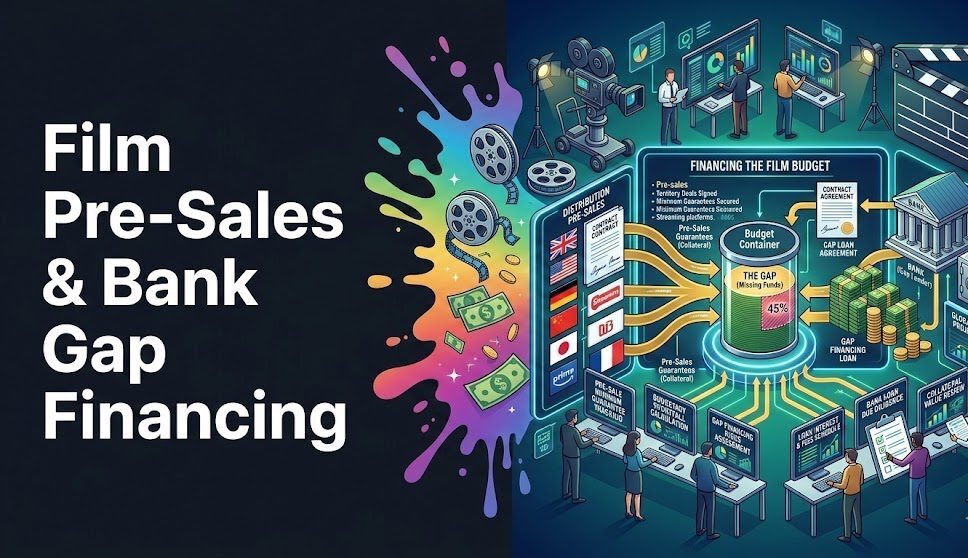
The budget gap isn’t the problem. Every independent film has one. The problem is producers who hit the gap without a plan—scrambling for equity they can’t find, slashing budgets that can’t be cut, or waiting on pre-sales that take too long to close.
In 2026, closing your budget requires a precise combination of film pre-sales and bank gap financing executed in the right sequence, with the right partners, before cameras roll. Get the sequence wrong and you’re chasing money in post-production. Get it right and you greenlight in six weeks.
Here’s the reality check nobody puts in a pitch deck: the market is genuinely harder than it was three years ago. Phil Hunt, founder and CEO of Head Gear Films—which has financed over 550 films and runs more productions per year than most Hollywood studios—puts it bluntly: “The whole industry has become much, much harder in terms of getting movies off the ground and getting movies sold.” That’s not pessimism. That’s a structural shift that changes how you build your budget from the ground up.
This guide breaks down how pre-sales actually work as debt collateral, what gap lenders are really looking for in 2026, how to build a capital stack that passes lender underwriting, and—critically—where most independent producers lose deals they should have closed. By the end, you’ll have a framework you can take into your next finance meeting. But first, let’s establish exactly where the money comes from.
Table of Contents
- The 2026 Independent Film Finance Reality Check
- How Pre-Sales Work as Debt Collateral: The MG Mechanics
- Territory Strategy: What to Sell, What to Hold, and Why
- Gap Financing Explained: Mezzanine Position, Real Costs
- What Gap Lenders Actually Look For in 2026
- Building the Capital Stack: Pre-Sales + Gap + Tax Incentives
- How Private Capital Lenders Are Filling the Bank Gap
- 5 Deal Killers That Sink Gap Financing Applications
- Step-by-Step: How to Close a $5–10M Independent Film Budget
- FAQ
- Conclusion
Ask VIQI: Which Lenders Are Actively Funding Projects Like Yours?
VIQI is Vitrina’s AI assistant—trained on 1.6 million titles, 360,000 companies, and 5 million entertainment professionals. Ask it which gap lenders are currently active in your budget range, which territories are delivering the strongest MGs in your genre, and who’s greenlighting projects in your market.
✓ Included with 200 free credits | ✓ No credit card needed
The 2026 Independent Film Finance Reality Check
Let’s start with what changed—and why it directly affects how you build your budget. The post-COVID period brought a surge of production activity driven by streamer demand and readily available capital. That cycle has corrected sharply. Phil Hunt at Head Gear Films describes it as a “big crunch”: the revenge production era of 2021–2022 flooded the market with content, streamer appetites contracted, and financing tightened in response. What’s left is a market where lenders are highly selective, pre-sale values have compressed in many genres, and the bar for gap financing has risen measurably.
Head Gear, processing 35–40 films per year from the center of the marketplace, sees more submissions than ever—and passes on far more than it used to. Hunt’s assessment of most incoming financing plans is direct: “The finance plans are just pie in the sky. They’re not going to work.” Budgets are too high for the revenues available, talent assumptions are unrealistic, and territory pre-sale projections don’t hold up to lender scrutiny.
But here’s what hasn’t changed: consumer demand for content is as strong as it’s ever been. Joshua Harris, President and Managing Partner of Peachtree Media Partners, frames it simply: “We are living in the content creation heyday. These devices are never going away.” The structural opportunity for independent film finance is real. The challenge is building a capital stack that matches where the market actually is—not where it was in 2022.
What does that mean in practice? It means your budget needs to be honest. Your pre-sales need to be conservative. Your gap needs to be sized for what lenders will actually advance—not what your sales agent tells you in a best-case scenario. And your territory strategy needs to preserve optionality while covering enough confirmed collateral to get the deal done.
This guide covers how to do exactly that. Start with pre-sales—because they’re the foundation of everything that follows.
Stop Guessing Who’s Financing. Get Targeted Outreach.
Stop searching and start getting funded. We identify the exact decision-makers currently backing projects like yours, turning raw data into risk-aligned capital partnerships.
Major Studios
Scouting early stage projects, IP, and Regional partners for global studio pipelines.
IP Owners & Leads
Connecting creative leads with qualified financiers and major streaming platforms.
Streamers
Securing high-value pre-buy content and discovering early-stage global IP for platforms.
Indie Producers
Bridging the gap for indie filmmakers to reach executive production partners and capital.
Global Financing Ecosystems
Mapping complex markets and pairing projects with disciplined, risk-aligned capital across global territories worldwide.
How Pre-Sales Work as Debt Collateral: The MG Mechanics
A pre-sale isn’t a sale in the traditional sense. It’s a license agreement—a distributor commits to pay a Minimum Guarantee (MG) for the right to distribute your completed film in a specific territory for a defined period, typically 15–20 years. The MG is the number that matters for financing. But the payment structure is what most producers underestimate.
Standard MG payment terms: 10% paid on signature, 90% paid on delivery of the completed film. That 90/10 split is your financing problem. You need production money now. The bulk of your MG value won’t pay out until you deliver a finished film. This gap—between the MG contract value and the upfront cash it generates—is precisely what bank financing and gap loans are designed to bridge.
Banks and specialized lenders advance against pre-sale contracts at 70–90% of the MG face value, depending on the distributor’s financial standing. An MG from France’s Pathé or Germany’s Constantin will lend at a higher advance rate than an MG from a less-established regional distributor. Banks rate distributors by territory—they’ve built decades of data on which parties reliably honor their delivery obligations. And crucially, as Joshua Harris at Peachtree explains, every distribution agreement includes a notice of assignment—a contractual clock on when the distributor must repay the lender once the film is delivered. That certainty is what makes pre-sales bankable.
Your sales agent sits at the center of this system. They create territory-by-territory sales estimates, pitch your package at film markets like Cannes, AFM, and EFM Berlin, negotiate MG deals, and facilitate the bank relationship. Their commission runs 10–15% of sales, with reimbursable expenses typically capped at $50,000–$75,000 per market cycle. Choosing the right agent isn’t just a distribution decision—it’s a financing decision. Lenders lend against sales agents as much as they lend against the film itself. A reputable agent with proven lender relationships can accelerate your financing timeline significantly. As Vitrina’s guide to sales agents in production financing covers in detail, their track record is one of the first things a gap lender will verify.
Territory Strategy: What to Sell, What to Hold, and Why
Not every territory should be pre-sold. That’s counterintuitive when you’re trying to close a budget—but selling everything upfront locks in today’s prices across all markets and eliminates your post-completion upside. The strategic question isn’t “what can I sell?” It’s “what should I sell to close the financing, and what should I hold to maximize value later?”
The general rule: pre-sell 50–70% of your estimated global value to close the production financing, and hold the rest for post-completion sales at premium prices. A completed film with strong reviews or a theatrical performance can command dramatically higher MGs than a pre-production package. Josh Harris at Peachtree articulates the logic directly—he’ll advance against the estimated domestic value of a territory even before a deal is executed, enabling the producer to make the film and then sell that territory for “three and four times” the advance amount in a completed-film marketplace.
Major territories to consider selling first: UK, France, Germany, Australia, and key Asian markets (Japan, South Korea). These carry the highest MG values for English-language commercial content and the strongest distributor credit ratings. They give you the highest advance rates from lenders. Mid-tier territories—Spain, Benelux, Scandinavia—can often be held back or bundled as package deals post-completion without significant risk to your financing close.
And domestic? The US rights are almost always best held back. As Harris at Peachtree describes, domestic represents the most valuable territory—and because it gates the international release, pre-selling it caps your upside on every market at once. Hit Man (Richard Linklater, with Glen Powell attached) closed 15 pre-sale contracts before production—covering Canada, Italy, Poland, Turkey, and the Middle East—before selling to Netflix for domestic. That holdback strategy directly enabled the Netflix deal’s premium valuation.
Find the Right Gap Lenders Before the Market Does
Trusted by Netflix, Warner Bros, and Paramount. Join 140,000+ companies on Vitrina—tracking active gap lenders, their deal criteria, current budget preferences, and the projects they’re greenlighting right now.
✓ 200 free credits | ✓ No credit card required | ✓ Full platform access
Gap Financing Explained: Mezzanine Position, Real Costs
Gap financing is a loan secured against a film’s unsold territorial distribution rights—the territories your sales agent estimates you’ll sell after completion but haven’t yet sold. It’s called gap financing because it closes the gap between your confirmed financing (equity + pre-sale advances + tax incentives) and your total production budget.
Standard gap typically covers 10–15% of your production budget. Once you push beyond 15%—into what the industry calls supergap territory—you’re taking on significantly more risk and lenders become much more selective. Anything above 30% is almost impossible to secure in the current market, full stop. The gap amount isn’t just a number. It’s a market signal. A 25% gap tells a lender that your pre-sales are weak, your territory estimates are inflated, or your equity stack is underdeveloped. Fix the underlying problem before you ask for the loan.
The cost structure is the part most producers budget wrong. Gap financing runs 8–15% per year on the principal, plus an upfront origination fee of 7–15% of the loan amount—charged once, on day one, before the first dollar of production spend. On a $1.5 million gap loan at a 10% origination fee and 8% annual interest over 18 months, your total cost is approximately $330,000—an effective rate of 22% of the original loan amount. That cost is real and accrues daily. Budget it explicitly. Don’t treat it as a rounding error.
Gap financing sits in the mezzanine position in the recoupment waterfall—after senior bank debt, before equity. It recoups before your investors see anything. That means every day your film spends in post-production, waiting for a domestic distributor, or sitting in festival limbo is a day gap interest accumulates. Speed to domestic release isn’t just a distribution ambition—it’s your primary gap cost control mechanism. Our full guide to gap financing and closing your budget covers how to structure the waterfall to accelerate repayment.
Phil Hunt (Founder & CEO, Head Gear Films) explains precisely why the independent film market has become harder to finance in 2026—and what it really takes to get a project through the gap:
What Gap Lenders Actually Look For in 2026
Gap financing is relationship-driven—but relationships don’t override fundamentals. Every active lender in the market right now is applying a structured underwriting process that you need to understand before you approach them. Here’s what they’re actually evaluating.
Pre-Sales Coverage and Sales Estimate Quality
Your sales agent’s estimates are the core underwriting input—but lenders discount them. Typically, lenders apply a 50–70% haircut to agent projections when calculating collateral value against unsold territories. If your agent estimates $3 million across remaining territories, a lender will underwrite $1.5–2.1 million. Your gap loan amount needs to be supportable at the discounted figure. Additionally, the sales estimates for the gap must be 1.5–2x the gap loan amount. That’s not negotiable—it’s the lender’s security cushion.
Distributor Credit Quality
Not all distribution contracts are equally bankable. Joshua Harris at Peachtree is explicit: “The financial strength of distributors is different. We have to go through and say, who is the distributor that’s putting up this minimum guarantee and how comfortable are we with their ability to be banked?” An MG from a financially robust A-list distributor in a major territory advances at 80–90% of face value. A contract from a less-established regional distributor in a smaller market may not advance at all.
Completion Bond
Non-negotiable. A completion bond—from an established guarantor like Film Finances, Unifi, or Media Guarantors—must be in place or in advanced stages for any gap financing application. It adds 3–6% to your production budget and serves as the lender’s insurance policy that your film will actually be delivered. Without it, the conversation is over before it starts. Harris describes Peachtree’s approach to risk as involving a “triple layer of protection”—the completion bond company, the commercial bank back leverage, and Peachtree’s own underwriting. The bond is layer one.
Budget Already 70%+ Secured
Most gap lenders require that 60–80% of your total budget is already confirmed before they’ll advance. Equity in, pre-sale advances contracted, tax incentive certification received. They’re not filling a 40% hole. They’re closing a 15–20% gap in an otherwise solid capital stack. Walk in with 50% secured and a 30% gap ask and you’ll be politely shown the door.
Commercial Package with Name Talent
In 2026, “recognizable cast” is a hard requirement, not a soft preference. Phil Hunt is direct about it: if you’ve got an action-thriller without star power, the market will pick the one that does every single time, regardless of script quality. Commercial genres—action, thriller, horror—carry the strongest international presale values and the most predictable territory pricing, which is exactly what gap lenders can model. Drama and comedy are far harder to gap-finance without significant cast attachment.
Find the Financiers Backing Your Genre
Stop searching and start getting funded. We identify the exact decision-makers currently backing projects like yours, turning raw data into risk-aligned capital partnerships.
Building the Capital Stack: Pre-Sales + Gap + Tax Incentives
The typical capital stack for a well-structured independent film in the $5–10 million budget range looks like this. It’s not aspirational—it’s what closes deals. Deviation from this model is possible but requires a compelling reason that lenders will accept in underwriting.
This structure closes. Tax incentives are the lever most producers underutilize. A 25–40% production rebate from a competitive jurisdiction—Georgia at 30%, New Jersey at 30–40%, or the UK at 25.5%—can meaningfully reduce your gap requirement or eliminate it entirely on projects that qualify. Banks lend against certified incentives at 80–90% of face value, making them nearly as reliable as cash in the capital stack.
But incentive timing matters. The rebate is backend money—it pays out after production wraps and audit confirms spend. That timing gap is where rebate loans come in. A bank will advance against an approved incentive certificate, bridging you through production while the audit processes. Factor the interest cost into your budget explicitly. And understand that “bankable” incentives—those from stable, well-administered programs with strong track records—command better advance rates than newer or less-certain programs.
Our pre-sale collateralizing debt guide breaks down exactly how each component converts from contractual value to production cash. Read it before your first lender meeting.
How Private Capital Lenders Are Filling the Bank Gap
The retreat of traditional commercial banks from entertainment lending has created a structural gap that private capital firms are actively filling. When City National Bank—historically one of the most active entertainment lenders—pulled back from the sector, it left a void. As Harris describes it: “City National lost their strategic focus… that created an enormous gap in the marketplace.” Private capital managers like Peachtree Media Partners stepped into that space.
Here’s what makes Peachtree’s model worth understanding: it bridges pure commercial bank lending and equity investment with a hybrid approach. Harris describes it as “glorified accounts receivables lending”—advancing against distribution agreements and tax incentive certifications the same way a commercial bank does, but with the added capability of lending against future territory value before the distribution deal is even executed. That’s the layer commercial banks won’t touch. And that’s the layer that enables independent producers to greenlight projects while preserving their upside in key markets.
Peachtree’s current fund—a $50 million raise scaling to $100 million—uses an 80/20 leverage structure: for every 20 cents from the fund, they borrow 80 cents from a commercial bank back-leverage partner. That structure lets a $100 million fund cover approximately $500 million worth of pictures. And because the commercial bank co-underwrites every deal, it adds a second layer of due diligence that independently validates the risk assessment.
The risk profile of this model? Remarkably low by the lender’s own accounting. Harris cites a loss given default rate of less than 0.5% on their deal portfolio—not because films never struggle commercially, but because the collateral structure ensures repayment. The real risk, he emphasizes, isn’t whether you get repaid. It’s timing—how long before all the collection triggers (domestic release, delivery notices, tax incentive payouts) convert to actual cash. Planning around that timing risk, not just the credit risk, is what separates sophisticated capital stacks from deals that fall apart in post-production.
Need a Gap Lender Introduction? Vitrina Concierge Finds Them.
Vitrina Concierge is your Virtual Agent. We don’t give you a list—we make warm introductions directly to decision-makers actively seeking your type of content.
- Korean animation studio → Netflix Adult Animation (week one)
- LA producer → Netflix UK, Fifth Season, Fox Entertainment (48 hours)
- Middle Eastern studio → Legendary Pictures (direct access)
5 Deal Killers That Sink Gap Financing Applications
These are the patterns that turn promising projects into rejected applications. All five are avoidable. None of them require extraordinary resources to fix—just earlier, more disciplined planning.
1. Gap Request Exceeds 25% of Budget
A 25%+ gap signals insufficient primary financing. Lenders interpret it as weak pre-sales, no completion bond in place, or an equity stack that hasn’t committed. If your gap calculation lands here, go back to the budget—not the lender. Cut the number, close more territory deals, or find additional equity. Don’t try to gap-finance your way out of a packaging problem.
2. No Completion Bond in Place
The completion guarantee isn’t optional. Without it, lenders have no assurance the film will be delivered—which means their collateral (the distribution contracts that trigger on delivery) may never pay out. Bond companies like Film Finances and Unifi assess your budget, schedule, and producer track record before issuing. Start the bond process before you approach gap lenders, not after. Our detailed guide to completion bonds and producer insurance covers what underwriters look for.
3. Sales Estimates Built on Best-Case Assumptions
Your sales agent will naturally present optimistic territory projections. That’s their job—maximizing your package’s perceived value at market. Your job is to stress-test those numbers to the 50–70% discount a lender will apply and verify your gap still closes. If the math only works at full agent estimates, the deal doesn’t hold up in underwriting. Build your capital stack around the haircut, not the headline.
4. Weak or First-Time Sales Agent Relationship
Lenders lend against sales agents as much as they lend against films. A first-time or unknown agent introduces relationship risk that most gap lenders won’t accept. If your current agent doesn’t have established lender relationships, consider co-repping with a more established firm for this project. The commission split is worth it if it unlocks a lender relationship you wouldn’t otherwise access.
5. Incomplete Documentation Package
Gap financing applications require a specific documentation set: complete line-item budget, confirmed financing plan (equity committed, pre-sale contracts executed), territory-by-territory sales estimates from your agent, cast/crew deal memos, chain of title documentation, and the completion bond assessment. Missing any of these stalls the process by weeks and signals disorganization to the lender. Lender due diligence is thorough—prepare for it to be thorough, not faster than you planned for.
Step-by-Step: How to Close a $5–10M Independent Film Budget
This is the sequence that works. It’s not theoretical—it’s the process that closed The King’s Speech at $15 million (which grossed over $400 million and repaid its gap loan rapidly), and it’s the process Head Gear Films and Peachtree Media run on dozens of projects per year.
Step 1: Lock the Package (Months 1–2)
Script, attached director, confirmed lead cast with measurable international recognition. Without this, your sales agent can’t create credible territory estimates and no lender will underwrite. This is where most independent films actually die—not at the financing stage, but at the packaging stage that precedes it. Be honest about whether your current attachments support the budget you’re targeting.
Step 2: Engage Your Sales Agent and Get Territory Estimates (Month 2)
Your sales agent reviews the package and produces territory-by-territory MG estimates. These become the inputs for your capital stack model. Stress-test them immediately—apply the 50–70% lender discount and verify whether the resulting collateral supports your intended gap amount. If the numbers don’t work at the discount, revise your budget assumptions or strengthen your package before going to market.
Step 3: Identify and Secure Your Production Incentive (Months 2–3)
Decide where you’re filming based on total economics—not just headline incentive rate. Factor crew availability, infrastructure, exchange rates, and whether the incentive is genuinely bankable (some programs have approval backlogs that make them difficult to advance against). Apply for pre-qualification before production begins. Tax incentive certification is a prerequisite for rebate loan financing and strengthens your gap application materially.
Step 4: Go to Market for Pre-Sales (Months 3–4)
Cannes, AFM, EFM Berlin—these are the markets where deals get done. Your agent sends packages to target distributors 2–3 weeks before each market. Prioritize major territories first: UK, France, Germany, Japan. Aim to close MG contracts covering 50–65% of your estimated global value before committing to production. Each executed contract becomes a piece of production financing collateral. Each signed MG with a creditworthy distributor closes a portion of your budget.
Step 5: Initiate Completion Bond and Lender Conversations Simultaneously (Month 4)
Don’t wait for the completion bond to close before approaching lenders. Start both processes in parallel. Bond companies and lenders have overlapping due diligence requirements—your budget, schedule, and chain of title need to be clean for both. Getting to lender conversations with a bond in process (not just planned) is meaningfully better than arriving cold.
Step 6: Close the Gap Loan and Greenlight (Month 5–6)
With pre-sales, incentive certification, equity committed, completion bond in place, and documentation complete, your gap lender finalizes the advance. Their legal team reviews the inter-party agreement—the document that governs priority positions and collection mechanics among all lenders. Once executed, production can commence. Budget your gap interest at the 18-month horizon, not the optimistic 12-month scenario.
Frequently Asked Questions
What is film pre-sales gap financing and how do they work together?
Film pre-sales are license agreements where distributors commit to pay Minimum Guarantees (MGs) for territorial rights before production. These contracts serve as debt collateral—banks advance 70–90% of the MG face value as production loans. Gap financing then closes the remaining 10–30% of the budget that pre-sales and equity don’t cover, secured against unsold territories. Together, they form the primary financing mechanism for most independent films in the $5–15 million budget range.
How much does gap financing actually cost in 2026?
The real cost is higher than the headline interest rate. Gap financing typically runs 8–15% annually on principal, plus an upfront origination fee of 7–15% of the loan amount. On a $1.5 million gap loan at a 10% origination fee and 8% annual interest over 18 months, the total cost is approximately $330,000—an effective rate of 22%. Budget this explicitly in your production finance plan. Interest accrues daily from funding, so every week of production delay and every month waiting for a domestic release adds real cost.
How many pre-sales do I need before approaching a gap lender?
Most gap lenders require at least 60–80% of your total budget already confirmed from equity, pre-sale advances, and tax incentives combined. For the gap specifically, your sales agent’s estimates on unsold territories must be 1.5–2x the gap loan amount—providing the lender’s security cushion after they apply a 50–70% discount to those estimates. Pre-selling enough major territories (UK, France, Germany, Japan) to establish strong creditworthy MG contracts is typically the most important step before any gap conversation.
What is a supergap loan and when should I use one?
A supergap loan is gap financing that exceeds 15% of your total production budget—typically ranging from 15–30%. It requires a stronger project package, carries higher costs, and is significantly harder to secure than standard gap. In the current market (2026), most active lenders have raised their bar for supergap significantly. Use standard gap (10–15%) where possible. If your analysis points to a 25%+ gap requirement, that’s a signal to cut the budget, close more pre-sales, or find additional equity—not to seek a larger gap loan.
Which genres perform best for international pre-sales in 2026?
Action, thriller, and horror consistently deliver the strongest international pre-sale values—they translate across languages and cultures with minimal performance degradation. Drama is territory- and star-dependent; without significant cast attachment, territory values drop sharply. Comedy is the most challenging genre internationally—it’s often considered a “domestic piece” with limited foreign presale value. Phil Hunt at Head Gear Films, who tracks live market demand across 35–40 productions per year, confirms this: the market right now wants low-cost, high-concept action and thriller content with recognizable talent.
How has the commercial bank retreat from film finance changed the market?
When City National Bank and others pulled back from active entertainment lending, it created a void that private capital firms have partially filled. Companies like Peachtree Media Partners operate in the space between traditional commercial bank lending and equity investment—advancing against distribution agreements and tax incentives as accounts receivable, with the added capability of lending against future territory value before deals are executed. This private capital layer has higher costs than commercial banks but greater flexibility. Understanding which lenders are currently active in your budget range—and which ones aren’t—is essential before you begin your financing process.
Should I hold back the US domestic rights?
In most cases, yes. The US domestic market is the highest-value territory, and it gates international release—foreign pre-sale contracts typically can’t trigger their delivery obligations until the domestic release occurs. Pre-selling domestic commits your highest-value asset at pre-production prices and eliminates your upside in the most important market. A completed film with positive reception will almost always command a significantly higher domestic deal than a pre-sale would have. The Hit Man case study—with its Netflix domestic sale following 15 international pre-sales—demonstrates the value of this approach in practice.
What documentation do I need to apply for gap financing?
A complete gap financing application requires: a detailed line-item budget with completion bond factored in, a confirmed financing plan showing all secured sources, executed pre-sale MG contracts with creditworthy distributors, territory-by-territory sales estimates from your reputable sales agent, confirmed cast and director deal memos, chain of title documentation, tax incentive pre-qualification or certification, and the completion bond assessment from an established guarantor. Missing any of these slows the process by weeks at minimum and signals disorganization that can kill a deal.
Conclusion: Close the Budget Before You Need It
The producers closing film pre-sales and bank gap financing deals in 2026 aren’t necessarily working on better projects than those who aren’t. They’re working on better-structured ones. The capital stack—territory strategy, gap sizing, incentive selection, lender relationships—is a craft that runs parallel to the creative one. Master it before you hit the market, not after.
Key Takeaways:
- Pre-Sales Are Debt Collateral, Not Just Distribution: Banks advance 70–90% of MG face value against executed pre-sale contracts. The distributor’s credit quality determines the advance rate—focus major territory deals on A-list creditworthy buyers first.
- Gap Financing Costs 22% All-In Over 18 Months: Budget it explicitly—origination fee (7–15%) plus daily-accruing interest (8–15% annually). Speed to domestic release is your primary cost control mechanism, not negotiation on headline rates.
- 70%+ Secured Before You Approach a Gap Lender: Equity committed, pre-sale MG contracts executed, and incentive certification in progress. A gap ask above 25% of budget signals a packaging problem, not a financing opportunity.
- Completion Bond Is Non-Negotiable: No completion bond, no gap conversation. Start the bond process—with Film Finances, Unifi, or Media Guarantors—before you approach lenders, not after. It takes time and it signals credibility lenders require.
- Hold Domestic and 30–40% of Territorial Value Post-Completion: A completed film commands premium pricing in unsold markets. The territory holdback strategy is how producers protect upside while still closing the financing they need to greenlight.
The market Phil Hunt describes—where finance plans “are just pie in the sky”—is the one you’re competing in. But it’s also a market where well-structured projects with real collateral, credible agents, and honest budgets still close. Build the stack first. Then greenlight.
Find Active Gap Lenders for Your Project—Start Today
Trusted by Netflix, Warner Bros, Paramount, and Google TV. Track 400,000+ projects. Access 3 million verified executives. Use VIQI to identify which lenders are actively seeking your project type, which territories are delivering the strongest MGs in your genre, and how comparable projects closed their capital stacks.
✓ 200 free credits | ✓ No credit card required | ✓ Cancel anytime
Find Film+TV Projects, Partners, and Deals – Fast.
VIQI matches you with the right financiers, producers, streamers, and buyers – globally.
Producers Seeking Financing & Partnerships?
Book Your Free Concierge Outreach Consultation
(To know more about Vitrina Concierge Outreach Solutions click here)
Producers Seeking Financing, Co-Pros, or Pre-Buys?
Vitrina Concierge helps producers reach the right financiers, commissioners, distributors, and co-production partners — with precision outreach, not cold pitching.
Join Industry Briefings Trusted by Leaders

Film & TV Financing: Pre-Buys
Learn how pre-buys work in current Film and TV financing, how they differ from pre-sales, and how they are used to close real finance plans.

Streamers – Netflix vs. Amazon – The 2026 Strategy
How Netflix and Amazon’s content and revenue strategies are diverging ahead of 2026.

Format Adaptations: Global Trends
Where formats are traveling, which adaptations are breaking out, and how streamers are backing remakes in 2025–2026.