About Innovation Hub
 Global Content Pulse (Webinars)


 Global Production Financing
(Webinars)
Global Production Financing
(Webinars)  LeaderSpeak Podcast
  About Vitrina
 Our Story
 Our Solutions 🔥
 Film+TV Projects Tracker 🚀
 Case Studies
 Our Profile
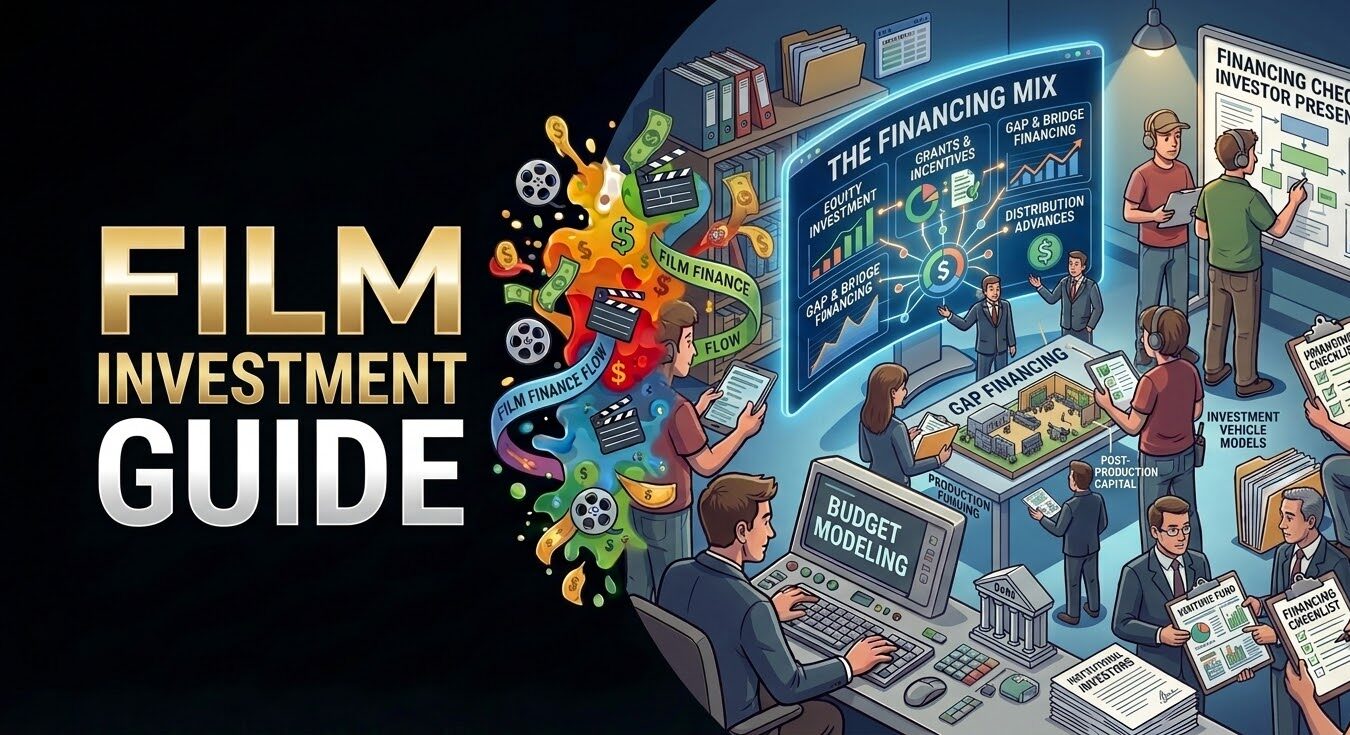
A complete guide to film investment for both first-time and experienced investors — how risk is assessed, where investor money sits in the capital stack, what recoupment actually looks like, and what the most active film financiers require before committing capital. Drawn from direct conversations with Goldfinch, Peachtree, Lee & Thompson, and others.
- How Film Investment Risk Is Actually Assessed in 2026
- The Film Investment Capital Stack: Where Your Money Actually Sits
- Debt vs Equity in Film Investment: A Critical Distinction
- The Film Recoupment Waterfall: How Your Investment Returns
- What Film Investors Actually Look At: The Goldfinch and Peachtree Frameworks
- Legal Protections Every Film Investor Should Require
- Completion Bonds: The Film Investor's Protection Against Production Failure
- Genre, Budget, and Cast: What Film Investors Need to Understand
- The Film Investor's Checklist: Questions to Ask Before Backing Any Film
Film investment is often misunderstood — by both the people seeking it and some of the people providing it.
The misunderstanding usually goes in one direction: film investment is treated as a creative bet. Back the right film, and the returns follow. But the financiers who have been deploying capital into independent films for decades — successfully, sustainably — do not think about it this way. They think about structure, risk position, and recoupment before they think about the film itself.
This guide is written for investors considering film investment, and for producers who want to understand how the capital side of their project is actually being evaluated. The content comes directly from Goldfinch, Peachtree Media Partners, Lee & Thompson, and other active market participants who are collectively among the most active financiers in the independent market.
The single most important thing an investor can understand before backing a film: where you sit in the capital stack determines almost everything about your risk, your return timeline, and your realistic probability of profit participation.
“Projects stall not because creativity is weak, but because structure is unclear.”
— Vitrina LeaderSpeak, 2026 Financing Playbook
This guide covers: How film investment risk is assessed · The capital stack and investor positions · Debt vs equity in film investment · How recoupment waterfalls work · What the 3.8–4% net profit benchmark means for investors · What Goldfinch and Peachtree require · The producer self-check from an investor's perspective
1. How Film Investment Risk Is Actually Assessed in 2026
The most experienced film investors do not start with the creative material. They start with the financial structure around it.
Kirsty Bell at Goldfinch — which has deployed over $250 million across 300+ projects with zero defaults in twelve years — applies a consistent methodology. She discounts projected sales by 60% when evaluating a project. The question is not what the film could make in an optimistic scenario. It is what percentage of the investment is genuinely at risk under realistic ones.
This approach reflects a broader shift in independent film financing. Capital that once moved forward on creative momentum now requires structured justification. Revenue projections are tested against real comparables. Budget assumptions are challenged. The capital stack is examined for clarity and logic.
Investors who understand this — and who ask the same questions Goldfinch and Peachtree ask — are investors who can evaluate film investment on its actual merits rather than on hope.
The Five Questions Every Film Investor Should Ask
- Does the projected revenue realistically support the budget, tested against real comparables?
- Is the capital stack clearly structured, with defined repayment order and investor positions?
- Is the tax incentive reliable and properly managed, or assumed and undocumented?
- Is there a completion bond in place to protect against production failure?
- Is the recoupment waterfall written down in contracts, or agreed verbally?
If any of these questions cannot be answered clearly by the producer before money is committed, that is a structural risk — not a creative one.
2. The Film Investment Capital Stack: Where Your Money Actually Sits
Every independent film is built on a capital stack. It defines who is funding the project, in what order, and how each investor is repaid once revenue starts flowing. Your position in this stack is the single most important variable in your film investment.
Senior Debt: The Most Protected Film Investment Position
Senior debt sits at the top of the capital stack and is repaid first. It is secured against predictable, contracted assets — tax credits, pre-sale agreements, and assigned distribution rights. Because of this protected position, it carries the lowest interest rate and the lowest risk.
Peachtree Media Partners is structured as a senior debt lender. Joshua Harris describes their primary risk as timing — not whether they get repaid, but when. That confidence comes from holding the top position with clearly defined collateral underneath them. Senior debt is as close to protected as film investment gets.
Gap Financing: Mid-Stack Film Investment Risk
Gap financing sits behind senior debt. It is based on projected but unsold territory revenues — values that are expected but not yet contracted. Because these revenues are not guaranteed, gap financing carries more risk and is priced accordingly. Not all lenders offer gap positions. Those that do will advance only a fraction of their conservative worst-case territory valuation.
Equity: The Highest-Risk Film Investment Position
Equity sits at the bottom of the capital stack. It is only repaid after all debt and gap financing has been cleared. It has no guaranteed return. Equity investors participate in upside — but they absorb all uncertainty first.
This is the position most private film investors occupy. It is also the position with the longest odds of profit participation. Sam Tatton-Brown at Lee & Thompson puts a number on it:
Percentage of UK independent films that reach net profits. Equity investors sit at the bottom of the stack and are paid only after all debt has cleared.
This benchmark does not mean film investment is a bad investment. It means equity investors need to understand their position accurately, price their risk accordingly, and not approach film investment with the same return expectations they bring to other asset classes. The investors who do well over time in film are the ones who understand this from the start.
● VITRINA CONCIERGE
Right Company. Right Decision-Maker. Right Message.
Vitrina Concierge reaches matched financiers on your behalf, every month — built around your project's structure and stage.
Explore Vitrina Concierge Outreach Solutions3. Debt vs Equity in Film Investment: A Critical Distinction
Debt and equity are not interchangeable film investment instruments. They carry different expectations, different risks, and different obligations. Treating them as interchangeable is one of the most common structural mistakes in independent film financing.
How Debt Investment in Film Works
Debt is structured against identifiable assets: pre-sale agreements, distribution contracts, tax incentives, and assigned rights. It expects priority repayment, carries a defined interest rate, operates on a fixed repayment timeline, and includes enforcement mechanisms if obligations are not met. Debt is designed to be repaid regardless of how the film performs commercially.
Peachtree's model illustrates this precisely. They lend against contracted assets. None of their collateral depends on the film being a commercial success. The risk they carry is about timing of repayment, not its certainty. That is a fundamentally different proposition from equity.
How Equity Investment in Film Works
Equity investment in film sits behind all debt. It has no guaranteed return. It participates in upside but absorbs uncertainty first. Equity investors are compensated for this risk through potential profit participation — but as the 3.8–4% net profit benchmark makes clear, that participation is the exception in independent film, not the rule.
What equity investors can and should require in return for this risk: transparency. Kirsty Bell at Goldfinch is explicit about what this means in practice — a clear investor hierarchy, a defined repayment order, transparent reporting throughout production and distribution, and written agreements rather than verbal assumptions. Equity investors who accept vague structures are accepting additional, unpriced risk.
Investor Takeaway
- Understand which position you occupy before committing: debt or equity carry fundamentally different risk profiles
- Equity in independent film rarely reaches net profit participation — price this into your expectations
- Require a written recoupment schedule before any money is committed
- Require transparent reporting obligations from the producer throughout production and distribution
- Never accept verbal agreements on investor hierarchy or repayment order
4. The Film Recoupment Waterfall: How Your Investment Returns
Recoupment is the mechanism by which your investment returns to you. It defines the order in which investors are repaid once a film starts generating revenue. Understanding this before you invest is not optional — it is the foundation of any informed film investment decision.
How Film Revenue Is Distributed to Investors
Revenue enters a collection account — a ring-fenced account managed by a third-party collection manager, independent of the producer. From there, it is distributed to investors in the contractually agreed order. Senior debt is repaid first. Gap financing follows. Then equity is recouped. Only after all of that has cleared does profit participation begin.
Lee & Thompson's Sam Tatton-Brown is emphatic on one point: this waterfall must be written down in detail before any capital is committed. Not agreed verbally. Not outlined in a pitch deck. Written into the legal contracts. Ambiguity at this stage creates disputes. Disputes delay repayment. Delays damage everyone involved.
Net Profits in Film Investment: What the Numbers Say
The 3.8–4% figure from Lee & Thompson is not a prediction about any specific film. It is a benchmark from the actual historical record of UK independent films. Most do not reach net profits. Most equity investors do not receive profit participation.
This does not mean equity investment in film is without value. Some investors prioritise the cultural contribution of the projects they back. Others build diversified film investment portfolios where individual losses are absorbed across a slate. The SEBI-regulated fund model used by 91 Film Studios in India — deploying equity capital across multiple regional language films — is one structured approach to managing this reality. What matters is that investors understand the realistic return landscape before they commit.
“Equity investors sit at the bottom of the stack. They are paid only after all debt has cleared. The recoupment waterfall must be written down, not assumed.”
— Lee & Thompson, as synthesised by Vitrina LeaderSpeak
5. What Film Investors Actually Look At: The Goldfinch and Peachtree Frameworks
The two most instructive perspectives on film investment evaluation come from opposite ends of the risk spectrum: Goldfinch as an equity and structured finance provider, and Peachtree as a debt lender. Together they cover most of the evaluation framework a serious film investor should apply.
How Goldfinch Evaluates a Film Investment
Kirsty Bell at Goldfinch evaluates every project through a disciplined risk assessment. The 60% sales discount applied to projections is not pessimism — it is a realistic correction for the gap between what producers project and what films typically earn. From that adjusted baseline, she assesses what percentage of the investment is genuinely at risk.
The other factors Goldfinch examines before committing equity capital: Is the budget realistic and not over-optimistic? Is financial oversight in place throughout production? How will investors be kept informed? Is recoupment clearly documented in contracts? Is the investor hierarchy clearly defined? These are structural questions, not creative ones. A film can be excellent and still fail this evaluation if the structure around it is unclear.
How Peachtree Evaluates a Film Lending Opportunity
Joshua Harris at Peachtree approaches film investment from a lender's perspective. The evaluation begins with one question: what secures the loan? Peachtree lends only against identifiable collateral — pre-sales, distribution contracts, tax incentives, and assigned rights. If collateral is not clearly defined and contractually committed, the conversation becomes difficult.
Peachtree also applies a triple-layer validation: their own underwriting, an independent completion bond company, and a commercial bank that independently lends against the same collateral. All three must be comfortable before Peachtree commits. This independent institutional validation at each stage is what makes their model defensible and their risk assessment reliable.
“The risk in debt lending against film is timing — not whether you get repaid, but when. That confidence comes from holding the top position in the stack with clearly defined collateral underneath.”
— Vitrina synthesis, Peachtree chapter
6. Legal Protections Every Film Investor Should Require
Legal structure is not a detail to sort out after a film investment is agreed. It is the framework that protects the investment. Sam Tatton-Brown at Lee & Thompson is direct on this: if the contracts are unclear, the financing is unstable — and that instability sits with the investor as much as the producer.
Chain of Title in Film Investment
Chain of title establishes who owns the rights to the underlying material — the screenplay, the underlying book, the life rights, or whatever the film is based on. If chain of title is not clean, the rights cannot be properly assigned, and security over them cannot be granted to investors or lenders. This is one of the most common causes of film financing stalling or collapsing.
Before committing any capital to a film investment, an investor should confirm that chain of title has been reviewed by qualified entertainment lawyers, that all rights are properly assigned to the production entity, and that no competing claims exist.
Security Over Rights in Film Investment
In a properly structured film investment, debt investors hold security over the rights in the film. This means that if the production defaults, the lender has a legal claim over the intellectual property itself. For equity investors, security is less direct — but a clearly documented investor hierarchy and recoupment schedule provides comparable contractual protection.
Regulatory frameworks also matter. Sam Tatton-Brown's observation from a long career at the intersection of production and law: changes to terms of trade legislation, EIS financing structures, and broadcaster commissioning terms have each materially changed what film investment structures are viable at different points in time. Film investors who understand the regulatory context of their investment are better positioned when the landscape shifts.
Investor Takeaway
- Confirm chain of title is clean and reviewed by entertainment lawyers before committing any capital
- Ensure rights are properly assigned to the production entity and that security over them is grantable
- Require a written, legally enforceable recoupment schedule as a condition of investment
- Understand the regulatory framework that governs your investment structure, including any applicable tax relief
- Get independent legal advice — do not rely solely on the producer's legal team
7. Completion Bonds: The Film Investor's Protection Against Production Failure
One of the most significant risks in film investment is that a film never gets finished. Financing runs short midway through production. The production stalls. The investment is stranded.
According to 91 Film Studios, operating in the Indian regional market, 50% of films that begin production never complete. The structural gap this represents is precisely what completion bonds exist to address in Western independent film financing.
of films that begin production do not get completed. A completion bond transfers this risk from investors and lenders to an institutional insurer.
A completion bond is an insurance policy from a third-party bond company — Film Finances, Unifi, and Media Guarantors are the main providers — that guarantees the film will be completed on time and on budget. If the production fails, the bond company steps in to either complete the film or repay the lenders.
For debt lenders like Peachtree, a completion bond is a mandatory requirement. For equity investors, it is one of the most important structural protections available. A film investment without a completion bond is an investment that has not been properly de-risked.
The practical minimum for bond viability is approximately $5 million in budget. Below that threshold, the cost of bonding relative to the budget size makes the structure uneconomic. Above it, engaging a bond company early — before approaching investors and lenders — signals that the production is serious and de-risked.
● VITRINA CONCIERGE
Partner-Outreach Managed by Vitrina.
We reach matched contacts every month for your requirements — right company, right decision-maker, right message.
Start with Vitrina Concierge8. Genre, Budget, and Cast: What Film Investors Need to Understand About Market Alignment
Independent film investment does not exist in a vacuum. Every film competes for sales in a market where buyers have specific preferences, and where revenue projections that ignore those preferences are not useful — they are misleading.
Phil Hunt at HeadGear Films, which finances 35–40 projects per year with direct visibility into what the international market pays, frames the issue directly: the starting point for evaluating a film is not creative ambition. It is market reality.
Which Genres Support Film Investment Most Reliably
Action, thriller, and horror consistently travel across international territories. Buyers understand them. Sales agents can model them. Revenue from these genres is more predictable, which makes them more reliable as film investment vehicles. Drama — especially pure drama — requires exceptional packaging to compensate for the added commercial uncertainty.
This is not a creative judgement. It is a sales market observation. Independent film investment depends heavily on international sales. If buyers in multiple territories cannot clearly position the film in their market, revenue becomes uncertain. Uncertain revenue means fragile film investment structure.
Cast Value in Film Investment
Cast attachment directly affects the value of a film investment. Phil Hunt's stated position is unambiguous: cut the budget before you compromise on cast. Without the right names attached, the film will not sell in the key territories that underpin the financing structure.
The test is not whether audiences recognise the cast member. It is whether that cast attachment translates into measurable sales in specific territories. These are different questions, and the second one is the one that matters for film investment purposes.
Budget-to-Revenue Alignment in Film Investment
The most common structural problem HeadGear sees across the projects they evaluate: a gap between what the film costs and what the market will realistically pay for it. If the budget exceeds what territory sales can support, the financing structure becomes fragile regardless of creative quality.
HeadGear's slate averages $8–9 million per project. Kirk D'Amico at Myriad Pictures identifies $5–15 million as the budget range where minimum guarantees can meaningfully support a film financing structure. Kirsty Bell at Goldfinch applies the 60% sales discount to test whether projected revenues actually support the cost at any budget level. Film investors should apply the same discipline.
9. The Film Investor's Checklist: Questions to Ask Before Backing Any Film
These questions are drawn directly from the evaluation frameworks of Goldfinch, Peachtree, Lee & Thompson, and the other financiers in the 2026 LeaderSpeak Financing Playbook. A producer who cannot answer them clearly before asking for your capital is a producer whose project is not yet ready.
On Risk and Structure
- What percentage of the investment is at risk under a realistic — not optimistic — sales scenario?
- Has the budget been tested against real comparable films at a similar genre, cast, and territory level?
- Is there a completion bond in place, and from which provider?
- What happens to the investment if the production fails to complete?
On Investor Position and Recoupment
- Where does my investment sit in the capital stack — senior debt, gap, or equity?
- What is the recoupment order, and is it documented in legal contracts?
- When does profit participation begin, and what is the realistic probability of reaching it?
- Who manages the collection account, and how are distributions reported?
On Legal Structure and Rights
- Has chain of title been independently reviewed by entertainment lawyers?
- Are all rights properly assigned to the production entity?
- Is security over the rights grantable to investors and lenders?
- Is the recoupment schedule consistent across all financing documents, not just the pitch?
On the Team and the Market
- Does the producer have a track record of completing and distributing films at this budget level?
- Is the cast attachment evidenced by territory sales data, not just name recognition?
- Is the territory sales strategy grounded in current buyer behaviour, or in last cycle's assumptions?
If most of these questions can be answered clearly and confidently, the project is ready for investment conversations. If several cannot, that is useful information — and it is better to have it before capital is committed than after.
“The projects that move forward are not simply the most ambitious. They are the ones whose financial structure supports their ambition.”
— Vitrina LeaderSpeak, 2026 Financing Playbook
● VITRINA CONCIERGE
Understanding the structure is the start. Knowing who to take it to is where it gets harder.
Vitrina Concierge works through that with you, one-to-one — from positioning your project to finding the right financier or commissioner.
Talk to Our Solutions Expert 1:1This guide is part of the Vitrina LeaderSpeak blog programme. All content is drawn from direct conversations with active financiers: HeadGear Films (Phil Hunt), Peachtree Media Partners (Joshua Harris), Myriad Pictures (Kirk D'Amico), Goldfinch (Kirsty Bell), 91 Film Studios (Naveen Chandra), and Lee & Thompson (Sam Tatton-Brown). No commentary has been layered over practitioner insight.
Related reading: How to Finance an Independent Film · Film Financing Explained · Independent Film Distribution Explained · The Film Recoupment Waterfall · Film Tax Incentives Explained