About Innovation Hub
 Global Content Pulse (Webinars)


 Global Production Financing
(Webinars)
Global Production Financing
(Webinars)  LeaderSpeak Podcast
  About Vitrina
 Our Story
 Our Solutions 🔥
 Film+TV Projects Tracker 🚀
 Case Studies
 Our Profile
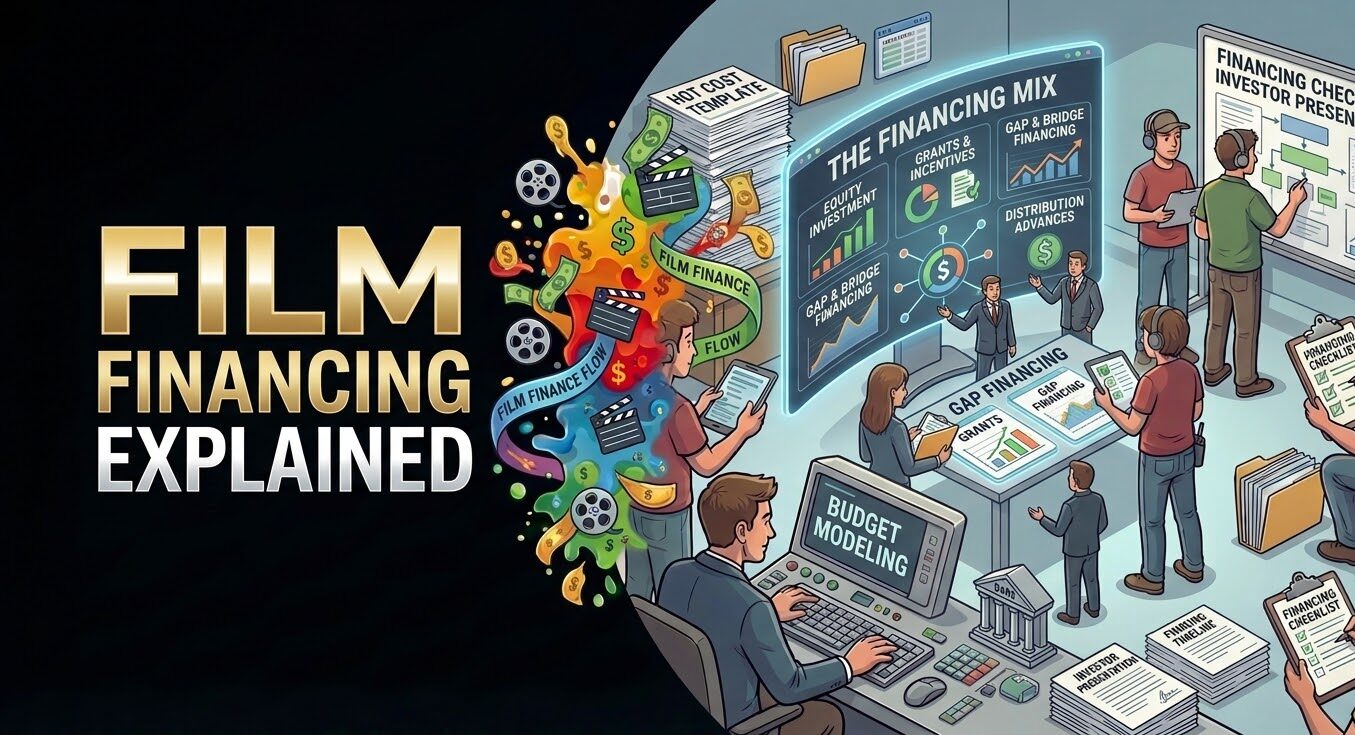
Film Financing Explained: Every Source, Structure, and Strategy in 2026
A complete guide to every film financing source available to independent producers in 2026 — debt, equity, tax credits, minimum guarantees, completion bonds, and regulated fund structures. Drawn from direct conversations with HeadGear, Peachtree, Myriad, Goldfinch, 91 Film Studios, and Lee & Thompson.
- The Film Financing Landscape in 2026
- Debt Financing for Film: How Peachtree Evaluates a Deal
- Equity Investment in Film: What Goldfinch Requires
- Minimum Guarantees: How Sales-Backed Finance Works
- Film Tax Incentives as a Financing Tool
- Regulated Fund Structures: The 91 Film Studios Model
- The Film Capital Stack: How Every Source Fits Together
- The Film Recoupment Waterfall
- Legal Structure and Chain of Title
- Choosing the Right Film Financing Source
Film financing in 2026 is not a single conversation. It is a set of separate conversations — each with a different type of capital, different expectations, and different criteria for saying yes.
Most producers understand this in theory. In practice, the problem is that the different sources of film financing are often treated as interchangeable. A lender is approached like an equity investor. A sales company is approached for money it does not offer. A tax credit is assumed rather than structured.
These mismatches slow deals down. Sometimes they end them.
This guide separates every major film financing source available to independent producers in 2026. It explains how each one works, what it requires, and where it fits in the overall structure. The content comes directly from six active financiers — a lender, a sales company, two equity and structured finance providers, a regulated fund manager, and an entertainment law firm — who collectively cover the full range of independent film financing.
“Projects stall not because creativity is weak, but because structure is unclear.”
— Vitrina LeaderSpeak, 2026 Financing Playbook
This guide covers: Debt financing for film · Equity investment in film · Minimum guarantees and pre-sales · Film tax incentives · Completion bonds · Regulated fund structures · How the capital stack connects them · What each source requires from producers
1. The Film Financing Landscape in 2026: What Has Changed
Independent film financing has entered a more structured phase. Capital is still being deployed — but the level of coherence required to access it has risen sharply.
What this means in practice: the questions financiers ask have become more specific. Revenue projections are now tested against real comparables, not accepted at face value. Budget assumptions are challenged rather than assumed. The capital stack is examined for logic and clarity, not just presence.
Across six separate financier conversations — HeadGear Films, Peachtree Media Partners, Myriad Pictures, Goldfinch, 91 Film Studios, and Lee & Thompson — one pattern was consistent. The deals that move forward are not the most ambitious. They are the ones whose financial structure supports their ambition.
Understanding the different sources of film financing — what each one is, what it requires, and where it fits — is the starting point for building that structure.
2. Debt Financing for Film: How Lenders Like Peachtree Evaluate a Deal
Debt financing is the most structured form of film financing available. A lender advances money against identifiable assets in the project. That money is repaid on a defined schedule, with interest, regardless of how the film performs at the box office.
Joshua Harris at Peachtree Media Partners, one of the most active specialty film lenders operating today, frames the model precisely: the risk they carry in debt lending is not whether they get repaid — it is when. That distinction matters. It shapes everything about what they require from producers.
What Film Debt Lenders Lend Against
Peachtree lends against identifiable, contractually defined assets. These typically include pre-sale agreements, distribution contracts, government tax incentives, and assigned rights in the film. None of these depend on the film being a commercial success. They depend on contracts being honoured and credits being paid out.
If collateral is unclear or uncontracted, the lending conversation becomes difficult quickly. Peachtree does not advance against hope or projections. They advance against paper.
The Completion Bond Requirement in Debt Financing
Peachtree requires a completion guarantee on every project they lend against. A completion bond is an insurance policy from a third-party bond company — Film Finances, Unifi, or Media Guarantors are the main providers in this market — that guarantees the film will be completed on time and on budget.
Without one, the single biggest risk in film lending — that a film never gets finished — sits entirely with the lender. The bond transfers that risk to an institutional insurer. For producers, the practical implication is that below $5 million in budget, the cost of bonding typically makes debt financing structures unviable.
Triple-Layer Risk Validation in Film Lending
Peachtree operates a multi-layered approach to risk. For any given deal, they seek alignment between their own underwriting, a bond company, and a commercial bank that independently lends against the same collateral. All three must be comfortable before Peachtree commits.
This is not inefficiency. It is independent institutional validation at each stage — which is exactly what makes their model defensible to their own investors.
Producer Takeaway
- Have identifiable collateral ready: pre-sales, distribution contracts, tax incentives, or assigned rights
- Ensure a completion bond is in place or actively in progress before approaching a lender
- Present a clear contract structure and a defined repayment plan — not a projection
- Model revenue realistically: the lender's risk is timing, not repayment
3. Equity Investment in Film: What Goldfinch and Others Require
Equity financing works very differently from debt. Equity investors put money into a film in exchange for a share of its revenues and profits. They sit at the bottom of the capital stack, meaning they are only repaid after all debt has been cleared. They have no guaranteed return. They absorb uncertainty in exchange for potential upside.
Because of that risk profile, equity investors require something debt lenders do not: genuine transparency about where their money is going and how it comes back.
How Goldfinch Evaluates Equity Investment in Film
Goldfinch has deployed over $250 million across 300+ projects with zero defaults in twelve years. Kirsty Bell, who leads their investment approach, discounts projected sales by 60% when evaluating a project. Her focus is on what percentage of the investment is genuinely at risk under realistic scenarios — not what upside looks like if everything goes well.
The questions she asks: Is the budget realistic? Is financial oversight in place? How will investors be kept informed? Is recoupment clearly documented? These are not creative questions. They are structural ones.
What Equity Investors in Film Need to See
Goldfinch looks for four things before committing equity capital: clear investor hierarchy, a defined repayment order, transparent reporting, and written agreements — not verbal assumptions. When the structure is clean, investors feel protected. When it is unclear, even a strong film can struggle to close equity financing.
Many independent films combine debt, equity, and incentives. This can work well — but only when every investor understands their position in the stack. Goldfinch is clear on this: mixed structures require more documentation, not less.
“Creativity gets a project started. Structure is what gets it financed.”
— Vitrina synthesis, Goldfinch chapter
4. Minimum Guarantees in Film Financing: How Sales-Backed Finance Works
A minimum guarantee (MG) is a payment made by a distributor to acquire the rights to a film in a specific territory, paid upfront before the film is released. That contracted payment can then be used as collateral for a bank loan or specialty lender. When MGs are in place across multiple territories, the aggregate sum can form a substantial part of a film's financing structure.
This is the model Kirk D'Amico at Myriad Pictures has operated for decades. Myriad is, at its core, a sales company. Their involvement in film financing is limited to providing MGs against distribution rights when the conditions are right. One thing they do not do: equity. Kirk D'Amico is explicit on this — if you approach Myriad as a potential equity partner, you have misread their model.
Which Films Can Attract Minimum Guarantees
MGs are not available for every project. Distributors only commit them to films they believe they can sell in their territory. That means genre, cast, and budget alignment matter before an MG conversation can even begin.
D'Amico identifies $5–15 million as the budget range where MGs can meaningfully support a financing structure. Below $5 million, MGs tend to be too small to anchor a plan. Above $30 million, pre-sales alone become insufficient — the film needs additional equity or other structural support.
Using Pre-Sales as Film Financing Collateral
When pre-sale agreements are in place, they can be taken to banks and specialty lenders including BondIt and Three Point Capital, both of which Myriad has worked with to finance MGs on productions they believe in. The lender advances a portion of the contracted MG value, using the distribution agreement as collateral.
Co-production can strengthen this structure further. It unlocks access to multiple incentives, shares production costs, and broadens the territory base from which MGs can be drawn. The trade-off is legal and operational complexity that must be managed from day one — not retrofitted after the deal is structured.
● VITRINA CONCIERGE
Right Company. Right Decision-Maker. Right Message.
Vitrina Concierge reaches matched financiers on your behalf, every month — built around your project's structure and stage.
Explore Vitrina Concierge Outreach Solutions5. Film Tax Incentives as a Financing Tool: What Lenders Accept
Tax incentives have become one of the most important anchors in independent film financing. When correctly structured, they support senior debt lending because they are government-backed and relatively predictable. The key word is 'relatively' — and every financier in this space measures that reliability carefully.
How Lenders Evaluate Film Tax Credits
Peachtree treats tax incentives as qualifying collateral. Kirsty Bell at Goldfinch includes the reliability of the credit in their overall risk assessment. Across both lenders, the same questions surface when a tax credit is presented as part of a film's financing structure.
- Is the incentive automatic or discretionary?
- Is it refundable or only transferable?
- What is the historical payout reliability in this territory?
- What is the typical timeline from qualifying expenditure to reimbursement?
- What compliance requirements must be met, and what happens if they are not?
A refundable, automatic incentive with a reliable 12-month payout cycle is a strong foundation for senior debt. A discretionary credit with uncertain timing and complex compliance is a risk that lenders either price heavily or decline to take.
Managing Film Tax Credits Through Production
Tax credits must be actively managed, not assumed. A delayed reimbursement creates real cash flow stress on a production. That requires understanding compliance rules from the start, accurately tracking qualifying spend throughout production, maintaining precise documentation, and aligning cash flow planning with the realistic reimbursement timeline.
Producers who treat the tax credit as a lump sum that arrives after production closes tend to find it creates problems before production closes.
6. Regulated Fund Structures in Film: The 91 Film Studios Model
Most independent film financing in Western markets operates through project-by-project arrangements — a producer assembles a capital stack for each film individually. In India, 91 Film Studios has built a different model: a SEBI-registered Category 2 Alternate Investment Fund (AIF) that deploys equity capital across a slate of regional language films through a regulated institutional structure.
Naveen Chandra, who founded 91 Film Studios, made the deliberate choice to focus exclusively on Indian regional language cinema: Tamil, Telugu, Marathi, Malayalam, Punjabi, Bengali, and others. His reasoning is strategic. Regional markets offer original stories, strong audience demand, and the ability to own and monetise intellectual property over the long term.
Why 91 Film Studios Uses an Equity-Only Fund Model
Naveen Chandra does not do debt financing. His model is equity-only. Investors in the fund receive equity participation and returns from both the film's revenue and the intellectual property the fund retains. This is a fundamentally different risk and return profile from Western debt-led models.
The fund structure matters for a specific reason: it introduces defined investment criteria, governance oversight, and reporting discipline. Capital is deployed across multiple films, which reduces dependence on any single outcome. Instead of isolated project bets, the portfolio approach distributes risk across a slate.
The Co-Producer Requirement in Film Fund Investing
One of Naveen Chandra's core risk principles is the co-producer requirement. He will not finance a film alone. Every project requires a co-producer who independently believes in the story and commits 50% of the financing alongside the fund. This co-producer validation is not a formality — it is a fundamental condition of every investment.
of films that begin production in the Indian regional market never complete. The 91 Film Studios fund model was built specifically to address this structural failure.
91 Film Studios also addresses the distribution gap directly: 50% of completed Indian films never reach proper theatrical distribution. Their financing model therefore accounts for completion funding, theatrical release strategy, satellite and digital rights, and the IP value that persists long after the first run. Financing does not end at production.
7. The Film Capital Stack: How Every Financing Source Fits Together
Each of the financing sources covered above occupies a specific position in a film's capital stack. Understanding where each one sits — and why — is what allows a producer to build a structure that actually works.
Most independent film capital stacks have three layers: senior debt at the top, gap financing in the middle, and equity at the bottom. Each layer carries a different level of risk, expects a different rate of return, and is repaid in a different order.
How Tax Credits and Pre-Sales Anchor Film Financing
Tax credits and confirmed pre-sale agreements typically sit underneath senior debt as the collateral that makes lending possible. They are the most predictable sources of revenue in the structure — government-backed in the case of credits, contractually committed in the case of pre-sales. Senior lenders like Peachtree build their positions against these assets.
Where Minimum Guarantees Fit in the Capital Stack
MGs can support senior or near-senior lending positions when they are contracted and properly assigned. The key is that the MG must be from a distributor with the financial standing to honour it, and the rights assignment must be clean enough for the lender to take security over it. This is where Lee & Thompson's emphasis on chain of title and legal structure becomes directly relevant to film financing.
Equity's Position in the Film Financing Stack
Equity sits at the bottom. It is repaid only after all debt and gap financing has cleared. Sam Tatton-Brown at Lee & Thompson cites a benchmark that every equity investor in independent film should understand before committing: only 3.8–4% of UK independent films actually reach net profits. Equity investors participate in upside — but the realistic probability of profit participation is low. This must be communicated clearly, not obscured.
Percentage of UK independent films that reach net profits. Equity investors sit at the bottom of the stack and are paid last.
A well-structured capital stack does not mean maximum complexity. It means every investor understands their position, every repayment order is documented, and every source of capital is matched to the right asset. Financiers who see a clear stack gain confidence. Those who see confusion find reasons to wait.
● VITRINA CONCIERGE
Partner-Outreach Managed by Vitrina.
We reach matched contacts every month for your requirements — right company, right decision-maker, right message.
Start with Vitrina Concierge8. The Film Recoupment Waterfall: How Revenue Flows Back to Investors
Once a film starts generating revenue, the recoupment waterfall determines who gets paid, in what order, and when profit participation begins. This is one of the most important documents in any film financing structure — and one of the most frequently left vague.
Lee & Thompson is unambiguous: the waterfall must be written down, not assumed. Every layer of the capital stack must be defined in contracts. Ambiguity creates disputes. Disputes delay repayment. Delays damage the relationships that future film financing depends on.
The Standard Film Recoupment Order
Revenue enters a collection account — a ring-fenced account managed by a third-party collection manager — and is distributed to investors in the agreed order. Senior debt is repaid first. Gap financing follows. Equity is then recouped. Only after all of that has cleared does profit participation begin.
Variations exist across deals. Some structures include deferments, corridor arrangements, or soft money recoupment positions. What matters in every case is that every investor knows their exact position before money is committed, not after the film has been delivered.
Why Recoupment Clarity Matters for Film Investors
Sam Tatton-Brown at Lee & Thompson describes the 3.8–4% net profit benchmark as a practical signal for any producer dealing with equity. Profit participation rarely happens in independent film. Equity investors who understand this going in are investors you can build a long-term relationship with. Equity investors who are surprised by it become a problem at the worst possible time.
Clear recoupment schedules also reduce legal friction. Financing closes faster when the legal structure is ready — and the recoupment waterfall is a central part of that structure.
Producer Takeaway
- Document the recoupment waterfall before approaching any investor — equity or debt
- Every investor must know their position in the stack, their repayment order, and when profit participation begins
- Use a collection account manager to distribute revenue: it protects all parties and reduces disputes
- Be honest with equity investors about the 3.8–4% net profit reality — before they commit, not after
9. Legal Structure and Chain of Title in Film Financing
Behind every film financing structure is a legal layer that many producers leave until last. This is consistently one of the most expensive mistakes in independent film.
Sam Tatton-Brown at Lee & Thompson is direct: if the contracts are unclear, the financing is unstable. A project must be able to answer a basic set of questions before capital will commit — and the answers must be consistent across all documents, not just in a pitch deck.
- Who owns the rights to the underlying material?
- Who has security over those rights, and is that security grantable?
- What is the repayment order across all investors?
- When do rights revert, and under what conditions?
- What happens to the financing structure in default?
Regulatory shifts also shape what film financing structures are viable at any given time. Changes to terms of trade legislation, EIS financing structures, and broadcaster commissioning terms have each, at different points, materially changed the financing landscape. Producers who understand the legal architecture of their deal are better positioned when regulation changes — as it inevitably does.
Chain of title must be clean before approaching any lender or investor. Rights must be properly assigned. Security must be grantable. The financing plan must be consistent with the legal documents. When these align, financing moves. When they do not, financing stalls.
10. Choosing the Right Film Financing Source for Your Project
Not every project needs every source of film financing. The right structure depends on the project's budget, genre, territory appeal, cast, and stage of development. The wrong structure — approaching a debt lender without collateral, or pitching a sales company for equity — wastes time for both parties.
Projects Under $5 Million
At this budget level, completion bond costs typically make debt financing structures unviable. Equity is the primary financing route. The equity investor must understand their position clearly: they sit at the bottom of the stack, and net profit participation in independent film is rare. Tax credits can strengthen the structure, but the project must be able to support the compliance overhead.
Projects Between $5 Million and $15 Million
This is the range where the full range of film financing sources becomes available. Pre-sales and MGs can anchor senior debt. Tax credits can support lending. Equity fills the gap. It is the sweet spot Kirk D'Amico at Myriad identifies for MG-supported structures, and the range where Goldfinch is most active. Peachtree's transaction range runs broader — $3M–$35M — but the $5–15M zone is where all of these financing layers align most cleanly.
Projects Above $15 Million
As budgets increase, reliance on pre-sales alone becomes insufficient. Additional equity is typically required, and the pressure on cast and genre alignment increases. Phil Hunt at HeadGear Films is clear: films above approximately $30 million become very difficult to finance independently without studio backing. Above that threshold, the financing model shifts significantly.
One nuance worth noting from HeadGear's experience: larger budget films, when properly structured with the right packaging, can actually carry less risk than mid-budget films with weak packaging. Budget size alone does not determine risk. Structure and packaging do.
“The projects that move forward are not simply the most ambitious. They are the ones whose financial structure supports their ambition.”
— Vitrina LeaderSpeak, 2026 Financing Playbook
● VITRINA CONCIERGE
Understanding the structure is the start. Knowing who to take it to is where it gets harder.
Vitrina Concierge works through that with you, one-to-one — from positioning your project to finding the right financier or commissioner.
Talk to Our Solutions Expert 1:1This guide is part of the Vitrina LeaderSpeak blog programme. All content is drawn from direct conversations with active financiers: HeadGear Films (Phil Hunt), Peachtree Media Partners (Joshua Harris), Myriad Pictures (Kirk D'Amico), Goldfinch (Kirsty Bell), 91 Film Studios (Naveen Chandra), and Lee & Thompson (Sam Tatton-Brown). No commentary has been layered over practitioner insight.
Related reading: How to Finance an Independent Film · Film Investment: What Investors Need to Know · Independent Film Distribution Explained · The Film Recoupment Waterfall · Film Tax Incentives Explained