

 Global Content Pulse (Webinars)


 Global Production Financing
(Webinars)
Global Production Financing
(Webinars)  LeaderSpeak Podcast
  About Vitrina
 Our Story
 Our Solutions 🔥
 Film+TV Projects Tracker 🚀
 Case Studies
 Our Profile

Film and TV global project monitoring is the strategic practice of tracking unreleased content through every stage of the production pipeline using structured, real-time data.
This involves monitoring titles from early development through production and post-production to identify investment, service, or acquisition opportunities.
According to industry analysis, the modern M&E supply chain encompasses over 600,000 companies and 5 million professionals, making manual tracking structurally impossible.
In this guide, you will learn how to overcome the industry data deficit by leveraging supply chain intelligence to gain a permanent insider advantage.
Table of Contents
Key Takeaways for Strategy Leaders
-
Proactive Sourcing: Real-time monitoring allows executives to identify high-value titles months before they are announced in trade publications.
-
Risk Mitigation: Centralized data replaces unreliable personal networks, reducing the financial risk associated with opaque cross-border deals.
-
Global Reach: Effective monitoring spans over 100 countries, ensuring no regional growth opportunity in territories like MENA or Southeast Asia is overlooked.
What is Global Film and TV Project Monitoring?
In the legacy era of entertainment, keeping track of new projects was a manual art performed by agents and acquisition executives. Today, global film and TV project monitoring has evolved into a structural science. It is the continuous observation of the content life cycle across international borders.
Unlike static directories, active monitoring provides real-time updates on funding status, production milestones, and attachment changes. This visibility is critical in a borderless market where content is increasingly developed through complex co-production models involving multiple independent partners.
Analyze production trends across high-growth regions:
Solving the Entertainment Data Deficit
The entertainment industry is currently suffering from a massive data trust deficit. While the supply chain has scaled to over 1.6 million titles and 140,000 companies, the methods used to track them remain fragmented and anecdotal. Relying on personal networks is no longer a viable strategy for global scale.
Data-powered monitoring eliminates this deficit by providing a single source of truth. By centralizing information on unreleased projects, companies can perform objective due diligence on potential partners and verify track records before committing significant capital.
Industry Perspective: Cloud-Native Production Workflows
Leon Silverman discusses the MovieLabs 2030 Vision and the necessity of secure, real-time data integration in the modern production pipeline.
Key Insight
The shift toward cloud-native creativity requires foundational principles for data security and real-time iteration, emphasizing why structured project monitoring is essential for future workflows.
The Production Pipeline Monitoring Framework
To gain a competitive edge, executives must track titles across the four critical stages of the production pipeline:
- Early Development: Monitoring unproduced IP and script acquisitions to identify early investment opportunities.
- Active Production: Tracking daily production board updates and logistics to assist service providers in identifying active bidding windows.
- Post-Production: Identifying projects entering the VFX and sound stage where localization and distribution partners are secured.
- Release and Distribution: Monitoring renewal potential and licensing windows to optimize content library ROI.
Discover green-lit projects for pre-sales:
Strategic Advantage in Content Acquisition
For content buyers and acquisition leads, monitoring is the primary tool for proactive sourcing. In an era of weaponized distribution, where premium content is licensed to rival platforms post-release, having real-time insights into license expiration and renewal status is a billion-dollar advantage.
By identifying projects in the post-production stage, buyers can secure regional rights before a title gains massive traction. This early detection strategy allows for better negotiation leverage and ensures a steady pipeline of diverse content for global platforms.
Industrializing Intelligence with Vitrina AI
Vitrina AI acts as a digital lighthouse for the entertainment industry. Incubated at SRI International, Vitrina leverages Vertical AI to map the entire supply chain, offering the Global Film and TV Projects Tracker—the industry widest scan of unreleased projects across 100+ countries.
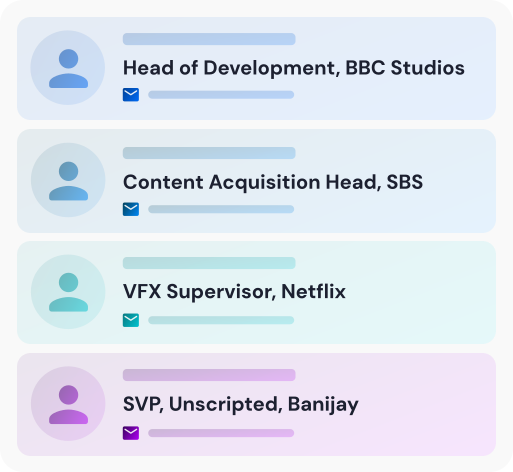
The platform tracks over 1.6 million titles, linking them to 140,000 verified company profiles and 5 million professionals. This deep interconnectivity transforms project monitoring from a manual chore into a data-driven science, enabling precision outreach to secure financing, pre-sales, or co-production deals.
Moving Forward
The transition from opaque networks to data-powered project monitoring is a structural metamorphosis for the entertainment industry. Executives who embrace real-time intelligence will be better positioned to navigate the complexities of global co-production and maximize the ROI of their content libraries.
Actionable Step: Audit your current sourcing methods. If your data relies on fragmented newsletters or personal spreadsheets, consider integrating a centralized supply chain intelligence platform to regain your insider advantage.
Frequently Asked Questions
What is global project monitoring?
It is the structural practice of tracking unreleased film and TV titles through development and production stages to identify strategic business opportunities.
Why is manual tracking no longer enough?
The industry scale—600,000+ companies and 1.6M+ titles—is too vast for fragmented personal networks to track effectively across international borders.
What stages does Vitrina AI track?
Vitrina tracks projects across four stages: In-Development, In-Production, Post-Production, and Release/Renewal.
How does monitoring help acquisition leads?
It allows leads to discover trending regional content early, enabling them to secure rights and pre-sales before competitors.
What is the entertainment data deficit?
It refers to the risk created by relying on opaque, unverified, or fragmented information instead of a centralized data-powered framework.
Can monitoring identify service opportunities?
Yes, post-production and tech vendors use monitoring to find projects entering bidding windows for sound, VFX, and localization.
How many countries does Vitrina AI cover?
Vitrina tracks unreleased projects across over 100 countries globally.
What is the Global Production Financing webinar?
A monthly briefing hosted by Vitrina that tracks production volumes and financing trends by region and genre over a rolling three-year view.
Find Film+TV Projects, Partners, and Deals – Fast.
VIQI matches you with the right financiers, producers, streamers, and buyers – globally.
Not a Vitrina Member? Apply Now!
Vitrina tracks global Film & TV projects, partners, and deals—used to find vendors, financiers, commissioners, licensors, and licensees
Join Industry Briefings Trusted by Leaders

White Space Opportunities in Animation
Deep dive into animation market gaps, studios, and commissioners. Use real-world animation case studies to capitalize on emerging business trends.

Deep dive into Co-Pros
Ambitious co-productions are key to global hits, but most deals collapse. This deep-dive briefing is the strategic playbook. We’ll break down the financing models, partnership structures, and market insights behind today’s successful deals.

Film & TV Financing: Tax Credits & Incentives
A focused look at how 2025 tax credits and incentives are reshaping Film & TV financing decisions — and where the real value now sits.

Film & TV Financing: Pre-Buys
Learn how pre-buys work in current Film and TV financing, how they differ from pre-sales, and how they are used to close real finance plans.
Vitrina tracks global Film & TV projects, partners, and deals—used to find vendors, financiers, commissioners, licensors, and licensees
Not a Vitrina Member? Apply Now!