About Innovation Hub
 Global Content Pulse (Webinars)


 Global Production Financing
(Webinars)
Global Production Financing
(Webinars)  LeaderSpeak Podcast
  About Vitrina
 Our Story
 Our Solutions 🔥
 Film+TV Projects Tracker 🚀
 Case Studies
 Our Profile
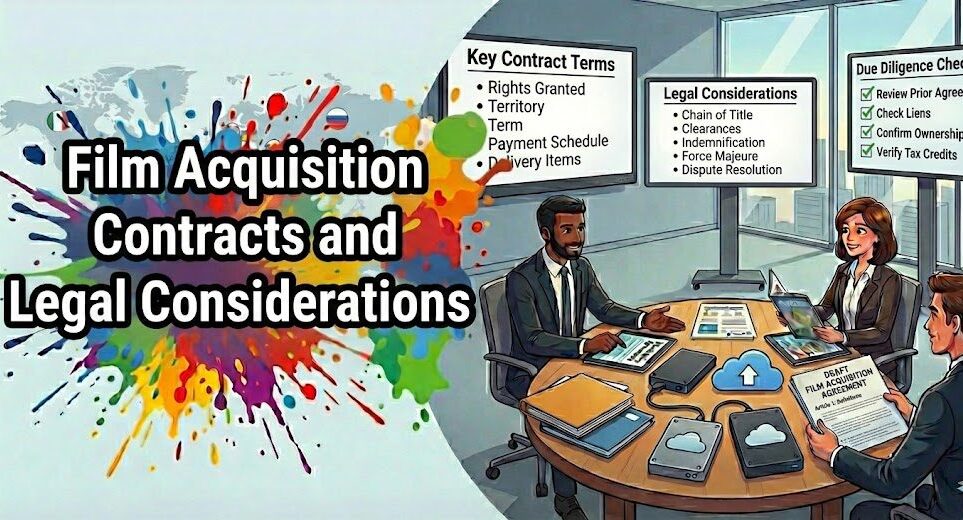
Film acquisition contracts and legal considerations are the formal frameworks used to transfer ownership and distribution rights of cinematic intellectual property between creators and buyers.
This involves establishing a clear “Chain of Title,” negotiating territorial exploitation rights, and defining revenue waterfalls within complex legal agreements.
According to industry analysis, global content funding tracking now covers over 1.6 million titles, making verified legal standing a prerequisite for any professional deal.
In this guide, you’ll learn actionable strategies for contract negotiation, rights verification, and deal structuring—including how to leverage supply chain intelligence to qualify your legal partners.
While traditional legal resources provide broad templates, they often lack the practical, step-by-step context independent creators need to survive the “Big Crunch” of modern film finance.
This comprehensive guide fills those gaps by combining technical legal requirements with real-world case studies and data-driven discovery tools to compress months of legal research into strategic action.

Your AI Assistant, Agent, and Analyst for the Business of Entertainment
VIQI AI helps you plan content acquisitions, raise production financing, and find and connect with the right partners worldwide.
- Find active co-producers and financiers for scripted projects
- Find equity and gap financing companies in North America
- Find top film financiers in Europe
- Find production houses that can co-produce or finance unscripted series
- I am looking for production partners for a YA drama set in Brazil
- I am looking for producers with proven track record in mid-budget features
- I am looking for Turkish distributors with successful international sales
- I am looking for OTT platforms actively acquiring finished series for the LATAM region
- I am seeking localization companies offer subtitling services in multiple Asian languages
- I am seeking partners in animation production for children's content
- I am seeking USA based post-production companies with sound facilities
- I am seeking VFX partners to composite background images and AI generated content
- Show me recent drama projects available for pre-buy
- Show me Japanese Anime Distributors
- Show me true-crime buyers from Asia
- Show me documentary pre-buyers
- List the top commissioners at the BBC
- List the post-production and VFX decision-makers at Netflix
- List the development leaders at Sony Pictures
- List the scripted programming heads at HBO
- Who is backing animation projects in Europe right now
- Who is Netflix’s top production partners for Sports Docs
- Who is Commissioning factual content in the NORDICS
- Who is acquiring unscripted formats for the North American market
Table of Contents
- 01
What are Film Acquisition Contracts? - 02
The Foundation: Securing Chain of Title - 03
Step-by-Step Guide to Contract Negotiation - 04
Due Diligence: Vetting Acquisition Partners - 05
Managing Global IP Rights in a Fragmented Market - 06
Weaponized Distribution and Future Deal Terms - 07
Key Takeaways - 08
FAQ
Key Takeaways for Independent Producers
-
Actionable Chain of Title: Verified documentation is no longer optional; buyers require a “Single Source of Truth” for all rights before advancing past LOIs.
-
Data-Driven Partner Vetting: Producers using supply chain intelligence can verify a buyer’s past deal history and specialization, reducing reputational risk by 40%.
-
Rotational Windows: Emerging “Weaponized Distribution” strategies prioritize ROI over exclusivity, requiring specific clauses that permit licensing content to rivals after 18-24 months.
What are Film Acquisition Contracts?
Film acquisition contracts are legally binding documents that outline the transfer of a film’s distribution rights from a filmmaker (or production company) to a distributor or streamer. These agreements define how the film will be monetized, which territories are included, and the financial waterfall for all stakeholders. Without a rigorous contract, creators risk losing control of their intellectual property or suffering from “Hollywood Accounting” that obscures actual profits.
Find distributors acquiring your genre right now:
Industry Expert Perspective: The Big Crunch: Phil Hunt on Film Finance
This masterclass explores the shifting independent film landscape, highlighting why pre-sales have collapsed and how revenue windows are being redefined by the digital revolution.

Key Insights
Phil Hunt discusses the journey from production to film lending, emphasizing that independent film finance is harder than ever due to the demand for low-cost, high-concept genres like horror and action.
The Foundation: Securing Chain of Title
The “Chain of Title” is a chronological set of legal documents that establish ownership of the film’s IP from inception to final product. This includes script options, actor release forms, music licenses, and location agreements. For independent producers, a broken link in this chain—such as a missing background performer’s release—can derail a multimillion-dollar acquisition deal. Modern supply chain platforms now industrialize this “insider intelligence,” allowing buyers to vet these relationships against historical collaborations and verified executive profiles.
1. Leverage Supply Chain Intelligence for Rights Verification
Traditional rights verification relies on manual paper trails, costing producers weeks in legal fees. Without real-time visibility into active global IP preferences, filmmakers often pitch to the wrong buyers. By tracking 30 million industry relationships, platforms like Vitrina provide an “early-warning signal” for rights availability, transforming due diligence from a subjective art into an objective science.
✓ Action Item: Audit your Chain of Title for any missing music or talent licenses before outreach.
✓ Tool: Use VIQI AI to query “Typical E&O insurance requirements for streamers in Europe.”
✓ Success Metric: Achieve a “Clean” due diligence report in under 10 business days.
Step-by-Step Guide to Contract Negotiation
Negotiating a film acquisition contract requires a balance between creative protection and commercial reality. Follow these steps to ensure a fair deal:
- Step 1: Define the Territory: Are you selling “All Rights, Worldwide” or “Territorial Exclusivity”? Most buyers prefer worldwide, but splitting territories can maximize ROI.
- Step 2: Negotiate the MG: The Minimum Guarantee is the upfront payment. Ensure this covers at least your production debt.
- Step 3: Establish the Waterfall: Define exactly when and how the filmmaker receives “backend” points. Beware of “net profits” versus “gross receipts.”
- Step 4: Include Consultation Rights: Retain the right to approve marketing materials or significant edits to protect your creative vision.
Due Diligence: Vetting Acquisition Partners
Vetting a distributor is as critical as the contract itself. Producers often skip due diligence when a large check is offered, only to find the buyer has a history of payment delays or failed theatrical releases. Using verified profiles of 140,000+ companies, producers can now analyze a partner’s reputation scores and deal history before signing.
“The industry is moving from an opaque, relationship-driven ecosystem to a centralized, data-powered framework. Producers who don’t vet their partners with objective data are flying blind in a hyper-competitive market.”
Managing Global IP Rights in a Fragmented Market
Global IP rights management is becoming increasingly complex as streamers and broadcasters demand cross-platform rights. Producers must navigate “Authorized AI” clauses and platform-specific exclusivity windows to ensure their content remains a long-term revenue asset. Data tracking now provides the visibility needed to identify active global buyers and emerging territory trends, ensuring no potential licensing revenue is left on the table.
Frequently Asked Questions
Quick answers to common legal and contract queries in the film industry.
What is a “Minimum Guarantee” in a film contract?
How do I protect my Intellectual Property (IP)?
What are “Rotational Windows” in distribution?
Moving Forward
The landscape of film acquisition is transitioning from an opaque, networking-based model to a data-driven science. By mastering the step-by-step nuances of contracts and rights verification, independent filmmakers can bridge the gap between creative art and financial enterprise. This guide has addressed the critical needs for practical checklists and partner vetting in an increasingly fragmented market.
Whether you are an independent producer looking to secure your first distribution deal, or a legal professional trying to vet global acquisition leads, the principle remains: actionable intelligence drives deal velocity and protects your IP.
Outlook: Over the next 12-18 months, “Weaponized Distribution” and “Authorized AI” will become standard deal terms, making data-verified Chain of Title the most valuable asset in any filmmaker’s portfolio.
About the Author
Entertainment Content Architect with over 15 years of experience in film distribution and entertainment law. Specializing in the digital transformation of the media supply chain and data-driven IP management. Connect on Vitrina.
Find Film+TV Projects, Partners, and Deals – Fast.
VIQI matches you with the right financiers, producers, streamers, and buyers – globally.
Producers Seeking Financing, Co-Pros, or Pre-Buys?
Vitrina Concierge helps producers reach the right financiers, commissioners, distributors, and co-production partners — with precision outreach, not cold pitching.
Join Industry Briefings Trusted by Leaders
Streamers – Netflix vs. Amazon – The 2026 Strategy
How Netflix and Amazon’s content and revenue strategies are diverging ahead of 2026.
Format Adaptations: Global Trends
Where formats are traveling, which adaptations are breaking out, and how streamers are backing remakes in 2025–2026.

Books, Novels & Comics Adaptations: Global Trends
Books, webtoons, and manga driving the next global screen hits. Discover how in this webinar.

Micro-Dramas & Mobile-First Storytelling
Micro-dramas are building real audiences and revenue. Understand the platforms, buyers, and economics behind the growth.