About Innovation Hub
 Global Content Pulse (Webinars)


 Global Production Financing
(Webinars)
Global Production Financing
(Webinars)  LeaderSpeak Podcast
  About Vitrina
 Our Story
 Our Solutions 🔥
 Film+TV Projects Tracker 🚀
 Case Studies
 Our Profile

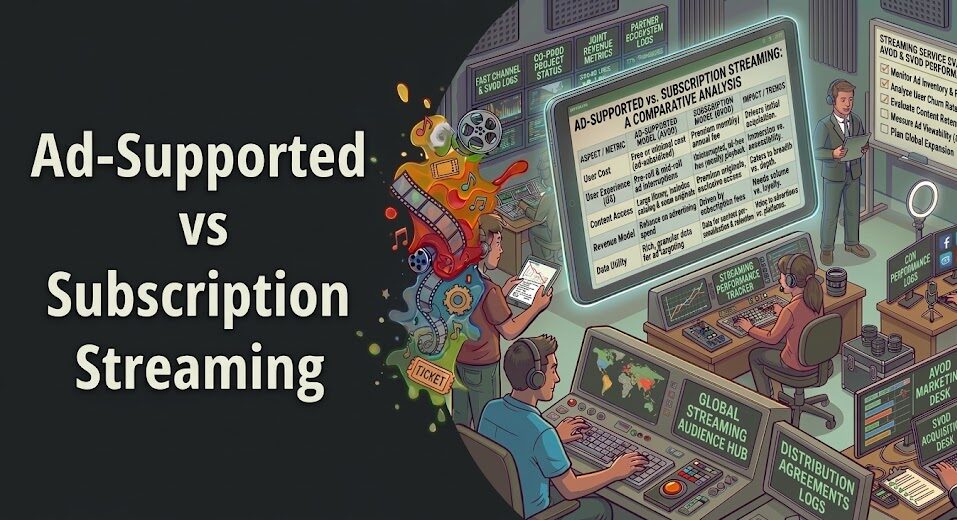
FAST and AVOD monetization has transitioned from a “budget alternative” to the primary revenue engine for the global streaming industry.
As subscription-based models (SVOD) hit a ceiling, platforms are shifting toward ad-supported tiers to capture price-sensitive audiences and diversify revenue. With the AVOD market projected to reach $72.93 billion by 2031 and Netflix seeing 45% of total household viewing hours on its ad-supported plan, the “Great Re-bundling” is officially ad-funded.
In this Article:
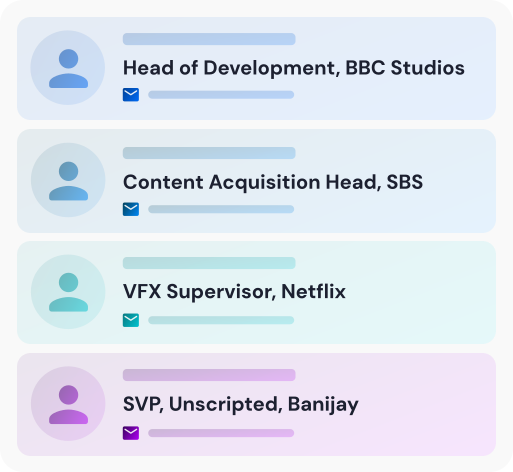
Stop Guessing Who’s Financing. Get Targeted Outreach.
Stop searching and start getting funded. We identify the exact decision-makers currently backing projects like yours, turning raw data into risk-aligned capital partnerships.
Major Studios
Scouting early stage projects, IP, and Regional partners for global studio pipelines.
IP Owners & Leads
Connecting creative leads with qualified financiers and major streaming platforms.
Streamers
Securing high-value pre-buy content and discovering early-stage global IP for platforms.
Indie Producers
Bridging the gap for indie filmmakers to reach executive production partners and capital.
Global Financing Ecosystems
Mapping complex markets and pairing projects with disciplined, risk-aligned capital across global territories worldwide.
The Strategic Shift: From Subs to CPMs
Behind closed doors, the conversation at major studios has fundamentally changed. We’re no longer in the “subscriber at any cost” era. The focus has pivoted to ARPU (Average Revenue Per User) optimization, and it’s becoming clear that ad-supported viewers are often more valuable than premium subscribers. It sounds counterintuitive, but the math doesn’t lie.
When you combine a $6.99 subscription fee with $10–$15 in monthly ad revenue, the total margin exceeds that of a $15.99 ad-free plan. This is the “Ad-Tier Paradox” that Netflix and Disney+ are currently weaponizing. According to recent Comscore data, Netflix’s ad-tier viewing hours jumped from 34% to 45% in just one year. That’s not just growth; it’s a structural transformation of the capital stack.
For independent producers, this shift is a double-edged sword. On one hand, production financing is increasingly tied to ad-revenue projections rather than flat licensing fees. On the other hand, the demand for “sticky” episodic content that can sustain mid-roll ads is higher than ever. Strategic players recognize that the 600,000+ companies in the Vitrina ecosystem are now recalibrating their sales estimates to account for these ad-funded waterfalls.
“The capital reality is that ad-supported tiers are de-risking the entire streaming investment thesis. We’re seeing a 20.15% CAGR for hybrid models through 2031, nearly triple the growth rate of pure-play SVOD.”
FAST vs. AVOD: Decoding the Mechanics
Understanding the nuance between FAST (Free Ad-Supported Streaming TV) and AVOD is essential for anyone navigating the distribution and licensing landscape. While both are ad-funded, they cater to different psychological states.
- AVOD (Advertising Video on Demand): Think of this as the “lean-forward” experience. Users actively select a title from a library (Hulu, Peacock, or the ad-tier of Netflix). It offers precision targeting based on user behavior and higher engagement.
- FAST (Free Ad-Supported Streaming TV): This is the “lean-back” experience. It mimics traditional linear TV with scheduled channels (Pluto TV, Tubi, The Roku Channel). It’s the ultimate tool for cord-cutters who miss the serendipity of channel surfing.
Why does this distinction matter to your bottom line? Because the CPMs (Cost Per Mille) differ. AVOD typically commands higher rates due to specific user data and lower ad-skipping rates. However, FAST channels have seen a 43% year-over-year growth in total hours watched because they solve “decision fatigue.” If you’re managing post-production for a library with thousands of hours of content, FAST is your best bet for high-volume monetization.

Phil Hunt, CEO of Head Gear Films, discusses the shifting film finance landscape and the role of revenue windows.
Find the Financiers Backing Your Genre
Stop searching and start getting funded. We identify the exact decision-makers currently backing projects like yours, turning raw data into risk-aligned capital partnerships.
The Vitrina Ad-Tier Viability Matrix™
To help producers and distributors evaluate their content for ad-supported tiers, we’ve developed The Vitrina Ad-Tier Viability Matrix™. This framework scores content based on its ability to drive recurring ad impressions rather than one-time ticket sales.
The Vitrina Ad-Tier Viability Matrix™
| Metric | Low Viability (SVOD) | High Viability (AVOD/FAST) |
|---|---|---|
| Narrative Structure | Continuous / Cinematic | Natural ad-break cliffhangers |
| Viewer Retention | Single-sitting (90 min) | High “Rewatchability” / Episodic |
| Ad-Engagement | Atmospheric / Slow | Action / Sports / Procedural |
| Contextual Fit | Niche / Experimental | Broad / Brand-safe / Shoppable |
Producers can use this matrix to “ad-proof” their scripts during the development phase. Need a second opinion? Ask VIQI about your project’s ad-readiness.
Interactive Ads & Shoppable Video: The 18.6% CAGR Opportunity
The real growth lever isn’t just showing more ads; it’s making them interactive. Shoppable video is the holy grail of FAST and AVOD monetization. We’re talking about interactive overlays that allow a viewer to buy a beverage or a piece of apparel directly from the screen without leaving the stream.
The data is startling. Interactive ad units are forecast to grow at an 18.62% CAGR through 2031. Why? Because they compress the marketing funnel. Retail media networks are now syndicating shoppable ads directly into premium streams. This turns a passive viewing session into a measurable retail event. For content owners, this means shifting from a standard CPM model to a “CP-Sale” or performance-based revenue split.
Now, look at the infrastructure required to support this. It requires low-latency connections and “silicon-level watermarking” for real-time authentication. This is why VFX and technical workflows are increasingly incorporating metadata layers that support these shoppable hotspots.
How Vitrina Helps with FAST and AVOD Monetization
Navigating the world of ad-supported streaming requires more than just content—it requires the right partnerships. Whether you’re looking for ad-tech providers, FAST channel aggregators, or regional AVOD platforms, Vitrina’s intelligence platform connects you to the entire supply chain.
Frequently Asked Questions
What is the main difference between FAST and AVOD monetization?
The primary difference is content delivery. FAST (Free Ad-Supported Streaming TV) provides a linear, scheduled channel experience similar to traditional cable, while AVOD (Advertising Video on Demand) allows users to pick and watch titles whenever they want. From a monetization standpoint, AVOD often allows for more precise user-level targeting, whereas FAST relies on broader demographic “contextual” targeting.
How much revenue do ad-supported tiers actually generate?
It varies by platform, but for major streamers like Netflix, the hybrid revenue (subscription + ads) often exceeds the revenue from their premium ad-free tiers. Global AVOD spending is expected to rise by 17% in 2025, driven by massive adoption of hybrid models. In some markets, the ad-tier ARPU is 20-30% higher than the pure subscription ARPU.
Why are interactive ads considered the “next growth lever”?
Interactive and shoppable ads allow for direct conversion, which increases the value of an ad spot significantly. Brands are willing to pay higher CPMs for “shoppable moments” that provide direct ROI data. This format is growing at an 18.62% CAGR, far outpacing traditional pre-roll and mid-roll spots.
Can independent films succeed on FAST channels?
Absolutely. FAST channels like Tubi and Pluto TV have become massive aggregators for independent libraries. The key is “packaging”—grouping films into themed linear channels (e.g., “Classic Noir,” “Modern Sci-Fi”) to attract a lean-back audience that might not have searched for the title individually.
Is FAST and AVOD monetization only for the US market?
No. While North America currently holds the largest share (41.6%), the Asia-Pacific region is projected to grow at a 14.4% CAGR through 2031. India, in particular, is a massive AVOD market where price-sensitive audiences have long preferred ad-supported models over high-cost subscriptions.
The Bottom Line
The “Great Re-bundling” of streaming is ad-funded, and the transition is accelerating. We’re moving away from a world of silos and toward a hybrid ecosystem where SVOD, AVOD, and FAST coexist to maximize every minute of attention. For the content supply chain, this means VFX and technical workflows—it’s a long-term engagement play.
If you’re looking to optimize your monetization strategy for this new ad-supported reality, the first step is knowing who to talk to. Vitrina’s platform provides the data and connections needed to navigate this $73 billion landscape with confidence. Don’t leave your ad-revenue to chance; leverage the “Insider’s Insider” to find your next growth lever.
Ready to Scale Your Monetization?
Join the industry’s largest supply chain network to find verified FAST and AVOD partners.
Find Film+TV Projects, Partners, and Deals – Fast.
VIQI matches you with the right financiers, producers, streamers, and buyers – globally.
Producers Seeking Financing, Co-Pros, or Pre-Buys?
Vitrina Concierge helps producers reach the right financiers, commissioners, distributors, and co-production partners — with precision outreach, not cold pitching.
Join Industry Briefings Trusted by Leaders
Format Adaptations: Global Trends
Where formats are traveling, which adaptations are breaking out, and how streamers are backing remakes in 2025–2026.

Books, Novels & Comics Adaptations: Global Trends
Books, webtoons, and manga driving the next global screen hits. Discover how in this webinar.

Micro-Dramas & Mobile-First Storytelling
Micro-dramas are building real audiences and revenue. Understand the platforms, buyers, and economics behind the growth.

Navigating Global Content Licensing Trends
How global content licensing is shifting beyond flat fees to flexible, deal-driven models.