About Innovation Hub
 Global Content Pulse (Webinars)


 Global Production Financing
(Webinars)
Global Production Financing
(Webinars)  LeaderSpeak Podcast
  About Vitrina
 Our Story
 Our Solutions 🔥
 Film+TV Projects Tracker 🚀
 Case Studies
 Our Profile
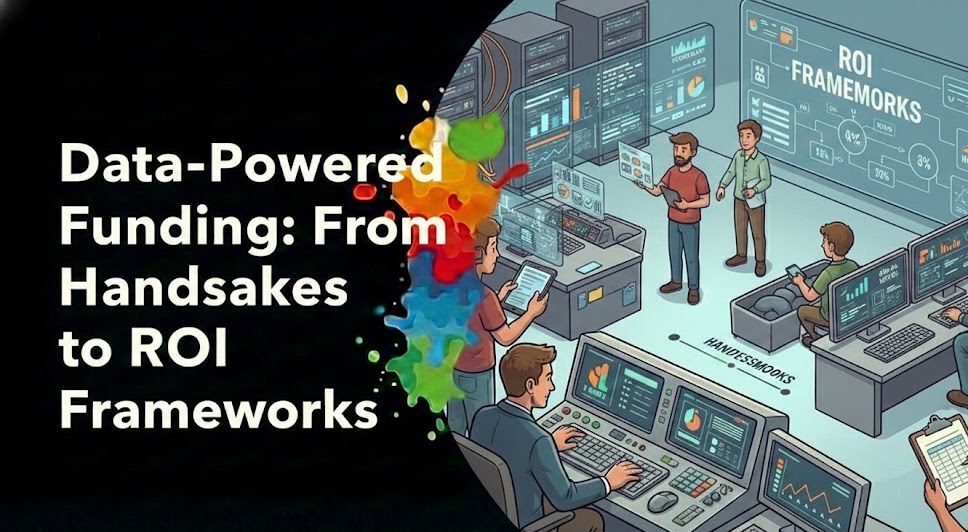
The data-powered funding era isn’t coming. It’s here—and if you’re still pitching investors on instinct and festival buzz, you’re losing deals to producers who’ve weaponized ROI frameworks into their financing decks. The shift is real. Capital in entertainment no longer flows on relationships alone. It flows to projects that can demonstrate return potential in measurable, structured terms before a single camera rolls.
This isn’t about making content less creative. It’s about making it more financeable. And the gap between those two ideas? That’s exactly where the smartest producers are now operating.
In this piece, we’ll walk you through how the handshake economy broke down, what the new ROI-driven capital stack actually looks like, and—critically—how real-time data intelligence is reshaping how deals get funded, structured, and closed. You’ll see exactly what investors like Joshua Harris at Peachtree Media Partners and Andrea Scarso at IPR VC now demand before they commit capital.
In This Article
Find Financing Partners Before They Fill Their Slate
140,000+ companies on Vitrina—including lenders, equity funds, and co-production partners. Ask VIQI which financing structures match your project’s budget and territory mix.
Ask VIQI About Financing Options
No credit card required · Instant intelligence · Trusted by Netflix, Warner Bros, and Paramount
Why the Handshake Economy Collapsed
For three decades, entertainment financing ran on Rolodex capital. You knew the right people at the right banks. You had dinner with the right family office. You were at Cannes when it mattered. That worked—until it didn’t.
Here’s the thing: the collapse wasn’t sudden. It was structural. Three forces eroded the handshake economy simultaneously, and producers who didn’t see it coming are still wondering why their slate isn’t getting financed.
Commercial Banks Retreated
The retreat of traditional banking from film lending left a vacuum that’s still not fully filled. Joshua Harris, President and Managing Partner of Peachtree Media Partners, described this bluntly in a recent Vitrina LeaderSpeak interview: “City National lost their strategic focus… that created an enormous gap in the marketplace.” City National had been the connective tissue of Hollywood film financing. When they pulled back, the personal relationships that had greased those deals for years suddenly didn’t matter anymore—because the capital itself had disappeared.
Private capital rushed to fill that gap. But private capital asks different questions. Relationship managers at commercial banks were happy to rely on reputation and track record. Private funds and family offices? They want the data.
The Streamer Pull-Back Changed Everything
The post-COVID “revenge production” boom created a false sense of security across the financing ecosystem. Capital was flowing freely between 2021 and 2022—streamers were commissioning at unprecedented rates, pre-sales were healthy, and gap lenders had more appetite than projects to fill. Phil Hunt, Founder and CEO of Head Gear Films—which has financed over 550 films in 25 years—called this out directly: “The whole industry has become much, much harder in terms of getting movies off the ground and getting movies sold.”
When streamers pulled back on licensing and began collapsing revenue windows, the math that had underpinned handshake deals no longer held. Territory values shifted. Pre-sale expectations compressed. Investors who’d been comfortable with relationship-based underwriting suddenly needed something more rigorous to justify their commitment.
The Data Deficit Became Visible
The third force is the one nobody talks about openly—but it’s the one driving the biggest structural shift. For years, information asymmetry favored established players. If you knew the market, you had an edge. But that edge is eroding fast. Institutional investors, private equity firms, and family offices entering entertainment are bringing analytical frameworks from other asset classes. They’re applying IRR modeling, comparable-project analysis, and portfolio risk assessments to content investment. And they’re doing it with better data than most producers have ever seen.
The question isn’t whether this shift is happening. It’s whether you’re ahead of it or behind it.
What ROI Frameworks Actually Look Like Now
ROI frameworks in entertainment financing aren’t just about projected box office anymore. That era is over. Today’s frameworks have to account for the full capital stack—debt, equity, soft money, and territory value—and model recoupment timelines across multiple revenue windows.
Let’s break down what sophisticated investors are actually looking at when they evaluate a project.
The Capital Stack as a Risk Map
Every capital stack tells a story—and smart investors read that story before they commit. At the senior position, you’ve got gap financing and completion bonds. Equity sits at the bottom. But it’s the shape of the stack that signals risk. A project with 30% gap financing against weak pre-sales is a very different risk profile than the same budget with 40% tax incentives stacked underneath gap debt.
Here’s what sophisticated equity investors now model against in their ROI frameworks:
| Capital Layer | Typical Range | ROI Impact |
|---|---|---|
| Tax Incentives / Soft Money | 20–50% of budget | De-risks floor; accelerates recoupment |
| Pre-Sales / Distribution MGs | 15–40% of budget | Collateral for gap debt; validates market |
| Gap Financing | 10–30% of budget | Bridges to greenlight; costs 8–15% annually |
| Equity Investment | 10–30% of budget | Highest risk; targets 120–150% return |
The recoupment waterfall matters as much as the stack itself. Equity investors—sitting last in the queue after distribution fees, senior debt, and gap financing are repaid—are now running IRR models that factor in 24-to-36-month recoupment timelines on best-case scenarios.
Recoupment Acceleration: The New Edge
What’s changed isn’t the structure of the waterfall—it’s the ability to compress the recoupment timeline. And that’s where data intelligence becomes a genuine financial advantage, not just an operational one. By stacking incentives intelligently—say, a 40% UK tax credit combined with a German pre-sale MG—you can move the equity recoupment window from 36 months to closer to 18 months. That’s not a marginal improvement. It’s a 200-to-300 basis point improvement in project IRR. That’s the difference between a deal that closes and one that doesn’t.
Stop Guessing Who’s Financing. Get Targeted Outreach.
Stop searching and start getting funded. We identify the exact decision-makers currently backing projects like yours, turning raw data into risk-aligned capital partnerships.
Major Studios
Scouting early stage projects, IP, and Regional partners for global studio pipelines.
IP Owners & Leads
Connecting creative leads with qualified financiers and major streaming platforms.
Streamers
Securing high-value pre-buy content and discovering early-stage global IP for platforms.
Indie Producers
Bridging the gap for indie filmmakers to reach executive production partners and capital.
Global Financing Ecosystems
Mapping complex markets and pairing projects with disciplined, risk-aligned capital across global territories worldwide.
Get 200 Free Credits to Build Your Financing Intelligence
Map co-production partners, lenders, and territory buyers in minutes—not months. Join 140,000+ film and TV companies already using Vitrina.
No credit card required · Cancel anytime
The Data Intelligence Advantage in Film Funding
Here’s the insider truth that most financing guides won’t tell you: the biggest margin leakage in entertainment production doesn’t happen in post. It doesn’t happen in distribution. It happens in the information gap—the space between what you know about the market and what’s actually happening in it.
The Fragmentation Paradox™ is Vitrina’s framework for understanding why this happens. The global entertainment supply chain has over 600,000 companies operating across production, financing, distribution, and services. But the average producer makes decisions based on relationships with fewer than 50 of them. That’s not just an opportunity cost. It’s a structural disadvantage baked into every deal you close.
What does that cost you concretely? Based on Vitrina’s analysis across thousands of production deals:
- 15–20% margin leakage from overpaying vendors without market benchmarks
- 3–6 month deal delays from manually verifying vendor capabilities through relationship networks
- Suboptimal financing structures from not knowing which lenders are actively deploying in your territory and genre
- Missed incentive stacking opportunities from not tracking policy changes in emerging production hubs
On a $10 million production, that 15–20% margin leakage translates to $600,000–$800,000 in recoverable value. And that’s before you factor in the timeline cost—because six months of delay on a financing structure isn’t just annoying. It’s gap interest accruing on capital you’re not yet deploying.
Real-Time Intelligence vs. Static Databases
The tools most producers use for market intelligence—IMDb, LinkedIn, six-month-old trade reports—are fundamentally backward-looking. They tell you what was true. But financing decisions depend on what’s true now: which lenders have appetite, which territories are hot, which co-production funds still have allocation, which partners have current capacity.
The Data Deficit/Insider Advantage framework captures this dynamic precisely. With static data, you’re operating with a 15–20% information disadvantage on every deal. With real-time intelligence—verified company capabilities, active deal tracking, current capacity status—that disadvantage flips into an advantage. Deals close 80–90% faster. You access 10–100x more qualified options. And you negotiate from a position of market knowledge, not relationship dependency.
Phil Hunt (Founder & CEO, Head Gear Films) on navigating today’s film financing crunch:
Head Gear Films has financed 550+ films over 25 years. Hunt explains why data-backed deal structures are now essential in a tightened market.
Building a Data-Backed Capital Stack
Let’s get specific. A data-backed capital stack isn’t just a stack with good numbers in it—it’s a stack where every layer has been validated against real market intelligence before you walk into a financing meeting.
Here’s what that validation looks like at each layer.
Layer 1: Incentive Intelligence
Don’t build a financing plan around tax incentives you haven’t verified in the past 90 days. Incentive regimes change. Saudi Arabia’s Vision 2030 allocation looks different in 2026 than it did in 2024. The UK’s enhanced tax credit structure has specific qualifying thresholds that many international productions miss because they’re working from outdated guidance. Sovereign Content Hubs™—MENA, APAC, and increasingly LATAM—are actively competing for production spend, but their incentive windows aren’t unlimited. Real-time tracking of active rebate programs and remaining allocation is the difference between a deal that closes in Q1 and one that misses the funding cycle entirely.
Layer 2: Pre-Sale Territory Validation
Pre-sales are only as strong as your market intelligence on territory values. And territory values shift—fast. A genre that was commanding 120% of MG from German buyers eighteen months ago might be at 80% today because of commissioning cycles at major broadcasters. Knowing the current market for your specific genre-budget combination in each target territory isn’t optional anymore. It’s the foundation of your financing plan.
But here’s where the data advantage becomes real: when you know the current appetite at, say, 23 MENA markets for thriller content in your budget range, you can sequence your pre-sale strategy to maximize the collateral value before you approach gap lenders. That sequencing—closing the highest-value territories first—directly improves your loan terms.
Layer 3: Equity Partner Intelligence
Equity capital in entertainment has professionalized dramatically over the past decade. Andrea Scarso, Managing Partner at IPR VC—a Helsinki-founded fund management company with 12 years in film/TV equity financing—puts it directly: “The challenge in the industry right now is not on deal flow. It’s on the quality of investing, it’s on how you structure the investment.”
“When you hit a successful IP, the upside can be greater than the overall risk you’re taking on a portfolio. But you need to set yourself up for best-case scenarios, working with the best companies—and that requires knowing who those companies are.
— Andrea Scarso, Managing Partner, IPR VC
IPR VC raises from institutional investors, family offices, and insurance companies—exactly the type of capital that demands rigorous ROI frameworks before committing. They take project-level equity positions with portfolio risk management, and they’re building toward a library of IP assets with long-tail revenue potential. Their typical investment timeline runs 12–24 months from commitment to first revenue—and they model the full recoupment cycle before they commit.
For producers, the implication is clear: if you want equity from funds like IPR VC, you need to speak their language. That means IRR projections, comparable IP performance data, portfolio fit analysis, and a demonstrated understanding of downside scenarios. Charm doesn’t close these deals anymore. Data does.
Connect With Verified Financing Partners in 48 Hours
Our Concierge team has mapped the exact lenders, equity funds, and co-production partners actively deploying capital in your territory and genre. Netflix UK found their co-production partner in 48 hours.
No commitment required · 140,000+ verified companies in our network
Inside Investor Decision-Making Today
What does it actually take to get a “yes” from a sophisticated entertainment financier right now? We’ve interviewed over 60 industry leaders through the Vitrina LeaderSpeak podcast series, and a clear pattern has emerged.
The Collateral Has to Be Real
For debt lenders, collateral validation has become the central question—and it’s more rigorous than ever. Joshua Harris at Peachtree Media Partners explains their model in terms that cut through the noise: “We’re not investing in film and TV. We lend in film and TV. We take a collateral position against the film IP.” Peachtree’s distinctive approach—advancing against future territory value before distribution agreements are executed—requires a precise understanding of what those territories are actually worth in today’s market.
That’s not a model built on relationships. It’s built on data. And when you approach a lender like Peachtree, they’re going to validate your territory valuations against current market intelligence. If your numbers don’t hold up, the deal doesn’t hold up.
Portfolio Fit Matters More Than You Think
Equity investors aren’t just evaluating your project in isolation. They’re evaluating how it fits into their portfolio’s risk profile. IPR VC, for example, is building a library of IP assets that collectively generates long-tail revenue. A single project doesn’t need to be a blockbuster—but it needs to fit a portfolio thesis where genre, budget, territory, and recoupment timing all work together.
What does this mean practically? You need to understand the equity investor’s portfolio logic before you pitch. Which territories does their current portfolio over-index on? Which genres are they underweight in? What’s their EBITDA protection threshold? The producers who answer these questions before they walk in—because they’ve done the intelligence work—are the ones who close.
Uncorrelated Returns Are the New Selling Point
Here’s an insight that’s reshaping how institutional capital thinks about entertainment: content performance is largely uncorrelated with macroeconomic cycles. Scarso notes that IPR VC has been able to demonstrate this to their limited partners—pension funds, insurance companies, family offices—showing that “the performances of some of these films are completely uncorrelated to what happens with the macroeconomics.” In a world of rising interest rates and equity market volatility, that uncorrelated return profile is genuinely attractive.
And Joshua Harris echoes this from the lending side: “We are living in the content creation heyday. These devices are never going away.” Insatiable consumer demand across streaming platforms, theatrical, and emerging formats means the underlying content business doesn’t disappear in a recession the way other asset classes do. That’s a powerful argument—but only if you can back it up with specific ROI data and comparable project performance.
The Vitrina ROI Intelligence Framework
Based on analysis across Vitrina’s network of 140,000+ film and TV companies and intelligence from over 60 industry leader interviews, we’ve developed the Vitrina ROI Intelligence Framework™—a four-layer approach to building financing pitches that close in today’s data-driven market.
Layer 1: Market Signal Validation
Before you structure any capital, validate your genre-territory-budget combination against current market signals. What are distributors actually paying for comparable projects in your target territories right now? What’s the gap between what you think your pre-sales are worth and what the market will actually pay? This isn’t pessimism—it’s risk management that makes your financing structure more credible, not less.
Layer 2: Incentive Stack Optimization
De-risk your production base before you approach equity. A project with 30–40% of budget covered by verified tax incentives—UK, Canada, Australia, Saudi Arabia, or emerging Sovereign Content Hubs™—fundamentally changes the risk conversation with every layer of your capital stack. Gap lenders see better collateral. Equity investors see a higher floor. And your own IRR looks more attractive because the incentive stack compresses recoupment timelines.
Layer 3: Partner Intelligence Mapping
Map your co-production and financing partners against verified intelligence—not anecdote. Which equity funds are currently deploying in your genre? Which lenders have active appetite for your territory mix? Which co-production partners have the track record, capacity, and treaty access that actually adds value to your package? Getting this right before your financing meetings means you’re walking in with an informed view of your options—not just the three names you know from the last festival circuit.
Layer 4: Recoupment Acceleration Planning
Model your recoupment timeline explicitly—and show investors how you’ll accelerate it. Through incentive stacking, presale sequencing, and gap financing structure, it’s realistic to compress a 36-month recoupment window to 18 months. Every month you compress translates directly to improved IRR for your equity investors. That’s not abstract—it’s a basis point conversation that sophisticated capital will respond to.
Find the Financiers Backing Your Genre
Stop searching and start getting funded. We identify the exact decision-makers currently backing projects like yours, turning raw data into risk-aligned capital partnerships.
Frequently Asked Questions
Key Takeaways: From Handshakes to ROI Frameworks
The shift from relationship-based to data-powered funding isn’t a trend to watch. It’s the market you’re operating in right now. The producers who close deals in 2025 and 2026 will be those who’ve weaponized intelligence into every layer of their financing structure—not those still relying on who they know from the last Cannes dinner.
- The handshake economy is structurally over. Commercial bank retreat, streamer pullback, and institutional capital entry have collectively rewritten the rules of entertainment financing.
- ROI frameworks are now table stakes. Equity investors like IPR VC and debt lenders like Peachtree Media Partners both require rigorous collateral validation, IRR modeling, and recoupment timeline analysis before committing capital.
- The Fragmentation Paradox costs real money. On a $10M production, the information gap between what you know and what’s available in the market translates to $600,000–$800,000 in recoverable margin. That’s not theoretical—it’s your EBITDA.
- Recoupment acceleration is the new competitive edge. Compressing a 36-month recoupment window to 18 months through incentive stacking and presale sequencing improves IRR by 200–300 basis points—a difference that changes which deals get funded.
- Sovereign Content Hubs™ are creating new financing opportunities. MENA, APAC, and LATAM incentive structures—properly validated and stacked—can de-risk the production base before you approach any equity investor.
Start Building Your Data-Powered Financing Strategy
Access 140,000+ verified companies—lenders, equity funds, co-production partners, and territory buyers. Get 200 free credits to start mapping your capital stack today.
No credit card required · Trusted by Netflix, Warner Bros, Paramount, and Google TV
Find Film+TV Projects, Partners, and Deals – Fast.
VIQI matches you with the right financiers, producers, streamers, and buyers – globally.
Producers Seeking Financing & Partnerships?
Book Your Free Concierge Outreach Consultation
(To know more about Vitrina Concierge Outreach Solutions click here)
Producers Seeking Financing, Co-Pros, or Pre-Buys?
Vitrina Concierge helps producers reach the right financiers, commissioners, distributors, and co-production partners — with precision outreach, not cold pitching.
Join Industry Briefings Trusted by Leaders

Film & TV Financing: Pre-Buys
Learn how pre-buys work in current Film and TV financing, how they differ from pre-sales, and how they are used to close real finance plans.

Streamers – Netflix vs. Amazon – The 2026 Strategy
How Netflix and Amazon’s content and revenue strategies are diverging ahead of 2026.

Format Adaptations: Global Trends
Where formats are traveling, which adaptations are breaking out, and how streamers are backing remakes in 2025–2026.