

 About Innovation Hub
 Global Content Pulse (Webinars)


 Global Production Financing
(Webinars)
Global Production Financing
(Webinars)  LeaderSpeak Podcast
  About Vitrina
 Our Story
 Our Solutions 🔥
 Film+TV Projects Tracker 🚀
 Case Studies
 Our Profile
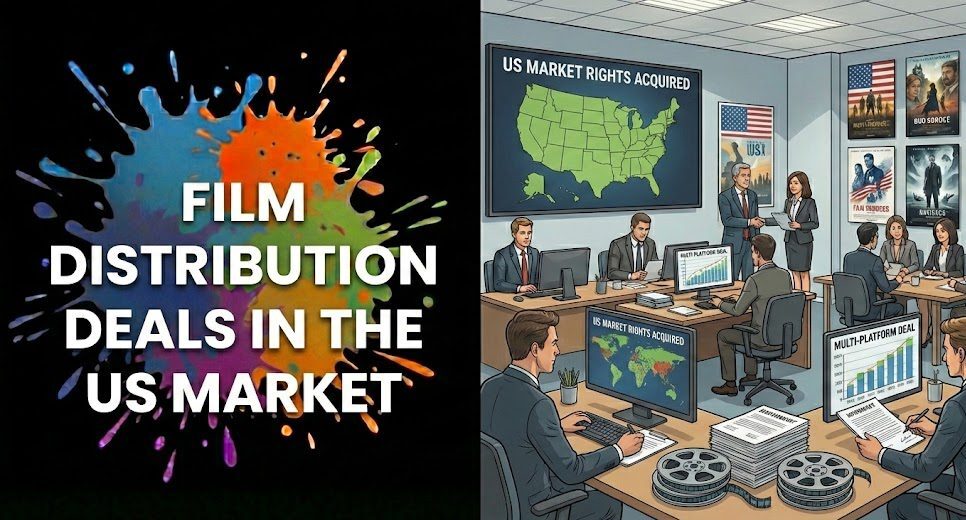
Costs associated with film distribution deals in the US market are the aggregate of distribution fees, Print and Advertising (P&A) expenses, technical delivery costs, and legal overheads required to bring a film to audiences.
This involves managing gross vs. net deal structures where distributors typically take 15% to 35% commission alongside deductible marketing expenses.
According to industry data, unrecovered P&A costs remain the leading cause of “negative equity” for independent projects in the US theatrical landscape.
In this guide, you’ll learn to identify hidden fees, optimize delivery workflows, and leverage supply chain intelligence to protect your project’s profitability.
While many resources provide high-level overviews of distribution, they often gloss over the granular technical deliverables and legal line items that can erode a producer’s share of the revenue.
This comprehensive guide fills those gaps by uncovering the hidden financial traps in modern distribution agreements and providing a data-driven framework for US market entry.

Your AI Assistant, Agent, and Analyst for the Business of Entertainment
VIQI AI helps you plan content acquisitions, raise production financing, and find and connect with the right partners worldwide.
- Find active co-producers and financiers for scripted projects
- Find equity and gap financing companies in North America
- Find top film financiers in Europe
- Find production houses that can co-produce or finance unscripted series
- I am looking for production partners for a YA drama set in Brazil
- I am looking for producers with proven track record in mid-budget features
- I am looking for Turkish distributors with successful international sales
- I am looking for OTT platforms actively acquiring finished series for the LATAM region
- I am seeking localization companies offer subtitling services in multiple Asian languages
- I am seeking partners in animation production for children's content
- I am seeking USA based post-production companies with sound facilities
- I am seeking VFX partners to composite background images and AI generated content
- Show me recent drama projects available for pre-buy
- Show me Japanese Anime Distributors
- Show me true-crime buyers from Asia
- Show me documentary pre-buyers
- List the top commissioners at the BBC
- List the post-production and VFX decision-makers at Netflix
- List the development leaders at Sony Pictures
- List the scripted programming heads at HBO
- Who is backing animation projects in Europe right now
- Who is Netflix’s top production partners for Sports Docs
- Who is Commissioning factual content in the NORDICS
- Who is acquiring unscripted formats for the North American market
Table of Contents
Key Takeaways for Producers
-
Audit Technical Deliverables: Hidden technical costs like QC reports and DCP creation can exceed $20,000 if not budgeted during post-production.
-
Cap Marketing Spend: Always negotiate a hard cap on P&A expenses to prevent distributors from spending your entire revenue share on unverified marketing.
-
Digital Efficiency: Prioritize digital-first distribution for niche projects to avoid the high overhead of theatrical DCP and shipping costs.
What are Distribution Costs in the US Market?
Film distribution costs represent the operational “toll” paid to move a film through the supply chain. In the US market, these costs are divided into distribution fees (the distributor’s profit) and distribution expenses (the actual costs incurred).
Distributors typically charge a fee of 15-35% of gross receipts, but the real complexity lies in the “deductibles.” These include everything from trailers and posters to digital storage and shipping fees.
Find transparent distribution partners for your project:
Theatrical vs. Digital: The Cost Breakdown
Theatrical distribution in the US remains the most expensive route for independent creators. Beyond the 50/50 box office split with exhibitors, you face significant costs for DCP (Digital Cinema Package) creation, virtual print fees (VPF), and localized marketing.
Digital distribution, including TVOD and SVOD, offers lower overhead but introduces “aggregator fees.” Platforms like Apple TV or Amazon typically require delivery via an approved aggregator, who may charge $1,500 – $5,000 per platform for technical onboarding.
Industry Expert Perspective: The Big Crunch: Phil Hunt on Film Finance
This video explores the current “Big Crunch” in film financing and distribution, highlighting why traditional revenue windows are collapsing and the impact on independent budgets.
Phil Hunt discusses the shift away from pre-sales and the necessity of lean production in an era where traditional distribution windows have tightened, requiring more strategic financial management from the outset.
The Hidden Costs: Legal and Technical Deliverables
Filmmakers often underestimate the “Deliverables” list. This isn’t just a hard drive; it’s a 30-page document including E&O (Errors and Omissions) insurance, chain of title reports, and detailed QC (Quality Control) reports.
- E&O Insurance: Can cost between $3,000 and $7,000 for a 3-year term.
- Technical QC: A professional lab report verifying sound and picture can cost $1,500 per pass.
- Chain of Title: Legal review of all scripts and music clearances is essential to secure any US deal.
How to Negotiate Favorable Distribution Terms
Successful negotiation hinges on understanding the “Recoupment Waterfall.” Producers should fight for “First Dollar Gross” if possible, but more realistically, you must cap the distributor’s marketing expenses.
Using supply chain intelligence, you can benchmark what other similar titles in your genre paid for P&A. This data prevents distributors from loading the project with “internal overhead” charges that act as hidden fees.
“The most expensive mistake an indie producer makes is assuming the distributor will handle the ‘boring’ technical costs. If you haven’t budgeted for delivery, you haven’t finished your film.”
Leveraging Data to Lower Distribution Friction
Vitrina AI transforms distribution from a manual, high-risk art into a data-driven science. By tracking 1.6 million titles and 140,000+ companies, producers can see exactly which distributors are active in their genre and what their historical deal-making patterns look like.
Tools like the VIQI AI Assistant allow you to query “Who is commissioning indie documentaries in the US?” or “List distributors with low P&A overhead,” providing the insider advantage once reserved for top-tier agents.
Moving Forward
The US film distribution landscape has shifted from relationship-dependent networking to data-driven platform targeting. By identifying the real costs associated with film distribution deals early, producers can protect their equity and ensure their project actually generates a return.
Whether you are an independent producer looking to secure a US theatrical release, or a sales agent trying to optimize digital licensing, understanding the granularity of fees is the difference between a “vanity release” and a profitable one.
Outlook: Over the next 18 months, the rise of FAST channels and niche SVOD will lower the technical entry barrier, but high-quality US theatrical distribution will remain a premium cost center requiring advanced negotiation.
Frequently Asked Questions
Quick answers to the most common queries about US film distribution costs.
What is a standard distribution fee in the US?
What are P&A expenses?
Are legal fees part of distribution costs?
How much does a DCP cost?
What is a marketing cap?
Do distributors pay for delivery?
What is E&O insurance?
What is the benefit of an aggregator?
About Vitrina Intelligence
Vitrina AI is the world’s leading supply chain intelligence platform, tracking over 1.6M titles and 140K+ companies to help entertainment professionals find the right partners. Connect with us on Vitrina.
Find Film+TV Projects, Partners, and Deals – Fast.
VIQI matches you with the right financiers, producers, streamers, and buyers – globally.
Producers Seeking Financing & Partnerships?
Book Your Free Concierge Outreach Consultation
(To know more about Vitrina Concierge Outreach Solutions click here)
Producers Seeking Financing, Co-Pros, or Pre-Buys?
Vitrina Concierge helps producers reach the right financiers, commissioners, distributors, and co-production partners — with precision outreach, not cold pitching.
Join Industry Briefings Trusted by Leaders

Deep dive into Co-Pros
Ambitious co-productions are key to global hits, but most deals collapse. This deep-dive briefing is the strategic playbook. We’ll break down the financing models, partnership structures, and market insights behind today’s successful deals.
Film & TV Financing: Tax Credits & Incentives
A focused look at how 2025 tax credits and incentives are reshaping Film & TV financing decisions — and where the real value now sits.

Film & TV Financing: Pre-Buys
Learn how pre-buys work in current Film and TV financing, how they differ from pre-sales, and how they are used to close real finance plans.
Streamers – Netflix vs. Amazon – The 2026 Strategy
How Netflix and Amazon’s content and revenue strategies are diverging ahead of 2026.