About Innovation Hub
 Global Content Pulse (Webinars)


 Global Production Financing
(Webinars)
Global Production Financing
(Webinars)  LeaderSpeak Podcast
  About Vitrina
 Our Story
 Our Solutions 🔥
 Film+TV Projects Tracker 🚀
 Case Studies
 Our Profile
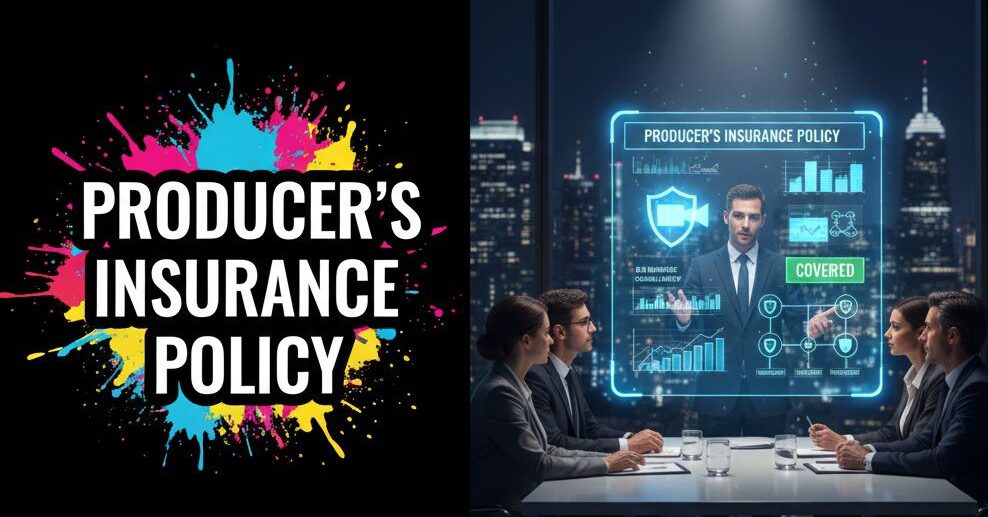
A completion bond is a specialized financial guarantee issued by a third-party bonding company that ensures a film will be completed and delivered on schedule and within budget.
For the producer, it is an essential insurance policy that protects the production from catastrophic cost overruns. For the bank, it is a non-negotiable “backstop” that guarantees their collateral—the finished film—will actually exist.
In today’s volatile production landscape, where Vitrina AI tracks over 1.6 million titles and a rapidly shifting network of 600,000 companies, the role of the completion bond has evolved from a simple legal requirement to a critical tool for financial sustainability.
This guide breaks down the tripartite relationship between the bond company, the bank, and the producer, providing the technical depth required to navigate the bonding process in 2025.
While creative vision drives the project, the bond ensures the project survives the physical realities of the production supply chain.
Discover how to leverage supply chain intelligence to satisfy bond company due diligence and secure your production’s financial future.
Table of Contents

Your AI Assistant, Agent, and Analyst for the Business of Entertainment
VIQI AI helps you plan content acquisitions, raise production financing, and find and connect with the right partners worldwide.
- Find active co-producers and financiers for scripted projects
- Find equity and gap financing companies in North America
- Find top film financiers in Europe
- Find production houses that can co-produce or finance unscripted series
- I am looking for production partners for a YA drama set in Brazil
- I am looking for producers with proven track record in mid-budget features
- I am looking for Turkish distributors with successful international sales
- I am looking for OTT platforms actively acquiring finished series for the LATAM region
- I am seeking localization companies offer subtitling services in multiple Asian languages
- I am seeking partners in animation production for children's content
- I am seeking USA based post-production companies with sound facilities
- I am seeking VFX partners to composite background images and AI generated content
- Show me recent drama projects available for pre-buy
- Show me Japanese Anime Distributors
- Show me true-crime buyers from Asia
- Show me documentary pre-buyers
- List the top commissioners at the BBC
- List the post-production and VFX decision-makers at Netflix
- List the development leaders at Sony Pictures
- List the scripted programming heads at HBO
- Who is backing animation projects in Europe right now
- Who is Netflix’s top production partners for Sports Docs
- Who is Commissioning factual content in the NORDICS
- Who is acquiring unscripted formats for the North American market
Key Takeaways for Producers
-
Tripartite Security: The bond protects the producer from overruns, the bank from delivery failure, and the distributor from missing their release window.
-
Financial Requirement: Most banks will not close a production loan without a perfected completion guarantee in place.
-
Risk Thresholds: A standard 10% contingency is usually required by the bond company to buffer against unforeseen production variables.
-
Supply Chain Trust: Using Vitrina to qualify production service partners can significantly reduce the bond company’s perceived risk and speed up the approval process.
What Exactly is a Completion Bond?
A completion bond is a contractual agreement that guarantees a motion picture will be finished and delivered to the distributor in accordance with the screenplay and the production schedule. If the production runs out of money, the bond company is legally obligated to either fund the completion of the project or, in extreme cases, repay the financiers their principal investment. It serves as the ultimate safety net, ensuring that the millions of dollars invested in the production are not lost due to mismanagement, technical failure, or acts of God.
Find verified completion bond companies and film insurers:
The Bank’s Perspective: Mitigating “Performance Risk”
Banks do not lend based on the creative merit of a script; they lend based on the probability of being repaid. While a tax credit or a distribution pre-sale serves as the collateral for the loan, that collateral is worthless if the film is never completed. This is known as Performance Risk. The completion bond transfers this risk from the bank to the bond company. Because the bond company has “deep pockets” and is often re-insured by massive global carriers, the bank can confidently release funds knowing that their exit strategy is protected.
Industry Expert Perspective: Financial Sustainability in Independent Film
Kirsty Bell, founder and CEO of Goldfinch, discusses the importance of disciplined business models in independent filmmaking. She explores how bridging the gap between art and enterprise requires rigorous financial planning and diverse revenue streams—a process that begins with securing the production’s foundation through proper bonding and insurance.
Kirsty Bell shares her journey from the financial world to independent film, emphasizing that creative success is only possible when built on a foundation of “disciplined art.” Her insights into bridging art and enterprise highlight why technical safeguards like completion bonds are non-negotiable for serious producers.
The Mechanics: Strike Price, Contingency, and Takeover Rights
The bond document is a complex legal instrument with several key technical components. The Strike Price is the total amount the bond company agrees to guarantee, which includes the production budget plus a mandatory Contingency (usually 10%). If the production exceeds this strike price, the bond company steps in to pay the difference. Crucially, the bond agreement grants the bonding company Takeover Rights—if the producer is significantly behind schedule or over budget, the bond company can legally fire the producer and take control of the set to finish the project themselves.
Analyze production volume and risk trends by region:
Satisfying the Bond Company: Vetting the Supply Chain
Bond companies are professional risk-assessors. Before issuing a guarantee, they will conduct exhaustive due diligence on the production’s “supply chain”—from the line producer’s track record to the reliability of the VFX house. In an industry with over 5 million professionals, this vetting process is often slow and manual. This is where Vitrina AI provides an unfair advantage. By leveraging Reputation Scores and verified deal history for 140,000+ companies, producers can present a “pre-qualified” package to the bond company, drastically reducing friction and accelerating the path to the first day of principal photography.
“The completion bond is the ultimate proof of a producer’s operational discipline. If you can’t get bonded, you can’t get bank-financed. In a data-driven supply chain, your ability to prove your partners’ reliability is your most valuable currency.”
Vet your production service partners with verifiable data:
Frequently Asked Questions
Technical answers to common questions about film completion guarantees.
What is the typical cost of a completion bond?
Can I film without a completion bond?
What does a “takeover” actually look like?
Does the bond cover creative changes?
Is COVID-19 still covered by completion bonds?
What is a “re-insurance” clause?
How do I qualify for a bond?
What happens if the film is finished but the distributor doesn’t like it?
Moving Forward
The complexity of modern global co-productions requires a new level of financial transparency. While the completion bond remains the “gold standard” for production security, the speed at which you can secure it now depends on your access to structured data. By moving away from opaque personal networks and toward the data-powered supply chain intelligence of Vitrina AI, you can satisfy even the most rigorous bond company requirements and unlock the bank financing your creative vision deserves.
Secure your partners. Perfect your budget. Backstop your production with the power of data.
Outlook: As AI-enhanced production tools reduce technical risk, expect bond companies to offer more dynamic, data-responsive pricing models for the elite tier of “pre-qualified” productions.
About the Author
Written by the Vitrina Finance and Supply Chain Analysis Team. We provide the structural intelligence needed to navigate the $250B global entertainment market, helping producers and financiers build more resilient, data-driven projects. Learn more at Vitrina AI.
Find Film+TV Projects, Partners, and Deals – Fast.
VIQI matches you with the right financiers, producers, streamers, and buyers – globally.
Producers Seeking Financing, Co-Pros, or Pre-Buys?
Vitrina Concierge helps producers reach the right financiers, commissioners, distributors, and co-production partners — with precision outreach, not cold pitching.
Join Industry Briefings Trusted by Leaders

Format Adaptations: Global Trends
Where formats are traveling, which adaptations are breaking out, and how streamers are backing remakes in 2025–2026.

Books, Novels & Comics Adaptations: Global Trends
Books, webtoons, and manga driving the next global screen hits. Discover how in this webinar.

Micro-Dramas & Mobile-First Storytelling
Micro-dramas are building real audiences and revenue. Understand the platforms, buyers, and economics behind the growth.

Navigating Global Content Licensing Trends
How global content licensing is shifting beyond flat fees to flexible, deal-driven models.