

 About Innovation Hub
 Global Content Pulse (Webinars)


 Global Production Financing
(Webinars)
Global Production Financing
(Webinars)  LeaderSpeak Podcast
  About Vitrina
 Our Story
 Our Solutions 🔥
 Film+TV Projects Tracker 🚀
 Case Studies
 Our Profile
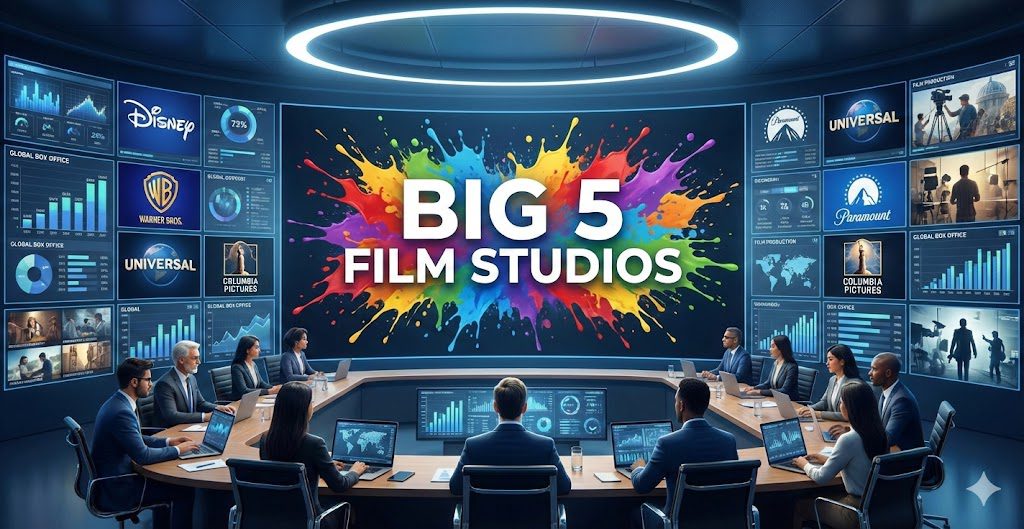
The Big 5 film studios—Universal Pictures, Paramount Pictures, Warner Bros., Walt Disney Studios, and Sony Pictures—represent the dominant tier of the global entertainment supply chain.
These entities control the vast majority of global theatrical box office and premium streaming IP, operating through complex vertical integration models.
According to recent industry data, major studio consolidation has accelerated, highlighted by the landmark $72 billion acquisition of Warner Bros. studio assets by Netflix in late 2025.
In this guide, you will learn how these titans are adapting their operational models, leveraging “Weaponized Distribution,” and utilizing supply chain intelligence to maintain market dominance in a fragmented digital landscape.
While legacy overviews of the Big Five focus on historical filmographies, they often overlook the technical shifts in M&A and the rise of “authorized AI” that are currently redefining studio workflows. Strategy teams now require more than just lists; they need a data-driven blueprint of the industry’s structural metamorphosis.
This comprehensive analysis fills those critical information gaps, providing actionable insights into the future of studio distribution, production hubs, and competitive intelligence.

Your AI Assistant, Agent, and Analyst for the Business of Entertainment
VIQI AI helps you plan content acquisitions, raise production financing, and find and connect with the right partners worldwide.
- Find active co-producers and financiers for scripted projects
- Find equity and gap financing companies in North America
- Find top film financiers in Europe
- Find production houses that can co-produce or finance unscripted series
- I am looking for production partners for a YA drama set in Brazil
- I am looking for producers with proven track record in mid-budget features
- I am looking for Turkish distributors with successful international sales
- I am looking for OTT platforms actively acquiring finished series for the LATAM region
- I am seeking localization companies offer subtitling services in multiple Asian languages
- I am seeking partners in animation production for children's content
- I am seeking USA based post-production companies with sound facilities
- I am seeking VFX partners to composite background images and AI generated content
- Show me recent drama projects available for pre-buy
- Show me Japanese Anime Distributors
- Show me true-crime buyers from Asia
- Show me documentary pre-buyers
- List the top commissioners at the BBC
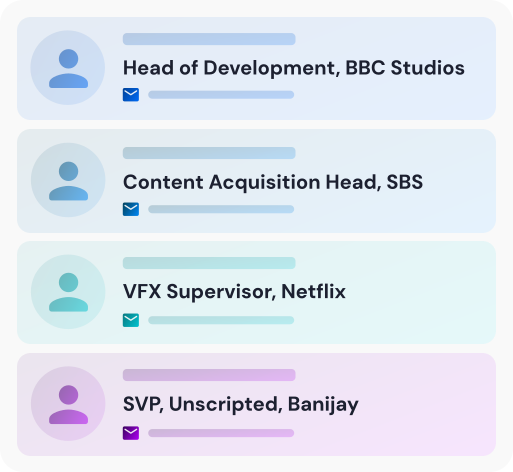
- List the post-production and VFX decision-makers at Netflix
- List the development leaders at Sony Pictures
- List the scripted programming heads at HBO
- Who is backing animation projects in Europe right now
- Who is Netflix’s top production partners for Sports Docs
- Who is Commissioning factual content in the NORDICS
- Who is acquiring unscripted formats for the North American market
Table of Contents
- 01
What Defines the Big 5 Film Studios in Today’s Market? - 02
How Are Operational Models Shifting in the Streaming Era? - 03
Why Are Mergers and Acquisitions Reshaping Studio Slates? - 04
What is Weaponized Distribution and How Does it Drive ROI? - 05
How is Authorized Generative AI Transforming Studio Workflows? - 06
Why Do Strategy Teams Need Real-Time Project Tracking? - 07
The 5 Biggest Challenges for Major Studios in 2025 - 08
How Are Studios Establishing New Global Production Hubs? - 09
Key Takeaways - 10
FAQ
Key Takeaways for Strategy & Acquisition Leads
-
Weaponized Distribution: Major studios are abandoning “walled gardens” to license premium content to rivals, prioritizing ROI over platform exclusivity.
-
Consolidation Trends: The Netflix-WBD deal signals a new era of “hyper-scale” where iconic IP like Harry Potter is consolidated under unified streaming umbrellas.
-
Authorized AI Markets: Studios are shifting from litigation to licensing, establishing $1 billion+ deals for “Authorized Data” to train generative AI models.
-
Supply Chain Intelligence: Tracking unreleased projects across 100+ countries is now critical for identifying early-stage co-production and financing opportunities.
What Defines the Big 5 Film Studios in Today’s Market?
The “Big 5” refers to the five major Hollywood film studios that dominate the global entertainment industry: Universal Pictures (Comcast), Paramount Pictures (Paramount Global), Warner Bros. (WBD), Walt Disney Studios (Disney), and Sony Pictures. These studios are distinguished not just by their historical libraries but by their massive infrastructure, encompassing production, marketing, and global distribution networks.
In the modern landscape, the definition of a “major” has expanded to include their associated streaming platforms, such as Disney+, Max, and Peacock. This vertical integration allows them to control the entire lifecycle of a content asset, from the initial script to the final digital stream. Unlike independent studios, the Big Five have the capital to produce multiple “tentpole” blockbusters annually, each often exceeding budgets of $200 million.
Analyze competitor content acquisition strategies:
How Are Operational Models Shifting in the Streaming Era?
Operational models at the Big 5 are shifting from a “volume-first” approach to “efficiency-first.” For years, the industry was locked in a “Streaming War” where studios prioritized subscriber growth over profit, spending billions on exclusive content. Today, that model is dead, replaced by a focus on maximizing Average Revenue Per User (ARPU) and market efficiency.
One critical shift is the transition from “Walled Gardens” to “Co-opetition.” A prime example is the recent “Frenemy Pact” between Amazon and Netflix, where Amazon MGM Studios began licensing James Bond films to its direct rival. This strategy prioritizes immediate licensing revenue and audience reach over rigid platform exclusivity, acknowledging that a hit title’s value is maximized when it is accessible across multiple ecosystems.
Why Are Mergers and Acquisitions Reshaping Studio Slates?
M&A activity is no longer just about buying libraries; it is about acquiring infrastructure and “weaponizing” distribution. The announced $72 billion acquisition of Warner Bros. by Netflix represents the pinnacle of this trend. By integrating a “Big 5” studio’s production capacity with a tech-native streaming platform, the entity achieves unprecedented scale and cross-platform monetization capabilities.
This consolidation forces remaining studios to rethink their competitive moats. When a tech giant acquires a major studio, they gain access to decades of premium IP (like Harry Potter or DC Comics) and a global production pipeline. For strategy teams, this means the “Big Five” list is constantly in flux, requiring real-time monitoring of deals intelligence to identify new power centers and potential licensing partners before the market stabilizes.
Track global content funding and acquisition trends:
Industry Expert Perspective: Radial Entertainment: Forging a Content Distribution Giant
As major studios consolidate, distribution strategies are evolving toward hybrid models. This video explores how mergers in the distribution space are creating new giants that combine legacy libraries with digital-first efficiency.
Garson Foos, CEO of Radial Entertainment, discusses the merger of Shout! Studios and FilmRise. He highlights how the combination of diverse content libraries and advanced distribution technology creates a powerhouse capable of serving the best of both worlds in film and TV distribution.
What is Weaponized Distribution and How Does it Drive ROI?
“Weaponized Distribution” is the emerging strategy of licensing high-value, first-run content to rival platforms 18 to 24 months post-release. This shift prioritizes immediate Return on Investment (ROI) over the long-term strategic benefit of keeping content exclusive. By licensing a “sunk” asset—content already produced and paid for—studios generate massive secondary revenue streams without additional production costs.
This “rotational window” strategy has become a standard for major studios looking to recoup costs on expensive franchises. It allows a film to thrive on its primary platform (e.g., Disney+) before being licensed to a third party (e.g., Netflix) to capture a wider audience. For acquisition leads, this creates a dynamic market where high-quality studio IP is becoming more accessible, albeit through specific, strategically timed windows.
How is Authorized Generative AI Transforming Studio Workflows?
The integration of generative AI into the Big 5 studios has transitioned from theoretical to a core business strategy. Rather than fighting AI, studios like Disney are establishing “Authorized Data” markets. Disney’s $1 billion investment in OpenAI represents a landmark deal where iconic characters and environments from Marvel and Pixar are licensed for AI training in a controlled, brand-safe environment.
This allows fans and creators to use tools like OpenAI’s Sora to generate short-form content using official studio assets while ensuring legal protections for talent likenesses. Simultaneously, studios are using AI-powered video analysis to identify emotional patterns and audience responses, unlocking new possibilities in content recommendations and metadata enrichment. This dual-front AI strategy—licensing and internal deployment—is becoming the technical foundation for the next decade of studio production.
Explore the impact of AI on the entertainment supply chain:
Why Do Strategy Teams Need Real-Time Project Tracking?
In an industry as complex as film and TV, relying on trade reports or social media noise is no longer sufficient. Strategy teams at major studios and their partners face a “data deficit” that leaves them vulnerable to missed opportunities. With over 600,000 companies and 5 million professionals worldwide, the modern supply chain requires structured, verifiable intelligence to navigate successfully.
Platforms like Vitrina AI solve this by providing a “single source of truth” for the M&E ecosystem. By tracking over 1.6 million titles and 140,000+ companies, Vitrina links projects to financing, key producers, and attached vendors. This interconnectivity reveals “early-warning signals” for new projects as they enter the development pipeline, transforming partner discovery from a manual art into a data-driven science.
The 5 Biggest Challenges for Major Studios in 2025
- 1. Content Saturation: Finding original IP that resonates in a borderless market is increasingly difficult, leading to a heavy reliance on sequels and spin-offs.
- 2. Fragmented Audience Data: Without a centralized view of viewing habits across both theatrical and streaming, studios struggle to personalize content offerings effectively.
- 3. Rising Production Costs: High-end episodic content and VFX-heavy blockbusters are pushing budgets to unsustainable levels, requiring new co-production models.
- 4. Intellectual Property Theft in AI: Litigation against unauthorized AI training—such as Disney’s cease-and-desist against Google—remains a major legal hurdle.
- 5. Talent Likeness Protection: Ensuring the ethical use of digital doubles and voice models in an AI-powered production era is a critical compliance risk.
How Are Studios Establishing New Global Production Hubs?
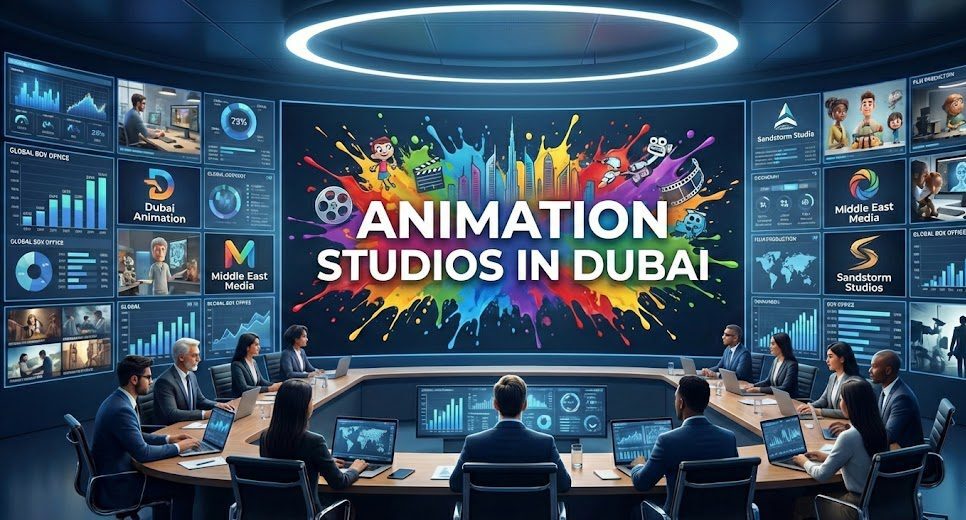
As production costs skyrocket in traditional centers like Los Angeles, major studios are leveraging supply chain intelligence to establish new production hubs. Warner Bros. Discovery Animation Group, for instance, used market intelligence to identify and strategize the opening of new animation centers beyond Hollywood, tapping into regional talent pools in the Middle East and Southeast Asia.
These decisions are driven by tax incentives, lower operational costs, and the desire to create local-language content that can be exported globally. By mapping the entire vendor ecosystem—from VFX houses in Brazil to post-production powerhouses in Mexico—studios can optimize their supply chains to deliver high-quality content at a fraction of domestic costs. This “hub-and-spoke” model is the future of global studio production.
Find active production hubs and service partners worldwide:
“The Big 5 are no longer just content creators; they are supply chain architects. The transition from walled gardens to weaponized distribution signals a market that values ROI over exclusivity, driven by the structural metamorphosis of the streaming landscape.”
Moving Forward
The independent film and major studio landscapes have converged into a data-driven ecosystem where deal velocity is dictated by supply chain intelligence. This transformation addresses the critical gaps explored in this guide: the need for technical operational models, M&A impact analysis, and real-world hub strategies.
Whether you are a Strategy Officer looking to identify acquisition targets, or an Acquisition Lead trying to secure premium studio IP through emerging distribution windows, actionable intelligence is your most valuable asset.
Outlook: Over the next 12 to 18 months, the “Weaponized Distribution” model will become the default as platforms prioritize ROI to survive further market consolidation.
Frequently Asked Questions
Quick answers to common queries about the Big 5 film studios and the evolving media supply chain.
Who are the Big 5 film studios today?
Is MGM part of the Big 5?
How does Netflix compete with the Big 5?
What is weaponized distribution?
How do studios use AI?
Why is project tracking important?
About the Author
Written by Vitrina’s Editorial Team, specializing in entertainment supply chain intelligence and market transformation. Our analysts track 1.6 million titles and 140,000+ companies to provide real-time strategic insights for industry leaders. Connect on Vitrina.
Find Film+TV Projects, Partners, and Deals – Fast.
VIQI matches you with the right financiers, producers, streamers, and buyers – globally.
Producers Seeking Financing & Partnerships?
Book Your Free Concierge Outreach Consultation
(To know more about Vitrina Concierge Outreach Solutions click here)
Not a Vitrina Member? Apply Now!
Vitrina tracks global Film & TV projects, partners, and deals—used to find vendors, financiers, commissioners, licensors, and licensees
Join Industry Briefings Trusted by Leaders

White Space Opportunities in Animation
Deep dive into animation market gaps, studios, and commissioners. Use real-world animation case studies to capitalize on emerging business trends.

Deep dive into Co-Pros
Ambitious co-productions are key to global hits, but most deals collapse. This deep-dive briefing is the strategic playbook. We’ll break down the financing models, partnership structures, and market insights behind today’s successful deals.

Film & TV Financing: Tax Credits & Incentives
A focused look at how 2025 tax credits and incentives are reshaping Film & TV financing decisions — and where the real value now sits.

Film & TV Financing: Pre-Buys
Learn how pre-buys work in current Film and TV financing, how they differ from pre-sales, and how they are used to close real finance plans.
Vitrina tracks global Film & TV projects, partners, and deals—used to find vendors, financiers, commissioners, licensors, and licensees
Not a Vitrina Member? Apply Now!