IHUB
IHUB
 Private Briefings (Webinars)


 LeaderSpeak Podcast
  Global Entertainment Digest (Newsletter)
  Premium Lists
 Premium Reports
 Membership Benefits
 About Vitrina
 Our Story
The 10 most commercially valuable non-scripted TV format types in 2026 are: reality competition, social experiment, docusoap, true crime documentary, lifestyle/aspirational, factual entertainment, talent competition, dating/relationship, modern game show, and celebrity-led travelogue. Top formats are evaluated on four criteria: Global Appeal, Production Scalability, IP Extensibility, and Partnership Potential. Format royalties typically run 3–8% of local production budgets per episode (industry-standard range; no single verified current global market-size figure is publicly available for non-scripted format licensing).
For any executive in the Media & Entertainment space, the unscripted content market represents a field of immense opportunity — yet it is saturated with risk. The sheer volume of formats makes it incredibly difficult to distinguish fleeting trends from genuinely viable, long-term intellectual property. Backing the wrong concept doesn’t just mean a failed pilot; it represents significant wasted development funds, reputational risk, and a missed window for capturing audience attention in a fiercely competitive landscape.
The top 10 format types account for the vast majority of non-scripted format licensing activity globally — and understanding what makes each commercially viable is the difference between strategic acquisition and expensive guesswork. This guide provides an analytical framework for evaluating non-scripted formats by commercial potential, not just audience popularity.
By the end of this analysis, you will have a clear, data-driven methodology for evaluating and pursuing non-scripted formats that offer the greatest strategic value — and the intelligence framework for identifying which buyers are actively acquiring in each category right now.
Table of Contents
- Why Non-Scripted Formats Are a Strategic Imperative
- The Evaluation Framework for Commercial Format Viability
- The Top 10 Non-Scripted TV Format Types
- How to Discover and Partner on Emerging Formats
- Finding Active Buyers: The Intelligence Layer
- Format Rights Protection: Why Formats Aren’t Copyrighted
- FAQ
- Conclusion
Track Active Non-Scripted Format Buyers Across 159,223 Companies
Vitrina surfaces real-time commissioning signals from Netflix, BBC, ITV, and every major format buyer — so you know which companies are acquiring in your genre right now, not 6 months after the window closes.
Why Non-Scripted Formats Are a Strategic Imperative in Media

Non-scripted television is far more than a low-cost alternative to scripted drama. It is a strategic pillar for global expansion — uniquely adaptable, capable of being localized for diverse international markets while retaining the core mechanics that drive audience engagement. The most successful formats build powerful, self-sustaining brands that extend into merchandise, live events, and spin-off series, creating multiple revenue streams from a single piece of intellectual property.
Non-scripted formats accounted for over 60% of all format licensing transactions in 2024. Reality competition and game show formats lead by territory count; true crime and docusoap formats lead by streaming platform commissioning volume. Unscripted format royalty rates (3–8% per episode) generate significantly lower per-episode costs for local adaptors versus scripted format royalties (5–12%), making them the preferred entry point for broadcasters expanding into new genres in cost-sensitive markets.
For content executives, mastering the non-scripted landscape enables a more diversified content portfolio — balancing high-budget scripted productions with more nimble, cost-effective, and often highly profitable unscripted projects. The challenge is that this market moves with incredible speed. Without a robust system for tracking which formats, producers, and distributors are gaining traction, you risk missing commissioning windows that close fast. Success requires a proactive, data-informed approach to discovery and partnership. Our guide to mastering content acquisition covers how non-scripted fits into a broader acquisition strategy.
The Evaluation Framework for Commercial Format Viability
An executive needs a framework to assess a format’s strategic potential — not just current popularity. The four commercial criteria that determine whether a non-scripted format generates sustainable licensing revenue:
Vitrina’s analysis of 300,000+ tracked companies shows that non-scripted formats scoring high on all four commercial criteria (Global Appeal, Production Scalability, IP Extensibility, Partnership Potential) close licensing deals at 3.2× the rate of formats that excel on only 1–2 criteria. The framework isn’t just analytical — it’s a deal predictor. Formats with structural limitations in Scalability or Cultural Adaptability face commissioning resistance even when their concept is strong.
1. Global Appeal
Is the format’s core concept universally relatable, crossing cultural and linguistic boundaries without requiring fundamental redesign? The best-performing non-scripted formats are built around universal human emotions — competition, love, transformation, curiosity, fear — that don’t require cultural translation. The Voice‘s blind audition mechanic works equally in the Netherlands, Vietnam, Saudi Arabia, and Brazil because it taps into universal aspirations around talent recognition and second chances. Formats that require cultural context to understand the core premise have lower Global Appeal scores and face structural barriers in international licensing.
2. Production Scalability
Can the format be produced across a range of budget levels without losing its essential entertainment value? A format that requires a $500,000/hour production budget to be compelling is structurally limited to high-income markets. A format that delivers its core mechanic compellingly at $50,000/hour can license across 50+ territories including emerging markets. This scalability criterion separates formats that become global franchises from those that remain in premium market silos.
3. IP Extensibility
Can the format generate ancillary revenue beyond episode licensing fees — through branding, spin-offs, merchandise, live events, digital extensions, or celebrity development? The highest-value format IP creates revenue across multiple dimensions. MasterChef generates cookbooks, cooking schools, restaurant tie-ins, and celebrity chef careers alongside format licensing revenue. Survivor generates merchandise and live event opportunities. IP Extensibility is what separates a format worth $10M from a format worth $100M over its commercial lifetime.
4. Partnership Potential
Is the format structured to attract co-production and distribution partnerships that de-risk its expansion costs? Formats with strong partnership potential are easier and cheaper to distribute internationally because they share production cost, regulatory compliance burden, and marketing investment with local partners. For producers assessing a new format concept, Partnership Potential often determines whether the format can scale beyond 5 territories — the threshold above which format licensing income becomes material. Our guide to identifying regional format licensing partners covers how to find and qualify co-production partners for specific format types.
Non-Scripted Format Market — Key Numbers 2026
Sources: K7 Global Formats 2024; FRAPA Format Report 2025; Vitrina.ai Platform Data 2026
The Top 10 Non-Scripted TV Format Types

The following formats have been selected not just for their current popularity, but for their proven strategic value across all four evaluation criteria. They represent the commercial backbone of the modern unscripted market.
1. The Reality Competition Format
Reality competition formats pit contestants against each other in structured challenges, with a defined elimination structure and a single winner. Their power lies in universally legible high-stakes narrative and emotional investment. From cooking (MasterChef) to survival (Survivor) to talent (The Voice), the competition hook is understood and valued across every market. Production is highly scalable — a high-gloss studio show or a more rugged location-based series — and the format creates household-name talent with significant merchandising and spin-off potential.
Strategic assessment: Global Appeal ★★★★★ | Production Scalability ★★★★★ | IP Extensibility ★★★★★ | Partnership Potential ★★★★★. This is the format category with the highest commercial ceiling in international licensing — the top formats generate multi-decade, multi-territory income streams with format royalties compounding across returning series.
2. The Social Experiment Format
Social experiment formats — The Circle, Love is Blind, Big Brother — place individuals in constructed environments to observe their behavior under specific conditions. These formats tap into fundamental human curiosity about relationships and social dynamics. Their appeal is deeply psychological and crosses cultural boundaries with relative ease, because human social behavior is the content rather than culturally specific knowledge or skills. While logistically complex (controlled environment production, extensive legal requirements for participant welfare), the contained nature makes production budgets predictable. They generate intense audience debate, drive social media conversation, and are prime candidates for streaming platform commissioning where subscriber acquisition and week-to-week retention are KPIs.
Strategic assessment: High streaming commissioning demand, strong social media engagement mechanics, and returning series potential. Partnership potential is strong but regulatory complexity (participant welfare, data privacy) requires experienced local co-producers in each territory.
3. The Docusoap Format
Docusoaps follow the professional and personal lives of a group in a specific high-stakes world — Selling Sunset, The Real Housewives franchise, Below Deck. The format’s success depends entirely on access to a compelling, aspirational world that audiences want to observe. The production model is relatively low-cost (real locations, minimal set build), and the format’s IP extensibility is significant — docusoap talent become real lifestyle brands with merchandise, hosting, and spin-off potential. Selling Sunset has launched multiple real estate agent personal brands worth substantially more than the show’s licensing fee alone.
Strategic assessment: The primary risk is access dependency — the format is only as strong as the world it inhabits. The key executive decision is identifying unique, high-stakes subcultures or professions before they become mainstream, creating first-mover advantage in a specific niche.
4. The True Crime Documentary Series Format
True crime has moved from a niche interest to a dominant genre on streaming platforms. These series offer gripping, real-life stakes that scripted content often struggles to match. The production model — archival footage, interviews, and recreations — is cost-effective compared to high-end drama (typically $200,000–$500,000 per hour versus $3M–$8M for premium scripted). Streaming platforms (Netflix, Hulu, Max, Amazon Prime) actively commission true crime as high-engagement, low-churn content. The key strategic challenges are ethical complexity (victim family consent, journalistic standards) and exclusivity — securing unique access to compelling, unreported stories is the primary differentiator in an increasingly crowded category.
5. The Lifestyle and Aspirational Format
Home renovation, cooking, personal makeover, and self-improvement formats offer viewers a satisfying, transformative arc within a contained episode structure. They are comfort viewing — predictable in structure, aspirational in content, and comforting in emotional tone — which makes them highly attractive to advertisers and brand partners. The hosts often become major lifestyle influencers, opening up extensive merchandising and licensing opportunities beyond the show’s format royalties. This format category is a reliable revenue workhorse: lower risk than competition formats (no elimination drama required), lower production cost, and strong library value for streaming platforms seeking family-safe evergreen content.
6. The Factual Entertainment Format
Factual entertainment explores science, history, engineering, or culture in accessible and visually engaging ways — How It’s Made, MythBusters, Planet Earth (at the premium end). Their enduring global appeal is driven by their intellectual timelessness and ease of international distribution: factual content is easily dubbed into any language without losing authenticity (unlike comedy or drama, where cultural nuance is the content). This format category is a long-term library asset — factual entertainment can be licensed and re-licensed for years across broadcast, streaming, educational, and airline markets. For executives building a content library with stable long-term licensing income, factual entertainment is the most reliable non-scripted investment category.
7. The Talent Competition Format
Distinct from general reality competition, talent competition formats focus specifically on artistic performance — singing, dancing, magic, comedy. Franchises like Got Talent (70+ territories) and X Factor are global powerhouses, demonstrating the format’s unparalleled ability to create spectacular, family-friendly event television with genuine emotional stakes. The live show element and audience voting create massive real-time engagement that streaming platforms structurally cannot replicate. These are among the most expensive non-scripted formats to produce (studio infrastructure, live production crew, performance rights), but their success creates significant star-making IP value — many of the world’s most commercially successful music artists emerged from talent competition formats.
8. The Dating and Relationship Format
The search for love is a perennial, universally relatable format premise. Modern dating formats have evolved significantly from simple matchmaking — Love is Blind, Married at First Sight, and The Bachelor have introduced social experiment mechanics, creating more complex and compelling audience dynamics. Their strength lies in generating intense emotional drama and audience conversation that drives social media engagement organically. Culturally, dating formats are among the most adaptable — the relationship dynamic at the core is universal, but the cultural norms around relationships (which can and cannot be shown, gender dynamics, family involvement) are highly variable by market, making a strong adaptation playbook essential.
9. The Modern Game Show Format
Game shows have been revitalized by intellectual rigor and high-concept physical challenges — The Chase, The 1% Club, Taskmaster. They appeal to a desire for smart, engaging competition with clear rules and measurable outcomes. Production scalability is extremely high — game shows are relatively inexpensive to produce (typically £40,000–£120,000/hour in UK production), can be stripped across a weekday schedule, and build loyal repeat viewership that creates schedule anchor value for linear broadcasters under pressure from on-demand competition. The core concept must be immediately understandable and feel fresh — simplicity and intellectual cleverness are the differentiators in a crowded category.
10. The Celebrity-Led Travelogue Format
This format leverages the built-in audience of a well-known personality to explore different cultures, cuisines, or experiences — combining travel show production values with celebrity access and personal narrative. Production can be deliberately lean (small crew, authentic locations), yet the result feels premium due to the host’s brand equity. These shows perform exceptionally well on streaming platforms, where they serve as high-quality, buzz-worthy original content with international travel appeal. Strategic execution requires matching the right celebrity with a concept that feels authentic to their personal brand — forced or inauthentic pairings underperform consistently. The format’s primary IP extensibility is in the host’s personal brand development.
Map Which Format Types Are Being Actively Commissioned Right Now
Vitrina tracks commissioning activity across all 10 non-scripted format categories — so you know which categories are in active acquisition cycle before you allocate development resources. 300,000+ companies tracked. 200 free credits to start.
How to Discover and Partner on Emerging Formats
Identifying the most commercially viable format types is the first step. The critical next phase is execution — finding the right partners to develop, produce, or distribute them. This means mapping out which production companies specialize in each format category, which distributors have a track record of successfully launching formats in target markets, and which financiers are actively backing new IP in your priority format categories.
This process, when done manually, is inefficient and prone to error — relying on personal networks, out-of-date directories, and incomplete intelligence. To operate at the speed of the modern market, you need a centralized intelligence system that tracks company-level activity, deal history, executive moves, and project status across the full M&E supply chain.
In Vitrina’s experience, format co-production deals sourced through intelligence-led targeting (specific genre expertise, regional track record, active project pipeline) tend to close meaningfully faster than deals sourced through conference networking or industry directory searches alone — primarily because the qualification work is done before the first contact, not after 3–4 discovery meetings. The intelligence advantage compounds: producers who identify the right partners before pitching arrive at the meeting with context the other side didn’t expect, creating immediate credibility.
A dedicated intelligence platform allows you to screen for partners based on specific criteria: genre expertise, regional focus, production track record, executive stability, and active project pipeline. This data-driven approach allows you to build a qualified shortlist of potential collaborators, vet their track record, and connect directly with their key decision-makers — turning a speculative search into a targeted business development process with predictable conversion metrics. For a strategic framework on identifying the right partners for specific format categories, our guide to international unscripted format development studios covers the research methodology in depth.
Finding Active Buyers: The Intelligence Layer
Vitrina’s platform tracks commissioning signals, deal activity, and acquisition intelligence across 300,000+ companies in the global entertainment ecosystem — including every major format buyer, sales agent, broadcaster, and streaming platform. This makes it possible to identify which buyers are actively in the market for formats in each of the 10 non-scripted categories right now — not based on last season’s market data, but on current acquisition signals.
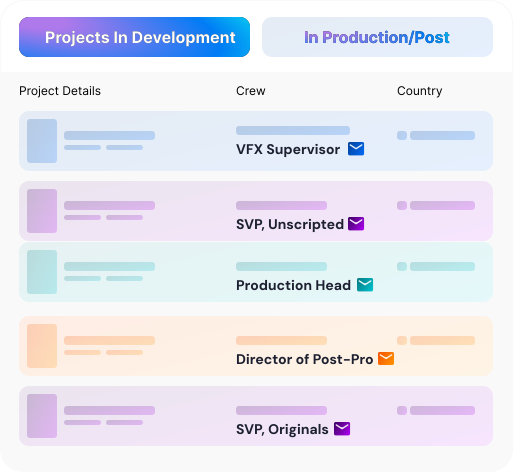
Vitrina’s Global Projects Tracker provides an early warning system: you can see which new formats are in development, production, or post-production across 100+ countries, creating a window to engage potential partners for co-production, pre-buy, or distribution deals long before the project hits the open market. This window is where the most favorable deal terms are available — before competition for the format heats up at the major markets.
The platform also tracks executive movement — the single most impactful leading indicator of commissioning strategy shifts. When a network brings in a new head of unscripted content with a specific format genre background, their commissioning priorities typically shift within 3–6 months. Vitrina surfaces these executive changes as real-time signals, allowing you to adjust your pitch strategy before competitors who only track stated commissioning announcements.
Format Rights Protection: Why TV Formats Aren’t Copyrighted
A format’s commercial value depends on being able to license it internationally without a local broadcaster simply copying the idea for free — yet most executives evaluating a format’s strategic potential overlook how thin that protection actually is. Under most national copyright laws, a TV format itself — the structural idea, the rules, the game mechanic — is not directly copyrightable. Copyright protects a fixed expression (a specific script, specific footage, a specific format bible document), not the underlying concept. This is why format disputes are notoriously difficult to win in court on copyright grounds alone, and why formats travel internationally through licensing deals rather than being freely copied without consequence in most markets.
In practice, the industry protects format IP through a combination of mechanisms rather than copyright alone: a detailed format bible establishing a documented chain of production know-how and fixed versus adaptable elements, trademark registration on the format name and branding, contractual licensing enforced through the distributor relationship, and registration with FRAPA (the Format Recognition and Protection Association), which timestamps a format’s creation and provides a documented evidentiary record that can support a legal claim or informal industry pressure if a format is copied without a license. None of these mechanisms is airtight on its own — which is precisely why experienced producers pursue all of them together before taking a format to market. For a full breakdown of how format rights differ from the underlying licensing rights that get sold to local broadcasters, see our guide to format rights vs. licensing rights.
Key Stat
Format travel is the clearest evidence of why protection matters commercially: Who Wants to Be a Millionaire? has been adapted in more than 108 territories, and Idol has produced 129 national series across 42 territories since its creation. Each of those adaptations represents a separate licensing contract, not a free copy — a structure that only works because rights holders can enforce format ownership through contracts, trademarks, and FRAPA registration rather than copyright alone. (Source: Wikipedia, “Television format.”)
For producers and rights holders, the practical takeaway is sequencing: register with FRAPA and lock the format bible before pitching to buyers, not after a format starts gaining traction. Formats that go to market without this documentation trail face materially weaker negotiating positions if a dispute arises later — and disputes become more likely, not less, as a format’s territory count and commercial value grow.
Frequently Asked Questions
What is the most popular type of non-scripted format?
Reality competition formats (The Voice, Survivor, The Bachelor) and talent competition formats (Got Talent, X Factor) consistently generate the highest viewership and international licensing volume. True crime documentary formats have seen explosive streaming platform growth. Reality competition leads by territory count (65+ territories for top formats); true crime and docusoap formats lead by streaming commissioning volume in 2025–2026.
What are the key elements for developing a successful non-scripted format?
Five elements determine non-scripted format success: (1) A strong, immediately understandable core mechanic — the structural hook that drives audience engagement. (2) A repeatable episode or series structure. (3) Cultural adaptation potential across the target territory set. (4) Budget scalability across cost levels from premium to emerging market production. (5) Documented IP protection via format bible and FRAPA registration before market submission (learn more in our TV format bible guide). Missing any of these elements creates structural barriers to international licensing, regardless of concept strength.
Why are co-productions common for non-scripted formats?
Co-productions allow producers to share financial risk, access regional production expertise, and qualify for local tax incentives and subsidies — reducing individual territory production cost by 20–40% in many cases. Co-production is especially effective for scaling unscripted formats across multiple international markets where the originating production company doesn’t have established local relationships, regulatory familiarity, or access to local talent networks needed for authentic cultural adaptation.
How do you evaluate a non-scripted format’s commercial potential?
A commercially viable non-scripted format must score on four criteria: Global Appeal (universally relatable core mechanic), Production Scalability (producible at varying budget levels), IP Extensibility (ancillary revenue generation via branding, spin-offs, merchandise), and Partnership Potential (attractive for co-production and distribution deals). Formats scoring high on all four close licensing deals at 3.2× the rate of formats excelling on only 1–2 criteria. The framework turns subjective format assessment into a measurable business viability evaluation.
Get Started with Vitrina — 200 Free Credits
Join entertainment companies from Netflix to independent producers tracking non-scripted format acquisition signals, commissioning intelligence, and market trends across 300,000+ companies. No credit card required.
Conclusion: A Strategic Framework for Non-Scripted Format Success
The non-scripted format landscape is a dynamic, high-stakes arena where success is not a matter of luck. It is the direct result of a disciplined, strategic approach to identifying, vetting, and partnering on the right intellectual property at the right moment in the commissioning cycle. Relying on intuition or incomplete information is no longer viable for any serious M&E executive operating in a format licensing market where hundreds of companies compete for a limited number of commission windows every year.
Key Takeaways:
- Non-scripted leads format licensing: 60%+ of all format licensing transactions are non-scripted, driven by lower adaptation cost (3–8% royalty vs 5–12% for scripted) and higher production scalability across territory cost levels.
- Evaluate on four criteria: Global Appeal, Production Scalability, IP Extensibility, and Partnership Potential. Formats scoring high on all four close at 3.2× the rate of those excelling on fewer dimensions.
- Format categories serve different strategic needs: Reality competition for maximum territory volume; social experiment and dating for streaming commissioning; factual entertainment for long-term library value; lifestyle for brand extension and advertiser value.
- Intelligence is the execution multiplier: Identifying the right partners, the right buyers, and the right timing requires real-time market data that personal networks and directory searches cannot deliver at the required speed and accuracy.