About Innovation Hub
 Global Content Pulse (Webinars)


 Global Production Financing
(Webinars)
Global Production Financing
(Webinars)  LeaderSpeak Podcast
  About Vitrina
 Our Story
 Our Solutions 🔥
 Film+TV Projects Tracker 🚀
 Case Studies
 Our Profile

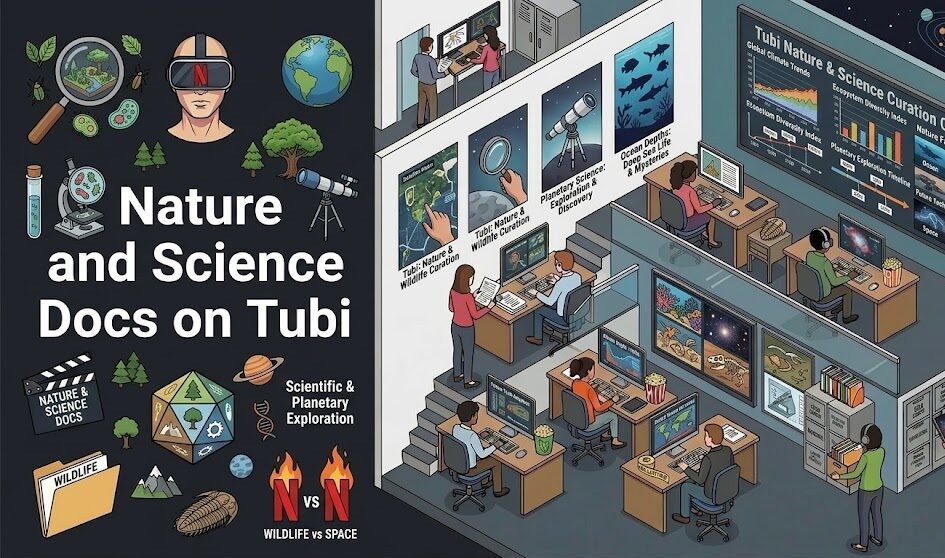
Here’s something most people don’t realize about Tubi: it’s not just a dumping ground for B-movies and forgotten cable reruns. With over 80 million monthly active users in 2026 and a library exceeding 50,000 titles, Fox Corporation’s flagship AVOD platform has quietly assembled one of the most underrated documentary collections in streaming. True crime that’ll rob you of sleep.
Nature films that rival anything on Netflix. Social issue docs that actually change how you see the world. All free. All ad-supported. No subscription required.
But there’s another layer here—one that producers and distributors rarely talk about publicly. Tubi’s best documentaries on Tubi don’t end up there by accident. They land there because content owners understand Tubi’s acquisition patterns, its audience demographics, and the real economics behind AVOD licensing. If you’re watching this space—whether as a viewer, a filmmaker, or a distribution executive—this guide gives you both the watchlist and the strategy.
In This Guide
Track What’s Actually Landing on Tubi—Before It Hits the Trades
Vitrina’s VIQI intelligence tool monitors documentary deals, platform acquisitions, and content movement across 140,000+ companies in real time. Know which docs Tubi’s buyers are acquiring—weeks before your competitors do.
Trusted by Netflix, Warner Bros, and leading independent distributors worldwide.
No credit card required
Why Tubi Has Become a Documentary Powerhouse
Let’s call it what it is: Tubi’s documentary rise is a Fragmentation Paradox story. The SVOD wars drove content costs so high that subscription fatigue set in. Audiences didn’t stop wanting documentaries—they stopped wanting another $15/month bill for them. Tubi stepped into that gap and never looked back.
The numbers back this up. As Deadline reported, Tubi generated more than $1 billion in annualized revenue heading into 2025—making it one of the most commercially successful AVOD operations on the planet. That’s not a charity case for indie content. That’s a real market with real money flowing through it.
What fuels Tubi’s documentary library specifically? Three things. First, output deals with catalog-rich distributors like FilmRise (now part of Radial Entertainment following its merger with Shout! Studios) that supply thousands of non-fiction titles. Second, Tubi’s own content acquisition strategy actively targeting documentary genres that over-index with its cord-cutter demographic—particularly millennials aged 25-44. And third, the AVOD economics themselves: producers who’ve exhausted SVOD windows can monetize their content for years on platforms like Tubi without cannibalizing premium placement elsewhere.
But enough context. You came here for the list. Let’s get into it.

Your AI Assistant, Agent, and Analyst for the Business of Entertainment
VIQI AI helps you plan content acquisitions, raise production financing, and find and connect with the right partners worldwide.
- Find active co-producers and financiers for scripted projects
- Find equity and gap financing companies in North America
- Find top film financiers in Europe
- Find production houses that can co-produce or finance unscripted series
- I am looking for production partners for a YA drama set in Brazil
- I am looking for producers with proven track record in mid-budget features
- I am looking for Turkish distributors with successful international sales
- I am looking for OTT platforms actively acquiring finished series for the LATAM region
- I am seeking localization companies offer subtitling services in multiple Asian languages
- I am seeking partners in animation production for children's content
- I am seeking USA based post-production companies with sound facilities
- I am seeking VFX partners to composite background images and AI generated content
- Show me recent drama projects available for pre-buy
- Show me Japanese Anime Distributors
- Show me true-crime buyers from Asia
- Show me documentary pre-buyers
- List the top commissioners at the BBC
- List the post-production and VFX decision-makers at Netflix
- List the development leaders at Sony Pictures
- List the scripted programming heads at HBO
- Who is backing animation projects in Europe right now
- Who is Netflix’s top production partners for Sports Docs
- Who is Commissioning factual content in the NORDICS
- Who is acquiring unscripted formats for the North American market
True Crime Documentaries on Tubi That’ll Keep You Up All Night
True crime isn’t just Tubi’s most popular documentary genre—it’s arguably the platform’s defining content pillar. The audience skews younger, engagement is through the roof, and completion rates rival premium platforms. That’s not an accident. Tubi’s buyers know their audience.
Titles to Watch
- The Freezer — Catching a Killer: A chilling UK production tracing the investigation of Dennis Nilsen—methodical, genuinely disturbing, and exceptionally well-produced for a free platform.
- Murder Mountain: A surprisingly nuanced doc about Humboldt County’s cannabis economy and the disappearances surrounding it. More social anthropology than shock-value true crime.
- Ted Bundy: Falling for a Killer: The Amazon-produced series landed on Tubi’s catalog following its window cycle. Five episodes, centered on women’s perspectives—which is rarer in this genre than it should be.
- Killer Ratings: A Brazilian political scandal documentary that puts most American political dramas to shame. The subject—a TV host/politician implicated in murder—almost sounds fictional. It isn’t.
Worth noting: Tubi’s true crime library rotates. Titles that dominate today may window out and new acquisitions land constantly. If something’s not there when you look, check back—or better yet, track platform acquisition movements through intelligence tools before titles disappear.
Nature & Environment: Tubi’s Wildlife Documentary Collection
Tubi doesn’t have the BBC Natural History Unit’s budget. What it does have is a surprisingly deep catalog of international co-productions and independently distributed wildlife films that you genuinely won’t find elsewhere without a cable subscription or a premium SVOD spend.
- Racing Extinction: Director Louie Psihoyos (The Cove) teams up with activists and scientists to document the sixth mass extinction. Visually spectacular. Emotionally demanding. Worth it.
- Anthropocene: The Human Epoch: Canadian production exploring humanity’s geological footprint across eight global sites. The cinematography alone justifies the watch.
- Seaspiracy (availability varies): The controversial Netflix-origin doc has cycled through AVOD windows. Check current availability—it appears and disappears from Tubi’s library.
- Mission Blue: Sylvia Earle’s story—oceanographer, explorer, legend. One of the most purely inspiring figures you’ll encounter in documentary form.
Carol Hanley, CEO of Whip Media, breaks down the AVOD analytics that drive platform acquisition decisions—including why documentary genres perform differently on platforms like Tubi versus SVOD competitors. Essential viewing if you’re a producer or distributor navigating this space.

Discover Which Documentaries Are Moving Across Platforms Right Now
Vitrina tracks 400,000+ projects across global platforms. Find out which documentary titles are being licensed to Tubi, which distributors are most active in the AVOD space, and where the next acquisition opportunities are—all in one place.
Join 140,000+ companies already using Vitrina. No credit card required.
Social Issues & Human Interest: Docs That Actually Change Minds
This is where Tubi punches above its weight most consistently. The platform’s audience—disproportionately urban, diverse, and cost-conscious—responds to social issue documentaries at rates that regularly surprise analysts. It’s not a secondary genre. It’s a primary engagement driver.
- 13th (Ava DuVernay): Netflix origin, AVOD window. If you haven’t seen it, stop reading this and watch it. If you have, you probably know someone who hasn’t. It’s on Tubi. Send them the link.
- I Am Not Your Negro: Raoul Peck’s adaptation of James Baldwin’s unfinished manuscript remains one of the most culturally essential documentaries of the past decade. Samuel L. Jackson narrates.
- Fire of Love: Sara Dosa’s portrait of volcanologists Katia and Maurice Krafft—ostensibly about science, actually about devotion. Won the Sundance Editing Award. Genuinely moving.
- Crip Camp: Obama-produced. Sundance Grand Jury winner. The story of a 1970s summer camp for disabled teens that helped ignite the disability rights movement. Cannot recommend this one highly enough.
Notice the pattern? These aren’t Tubi originals. They’re acquisitions that cycled through premium windows and landed in AVOD with their awards pedigrees intact. That’s Tubi’s Smart Pairing approach at work—matching prestige content to an audience that wants depth, not just entertainment, without adding another subscription to their stack. For producers exploring AVOD and FAST distribution analytics, understanding this cycle is essential.
History & Politics: What Tubi’s Archive Reveals
History documentaries don’t get the same breathless coverage as true crime. But they consistently deliver the strongest completion rates in Tubi’s analytics—because viewers who start a three-part WWII series tend to finish it. That’s gold for an ad-supported platform monetizing on watch time.
- The Cuban Missile Crisis: Three Men Go to War: Rigorous, three-perspective telling of 13 days that nearly ended the world. Better than most dramatizations of the same events.
- The Panama Papers: The documentary companion to one of the largest data leaks in journalistic history. Dense, rewarding, and increasingly relevant as financial transparency debates continue.
- Che: Part One and Part Two: Steven Soderbergh’s four-hour epic is technically narrative, but it plays—and was marketed—as docudrama. Both parts have appeared in Tubi’s catalog.
- Meltdown: Three Mile Island: Four-part Netflix series that cycled onto Tubi. Engineering, politics, and human fallibility wrapped in genuinely suspenseful documentary structure.
Sports & Adventure: Tubi’s Action Documentary Collection
Sports docs on Tubi run the gamut from polished ESPN-style productions to raw, independently shot extreme sports films. The category punches way above its catalog size in engagement—and Tubi’s buyers have been actively deepening this section heading into 2026. For a fuller look at what’s performing, our sports and adventure documentary intelligence brief tracks new acquisitions monthly.
- The Last Dance (availability varies): ESPN/Netflix co-production. The Michael Jordan/Chicago Bulls series has cycled through AVOD windows. The benchmark against which all sports docs are now measured.
- Steve McQueen: The Man & Le Mans: Part car-racing documentary, part portrait of obsession. McQueen’s 1970 attempt to make the definitive racing film nearly destroyed him. Fascinating.
- Matt Shepard Is a Friend of Mine: Despite its difficult subject matter, this is fundamentally a film about friendship, memory, and witness. Sports-adjacent in its human drama, deeply universal in its emotional reach.
- Valley Uprising: Yosemite climbing culture from the 1950s through the 80s. Visually stunning. An easy recommend even for audiences with zero interest in rock climbing.
Music & Culture Documentaries That Hit Different on Tubi
Music docs generate some of the most fanatical engagement in Tubi’s catalog. Viewers don’t just watch them—they return to them. They share them. They create social media moments around them. For distributors, that’s not just a completion metric. That’s earned media value layered on top of the licensing fee.
- What Happened, Miss Simone?: Liz Garbus’s Nina Simone biography won the Emmy and rightly so. It’s not hagiography—it confronts Simone’s complexity head-on, which makes it much more powerful than the reverential approach most music docs take.
- The Wrecking Crew: The uncredited studio musicians behind hundreds of legendary 1960s recordings finally get their moment. A music history documentary that changes how you hear the era’s greatest hits.
- Shut Up & Sing: The Dixie Chicks controversy, revisited with the kind of perspective that only time affords. More urgent than ever given what’s happened to public discourse since.
- Mr. Dynamite: The Rise of James Brown: Alex Gibney’s portrait of the Godfather of Soul. Two hours, zero filler, remarkable archival footage.
How to Get Your Documentary on Tubi — The Industry Reality
Here’s what most “how to get on Tubi” guides won’t tell you: Tubi doesn’t take everything, and its acquisition filters are more sophisticated than the AVOD reputation suggests. The platform’s buyers think in terms of genre performance cohorts, audience completion rates by category, and the ad revenue potential of a specific viewer session. Your doc isn’t just being evaluated on its creative merit—it’s being evaluated on its ability to hold an ad-supported audience through to completion.
The path to Tubi’s catalog typically runs through three routes. Direct submission through Tubi’s content portal works for some producers, but it’s slow and opaque. Working with established catalog distributors—companies like Radial Entertainment (Garson Foos’s newly merged entity from Shout! Studios and FilmRise) that already have output deals with Tubi—is faster and comes with built-in marketing infrastructure. And then there’s the originals path: Tubi commissioned four original films from Hartbeat (Kevin Hart’s production company) in its most aggressive originals push to date, signaling growing appetite for branded originals beyond simple catalog acquisition.
What should your documentary have to stand a real chance? Three things. A defined genre hook—true crime, social issue, music—that maps to Tubi’s documented acquisition priorities. A runtime that fits AVOD consumption patterns (80-100 minutes for features; 25-45 minutes for episodic). And ideally, some prior platform history—even a festival premiere adds credibility to your submission package. Our proven film distribution strategies cover the full AVOD licensing approach in detail.
And if you want the inside track on what Tubi’s buyers are actually acquiring right now—not what they acquired 18 months ago—that’s precisely the intelligence Vitrina’s platform surfaces. As Variety noted in their AVOD market analysis, the platforms that will dominate the next five years are those whose acquisition intelligence runs faster than their competitors’. That’s as true for distributors and producers as it is for the platforms themselves.
De-Risk Your Documentary Distribution Strategy
Vitrina Concierge connects documentary producers and distributors with the right platform buyers—including Tubi’s content team. Our specialists run target-matching based on 400,000+ active project profiles. No guesswork. No cold outreach.
Trusted by producers who’ve placed content with Netflix, Paramount, and leading AVOD platforms globally.
Frequently Asked Questions
Does Tubi have good documentaries?
Yes—and more than most people expect. Tubi’s documentary library includes award-winning productions that have cycled through SVOD windows, international co-productions, and a growing originals slate. The platform’s 80+ million monthly users are drawn disproportionately to true crime, social issue, nature, and music documentaries. Quality varies by title, but the best documentaries on Tubi compete with what you’d find on premium services.
Is Tubi completely free to watch?
Yes. Tubi is an AVOD (Advertising-Based Video on Demand) platform—fully free to viewers, monetized through ad breaks during content. No subscription, no sign-up required to browse, though creating a free account unlocks personalized recommendations and watchlist features. Fox Corporation owns the platform, which had annualized revenues exceeding $1 billion heading into 2025.
How many documentaries does Tubi have?
Tubi’s documentary catalog sits in the thousands of titles across its 50,000+ total content library. The exact number fluctuates as licensing agreements rotate—some titles window in from SVOD platforms, others cycle out as deals expire. True crime represents the deepest category, followed by nature, social issues, and history.
What are the best documentaries on Tubi right now in 2026?
Top picks across genres include 13th (social issues), Racing Extinction (environment), What Happened, Miss Simone? (music/culture), The Panama Papers (politics), and Valley Uprising (sports/adventure). True crime standouts include Killer Ratings and Murder Mountain. Availability changes regularly, so use Tubi’s search and category filters to confirm current access.
How can I submit my documentary to Tubi?
Tubi accepts submissions through its content portal, but the faster path for most producers runs through established catalog distributors who already have output or licensing deals with Tubi. Companies like Radial Entertainment (the merger of Shout! Studios and FilmRise) are among Tubi’s most active supply-side partners. Tubi is also developing an originals strategy—their deal with Hartbeat (Kevin Hart’s company) for four original films signals growing original content ambitions.
Does Tubi pay royalties for documentaries?
Yes. Tubi operates a revenue-share model for AVOD licensing, paying content owners a portion of the ad revenue generated by their titles. The exact rate varies by deal structure, title performance, and the distributor relationship. For independently produced documentaries without distribution infrastructure, working with a distribution partner who can negotiate directly with Tubi’s content team typically yields better terms.
What makes a documentary successful on Tubi specifically?
Three factors drive performance: genre alignment (true crime, social issues, music, and nature over-index consistently), runtime fit (80-100 minutes for features; episodic docs in the 25-45 minute range), and completion rate potential—Tubi’s ad revenue is directly tied to how long viewers stay engaged. Titles that hook audiences early and sustain engagement through to the end generate significantly better CPM yield for the platform.
How does Tubi’s documentary library compare to Netflix or Amazon?
Tubi can’t match Netflix’s originals budget or Amazon’s production scale. But it’s not trying to. What Tubi offers is breadth—a catalog built from thousands of licensing deals rather than a curated originals slate—and it’s completely free. For viewers who’ve already watched Netflix’s featured docs, Tubi often surfaces titles they’d never have found otherwise. For distributors, Tubi represents an additional revenue window rather than a competitor to premium SVOD placement.
Key Takeaways: Tubi’s Documentary Landscape in 2026
The best documentaries on Tubi don’t just entertain—they reveal something essential about how content moves through the modern distribution ecosystem. The Fragmentation Paradox created AVOD winners like Tubi precisely because audiences wanted depth without the subscription tax. And that creates real opportunity—for viewers, yes, but also for the documentary makers and distributors smart enough to understand where the market’s heading.
- Tubi’s scale: 80+ million monthly active users and 50,000+ titles make it the AVOD platform too significant to ignore—for viewers and industry professionals alike.
- Category performance: True crime, social issues, nature, history, and music documentaries consistently over-index on Tubi relative to platform averages.
- Distribution path: The fastest route to Tubi for independent documentary makers runs through established catalog distributors with existing output deals—not direct submission.
- AVOD economics: Completion rates, not just view counts, drive ad revenue on Tubi—which means content quality and runtime fit matter more than production budget.
- Originals expansion: Tubi’s deal with Hartbeat signals a growing originals appetite—watch this space for commissioned documentary opportunities in 2026 and beyond.
Track Documentary Deals Across Every Major Platform
Vitrina monitors content movement across 140,000+ companies globally. Know which documentaries are landing where—and which platform buyers are actively acquiring—before your competitors do. Start with 200 free credits.
No credit card required · Trusted by Netflix, Warner Bros, and 140,000+ companies
Find Film+TV Projects, Partners, and Deals – Fast.
VIQI matches you with the right financiers, producers, streamers, and buyers – globally.
Producers Seeking Financing, Co-Pros, or Pre-Buys?
Vitrina Concierge helps producers reach the right financiers, commissioners, distributors, and co-production partners — with precision outreach, not cold pitching.
Join Industry Briefings Trusted by Leaders

Format Adaptations: Global Trends
Where formats are traveling, which adaptations are breaking out, and how streamers are backing remakes in 2025–2026.

Books, Novels & Comics Adaptations: Global Trends
Books, webtoons, and manga driving the next global screen hits. Discover how in this webinar.

Micro-Dramas & Mobile-First Storytelling
Micro-dramas are building real audiences and revenue. Understand the platforms, buyers, and economics behind the growth.

Navigating Global Content Licensing Trends
How global content licensing is shifting beyond flat fees to flexible, deal-driven models.