About Innovation Hub
 Global Content Pulse (Webinars)


 Global Production Financing
(Webinars)
Global Production Financing
(Webinars)  LeaderSpeak Podcast
  About Vitrina
 Our Story
 Our Solutions 🔥
 Film+TV Projects Tracker 🚀
 Case Studies
 Our Profile
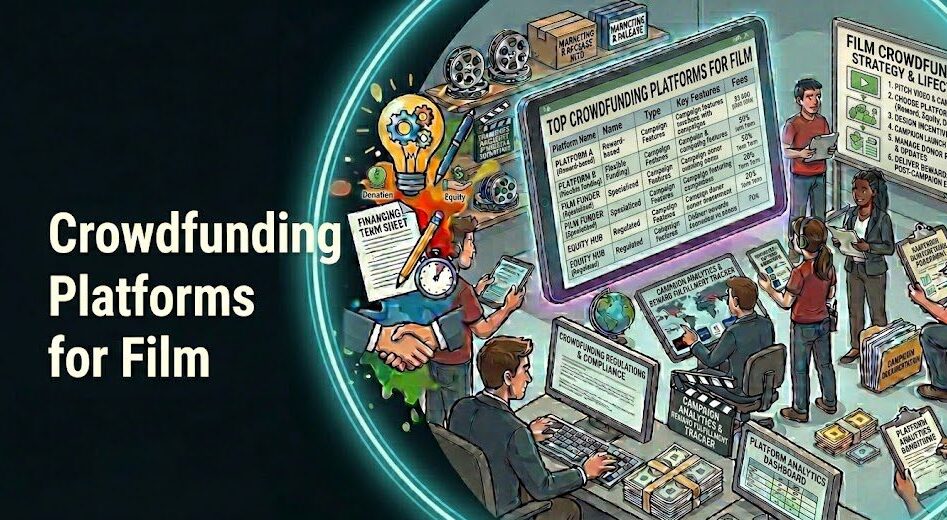
You’ve got a compelling script. A director attached. Maybe even a sales agent circling. But there’s a gap in your capital stack—and you’re wondering whether crowdfunding for film can actually close it. Here’s the thing: it can. But only if you pick the right platform for your project type, your audience, and your financing strategy.
The best crowdfunding platforms for film aren’t interchangeable. Kickstarter works differently from Seed&Spark. Indiegogo operates on a completely different funding model than Patreon. And choosing wrong doesn’t just cost you momentum—it can cost you the project entirely. As we explore in our complete guide to how film financing works, crowdfunding typically fills a specific gap rather than replacing institutional capital. That context matters before you launch a single campaign.
This breakdown covers the seven platforms that actually deliver for film projects—what they’re best for, what they cost you, and where producers consistently go wrong with each one. No fluff. Just the decision framework you need.
In This Article
- Why Crowdfunding Works for Film (When It Works)
- Kickstarter: The Proven Powerhouse
- Indiegogo: Flexible Funding That Keeps Your Money
- Seed&Spark: Built for Filmmakers
- Patreon: The Long Game for Series Creators
- GoFundMe: Best for Short Films
- Slated: Where Crowdfunding Meets Film Finance
- How to Choose the Right Platform
- What Most Filmmakers Get Wrong
- Frequently Asked Questions
- Key Takeaways
Ask VIQI: Which Film Financing Sources Match My Project Right Now?
VIQI is Vitrina’s AI assistant—trained on 1.6 million titles, 360,000 companies, and 5 million entertainment professionals. Ask it which financing mix—crowdfunding, gap, presales, or incentives—makes sense for your specific project.
✓ Included with 200 free credits | ✓ No credit card needed
Why Crowdfunding Works for Film (When It Actually Works)
Let’s be direct about something most crowdfunding guides skip: for a $3M independent feature, you’re not replacing your capital stack with a Kickstarter campaign. That’s not the play. But for proof-of-concept shorts, documentary projects, micro-budget features under $300K, and as a demand-signal tool that de-risks your project for institutional investors—crowdfunding is one of the most underutilized levers in independent film finance.
The Fragmentation Paradox in film financing means producers waste months chasing the wrong capital sources. Crowdfunding solves a different problem—it builds your audience before your film exists. That audience data becomes a credibility signal when you approach sales agents or broadcasters. According to Deadline, the film and TV crowdfunding sector has grown consistently since 2019, with documentary projects driving the largest share of successful campaigns by percentage funded.
But here’s what producers often miss—platform selection is strategic, not arbitrary. The wrong platform for your project type means your campaign dies in week one. And a failed public campaign can actually damage your project’s credibility with professional investors. So let’s get this right.
Stop Guessing Who’s Financing. Get Targeted Outreach.
Stop searching and start getting funded. We identify the exact decision-makers currently backing projects like yours, turning raw data into risk-aligned capital partnerships.
Major Studios
Scouting early stage projects, IP, and Regional partners for global studio pipelines.
IP Owners & Leads
Connecting creative leads with qualified financiers and major streaming platforms.
Streamers
Securing high-value pre-buy content and discovering early-stage global IP for platforms.
Indie Producers
Bridging the gap for indie filmmakers to reach executive production partners and capital.
Global Financing Ecosystems
Mapping complex markets and pairing projects with disciplined, risk-aligned capital across global territories worldwide.
1. Kickstarter: The Proven Powerhouse for Film Crowdfunding
Best for: Feature films, documentaries, animated projects with established director profiles
Funding model: All-or-nothing (reach your goal or keep nothing)
Platform fee: 5% of funds raised + payment processing fees (~3-5%)
Kickstarter has raised more film capital than any other crowdfunding platform—full stop. The film and creative work category has seen over $700 million pledged since the platform launched. That brand recognition works in your favor. People trust Kickstarter with their credit cards in a way they don’t for smaller platforms.
The all-or-nothing model is Kickstarter’s defining feature—and its biggest psychological lever. Backers are more willing to pledge when they know the project only proceeds if it’s fully viable. It creates urgency. It signals conviction. And it means your backers know exactly what they’re getting into.
The downside? If you set your goal too high and miss it, you walk away with nothing. Not $80K of a $100K goal—nothing. That’s a brutal system if you don’t have a pre-existing audience or marketing plan. Weaponize Kickstarter by running it as a community-building engine first, funding mechanism second.
2. Indiegogo: Flexible Funding That Keeps Your Money
Best for: Projects where partial funding is still useful; international campaigns
Funding model: Flexible (keep what you raise) OR Fixed (all-or-nothing)
Platform fee: 5% + ~3% processing; lower if you hit goal
Indiegogo gives you something Kickstarter doesn’t: the option to keep whatever you raise, even if you fall short. For a documentary crew that can do a rough cut with $40K and finish with $80K, that flexibility is enormously practical.
But there’s a real cost to flexible funding. It removes the psychological urgency that makes all-or-nothing campaigns so effective. Backers don’t feel the same pressure to push you over the line. And frankly, the Indiegogo platform has less organic discovery traffic than Kickstarter—your campaign lives or dies by the audience you bring to it.
Indiegogo’s InDemand feature is worth knowing about—it lets you continue raising funds after a campaign ends, converting a successful launch into ongoing pre-sales. Several indie features have used this to accelerate into production while maintaining community momentum. Smart producers use this as a bridge between their crowdfunding audience and their full capital stack assembly.
Track What’s Getting Greenlit Before It Hits the Trades
Trusted by Netflix, Warner Bros, and Paramount. Join 140,000+ companies tracking the global entertainment supply chain—including which projects are at crowdfunding stage right now.
✓ 200 free credits | ✓ No credit card required | ✓ Full platform access
3. Seed&Spark: Built Exclusively for Filmmakers
Best for: Independent feature films; diverse and underrepresented voices; projects with distribution ambitions
Funding model: Flexible crowdfunding + streaming distribution integration
Platform fee: 5% + processing; lower tiers for returning campaigns
Seed&Spark is the only major platform built specifically for film and TV. That focus changes everything. The community is made up of film lovers who want to support independent cinema—not general consumers discovering a gadget. Your project’s launch page looks like a film-industry pitch deck, not an Amazon product listing.
What makes Seed&Spark genuinely distinctive is its integrated streaming distribution pathway. Projects that hit funding goals get consideration for distribution through the platform’s curated streaming channel. For a producer building toward a hybrid distribution model, that’s not a minor footnote—it’s a complete de-risking of your distribution uncertainty before you’re even in production.
The tradeoff is reach. Seed&Spark has a smaller total user base than Kickstarter or Indiegogo. You’ll drive more of your own traffic. But the conversion rate of film-specific community members tends to be higher—people who back on Seed&Spark often come back and back again.
4. Patreon: The Long Game for Documentary and Series Creators
Best for: Documentary series, episodic content, creators with existing social audiences
Funding model: Monthly recurring subscriptions from fans
Platform fee: 8-12% depending on plan tier
Patreon isn’t a campaign platform—it’s a recurring revenue model. And that distinction matters enormously. Instead of a 30-day sprint, you’re building a sustainable financial base that funds production month by month. Some documentary filmmakers have raised $15,000–$40,000 per month through Patreon while in production on multi-year projects. That’s real working capital.
But Patreon requires something most crowdfunding platforms don’t: a pre-existing audience. If you’re launching your first project, Patreon is a slow burn. If you’ve already built a following through YouTube, podcasting, or social media—and you’re creating content in a specific niche—Patreon can become your most reliable financing source. Not your biggest. Your most reliable.
The fan-funded production model explored in our analysis of fan-funded content financing shows exactly how this plays out at scale—and where the ceiling tends to be for different content categories.
5. GoFundMe: Best for Short Films and Personal Projects
Best for: Short films under $50K; passion projects; student and emerging filmmaker work
Funding model: Keep everything raised, no goal requirement
Platform fee: 0% platform fee (processing fees apply at ~2.9% + $0.30)
GoFundMe has essentially zero platform fee—that’s its headline advantage. You keep everything you raise, with only payment processing costs deducted. For a short film raising $20,000, that difference versus a 5% Kickstarter fee is $1,000 back in your pocket.
The limitation is context. GoFundMe is perceived as a personal fundraising tool—medical bills, community causes, emergency support. Launching a narrative feature film on GoFundMe can look amateurish to industry observers, even if your project is genuinely excellent. Use GoFundMe for micro-budget shorts where your audience is personal—friends, family, your immediate community. Don’t try to build professional credibility on a platform that’s not positioned for it.
6. Slated: Where Crowdfunding Meets Professional Film Finance
Best for: Mid-budget independent features seeking accredited investors alongside crowd contributions
Funding model: Equity crowdfunding + investor matching
Platform fee: Varies; equity-based structure with Reg CF compliance
Slated occupies a different category entirely—it’s an equity crowdfunding and investor-matching platform built specifically for the film industry. Rather than donations or perks, backers receive actual equity stakes in your project. That changes the investor profile completely: you’re attracting accredited investors and film-finance professionals, not just fans.
For producers building a $500K–$2M capital stack, Slated can sit alongside gap financing and tax incentives as a legitimate equity layer. The platform’s scoring system—which rates projects on commercial viability—also functions as a useful credibility signal when approaching institutional lenders. As reported by Variety, equity crowdfunding has emerged as one of the fastest-growing film financing mechanisms for sub-$5M projects over the past three years.
Need Financiers Beyond Crowdfunding? We’ll Find Them.
Vitrina Concierge is your Virtual Agent. We don’t give you a list—we make warm introductions directly to decision-makers actively seeking your type of content.
- LA producer → Netflix UK, Fifth Season, Fox Entertainment (48 hours)
- Middle Eastern studio → Legendary Pictures (direct access)
- Korean animation studio → Netflix Adult Animation (week one)
How to Choose the Right Crowdfunding Platform for Your Film
Here’s the decision framework that actually works. Ask yourself four questions before you pick a platform:
1. How large is my existing audience? If you’ve got under 2,000 email subscribers or social followers, Kickstarter’s built-in discovery gives you the best organic lift. If you’re above that threshold, Seed&Spark or Indiegogo work well—you’re bringing the audience yourself.
2. What happens if I fall short of goal? If partial funding is still genuinely useful—you can shoot a proof-of-concept with $30K even if your goal was $80K—choose Indiegogo’s flexible model. If your project truly requires hitting the number to proceed, all-or-nothing drives stronger backer behavior.
3. Who are my backers—fans or investors? Pure fan support points to Kickstarter, Indiegogo, or Seed&Spark. Accredited investors or finance professionals? Slated is built for that conversation.
4. Is this a campaign or a community? One-time projects suit Kickstarter and Indiegogo. If you’re building an ongoing creative universe—a documentary series, a branded content slate—Patreon’s subscription model becomes your most powerful long-term tool.
Find the Financiers Backing Your Genre
Stop searching and start getting funded. We identify the exact decision-makers currently backing projects like yours, turning raw data into risk-aligned capital partnerships.
What Most Filmmakers Get Wrong About Crowdfunding
The number one mistake? Treating crowdfunding as a passive fundraising exercise. You don’t post a campaign and wait. Successful film crowdfunding campaigns are active marketing operations—daily outreach, backer updates, social media pushes, and often a PR strategy running in parallel.
The second mistake is setting goals based on what you need rather than what your audience can realistically deliver. Your goal should be the minimum viable amount—the amount you can genuinely use to produce real value, not the full production budget wrapped in wishful thinking. Accelerate past your goal with stretch targets.
And the third—chronically underestimating campaign lead time. Your campaign should be built 8–12 weeks before launch, not 8–12 days. The audience development, email list building, press outreach, and creative asset production that precede your launch are what determine whether you hit 30% of goal in 48 hours (which signals algorithmic success) or limp to 15% and go invisible.
Crowdfunding is one piece of a broader financing architecture. The most effective independent producers we’ve seen use it as both a demand-proof mechanism and a first community layer—then layer in presales, tax incentives, and gap financing to complete their capital stack. That’s the Smart Pairing approach: each capital source covers a different risk profile in your total financing structure.
Frequently Asked Questions
What is the best crowdfunding platform for film projects in 2025?
Kickstarter remains the leading platform for film crowdfunding in 2025 due to its brand recognition, large backer community, and film category credibility. Seed&Spark is the top choice for filmmakers who want a film-specific platform with integrated distribution pathways. The best choice depends on your project size, audience, and funding model preference.
How much can you realistically raise crowdfunding a film?
Most successful film crowdfunding campaigns raise between $20,000 and $150,000. Campaigns backed by strong existing audiences or celebrity-level directors can exceed $500,000. Documentary projects typically see the highest success rates. For budgets above $300K, crowdfunding is best used alongside institutional film financing rather than as a standalone capital source.
Does Kickstarter or Indiegogo work better for film crowdfunding?
Kickstarter generally works better for film projects with strong existing audiences due to its all-or-nothing urgency mechanism and higher organic discovery. Indiegogo’s flexible funding model is better suited for projects where partial funding is still actionable—such as documentary films where you can shoot with whatever is raised. Both charge roughly the same fees (around 5% plus processing).
Can crowdfunding replace traditional film financing?
No—for most professional film projects, crowdfunding is a supplementary capital source, not a replacement for institutional financing. It works best as the equity layer for micro-budget productions (under $300K) or as a demand-proof tool that makes a project more attractive to sales agents, distributors, and gap lenders. Most producers use it alongside presales, tax incentives, and equity investment.
What percentage does Kickstarter take from film campaigns?
Kickstarter charges a 5% platform fee on the total amount raised, plus payment processing fees of approximately 3-5% depending on your country and payment method. If your campaign fails to meet its goal, no money changes hands and no fees are charged. Budget 8-10% of your campaign goal to cover platform and processing costs when planning your minimum viable target.
Is Seed&Spark worth using for independent film financing?
Yes—especially for producers who want a film-specific crowdfunding community and potential streaming distribution integration. Seed&Spark has a smaller total user base than Kickstarter, but its audience is entirely composed of film supporters with higher per-campaign conversion rates. It’s particularly effective for diverse voices and underrepresented stories that resonate with its community.
How early should I start preparing a film crowdfunding campaign?
Start preparing 8–12 weeks before your campaign launch date. This includes building your email list, creating all visual assets (video pitch, stills, rewards graphics), conducting press outreach, and warming up your social media audience. Campaigns that hit 30% of their goal within the first 48 hours have significantly higher completion rates—and that result is almost entirely determined by the pre-launch preparation period.
Key Takeaways
Picking the right platform is half the battle with film crowdfunding. The other half is treating your campaign as a professional marketing operation—not a passive ask. Here’s what to take away:
- Kickstarter is still the dominant platform for film—use it if you have an existing audience and can benefit from all-or-nothing urgency.
- Indiegogo’s flexible model is the right choice when partial funding keeps your project moving forward.
- Seed&Spark is purpose-built for filmmakers and offers a distribution pathway most platforms don’t—a meaningful advantage for emerging producers.
- Patreon suits recurring content and creators with an established audience who want monthly revenue rather than a single campaign sprint.
- Slated bridges crowdfunding and professional film finance—the right tool when you’re raising equity from accredited investors alongside crowd contributions.
- Crowdfunding works best as one layer of a complete capital stack, alongside presales, incentives, and gap financing—not as a standalone solution for professional productions.
Find Co-Production Partners and Financiers for Your Project in 48 Hours
Trusted by Netflix, Warner Bros, Paramount, and Google TV. Track 400,000+ projects. Access 3 million verified executives. Ask VIQI strategic questions about your financing mix.
✓ 200 free credits | ✓ No credit card required | ✓ Cancel anytime
Or explore Vitrina Concierge for hands-on introductions to active financiers and co-production partners.
Find Film+TV Projects, Partners, and Deals – Fast.
VIQI matches you with the right financiers, producers, streamers, and buyers – globally.
Producers Seeking Financing & Partnerships?
Book Your Free Concierge Outreach Consultation
(To know more about Vitrina Concierge Outreach Solutions click here)
Producers Seeking Financing, Co-Pros, or Pre-Buys?
Vitrina Concierge helps producers reach the right financiers, commissioners, distributors, and co-production partners — with precision outreach, not cold pitching.
Join Industry Briefings Trusted by Leaders

Film & TV Financing: Pre-Buys
Learn how pre-buys work in current Film and TV financing, how they differ from pre-sales, and how they are used to close real finance plans.
Streamers – Netflix vs. Amazon – The 2026 Strategy
How Netflix and Amazon’s content and revenue strategies are diverging ahead of 2026.

Format Adaptations: Global Trends
Where formats are traveling, which adaptations are breaking out, and how streamers are backing remakes in 2025–2026.