About Innovation Hub
 Global Content Pulse (Webinars)


 Global Production Financing
(Webinars)
Global Production Financing
(Webinars)  LeaderSpeak Podcast
  Global Entertainment Digest (Newsletter)
  About Vitrina
 About VIQI
 Our Story
 Our Solutions 🔥
 Film+TV Projects Tracker 🚀
 Case Studies
 Our Profile

Baltimore has evolved from a gritty cinematic backdrop into a high-efficiency production hub, offering a unique blend of architectural versatility and aggressive fiscal incentives. For executive producers and location managers, navigating the intersection of municipal permits, Baltimore Police Department (BPD) coordination, and the recently expanded Maryland Film Production Activity Tax Credit is no longer just a logistical task—it is a critical financial strategy to de-risk high-stakes projects.
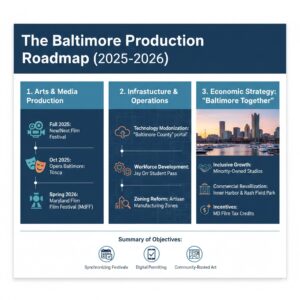
Table of contents:
-
- The FY2025/2026 Fiscal Landscape: Maryland Tax Credit Expansion
- Operational Permitting: The Baltimore Film Office Protocol
- Police Support & Public Safety: Managing BPD on Set
- The “Small Film” Advantage: Incentives for Independent Entities
- Leveraging Vitrina for Baltimore Production Sourcing
- Strategic FAQ

Your AI Assistant, Agent, and Analyst for the Business of Entertainment
VIQI AI helps you plan content acquisitions, raise production financing, and find and connect with the right partners worldwide.
- Find active co-producers and financiers for scripted projects
- Find equity and gap financing companies in North America
- Find top film financiers in Europe
- Find production houses that can co-produce or finance unscripted series
- I am looking for production partners for a YA drama set in Brazil
- I am looking for producers with proven track record in mid-budget features
- I am looking for Turkish distributors with successful international sales
- I am looking for OTT platforms actively acquiring finished series for the LATAM region
- I am seeking localization companies offer subtitling services in multiple Asian languages
- I am seeking partners in animation production for children's content
- I am seeking USA based post-production companies with sound facilities
- I am seeking VFX partners to composite background images and AI generated content
- Show me recent drama projects available for pre-buy
- Show me Japanese Anime Distributors
- Show me true-crime buyers from Asia
- Show me documentary pre-buyers
- List the top commissioners at the BBC
- List the post-production and VFX decision-makers at Netflix
- List the development leaders at Sony Pictures
- List the scripted programming heads at HBO
- Who is backing animation projects in Europe right now
- Who is Netflix’s top production partners for Sports Docs
- Who is Commissioning factual content in the NORDICS
- Who is acquiring unscripted formats for the North American market
The FY2025/2026 Fiscal Landscape: Maryland Tax Credit Expansion
The Maryland General Assembly has signaled a clear commitment to the entertainment supply chain by aggressively scaling its Film Production Activity Tax Credit. According to the Maryland Department of Commerce, the annual allocation has been raised from its historic $12 million baseline to $17.5 million for fiscal year 2025, with a scheduled increase to $20 million in fiscal year 2026. This escalation is designed to capture larger, long-form series that provide sustained employment for local crew.
The credit structure is particularly aggressive for television projects. While feature films are eligible for a refundable tax credit of up to 28% of qualified direct costs, television series—defined as a production intended for nationwide commercial distribution—can claim up to 30%. For major studio productions, the per-project cap is set at $10 million, effectively allowing for substantial rebates on high-budget episodic content. To qualify, a production must incur at least $250,000 in Maryland-based direct costs and conduct at least 50% of its principal photography within the state.
Operational Permitting: The Baltimore Film Office Protocol
The Baltimore Film Office (BFO) serves as the primary gateway for all municipal approvals. Unlike many fragmented jurisdictions, Baltimore operates a centralized “one-stop” model where requests for traffic control, parking, and city-owned property use are funneled through the BFO. Data from the Baltimore County and City permit offices indicate that a standard film permit fee is approximately $258, though this is often the smallest component of the budget compared to the associated service fees for road closures or signal supervisors.
Efficiency is paramount. For productions utilizing state-maintained roads (common in Baltimore’s arterial corridors), a secondary “Special Event Permit” from the State Highway Administration is required. Industry insiders note that while private property filming does not technically require a city permit, notifying the BFO is standard practice to de-risk “suspicious activity” calls to the BPD, especially during night shoots or scenes involving pyrotechnics.
Police Support & Public Safety: Managing BPD on Set
Coordinating with the Baltimore Police Department is a non-negotiable pillar for any production involving public space. The BFO handles the initial request for BPD details, but the financial responsibility lies entirely with the production entity. According to BPD service fee schedules, hourly rates for off-duty or “overtime” officers follow a strict hierarchy: a standard Police Officer is billed at approximately $37/hr, while Sergeants and Lieutenants—required for larger footprints or high-risk scenes—cost $74/hr and $88/hr, respectively.
For productions involving simulated weapons or high-speed vehicle maneuvers, BPD staffing is mandatory. The BFO assists in determining the necessary staffing levels to ensure public safety without over-inflating the budget. It is critical to note that for complex sequences in popular areas like the Inner Harbor or Federal Hill, the BPD’s role extends beyond traffic; they act as the essential liaison for managing pedestrian flow and ensuring the “set envelope” remains secure from unauthorized interference.
The “Small Film” Advantage: Incentives for Independent Entities
A unique feature of Maryland’s strategy is the “Maryland Small Films” category. Recognizing that independent and local productions often struggle to meet the $250,000 spend threshold, the state has carved out 10% of the annual tax credit allocation specifically for small or independent entities. These productions only need to demonstrate a spend of $25,000 to $500,000 to access a 28% refundable credit, capped at $125,000 per project.
To qualify as a Small Film, the entity must have been organized in Maryland for at least three months prior to application and must be independently owned. This provision has stabilized the local ecosystem, ensuring that Baltimore’s boutique post-production houses and specialized camera rentals remain viable by supporting a consistent flow of smaller, incentivized projects.
Leveraging Vitrina for Baltimore Production Sourcing
Navigating the Baltimore landscape requires more than just government forms; it requires a vetted network of partners who understand the local nuances of BPD coordination and tax credit compliance. Vitrina’s intelligence platform provides producers with the “Insider’s Insider” view of the Maryland supply chain, moving beyond simple directories to project-verified expertise.
Optimize Your Baltimore Production Strategy
Use VIQI, Vitrina’s AI agent, to instantly map the Baltimore production landscape and identify partners with proven track records in the Maryland incentive program.
Strategic Conclusion
The Baltimore film market is currently in a state of high-growth equilibrium. With the Maryland tax credit cap expanding to $20 million by FY2026 and the municipal permit process remaining one of the most streamlined in the Mid-Atlantic, the city offers a compelling ROI for high-budget episodic and feature content. However, the complexity of BPD logistics and the strict “qualified vendor” requirements for tax credit eligibility mean that success is predicated on pre-production intelligence rather than reactive problem-solving.
For executives looking to deploy capital in Baltimore, the path forward involves early-stage mapping of the local supply chain. By leveraging Vitrina’s project-tracking and company-profiling tools, producers can ensure that every dollar spent in Maryland is both operationally efficient and fiscally optimized. As the competitive landscape for US-based incentives tightens, Baltimore’s combination of historic aesthetics and modern fiscal support stands out as a premier destination for the next generation of global content.
Strategic FAQ
What is the minimum spend to qualify for Maryland film tax credits?
For standard feature films and television series, the minimum qualified direct spend in Maryland must exceed $250,000. However, for “Maryland Small Films,” the threshold is significantly lower, requiring only $25,000 in local spending to qualify for the 28% refundable credit.
How early should I apply for a Baltimore film permit?
The Baltimore Film Office recommends submitting permit applications at least 30 calendar days before the proposed shoot date. For complex productions requiring extensive road closures or significant Baltimore Police Department support, earlier submission is advised to ensure all municipal and state highway approvals are secured.
Are “Above-the-Line” (ATL) costs included in the Maryland tax credit?
Yes, as of the latest legislative updates (SB 452), “total direct costs” now include salaries, wages, and other compensation for writers, directors, and producers. However, there is a $500,000 individual compensation threshold; if an individual’s Maryland compensation exceeds this amount, none of their costs can be included in the credit calculation.
Is Baltimore Police support required for all film shoots?
Police support is not mandatory for filming on private property unless it impacts public right-of-ways. However, BPD presence is required for any intermittent traffic control (ITC), full road closures, or scenes involving simulated weapons, stunts, or pyrotechnics to ensure public safety and compliance with city ordinances.
Find Film+TV Projects, Partners, and Deals – Fast.
VIQI matches you with the right financiers, producers, streamers, and buyers – globally.
Producers Seeking Financing, Co-Pros, or Pre-Buys?
Vitrina Concierge helps producers reach the right financiers, commissioners, distributors, and co-production partners — with precision outreach, not cold pitching.
Join Industry Briefings Trusted by Leaders

Format Adaptations: Global Trends
Where formats are traveling, which adaptations are breaking out, and how streamers are backing remakes in 2025–2026.

Books, Novels & Comics Adaptations: Global Trends
Books, webtoons, and manga driving the next global screen hits. Discover how in this webinar.

Micro-Dramas & Mobile-First Storytelling
Micro-dramas are building real audiences and revenue. Understand the platforms, buyers, and economics behind the growth.

Navigating Global Content Licensing Trends
How global content licensing is shifting beyond flat fees to flexible, deal-driven models.