About Innovation Hub
 Global Content Pulse (Webinars)


 Global Production Financing
(Webinars)
Global Production Financing
(Webinars)  LeaderSpeak Podcast
  Global Entertainment Digest (Newsletter)
  About Vitrina
 About VIQI
 Our Story
 Our Solutions 🔥
 Film+TV Projects Tracker 🚀
 Case Studies
 Our Profile
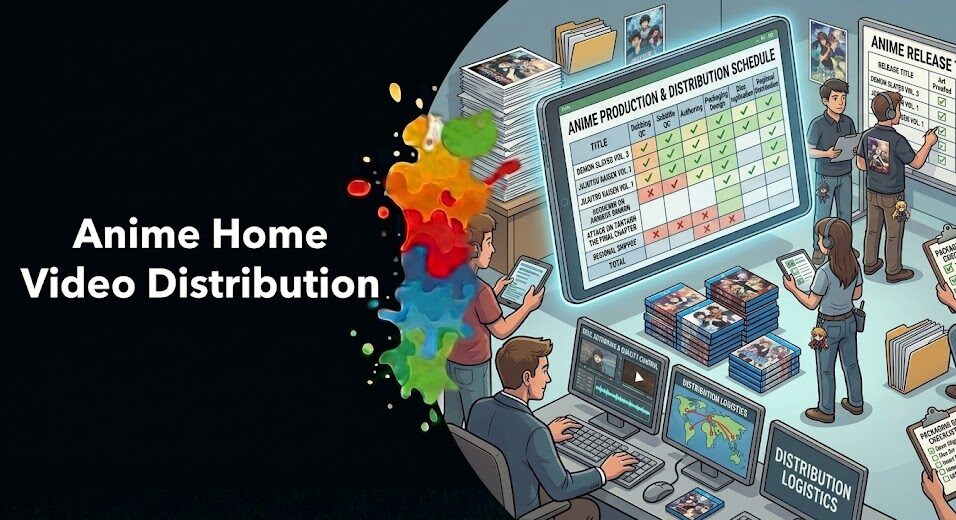
Physical and digital home video is still moving serious money in the anime industry. But here’s what most buyers—and plenty of veteran licensees—get wrong: anime home video distribution rights are licensed in layers, and the rules governing those layers are nothing like standard film or TV deals.
You’re not just acquiring a title. You’re negotiating a specific bundle of format permissions, territory exclusivity, release window timelines, and localization commitments—all against a rights structure that originates entirely in Japan.
Get any one of those layers wrong, and you don’t have a product. You have a contract dispute. And those disputes don’t just cost legal fees—they kill release schedules and damage relationships with Japanese rights holders who have long memories and shorter patience.
This guide breaks down exactly how anime home video licensing works—from who controls the rights in Japan to what distributors like Crunchyroll, Sentai Filmworks, and Aniplex of America actually negotiate for. If you’re buying, selling, or tracking anime distribution rights at a professional level, you need to know this cold.
Track Anime Licensing Deals Before They’re Public
Trusted by Netflix, Warner Bros, and Paramount. Join 140,000+ companies tracking global content licensing activity on Vitrina.
✓ 200 free credits | ✓ No credit card required | ✓ Full platform access
What Anime Home Video Distribution Rights Actually Cover
Let’s be precise about what you’re actually licensing when you acquire anime home video rights. The term covers a specific bundle of exploitation rights, and each one is negotiated separately—or at least it should be.
The core home video bundle typically includes: Blu-ray and DVD manufacture and retail distribution, Electronic Sell-Through (EST) on platforms like iTunes and Vudu, and sometimes Download-to-Own (DTO) on regional storefronts. What it does not automatically include is streaming—not subscription, not transactional, and definitely not broadcast. Those are separate rights packages with separate MG floors and separate window restrictions.
And this is where buyers run into trouble. A distributor might secure physical Blu-ray rights for North America, then discover that EST rights were bundled with the streaming deal sold to a different party. Your pressed discs sit in a warehouse while a competing platform’s digital storefront has the downloads. Not theoretical—this happens.
The smarter play is to map the full rights stack before you go anywhere near a licensing negotiation. As we covered in our complete guide to anime licensing and distribution strategy, the Fragmentation Paradox in anime—where a single title’s rights are split across 6 to 12 different parties across formats and territories—creates both risk and opportunity for buyers who understand the full picture.
The Production Committee System: Why All Roads Lead to Japan
You can’t understand anime licensing without understanding seisaku iinkai—the Japanese production committee structure. This is the upstream choke point that controls every downstream deal, including yours.
A production committee is a joint venture of 4 to 12 Japanese companies—a mix of studios, publishers, toy manufacturers, music labels, and sometimes video game developers—formed specifically to fund and own a single anime title. Each committee member contributes to production costs and receives a proportional share of IP rights across different exploitation categories. One member might control music rights. Another holds pachinko licensing. A third—often the lead animation studio or a major publisher—controls international distribution rights.
That international distribution rights holder is your actual counterparty for any home video deal. But reaching them isn’t always direct. Many Japanese rights holders work through Japanese sub-agents or domestic trading companies who add another layer to the negotiation chain.
Why does this matter for home video specifically? Because the production committee that approved a streaming deal for your territory may not be the same decision-making bloc that greenlights physical distribution. Approval dynamics inside these committees are opaque—and deals that seem done can collapse when a minority committee member objects to physical manufacturing terms. According to Variety, the consolidation wave reshaping Western anime distributors has pushed rights negotiations increasingly toward direct producer relationships—partly because committee dynamics have become harder to navigate through intermediaries.

Your AI Assistant, Agent, and Analyst for the Business of Entertainment
VIQI AI helps you plan content acquisitions, raise production financing, and find and connect with the right partners worldwide.
- Find active co-producers and financiers for scripted projects
- Find equity and gap financing companies in North America
- Find top film financiers in Europe
- Find production houses that can co-produce or finance unscripted series
- I am looking for production partners for a YA drama set in Brazil
- I am looking for producers with proven track record in mid-budget features
- I am looking for Turkish distributors with successful international sales
- I am looking for OTT platforms actively acquiring finished series for the LATAM region
- I am seeking localization companies offer subtitling services in multiple Asian languages
- I am seeking partners in animation production for children's content
- I am seeking USA based post-production companies with sound facilities
- I am seeking VFX partners to composite background images and AI generated content
- Show me recent drama projects available for pre-buy
- Show me Japanese Anime Distributors
- Show me true-crime buyers from Asia
- Show me documentary pre-buyers
- List the top commissioners at the BBC
- List the post-production and VFX decision-makers at Netflix
- List the development leaders at Sony Pictures
- List the scripted programming heads at HBO
- Who is backing animation projects in Europe right now
- Who is Netflix’s top production partners for Sports Docs
- Who is Commissioning factual content in the NORDICS
- Who is acquiring unscripted formats for the North American market
How the Licensing Process Works: From Japan to Your Market
Here’s the thing: the anime licensing process for home video doesn’t follow a single script. But the most common path looks like this.
A Western distributor—say, Sentai Filmworks or NIS America—identifies a title during its Japanese simulcast window. They approach the rights holder (or their agent) and submit a licensing inquiry. This triggers a qualification process: the rights holder evaluates the distributor’s release track record, distribution infrastructure, localization capabilities, and—critically—their ability to hit physical release dates that align with the Japanese home video schedule.
Japanese rights holders care deeply about release timing. A popular title’s Japanese Blu-ray volumes release on a monthly or bi-monthly schedule, and overseas physical releases are expected to follow within a reasonable window—typically 6 to 18 months after Japanese release. Blow that window, and you’re not just losing sales. You’re damaging a relationship that affects your access to future titles.
Once approved, the deal terms get negotiated. The key variables are: Minimum Guarantee (MG) paid to the rights holder, territory scope (North America only, English-speaking world, or broader regional grants), license term (typically 3 to 7 years for home video, shorter than film presales), and localization specifications—whether you’re required to produce an English dub, subtitle-only, or both.
MG levels vary dramatically by title popularity. A mid-tier simulcast title might carry a home video MG of $10,000 to $40,000 for North American physical rights. A proven franchise from a major property—something like a sequel season to a top-10 title—can push MGs north of $150,000 to $300,000 for a full rights bundle. And for blockbuster properties with established collector fanbases, you’re looking at seven-figure commitments before you’ve sold a single disc.
But the MG is only part of your cost structure. Add localization (dub production averages $500 to $1,500 per episode for union voice work), manufacturing, packaging design, and retail distribution margins, and the full recoupment calculation gets complicated fast.
Find Anime Rights Holders and Distributors in 48 Hours
Vitrina’s Smart Pairing technology connects acquisition teams with verified anime rights holders, sales agents, and distribution partners across 140 countries. Search 400,000+ projects with rights availability filters.
✓ 200 free credits | ✓ No credit card required | ✓ Cancel anytime
Physical vs. Digital: How Rights Are Split Across Formats
Here’s a configuration that catches buyers off guard: the same anime title can have three different licensees for three different format categories—and all three deals can be entirely valid, non-competing, and active simultaneously.
Physical rights (Blu-ray/DVD manufacturing and retail) might go to one company. SVOD streaming rights might go to another—say, Crunchyroll for its subscription platform. And EST/DTO rights—the ability to sell digital downloads through Apple TV, Amazon, and Vudu—might form a third separate deal with a digital aggregator or the streaming platform itself.
Why would a rights holder fragment the deal this way? Two reasons: maximizing total recoupment, and managing risk. Physical distributors with strong collector-market infrastructure aren’t always the same companies with robust digital retail relationships. And streaming platforms that want SVOD exclusivity often resist paying the MG premium that would buy them physical rights too. Splitting the stack lets the rights holder collect MGs from multiple buyers without granting anyone a monopoly.
The window sequencing matters too. Japanese rights holders typically enforce a physical-first window for high-demand titles—meaning the Blu-ray must release before or simultaneously with any digital availability in your territory. This protects collector sales, which still carry significant unit economics in the anime market. Our analysis of post-theatrical rights windows covers how these sequencing structures play out across different content categories.
What Distributors Like Funimation, Sentai, and Aniplex Negotiate For
Different distributors come to the table with very different negotiating priorities—and knowing whose deal structure you’re competing against matters.
Crunchyroll (which absorbed Funimation under Sony Pictures Entertainment’s consolidation strategy) negotiates primarily for bundled streaming plus physical rights—Weaponizing its subscriber base as leverage to push for broader territory grants and longer license terms. The pitch to Japanese rights holders is scale: over 10 million paid subscribers as a marketing vehicle for physical releases. But this same scale means Crunchyroll is negotiating hundreds of deals simultaneously, which creates response latency that smaller rights holders find frustrating.
Sentai Filmworks—now operating under AMC Networks’ ownership—takes a different approach. They’re known for acquiring mid-tier and niche titles at aggressive MG terms, then building collector-edition physical products that generate strong per-unit margins. Their negotiating priority is typically physical-first with EST bundled in, leaving streaming rights available for separate deals. As reported by Deadline, AMC Networks’ acquisition of Sentai in 2022 gave the distributor significant balance sheet backing to compete for larger MG commitments on premium titles.
Aniplex of America—the North American arm of Sony Music Entertainment Japan—operates as a quasi-rights holder rather than a pure licensee. Because Aniplex (Japan) is often a production committee member on major titles, Aniplex of America negotiates from the inside, with direct access to source materials, marketing assets, and music rights that third-party licensees can’t touch. This is why their physical releases command premium pricing—typically $80 to $150+ per limited edition set—and still sell through strong collector markets.
Discotek Media and NIS America occupy different niches—Discotek focuses on catalog titles and restoration projects, while NIS America concentrates on JRPG-adjacent franchises with built-in gaming fanbases. Both negotiate for narrower physical-only bundles with shorter terms, which makes their deals easier to close but harder to recoup without strong collector demand.
How to Spot a Legitimately Licensed Anime Release
This one matters for anyone on the acquisition or compliance side—and frankly, for anyone commissioning physical product in a market where bootlegs still circulate at scale.
A legitimately licensed anime home video release carries several verifiable markers. Regional encoding is the first checkpoint—North American releases are Region A for Blu-ray and Region 1 for DVD, though many modern releases are region-free to capture the grey import market. But region coding alone doesn’t confirm legitimacy.
More telling are: an explicit copyright notice crediting both the original Japanese rights holder and the Western licensee, MSRP pricing that falls within market norms (bootlegs often undercut by 40%+), localization credits for English voice cast and subtitle translators, and physical packaging that includes licensed artwork approved by the production committee.
The production committee approval process for packaging artwork is notoriously strict. Japanese rights holders review and approve every piece of Western packaging—key art, back copy, disc label design—before manufacturing runs. An unlicensed product can’t replicate this approval trail. So if you’re evaluating a physical product for distribution or retail, the packaging approval paperwork is your most reliable due diligence asset. Request it. Legitimate licensees have it.
The Revenue Windows That Make Home Video Still Matter
Physical home video revenue in anime is genuinely different from live-action film. Don’t let the general Hollywood narrative about collapsing disc sales mislead your P&L projections.
In Japan, the home video market for anime has historically been the primary profitability signal for a series. A title selling fewer than 3,000 Blu-ray units per volume in Japan is considered underperforming—not cancelled, but struggling. Titles hitting 7,000 to 10,000+ units per volume are greenlit for second seasons almost automatically. This is why Japanese rights holders still attach such weight to physical release quality in Western markets—it reflects franchise health.
But here’s the shift Phil Hunt (CEO, Head Gear Films) described in a recent Vitrina LeaderSpeak conversation: the value of the pay-one window—what used to be the primary revenue driver for distributors—has moved dramatically toward transactional rather than subscription sales. For anime specifically, EST and DTO have absorbed much of the revenue that physical disc sales carried a decade ago. Collector premium editions remain strong, but standard-definition disc volumes that once moved tens of thousands of units now face hard ceilings.
Your capital stack for an anime home video deal in 2026 should reflect this: premium collector SKUs carry the margin, standard editions cover volume, and EST/DTO provides the long tail. Build your recoupment model around all three, not any one alone. For deeper analysis on how these window structures are evolving, see our strategic breakdown of top anime distributors and their format positioning.
What the Sony-Crunchyroll Consolidation Changed for Home Video Buyers
The merger of Funimation into Crunchyroll under Sony’s media umbrella wasn’t just a corporate restructuring. It fundamentally changed the competitive dynamics of the anime home video distribution market in North America.
Before the merger, Funimation and Crunchyroll competed for the same titles. Rights holders—including Japanese production committees with Sony connections—had genuine leverage from that competition. MG escalation was real. But now a single entity controls the dominant streaming platform, the dominant physical distributor (through Right Stuf acquisition), and has deep ties to Aniplex on the rights ownership side. That’s three nodes of the value chain under one roof.
For independent buyers, this creates a more fragmented acquisition opportunity—not less. Crunchyroll’s scale means they can’t pursue every mid-tier and niche title aggressively. Smaller distributors like Discotek, Media Blaster, and Maiden Japan are picking up titles that a pre-merger Funimation would have contested. And Japanese rights holders—particularly those outside the Sony orbit—are actively cultivating non-Crunchyroll relationships to De-risk their own distribution dependency.
If you’re an independent acquiring in this space, that’s your opening. The Smart Pairing opportunity is in the mid-tier: titles with 3,000 to 8,000 Japanese Blu-ray sales per volume, proven fanbases, and rights holders who are motivated to work with distributors who actually care about the physical product. That’s a defensible niche that the Crunchyroll machine isn’t optimized to serve.
Ask VIQI: Get Anime Rights Intel in Seconds
VIQI is Vitrina’s AI research assistant—trained on 400,000+ entertainment projects and 140,000+ companies. Ask about rights holders, distribution structures, and market intelligence for specific titles and territories.
✓ Instant answers | ✓ No credit card required | ✓ Free to try
Frequently Asked Questions: Anime Home Video Distribution Rights
What’s the difference between anime streaming rights and home video rights?
They’re entirely separate license categories, each negotiated with its own MG, window, and territory scope. Streaming rights (SVOD, AVOD, TVOD) grant the ability to host and distribute a title digitally on subscription or pay-per-view platforms. Home video rights cover physical manufacture (Blu-ray/DVD) and Electronic Sell-Through (EST/DTO). A distributor can hold one without the other—and frequently does. Before entering any negotiation, map which right bundle you’re actually acquiring and verify that it doesn’t conflict with existing deals the rights holder has already signed.
Who holds anime home video rights for international distribution?
Rights originate with Japan’s production committee—a joint venture of the studios, publishers, and financiers who funded production. The committee designates specific members to control international rights categories. For home video, this is often the lead animation studio, a major publisher, or a media trading company. Reaching this counterparty sometimes requires going through a Japanese sub-agent or domestic sales representative. Direct relationships with production committee members are the most efficient path, but they take years to build without a strong introduction infrastructure.
How long does an anime home video license typically last?
License terms for anime home video rights run 3 to 7 years for most deals—shorter than typical film presale agreements (15-20 years) but longer than many SVOD streaming deals (2-3 years). Japanese rights holders generally prefer shorter initial terms on physical rights for new partnerships, with renewal options built in. Once you’ve demonstrated strong release execution and sales performance, renewal terms and MG negotiations become significantly more favorable. Don’t treat the initial term as a ceiling—treat it as an audition.
What Minimum Guarantee should I expect to pay for anime home video rights?
MGs scale dramatically with title performance. A mid-tier simulcast title with modest Japanese viewership might carry a North American home video MG of $8,000 to $35,000. A top-20 simulcast title with established merchandise revenue in Japan can push $100,000 to $300,000 for a full home video rights bundle. Collector-tier franchise properties from major studios or established publishers can reach seven figures for comprehensive rights packages. Your recoupment model needs to factor in localization costs, manufacturing, and retail margins on top of the MG—so don’t anchor your offer on MG alone.
Do I need Japanese approval for packaging artwork on licensed anime Blu-rays?
Yes—and this is non-negotiable. Production committee approval is required for all physical packaging materials, including key art, back cover copy, disc label designs, and any insert or booklet artwork. Rights holders typically require submission of finalized artwork 60 to 90 days before manufacturing, with a review cycle of 2 to 4 weeks. Build this timeline into your release schedule. Delays in artwork approval have pushed back physical release dates and forced distributors into costly manufacturing holds. Get your localization and packaging pipeline running in parallel with the rights negotiation, not after.
How does the Crunchyroll-Funimation merger affect independent anime distributors?
The Sony consolidation of Crunchyroll and Funimation created both pressure and opportunity for independent distributors. The merged entity controls the dominant North American streaming and physical distribution platform—which gives it leverage on premium titles. But its scale also means it’s less focused on mid-tier and niche acquisitions, leaving a real opening for distributors who specialize in collector editions, catalog deep cuts, and genre niches that Sony’s infrastructure isn’t optimized for. Japanese rights holders outside Sony’s orbit are actively seeking non-Crunchyroll distribution relationships to De-risk their dependency on a single buyer. That’s a structural advantage for well-positioned independents.
Can I acquire anime home video rights for multiple territories in one deal?
Multi-territory home video deals are possible, but they require stronger relationships, larger MG commitments, and demonstrated distribution infrastructure across those territories. Rights holders typically prefer granting regional bundles—English-speaking world, Western Europe, or pan-APAC—rather than individual country grants, because multi-territory deals reduce their administrative overhead. But they’ll only grant regional bundles to distributors with proven reach. If you’re entering multi-territory negotiations, your strongest card is demonstrable retail relationships and localization capabilities in each territory you’re requesting. Numbers matter here: show them your unit sales history by market.
The Bottom Line on Anime Home Video Rights
Anime home video rights aren’t complicated once you understand the structure—but that structure is genuinely different from general film and TV licensing. The production committee controls everything upstream. Rights are split by format, territory, and window. MGs are real and negotiation-dependent. And the market dynamics are shifting faster than most buyers’ deal frameworks are built to handle.
Here’s what you should take away from this:
- Map the full rights stack first: Know which format categories are available before you open any negotiation—streaming, physical, and EST are all separate.
- The production committee is your actual counterparty: Japanese sub-agents and trading companies are intermediaries—understand who’s sitting at the ultimate approval table.
- Build your recoupment model around three SKUs: Premium collector editions, standard volume releases, and EST/DTO long-tail revenue. All three are necessary for a viable home video deal in 2026.
- Packaging approval timelines will break your schedule if ignored: Start the artwork process 90+ days before your target manufacturing date, not after you’ve signed the license.
- The mid-tier is the opportunity: Sony’s consolidation has pulled Crunchyroll toward premium titles, leaving Japanese rights holders of mid-tier and niche properties actively looking for well-resourced independent distribution partners.
Connect With Vetted Anime Home Video Distribution Partners
Vitrina’s platform connects rights holders and distributors directly—140,000+ companies across the entertainment supply chain, from Japanese production companies to North American Blu-ray specialists. Netflix UK found a co-production partner through Vitrina in 48 hours.
✓ 200 free credits | ✓ No credit card required | ✓ Verified company profiles
Find Film+TV Projects, Partners, and Deals – Fast.
VIQI matches you with the right financiers, producers, streamers, and buyers – globally.
Producers Seeking Financing, Co-Pros, or Pre-Buys?
Vitrina Concierge helps producers reach the right financiers, commissioners, distributors, and co-production partners — with precision outreach, not cold pitching.
Join Industry Briefings Trusted by Leaders

Books, Novels & Comics Adaptations: Global Trends
Books, webtoons, and manga driving the next global screen hits. Discover how in this webinar.

Micro-Dramas & Mobile-First Storytelling
Micro-dramas are building real audiences and revenue. Understand the platforms, buyers, and economics behind the growth.

Navigating Global Content Licensing Trends
How global content licensing is shifting beyond flat fees to flexible, deal-driven models.