About Innovation Hub
 Global Content Pulse (Webinars)


 Global Production Financing
(Webinars)
Global Production Financing
(Webinars)  LeaderSpeak Podcast
  About Vitrina
 Our Story
 Our Solutions 🔥
 Film+TV Projects Tracker 🚀
 Case Studies
 Our Profile
If you’re still building your film production 2026 slate the way you did in 2022, you’re already behind. The financing windows are tighter, the competition for territories is fiercer, and the gap between producers who have real market intelligence and those who don’t has never been wider. This isn’t a crisis — it’s a correction. And the producers who understand the new rules are closing deals while others are still cold-calling old contacts.
Here’s what’s different now. The post-COVID production boom — which flooded the market with content and easy capital between 2021 and 2022 — has fully reversed. As Phil Hunt, Founder & CEO of Head Gear Films (who’ve financed 550+ movies over 23 years) confirmed in a recent Vitrina LeaderSpeak conversation, the industry has entered what he calls “the big crunch”: it’s become much, much harder to get movies off the ground and get them sold. That’s not pessimism. That’s the market telling you something.
But here’s the thing — the producers navigating this well aren’t doing anything magical. They’re using smarter information, faster partner discovery, and more disciplined capital stacking. This framework breaks down exactly how to do that in 2026.
Table of Contents
- The 2026 Film Production Landscape Has Changed Fundamentally
- What the Fragmentation Paradox Is Costing You Right Now
- Building a Resilient Capital Stack in 2026
- How Sovereign Hubs Are Reshaping Production Geography
- Pre-Sales and Gap Financing: What Still Works
- Smart Pairing — Finding the Right Partners Without 6 Months of Outreach
- Why Data Intelligence Is Now a Core Production Tool
- FAQ
- Conclusion
Ask VIQI: Who Are the Active Film Financiers in Your Territory Right Now?
VIQI is Vitrina’s AI assistant — trained on 1.6 million titles, 360,000 companies, and 5 million entertainment professionals. Ask it anything about your production financing landscape before you make your next move.
✓ Included with 200 free credits | ✓ No credit card needed

Your AI Assistant, Agent, and Analyst for the Business of Entertainment
VIQI AI helps you plan content acquisitions, raise production financing, and find and connect with the right partners worldwide.
- Find active co-producers and financiers for scripted projects
- Find equity and gap financing companies in North America
- Find top film financiers in Europe
- Find production houses that can co-produce or finance unscripted series
- I am looking for production partners for a YA drama set in Brazil
- I am looking for producers with proven track record in mid-budget features
- I am looking for Turkish distributors with successful international sales
- I am looking for OTT platforms actively acquiring finished series for the LATAM region
- I am seeking localization companies offer subtitling services in multiple Asian languages
- I am seeking partners in animation production for children's content
- I am seeking USA based post-production companies with sound facilities
- I am seeking VFX partners to composite background images and AI generated content
- Show me recent drama projects available for pre-buy
- Show me Japanese Anime Distributors
- Show me true-crime buyers from Asia
- Show me documentary pre-buyers
- List the top commissioners at the BBC
- List the post-production and VFX decision-makers at Netflix
- List the development leaders at Sony Pictures
- List the scripted programming heads at HBO
- Who is backing animation projects in Europe right now
- Who is Netflix’s top production partners for Sports Docs
- Who is Commissioning factual content in the NORDICS
- Who is acquiring unscripted formats for the North American market
The 2026 Film Production Landscape Has Changed Fundamentally
Let’s be direct about what happened. From 2020 to 2022, capital was cheap, streamers were spending aggressively, and even mid-budget independent films could find financing windows with relative ease. That era is over. The global content spend correction — combined with rising interest rates, completion bond tightening, and a more cautious gap lending environment — means your 2026 production strategy has to be built on harder math.
According to Variety, the independent film sector has seen financing timelines stretch by 40-60% compared to pre-2023 norms, with more lenders demanding higher collateral coverage before advancing funds. And it’s not just debt. Equity is harder too — family offices and institutional investors who experimented with content as an asset class have largely retreated, demanding better-structured deals with clearer recoupment paths.
But don’t mistake difficulty for impossibility. What’s actually happened is a talent sorting mechanism. Producers who know their market — who can identify the right financiers for their specific project type before their competitors do, who understand the territory-by-territory presale landscape, and who can stack incentives intelligently — are still greenlighting films. They’re just doing it with better information.
That’s the real shift in film production strategy for 2026. It’s not about working harder. It’s about working with far better intelligence than the market-average producer.
Expert Perspective
Phil Hunt (Founder & CEO, Head Gear Films) shares how his firm finances 35–40 films per year — more than most studios — and what the “big crunch” really means for independent producers heading into 2026.
Vitrina LeaderSpeak Episode 62 — “550 Films and Counting: Head Gear’s Quarter Century of Film Financing”
What the Fragmentation Paradox Is Costing You Right Now
The Fragmentation Paradox is one of the most expensive invisible costs in film production — and most producers don’t even track it. Here’s how it works: the global entertainment supply chain has over 600,000 companies, but the average producer operates with knowledge of maybe 50 to 100 of them. That’s a visibility gap of 99.98%. And that gap translates directly into margin leakage, timeline delays, and missed financing opportunities.
Think about a typical scenario. You need a French co-producer to unlock a co-production treaty and access regional incentives. You know 2 or 3 companies from festival circuits. But there are 500+ qualified French production companies — and some of the best matches for your project are ones you’ve never heard of. You spend 6 months reaching out, getting rejections, revising your approach. All while your financing window tightens.
The cost isn’t just time. On a $10M production, Vitrina’s research shows that the Fragmentation Paradox typically costs producers 15-20% margin leakage through suboptimal vendor pricing, unnecessary intermediaries, and delayed deal closures. That’s $1.5–2M on a single project — money that disappears without anyone noticing, because it never shows up as a line item. It’s the absence of a better deal, not the presence of a bad one.
And here’s what makes this particularly painful in 2026: the margin compression from tighter financing terms means you can’t absorb those losses the way you could when cap rates were lower. Every percentage point matters now. The producers who’ve internalized this are aggressively de-risking their supply chain — using verified intelligence instead of anecdotal relationship knowledge.
As we explored in our guide to finding co-production partners and financing opportunities, the producers closing deals fastest in this environment aren’t necessarily the ones with the biggest Rolodexes. They’re the ones with the most complete picture of who’s actively deploying capital right now.
See Which Financiers Are Actively Backing Projects Like Yours
Trusted by Netflix, Warner Bros, and Paramount. Join 140,000+ companies tracking the global entertainment supply chain — and stop operating with 1% of the market’s available intelligence.
✓ 200 free credits | ✓ No credit card required | ✓ Full platform access
Building a Resilient Capital Stack in 2026
The capital stack discipline that defines successful film production in 2026 hasn’t changed philosophically — but the execution has tightened considerably. You still need to think in layers: equity at the base, pre-sales and distribution guarantees above it, tax incentives stacked on top, and gap or mezzanine debt to close any remaining funding hole. But each of those layers is harder to fill today, and the order matters more than ever.
Joshua Harris, Managing Principal at Peachtree Media Advisors, put it plainly in a Vitrina conversation: lenders want someone else to have skin in the game. If you walk into a gap financing conversation without meaningful equity already committed — ideally from a credible co-production partner — you’re going to face either rejection or punishing terms. More collateral means more of the pie; less collateral means lenders will want someone subordinate to them bearing the first-loss risk.
The typical 2026 capital stack for a mid-budget independent feature looks something like this:
The EBITDA math here is unforgiving. If your gap lender’s effective cost runs to 15% annually (including origination fees and interest), every month of production delay compounds that exposure. The producers closing cleanly in 2026 are the ones who’ve secured 70–75% of their budget before they enter gap financing conversations — not after. That sequencing discipline is what separates funded projects from stalled ones.
But gap financing isn’t the enemy here. It’s a tool. Used correctly — with strong pre-sale coverage, a completion bond in place, and a reputable sales agent providing conservative territory estimates — gap debt bridges the last 10–20% of budget efficiently. The problem is when producers try to use it to replace equity they haven’t yet secured. That’s when lenders walk.
How Sovereign Hubs Are Reshaping Production Geography
One of the most strategically important shifts in global film production for 2026 is the emergence of what Vitrina identifies as Sovereign Hubs — markets where state capital, infrastructure investment, and incentive programs converge to create a genuinely new production ecosystem. You can’t afford to ignore these.
Saudi Arabia is the clearest example. Vision 2030 has allocated $71.2 billion to the entertainment sector, with over $4 billion specifically earmarked for film (SAR 15B). The 40% cash rebate program — available to international productions with a minimum $200K spend and at least 5 days of filming in the Kingdom — is one of the most competitive incentives anywhere in the world right now. Add the Cultural Development Fund’s $62.4 million+ already deployed to film projects, and you have a real capital ecosystem, not a vanity project.
But here’s what makes Sovereign Hubs strategically interesting beyond the rebates: they represent patient capital. Unlike quarterly-earnings-driven investors or fund managers chasing short-term IRR, sovereign-backed investment vehicles have decade-long mandates. Saudi Arabia wants 100 films produced by 2030 — that’s not a target, it’s a commitment. For producers who can structure projects with genuine Saudi cultural content, the recoupment dynamics look very different from a traditional gap lender arrangement.
The UAE, Qatar, and Jordan are following similar playbooks — each with distinct incentive structures and content priorities. Stacking these incentives across a co-production structure can, in the right project configuration, cover 60–80% of total budget through soft money and rebates alone. That’s not a theoretical ceiling. That’s achievable with the right strategic design. Our guide to international co-production strategies covers the specific treaty structures that make this stacking possible.
Pre-Sales and Gap Financing: What Still Works in 2026
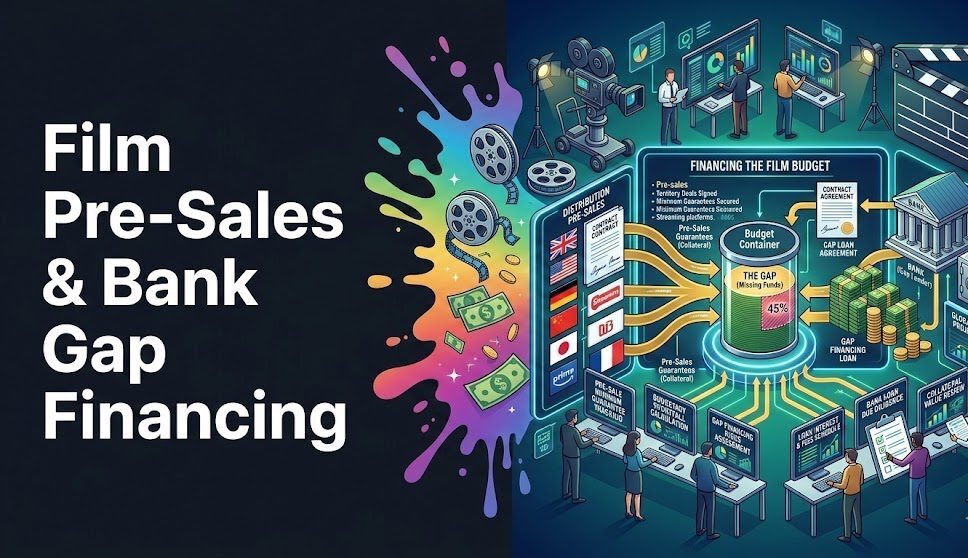
Pre-sales are distribution deals signed before production begins, where a buyer pays a minimum guarantee (MG) against future distribution rights in their territory. They’re still the bedrock of independent film financing — but the bar for what generates a meaningful MG has risen sharply. Buyers are more selective. They want commercial genre, recognizable cast attachments, and a clear track record from the producing team.
The territories that still move deals in 2026 are Germany, Japan, Australia, Korea, and — increasingly — MENA via platforms like OSN. As Rolla Karam, SVP of Content Acquisition at OSN, noted in a recent Vitrina interview, their platform now covers 23 countries across the Middle East and North Africa, with Saudi Arabia and the GCC as the core market. For the right content — particularly content with “from the region, for the region” positioning — OSN represents a genuine pre-sale anchor, not just a backend play.
Gap financing — specifically the mezzanine debt that covers the gap between your secured financing and your total budget — still works when you structure it right. The sweet spot is 10–20% of production budget, secured against unsold territorial rights, with a reputable sales agent providing territory-by-territory estimates at 1.5–2x the gap amount. That coverage ratio isn’t negotiable — lenders need that buffer to feel protected against market risk.
What doesn’t work anymore is treating gap financing as a substitute for real pre-sale momentum. If you’re trying to gap 30% of a budget because buyers haven’t committed to major territories, that signals to lenders exactly what it is: insufficient market confidence. The most disciplined producers in 2026 are targeting 50–70% budget coverage through pre-sales and incentives before ever opening a gap conversation. That sequencing is what unlocks favorable terms — typically 8–12% annualized rather than the punishing rates reserved for weaker packages.
According to Screen International, independent films with strong European co-production treaties and at least two major territory pre-sales are closing financing in roughly half the time of projects relying primarily on equity. That timeline compression matters — every additional month of development burn rate is capital that could have gone into production.
Need Financiers for Your Project? We’ll Find Them.
Vitrina Concierge is your Virtual Agent. We don’t give you a list — we make warm introductions directly to decision-makers actively seeking your type of content.
- Korean animation studio → Netflix Adult Animation (week one)
- LA producer → Netflix UK, Fifth Season, Fox Entertainment (48 hours)
- Middle Eastern studio → Legendary Pictures (direct access)
Smart Pairing — Finding the Right Partners Without 6 Months of Outreach
Smart Pairing is Vitrina’s term for what good partner discovery actually looks like when you de-risk it with verified data. It’s not just matching a producer with a co-producer — it’s matching the right producer, with the right project, to a co-production partner whose current capacity, financial health, and strategic priorities align with your specific needs. That last part is the piece the old way of doing things almost always got wrong.
Here’s the real problem with traditional network-based partner discovery: it’s backward-looking. The contacts you know from festivals and markets were relevant to projects you already made. Your next project has different budget requirements, different territory targets, different incentive optimization needs. And the companies best positioned to help you may not be the ones you already know — they’re the ones doing exactly this type of project right now, with capacity available, in the territories you need.
Phil Hunt described Head Gear’s approach this way: they’re looking for projects “the market really wants.” They position themselves at the center of the marketplace carousel — not waiting for the right projects to find them, but actively identifying where market demand and project opportunity intersect. That’s not a relationship advantage. That’s an information advantage, operationalized at scale across 35–40 films per year.
The practical outcome of better Smart Pairing: Vitrina’s data shows that producers who access verified partner intelligence before outreach reduce their deal-closure timeline by 80–90%. Instead of a 3–6 month search process, they’re identifying qualified, motivated partners in days — and entering conversations with market-rate benchmarks that protect their negotiating position from the start.
You can explore Vitrina’s data-driven co-production lead generation framework to see how this plays out across different project types and territories.
Why Data Intelligence Is Now a Core Production Tool
Five years ago, producers thought of market intelligence as a research function — something you did before a market, or when you were building a new project. In 2026, the producers executing at the highest level treat data intelligence the same way they treat legal or line production: it’s not optional infrastructure, it’s operational infrastructure.
Why the shift? Because the speed of competitive advantage in financing and distribution has accelerated dramatically. When Netflix or Warner Bros expansion moves create new partnership opportunities, the producers who know about it before it hits the trades can position projects accordingly — 6 weeks ahead of the market, not 6 weeks behind it. The difference between first and second contact on those opportunities is the difference between a deal and a pass.
Vitrina tracks 400,000+ projects and 140,000+ active companies across the global entertainment supply chain — verified capabilities, real-time capacity, current deal activity, and benchmarked pricing. That’s not a directory. It’s market intelligence at a scale that was previously available only to the largest studios, now accessible to independent producers at the project level.
But the specific use cases matter. Here’s where data intelligence changes the ROI calculation most meaningfully in 2026:
- Vendor pricing benchmarks: When you know the market range for VFX services or post-production in a given territory, you negotiate from a position of knowledge — not from an inflated quote. On a $10M production, that can protect $600K+ in margin.
- Financier activity tracking: Knowing which equity providers and gap lenders are actively deploying capital right now — not 6 months ago — means you’re calling the right conversations at the right time.
- Greenlight signal intelligence: Identifying which projects are moving through development before they’re announced publicly gives you positioning advantage with buyers, co-producers, and service vendors.
- Territory pre-sale sequencing: Understanding which territories are currently overweight on similar content lets you prioritize your sales agent conversations — maximizing MG value rather than burning time on territory relationships that aren’t going to close.
And it’s not just producers who benefit. As Andrea Scarso, Managing Partner at IPR VC (a London-based fund management firm connecting institutional capital with the creative industry), noted in a Vitrina interview: the challenge for equity investors in entertainment isn’t deal flow — it’s the quality of underwriting and how you structure the investment. Better producer intelligence reduces underwriting risk, which reduces cost of capital for everyone in the stack. That’s a systemic benefit, not just a producer one.
Frequently Asked Questions: Film Production Strategy 2026
What is a film production capital stack in 2026?
A film production capital stack in 2026 is the layered financing structure used to fund a project — typically combining equity (20–30%), pre-sales or minimum guarantees (30–50%), tax incentives (15–30%), and gap or mezzanine debt (10–20%). Building this stack requires securing each layer in the right sequence: equity and pre-sales first, then incentives and gap. Lenders consistently require that at least 70% of the budget is already committed before advancing gap financing.
How has the independent film financing environment changed since 2022?
The post-COVID “revenge production” era — characterized by easily available capital and aggressive streamer spending — ended sharply around 2023. By 2026, gap lenders require higher collateral coverage, equity investors demand clearer recoupment paths, and buyers are more selective on pre-sales. Financing timelines have stretched by 40–60% compared to 2021 norms. Producers who adapted by improving their market intelligence and deal structure discipline are still closing — those who haven’t adjusted are stalling at the finance plan stage.
What is gap financing and how does it work for film production?
Gap financing is a debt facility that covers the funding gap between secured capital (pre-sales, equity, tax incentives) and the total production budget. It typically covers 10–20% of an independent film’s budget and is secured against unsold territorial distribution rights — particularly foreign territories like Germany, Japan, Korea, and Australia. Lenders advance against the projected value of those rights, usually requiring a reputable sales agent’s estimates at 1.5–2x the gap amount. An effective annual cost of 8–15% (including fees) is typical for well-structured packages.
What are Sovereign Hubs and why do they matter to producers in 2026?
Sovereign Hubs are markets where state capital, infrastructure investment, and production incentive programs converge to create new production ecosystems. Saudi Arabia is the leading example — with a 40% cash rebate on qualifying spend, over $4 billion in film-specific investment, and a mandate to produce 100 films by 2030. Unlike commercial investors, sovereign-backed programs have decade-long commitments and patient return expectations. For producers who can build genuine co-production structures in these markets, the combination of incentive stacking, co-production treaties, and patient equity can cover 60–80% of budget through soft money alone.
How does the Fragmentation Paradox affect film production budgets?
The Fragmentation Paradox describes the information gap between the 600,000+ companies in the global entertainment supply chain and the 50–100 companies the average producer knows. This gap causes margin leakage (15–20% of budget through suboptimal vendor pricing and unnecessary intermediaries), timeline delays (3–6 months for partner searches), and missed financing opportunities. On a $10M production, that’s $1.5–2M in invisible losses — money that never appears as a line item because it represents the absence of better deals, not the cost of bad ones.
How can producers find co-production partners faster in 2026?
The fastest path to co-production partners in 2026 is verified market intelligence — specifically knowing which companies have current capacity, the right strategic priorities, and a track record in your genre and budget range before initiating outreach. Platforms like Vitrina map 140,000+ active companies with verified capabilities, real-time capacity indicators, and deal history. Producers using this approach reduce partner search timelines by 80–90% compared to festival and market networking alone — from 3–6 months to days or weeks.
What film production strategy framework works best for independent producers in 2026?
The most effective film production strategy framework for 2026 combines five elements: (1) a disciplined capital stack built sequentially from equity and pre-sales to incentives and gap debt; (2) Sovereign Hub integration to access patient capital and high-value rebates; (3) Smart Pairing to identify optimal co-production partners with verified capability data; (4) pre-sale sequencing that targets the most active territory buyers for your specific genre; and (5) real-time market intelligence to identify greenlit projects and active financiers before the news reaches the trades. Producers who execute all five consistently outperform the market on both timeline and recoupment metrics.
How does Vitrina help with film production strategy?
Vitrina is a market intelligence platform trusted by Netflix, Warner Bros, Paramount, and Google TV that maps 140,000+ active companies, 400,000+ projects, and 3 million verified entertainment executives. For producers, Vitrina’s core value is resolving the Fragmentation Paradox — giving you verified intelligence on partners, financiers, vendors, and market pricing in days rather than months. The VIQI AI assistant lets you ask strategic questions about your specific market in natural language. The platform offers 200 free credits with no credit card required.
Conclusion: The Producers Winning in 2026 Are Playing a Different Information Game
The 2026 film production landscape is genuinely harder than the post-COVID boom years — but it’s also more transparent for the producers willing to invest in real market intelligence. The gap between those who operate on anecdote and network memory versus those with verified, real-time supply chain data has never been more decisive.
Key Takeaways:
- Capital Stack Discipline: Secure 70%+ through equity and pre-sales before entering gap conversations — lenders want skin in the game, and the sequencing determines your terms.
- Sovereign Hub Access: Saudi Arabia’s 40% cash rebate and $4B+ film allocation represent one of the best risk-reduction tools available globally right now — build it into your incentive stacking strategy.
- Fragmentation Paradox Cost: The invisible 15–20% margin leakage from operating with limited supplier knowledge is recoverable — but only if you replace anecdotal networking with verified market intelligence.
- Smart Pairing Speed Advantage: Producers using verified partner data close deals 80–90% faster than those relying on traditional outreach — that timeline compression is a direct EBITDA improvement.
- Pre-Sale First: Target 50–70% budget coverage through territory pre-sales and incentives before any gap conversation. The market signals this sends to lenders unlock favorable terms that compound your ROI.
The industry’s “big crunch” is a feature, not a bug. It’s removing under-resourced producers and rewarding the ones who’ve built the right intelligence infrastructure. Don’t wait until you’re 3 months into a stalled finance plan to discover what you didn’t know about your market. The producers who win in 2026 are the ones who weaponize information before the market knows they’re looking.
Build Your 2026 Production Strategy With the Right Intelligence
Trusted by Netflix, Warner Bros, Paramount, and Google TV. Track 400,000+ projects. Access 3 million verified executives. Ask VIQI strategic questions about your market — right now.
✓ 200 free credits | ✓ No credit card required | ✓ Cancel anytime
Need direct introductions to active financiers? Explore Concierge Service →
Find Film+TV Projects, Partners, and Deals – Fast.
VIQI matches you with the right financiers, producers, streamers, and buyers – globally.
Producers Seeking Financing & Partnerships?
Book Your Free Concierge Outreach Consultation
(To know more about Vitrina Concierge Outreach Solutions click here)
Producers Seeking Financing, Co-Pros, or Pre-Buys?
Vitrina Concierge helps producers reach the right financiers, commissioners, distributors, and co-production partners — with precision outreach, not cold pitching.
Join Industry Briefings Trusted by Leaders
Streamers – Netflix vs. Amazon – The 2026 Strategy
How Netflix and Amazon’s content and revenue strategies are diverging ahead of 2026.

Format Adaptations: Global Trends
Where formats are traveling, which adaptations are breaking out, and how streamers are backing remakes in 2025–2026.

Books, Novels & Comics Adaptations: Global Trends
Books, webtoons, and manga driving the next global screen hits. Discover how in this webinar.