IHUB
IHUB
 Global Content Pulse (Webinars)


 Global Production Financing
(Webinars)
Global Production Financing
(Webinars)  LeaderSpeak Podcast
  Global Entertainment Digest (Newsletter)
  About Vitrina
 About VIQI
 Our Story
 Our Solutions 🔥
 Film+TV Projects Tracker 🚀
 Case Studies
 Our Profile
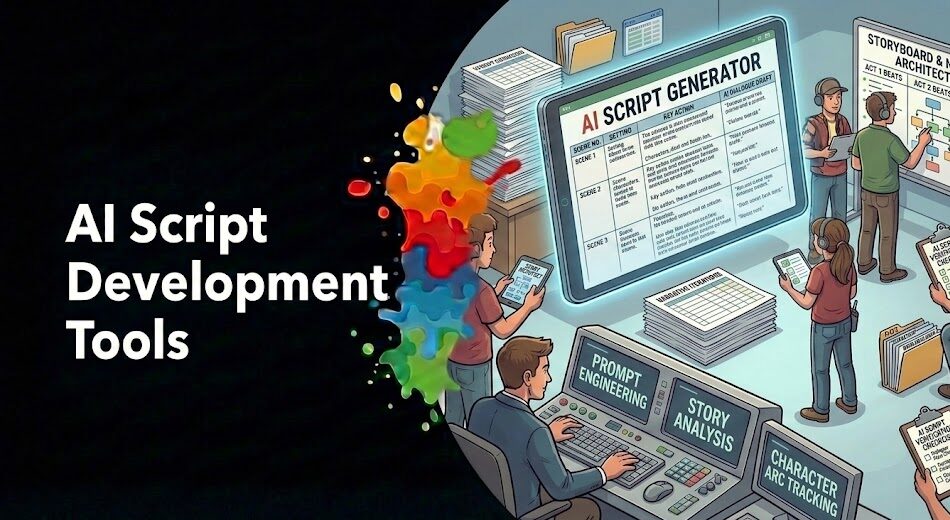
Every development exec worth their greenlight has the same question right now: which AI script development tools actually move the needle—and which ones are just expensive toys your writers’ room will abandon by week three? Studios from Netflix to Warner Bros. are placing real bets in 2026, and the divide between smart adopters and cautious bystanders is widening fast.
Here’s the thing—this isn’t a story about AI replacing writers. It’s about de-risking development spend at a time when the average drama pilot costs $5–8M to take from outline to greenlight, and more than 60% of those scripts never make it to production. The studios that are winning right now are the ones treating AI as a capital efficiency play, not a creative shortcut.
You’re about to see exactly what’s working, who’s using it, and—critically—where the tools fall short. No hype. Just what’s happening on the ground in 2026.
Table of Contents
- Why 2026 Is the Inflection Point for AI Script Development
- The 5 AI Script Development Tool Categories Dominating Studio Pipelines
- What Scriptation’s Steve Vitolo Gets Right About Script Workflow
- The Real Barrier Isn’t the Technology—It’s the Integration
- The ROI Case for AI Script Development (By the Numbers)
- How Vitrina Accelerates AI-Integrated Development Intelligence
- FAQ: AI Script Development Tools in 2026
- Key Takeaways
Find AI-Ready Production Partners in 48 Hours
Netflix, Warner Bros., and Paramount trust Vitrina to track AI-integrated production companies across 140,000+ suppliers. Get 200 free credits—no credit card required.
Why 2026 Is the Inflection Point for AI Script Development
The numbers don’t lie. According to Variety, streaming platforms collectively put 35% fewer projects into active development in 2024 compared to 2022’s peak—which means your competition for greenlight attention just got savage. Every project that enters the development pipeline needs to be battle-tested before anyone writes a check.
That’s exactly where AI script development tools found their moment. Not as creativity engines—but as de-risking infrastructure. Think of it as the capital stack for your development process: you’re layering data-driven story analysis on top of institutional knowledge so you’re not flying blind into a $2M script commitment.
And it’s not fringe adoption anymore. Seth Hallen and Craig German—two of the sharpest minds on AI’s impact on the entertainment supply chain—have been explicit about this shift: localization, scriptwriting workflow, and post-production are the three areas where AI integration has moved fastest. That conversation’s been happening at the infrastructure level since 2024, and 2026 is where the decisions crystallized into standard practice at mid-to-large studios.
The 5 AI Script Development Tool Categories Dominating Studio Pipelines
1. Story Intelligence Platforms
These tools—think Cinelytic, ScriptBook, and Largo.ai—run your script through predictive analytics before it gets anywhere near a greenlight meeting. They analyze structural beats, character arcs, genre conventions, and commercial viability against thousands of comparable titles. Warner Bros. has been using data-driven script evaluation since at least 2019, and by 2026 that process is embedded into early development at most major studios.
What you’re really buying is negotiating leverage. When your story intelligence platform flags that your protagonist’s arc lacks a credible midpoint break—with comps to 47 similar projects that underperformed—you can fix it in development rather than in reshoots. That’s the ROI calculation: $50K in AI analysis versus $800K in post-production fixes.
2. Collaborative Cloud Script Platforms
This is where script-as-infrastructure gets practical. Josh Klein, CEO of Scripto, built his platform specifically around the live-data problem in production workflows—the chaos of version control when eight people are touching a document simultaneously. Scripto’s cloud-based model means your EP in London, your showrunner in LA, and your network contact in New York are always working from the same locked draft. No more “which version is current” emergencies at 11pm before a notes call.
But that’s just table stakes in 2026. The AI layer on top of collaborative platforms is where studios are finding serious workflow compression. Revision tracking, continuity flagging, and automatic script breakdown cross-referencing now happen in real time—not after a PA spends three days manually pulling locations and cast requirements.
3. Script Breakdown and Pre-Production Automation
Your AI script breakdown software is working as your first line of production intelligence. Tools like StudioBinder’s AI layer, Celtx’s automated breakdown engine, and purpose-built platforms from companies like Movie Magic can now convert a script into a preliminary production breakdown—locations, cast requirements, props, VFX flags—in under 30 minutes. A job that used to take an experienced 1st AD two full days.
The real value? That breakdown feeds directly into your budget modeling. By the time your development exec takes a project to the next greenlight stage, they’re walking in with a data-informed cost estimate—not a finger-in-the-wind number that gets embarrassed when physical production actually starts.

Your AI Assistant, Agent, and Analyst for the Business of Entertainment
VIQI AI helps you plan content acquisitions, raise production financing, and find and connect with the right partners worldwide.
- Find active co-producers and financiers for scripted projects
- Find equity and gap financing companies in North America
- Find top film financiers in Europe
- Find production houses that can co-produce or finance unscripted series
- I am looking for production partners for a YA drama set in Brazil
- I am looking for producers with proven track record in mid-budget features
- I am looking for Turkish distributors with successful international sales
- I am looking for OTT platforms actively acquiring finished series for the LATAM region
- I am seeking localization companies offer subtitling services in multiple Asian languages
- I am seeking partners in animation production for children's content
- I am seeking USA based post-production companies with sound facilities
- I am seeking VFX partners to composite background images and AI generated content
- Show me recent drama projects available for pre-buy
- Show me Japanese Anime Distributors
- Show me true-crime buyers from Asia
- Show me documentary pre-buyers
- List the top commissioners at the BBC
- List the post-production and VFX decision-makers at Netflix
- List the development leaders at Sony Pictures
- List the scripted programming heads at HBO
- Who is backing animation projects in Europe right now
- Who is Netflix’s top production partners for Sports Docs
- Who is Commissioning factual content in the NORDICS
- Who is acquiring unscripted formats for the North American market
4. AI-Assisted Writing and Rewriting Tools
Here’s where the conversation gets more nuanced. Tools like Final Draft’s AI features, Fade In’s integration layers, and specialized platforms like Dramatron (Google DeepMind’s research project turned production tool) are now in active use—but not as ghostwriters. The studios that are using them well treat them as editorial accelerators: generating scene alternatives, checking dialogue consistency, and flagging exposition dumps that slow the read.
This is decidedly not the “AI writes your pilot” story that caused so much anxiety during the WGA strikes. The smarter studios are positioning AI as the assistant that does the work nobody wants to do—draft three alternative takes on a cold open, check that a character’s speech patterns are consistent across 110 pages, cross-reference that your title sequence logic works. That’s where the actual time savings lives.
5. IP and Market Fit Analysis Tools
Before you commit six months and $400K to developing an original script, do you actually know whether there’s a buyer? This is the category that’s grown fastest since 2024—platforms that map your concept against active acquisition trends, platform content strategies, and global rights availability. The Fragmentation Paradox is brutal in development: 140,000+ active production and acquisition companies, but most development execs are working from relationships with maybe 30 of them.
The studios using Vitrina’s intelligence layer are getting ahead of this. Instead of pitching blind into the market, they’re tracking which platforms have content gaps in specific genres, which co-production partners are actively seeking projects that fit their tax incentive profile, and which IP categories the major streamers are quietly—before it hits the trades—building acquisition pipelines around.
Track Which Platforms Are Buying Your Script’s Genre—Right Now
Join 140,000+ film and TV companies using Vitrina to discover buyers, partners, and co-production opportunities before the competition finds out. Ask VIQI for instant answers.
What Scriptation’s Steve Vitolo Gets Right About Script Workflow in 2026
Steve Vitolo, founder and CEO of Scriptation, has been living this problem for years. His Emmy-winning app—used across productions including Game of Thrones and Saturday Night Live—was built around a deceptively simple insight: scripts are living documents, and the industry was treating them like PDFs.
In a conversation on the Vitrina Podcast, Vitolo broke down how Scriptation’s annotation transfer technology works: when a revised script comes in, every note from the previous draft migrates automatically to the corresponding new page. No more lost margin notes. No more actors turning up to set without their character-specific callouts from the director.
Steve Vitolo (Founder & CEO, Scriptation) explains how script workflow technology is transforming collaboration across productions of all sizes.
What’s interesting about the Scriptation story—and why it matters for how you think about AI script development tools—is that the platform didn’t try to be everything. It solved one workflow problem brilliantly, and the productions adopted it because the ROI was immediate and obvious. That’s the lesson. The studios that are struggling with AI adoption are the ones that bought comprehensive platforms and then couldn’t get their writers’ rooms to change behavior. The ones succeeding? They started with a single pain point and let adoption spread organically.
The Real Barrier Isn’t the Technology—It’s the Integration
Let’s be direct about what’s actually slowing AI script development adoption in 2026. It’s not skepticism about the tools. It’s not WGA resistance, which has largely moved toward frameworks governing AI use rather than blanket opposition. The barrier is integration with existing workflows.
Most production companies are running script development across four to seven different tools: Final Draft for writing, Google Docs for notes, email chains for approvals, dedicated storage for versions, a separate system for rights tracking, and something else entirely for budget modeling. Asking your development team to add an AI layer on top of that stack—without removing anything—is a recipe for shelfware.
The most effective AI pre-production tool deployments in 2026 share a common characteristic: they replace a workflow step rather than adding one. Scripto replaced the chaos of emailed PDF revisions. Scriptation replaced manual re-annotation. StudioBinder’s AI breakdown replaced a multi-day manual process. That’s the pattern that sticks.
The ROI Case for AI Script Development (By the Numbers)
You need to make this case internally. So here’s the arithmetic your CFO will recognize. According to The Hollywood Reporter, the average cost of developing a scripted drama from concept to production-ready script is $1.2–2.5M. Of that, roughly 40% is pure iteration cost—notes cycles, rewrites, and the carrying cost of a project that stagnates in development.
AI script development tools target that 40% directly:
- Story intelligence analysis: $30–80K investment can flag structural issues before $200K rewrite cycle
- Automated script breakdown: Reduces pre-production prep time by 60–70%, compressing timeline by 3–4 weeks
- Collaborative cloud platforms: Eliminates version control errors that typically add 2–3 revision cycles to every script
- Market fit analysis: De-risks development spend by validating buyer appetite before full development commitment
Across a 10-project development slate, conservative estimates put the total AI tool investment at $200–400K annually. The timeline compression alone—getting to greenlight or pass 6–8 weeks faster per project—is worth $500K+ in carrying costs on a $50M slate. That’s before you factor in the projects that don’t get greenlit because the story intelligence caught the structural problems early.
How Vitrina Accelerates AI-Integrated Development Intelligence
Here’s where the Fragmentation Paradox creates a specific problem for script development in 2026. You’ve invested in AI tools. Your development team knows what their script needs. But when it comes to packaging—finding the right director, the right co-production partner with the right territorial tax incentive profile, the right sales agent who’s actively working buyers for this genre—you’re back to working your personal network.
That’s a $600K+ information deficit problem on a mid-range production. Vitrina’s AI-powered supply chain intelligence resolves it by mapping 140,000+ active suppliers against your project’s specific requirements—budget range, genre, territory, co-production needs, and timeline. What used to take 3–6 months of festival networking now happens in days. Smart Pairing technology cross-references your project’s production profile against verified deal histories, capacity status, and market pricing benchmarks.
That’s the missing layer most studios aren’t thinking about. Your AI script tools handle what’s on the page. Vitrina handles what happens after the page—connecting the script to the right ecosystem of partners, financiers, and buyers to actually get it made.
Connect Your Script to the Right Buyers and Partners Worldwide
Netflix UK found co-production partners in 48 hours using Vitrina. Your next packaging move could happen just as fast. No commitment required.
FAQ: AI Script Development Tools in 2026
What are the best AI script development tools for studios in 2026?
The leading AI script development tools in 2026 fall into five categories: story intelligence platforms (Cinelytic, ScriptBook, Largo.ai), collaborative cloud script platforms (Scripto, Scriptation), AI-assisted script breakdown tools (StudioBinder AI, Celtx), AI writing assistance tools (Final Draft AI, Dramatron), and market fit analysis platforms (Vitrina). The right combination depends on where your development workflow currently loses the most time and money—most studios start with script breakdown automation for the most immediate ROI.
How are Netflix and Warner Bros. using AI in script development?
Netflix and Warner Bros. both use data-driven script evaluation tools to assess commercial viability and structural strength before committing to full development budgets. Netflix’s data science infrastructure has been applied to greenlight decision-making since 2019, with AI analysis now embedded in early-stage project evaluation. Warner Bros. has invested in predictive analytics for script assessment. Both studios treat AI tools as risk-reduction infrastructure rather than creative replacements—using them to catch development problems early, when fixes cost $50K rather than $800K.
Do AI script development tools replace writers?
No—and this distinction matters for how you pitch AI adoption internally. The AI script development tools studios are actually deploying in 2026 handle structural analysis, revision tracking, script breakdown automation, and market fit evaluation. They reduce the administrative and analytical burden on writers and development teams, compressing timelines by 30–40% without replacing creative judgment. The WGA’s post-2023 framework governs AI use in creative writing specifically, and most studio AI deployments operate entirely outside those provisions by focusing on workflow and analytics rather than content generation.
What is the ROI of AI script development tools for production companies?
The ROI of AI script development tools varies by use case, but the most defensible numbers come from timeline compression and iteration cost reduction. Automated script breakdown cuts 2–3 days of manual work per project. Story intelligence analysis can prevent expensive rewrite cycles—each caught structural problem avoids approximately $150–200K in revision costs. Across a 10-project development slate, the annual investment in AI tools ($200–400K) typically generates $500K–1M+ in combined time savings and error prevention, with additional upside from faster time-to-greenlight or time-to-pass decisions.
How do AI script breakdown tools work in pre-production?
AI script breakdown tools parse a completed script and automatically identify and categorize all production elements: locations, cast requirements, props, wardrobe needs, VFX sequences, stunts, and special equipment. Platforms like StudioBinder’s AI engine and Celtx can produce a preliminary breakdown in under 30 minutes that previously required 2 full days of a 1st AD’s time. The output feeds directly into preliminary budgeting and scheduling workflows, meaning your development team arrives at the next greenlight stage with data-informed cost modeling rather than estimates.
What is Scriptation and why do studios use it?
Scriptation is an Emmy-winning script management app founded by Steve Vitolo that solves the version control and annotation problem in active productions. Its signature feature is annotation transfer—when a revised script is issued, all notes and markups from the previous draft automatically migrate to the corresponding new pages. Productions including Game of Thrones and Saturday Night Live have used Scriptation to eliminate the chaos of managing multiple annotated script versions across large creative teams. In 2026, it’s considered standard infrastructure on mid-to-large scripted productions.
How does Vitrina help with AI-driven script development and packaging?
Vitrina’s AI-powered supply chain intelligence platform helps studios move from script to packaging faster by mapping 140,000+ active production companies, co-production partners, sales agents, and financiers against a project’s specific profile. Where AI script tools handle the creative and structural side of development, Vitrina handles the market intelligence side—identifying which buyers are actively acquiring your genre, which co-production partners fit your budget and territory needs, and which financiers have active deal capacity. The Smart Pairing feature matches your project against verified deal histories and real-time capacity data, compressing what used to be a 3–6 month networking process into days.
Are AI script development tools compliant with WGA agreements?
The WGA’s 2023 contract and subsequent framework updates established specific rules around AI use in creative writing—primarily covering the use of generative AI to produce or rewrite scripts. The AI script development tools most widely adopted in 2026 (script breakdown automation, story analysis, workflow platforms, and market intelligence tools) operate outside these provisions because they focus on analysis, logistics, and workflow rather than content generation. Studios should confirm their specific tool usage with legal counsel, but the category distinction between creative AI and production AI is now well-established in industry practice.
Key Takeaways
- AI script development tools in 2026 are primarily risk reduction infrastructure—not creative replacements. The ROI case centers on catching structural and production problems early, before they become expensive.
- The five categories driving real studio adoption are: story intelligence platforms, collaborative cloud script tools, AI script breakdown software, AI writing assistance, and market fit analysis platforms.
- Integration is the real barrier. Tools that replace a workflow step get adopted. Tools that add a step get ignored. Start with the biggest manual pain point in your current process.
- Steve Vitolo (Scriptation) and Josh Klein (Scripto) represent the platforms that solved workflow problems so well they became production infrastructure—use their approach as your adoption template.
- The Fragmentation Paradox means great script tools aren’t enough. Connecting your project to the right buyers, partners, and financiers still requires real-time market intelligence—which is where platforms like Vitrina complete the picture.
- The 15 ways AI is transforming film production in 2026 span the entire pipeline—script development is the entry point, not the end point.
Stop Developing Scripts Into the Void
Join 140,000+ companies using Vitrina to find the right co-production partners, buyers, and financiers for every project in your slate. Get 200 free credits—no credit card required.
Used by Netflix, Paramount, Warner Bros. and hundreds of independent studios worldwide.
Find Film+TV Projects, Partners, and Deals – Fast.
VIQI matches you with the right financiers, producers, streamers, and buyers – globally.
Producers Seeking Financing & Partnerships?
Book Your Free Concierge Outreach Consultation
(To know more about Vitrina Concierge Outreach Solutions click here)
Join Industry Briefings Trusted by Leaders
Unscripted Is Eating the World: The Multi-Billion Reality and Format Boom
Unscripted is the new prestige — inside the $19.8B global format boom reshaping how streaming platforms compete.
Scripted Without Borders
As global drama evolves, which stories travel, which stay local, and how are they getting financed?

What Film & TV Financiers Actually Want in 2026
What do Film and TV financiers look for before they invest? Join the briefing to understand how capital decisions are changing in 2026.
From Prompt to Production: How AI Is Rewriting the Rules of Filmmaking
AI is reshaping every stage of filmmaking. Discover where it delivers real value across development, production, and distribution.